
- Buy Crypto
- Markets
 Futures
- Spot
- Copy Trade
- Earn
- More
8 Most Expensive Cryptocurrencies by Price in 2026

Key Takeaways
- Bitcoin remains the most expensive cryptocurrency as of January 2026, valued at $88,877.30 per coin, highlighting its status as “digital gold.”
- Market capitalizations are crucial to understanding the value of cryptocurrencies, with price per coin being only one aspect of their financial position.
- Supply and demand dynamics, including deflationary mechanisms like token burning, largely influence the price per cryptocurrency.
- Investing in expensive cryptocurrencies like Bitcoin and Ethereum may provide lower risk due to their established reputation and trust among investors.
WEEX Crypto News, 2026-01-28 07:11:13
In the ever-evolving landscape of digital currencies, certain names continue to capture the spotlight due to their exorbitant price per coin. As of January 2026, Bitcoin held the revered title of the most expensive cryptocurrency, valued at a staggering $88,877.30 per unit. Beyond Bitcoin, several other digital currencies command high prices, underscoring the diverse and intricate nature of the cryptocurrency market.
Understanding the Most Expensive Cryptocurrencies
To get the complete picture, it’s essential to differentiate between coins that boast the highest price per unit and those with the largest market capitalizations. While the price of a single coin can allure potential investors, market cap—being the total value of all coins in circulation—plays a pivotal role in assessing a coin’s financial worth and potential for growth.
The Pioneering Role of Bitcoin
Bitcoin, introduced in 2008 by the enigmatic Satoshi Nakamoto, laid the foundation for the decentralized financial systems we witness today. Originally, Bitcoin was an answer to centralized financial control, manifesting as a peer-to-peer payment system based on the principles of blockchain technology. Its invitation to innovation led it to be dubbed “digital gold,” symbolizing value retention and economic independence. The transition of Bitcoin from experimentation to an asset with significant financial recognition was completed in 2010 when 10,000 Bitcoins were exchanged for two pizzas. Fast forward to 2026, Bitcoin’s price reflects not only its monetary value but also its influence and historical significance in the cryptocurrency world.
Exploration of the High-Value Cryptocurrencies
The allure of cryptocurrencies isn’t confined to Bitcoin. Ethereum, for instance, introduced smart contracts to blockchain technology, expanding its application beyond currency exchange to decentralized application platforms. Despite not having reached its 2021 record, Ethereum’s adaptability and robust ecosystem sustain its lofty market demand, as evidenced by its current price of $3,001.69 per coin. Ethereum’s transition to a proof-of-stake model marks a notable shift, contributing to a modestly deflationary supply.
Yearn Finance, Tether Gold, and Maker are other notable mentions in the realm of expensive cryptocurrencies. Yearn Finance, with its limited token supply and decentralized finance model, presents a unique proposition of capped resources paired with governance capabilities. Tether Gold links digital finance with a real-world asset, offering investors the allure of gold-backed security without the physical limitations. Meanwhile, MakerDAO’s novel approach of backing its stablecoin DAI with cryptocurrencies instead of fiat currencies signifies the dynamic adaptability inherent within the crypto economy.
The Dynamics of Supply and Demand
One of the main aspects that underscore cryptocurrency valuation is the interplay of supply and demand. Coins like Bitcoin and Ethereum are subject to sophisticated checks such as halving events or token burns, which systematically reduce their supply over time, thus affecting their price trajectories as demand maintains or increases. This scarcity plays into the market psychology, often spurred by mass adoption and mainstream acknowledgment of these assets.
Crypto tokens representing limited supply or innovative applications, like Bittensor’s TAO, add another layer to this discussion. With a fixed supply model akin to Bitcoin, TAO taps into the burgeoning potential of artificial intelligence markets, highlighting how technological evolution can shape valuational metrics.
Investing in Expensive Cryptocurrencies
Investing in high-priced cryptocurrencies involves a nuanced combination of financial aptitude and foresight. Reputation and historical performance make digital assets like Bitcoin and Ethereum attractive choices for those seeking lower risks associated with untested ventures. Established forerunners in the crypto space possess trust and recognition that newer tokens find hard to emulate, besides benefiting from reduced inflationary risks due to their advanced stage in distribution sequences.
However, footing in established cryptocurrencies doesn’t come without its pitfalls. High capital investments can result in limited short-term gains and susceptibility to price volatility, with prices potentially declining sharply during market contractions. The ‘bigger they are, the harder they fall’ metaphor aptly captures the heightened exposure to market downturn impacts experienced by these cryptocurrencies.
Factors Leading to High Prices
Several essential aspects influence how a cryptocurrency attains high per-unit prices. A minuscule circulating supply tends to bolster a token’s price if coupled with strong demand. Similarly, deflationary mechanics—processes that shrink availability over time—channel rising price tendencies. Cryptocurrencies encompassing limited or decreasing supply curves, such as Bitcoin, Bitcoin Cash, and Bittensor, align with this narrative.
Moreover, compelling demand even amid potential supply release can elevate prices, as portrayed by Bittensor’s performance between 2023 and 2024, accentuating the essence of anticipation and future potential in evaluating cryptocurrency investments.
Concluding Thoughts on Expensive Cryptocurrencies
While Bitcoin remains unrivaled as the most expensive cryptocurrency for now, the spectrum of high-value digital currencies offers a fascinating view of today’s digital economy. Consideration for investing in this space involves balancing price insights with market capitalization assessments and remaining vigilant to imminent supply changes and demand movement. Understanding whether a cryptocurrency’s cost equates to worth requires dissecting its market dimensions, growth narrative, and tokenomics thoroughly.
In essence, within this revolutionary digital age, knowing the worth of cryptocurrency implies acknowledging its roots, dynamics, and niches—areas where platforms like WEEX Crypto News help demystify with updates and insights for enthusiasts and investors alike.
FAQs
What is currently the most expensive cryptocurrency?
Bitcoin is the most expensive cryptocurrency as of 2026, with its value per coin standing at an impressive $88,877.30, a figure that encapsulates its historical significance and market dominance.
Why is Bitcoin considered digital gold?
Bitcoin’s fixed supply, decentralized nature, network security, and broader adoption have cemented its status as a store of value akin to gold, earning the title “digital gold.”
Are expensive cryptocurrencies safe investments?
These cryptocurrencies often symbolize market trust and have shown relative resilience, making them relatively safer investments. However, potential investors should remain aware of market volatility and an asset’s lifecycle stage.
What impacts cryptocurrency prices the most?
Cryptocurrency prices are chiefly impacted by supply dynamics, market demand, technological advancements, and broader adoption trends. Factors of scarcity, deflationary schedules, and robust market presence can significantly influence pricing.
Why focus on market capitalization over price per coin?
Market capitalization better reflects an asset’s overall worth since it accounts for the total coins in circulation, providing a fuller picture of financial standing beyond just the price per individual coin.
You may also like

Ray Dalio Dialogue: Why I'm Betting on Gold and Not Bitcoin

Who Took the Money in the AI Era? A Must-See Investment Checklist for HALO Asset Trading
Wall Street Bears Target Ethereum: Vitalik In the Know Takes Flight, Tom Lee Remains Bullish

Pump.fun Hacker Steals $2 Million, Receives 6-Year Prison Sentence, Opts for 'Self-Detonation'

6% Annual Percentage Yield as Musk Declares War on Traditional Banks

36 years, 4 wars, 1 script: How does capital price the world in conflict?

Mining Companies' Great Migration: Some Have Already Secured $12.8 Billion in AI Orders
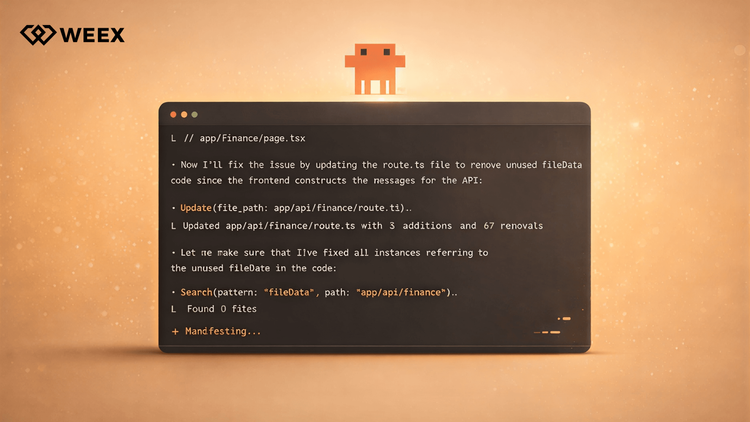
What Is Vibe Coding? How AI Is Changing Web3 & Crypto Development
What is vibe coding? Learn how AI coding tools are lowering the barrier to Web3 development and enabling anyone to build crypto applications.
The parent company of the New York Stock Exchange strategically invests in OKX: The intentions behind the $25 billion valuation

WEEX P2P update: Country/region restrictions for ad posting
To improve ad security and matching accuracy, WEEX P2P now allows advertisers to restrict who can trade with their ads based on country or region. Advertisers can select preferred counterparty locations for a safer, smoother trading experience.
I. Overview
When publishing P2P ads, advertisers can now set the following:
Allow only counterparties from selected countries or regions to trade with your ads.
With this feature, you can:
Target specific user groups more precisely.Reduce cross-region trading risks.Improve order matching quality.
II. Applicable scenarios
The following are some common scenarios:
Restrict payment methods: Limit orders to users in your country using supported local banks or wallets.Risk control: Avoid trading with users from high-risk regions.Operational strategy: Tailor ads to specific markets.
III. How to get started
On the ad posting page, find "Trading requirements":
Select "Trade with users from selected countries or regions only".Then select the countries or regions to add to the allowlist.Use the search box to quickly find a country or region.Once your settings are complete, submit the ad to apply the restrictions.
When an advertiser enables the "Country/Region Restriction" feature, users who do not meet the criteria will be blocked when placing an order and will see the following prompt:
If you encounter this issue when placing an order as a regular user, try the following solutions.
Choose another ad: Select ads that do not restrict your country/region, or ads that allow users from your location.Show local ads only: Prioritize ads available in the same country as your identity verification.
IV. Benefits
Compared with ads without country/region restrictions, this feature provides the following improvements.
Aspect
Improvement
Trading security
Reduces abnormal orders and fraud risk
Conversion efficiency
Matches ads with more relevant users
Order completion rate
Reduces failures caused by incompatible payment methods
V. FAQ
Q1: Why are some users not able to place orders on my ad?
A1: Their country or region may not be included in your allowlist.
Q2: Can I select multiple countries or regions when setting the restriction?
A2: Yes, multiple selections are supported.
Q3: Can I edit my published ads?
A3: Yes. You can edit your ad in the "My Ads" list. Changes will take effect immediately after saving.

What are the key highlights of this year's Ethereum's most important upgrade, the Glamsterdam upgrade?

March 6 Key Market Update You Can't Miss! | Alpha Morning Report

Sell Nvidia, Buy Power Plant: 27-Year-Old AI Investor Earns $5 Billion in One Year
The $24 Million Heist Behind It: The Most Dangerous Vulnerability in the Crypto World is Actually Human

Justin Sun Lawsuit Dismissed, BlackRock Bullish on Tokenization, What Is the English-Speaking Community Paying Attention To?

Morning News | NYSE parent company invests in OKX; Morgan Stanley provides $500 million loan to Core Scientific; Western Union partners with Crossmint to launch stablecoin USDPT

These former crypto builders have transitioned to the hottest AI projects globally



 App
App