
 Buy Crypto
- Markets
 Futures
- Spot
- Copy Trade
- Earn
- More
a16z Leads $18M Seed Round for Catena Labs, Crypto Industry Bets on Stablecoin AI Payment

On May 20, Circle co-founder Sean Neville announced that his new project, Catena Labs, has successfully completed an $18 million seed round of financing.
This round of financing was led by a16z Crypto, with follow-on investments from Breyer Capital, Coinbase Ventures, and former parent company Circle Ventures, as well as NFL star Tom Brady.
a16z Crypto co-founder and general partner Chris Dixon said: Sean Neville and the Catena team have the expertise to tackle this challenge. They are building financial infrastructure that agents can rely on, and we are excited to support their vision.

AI Opening a Bank?
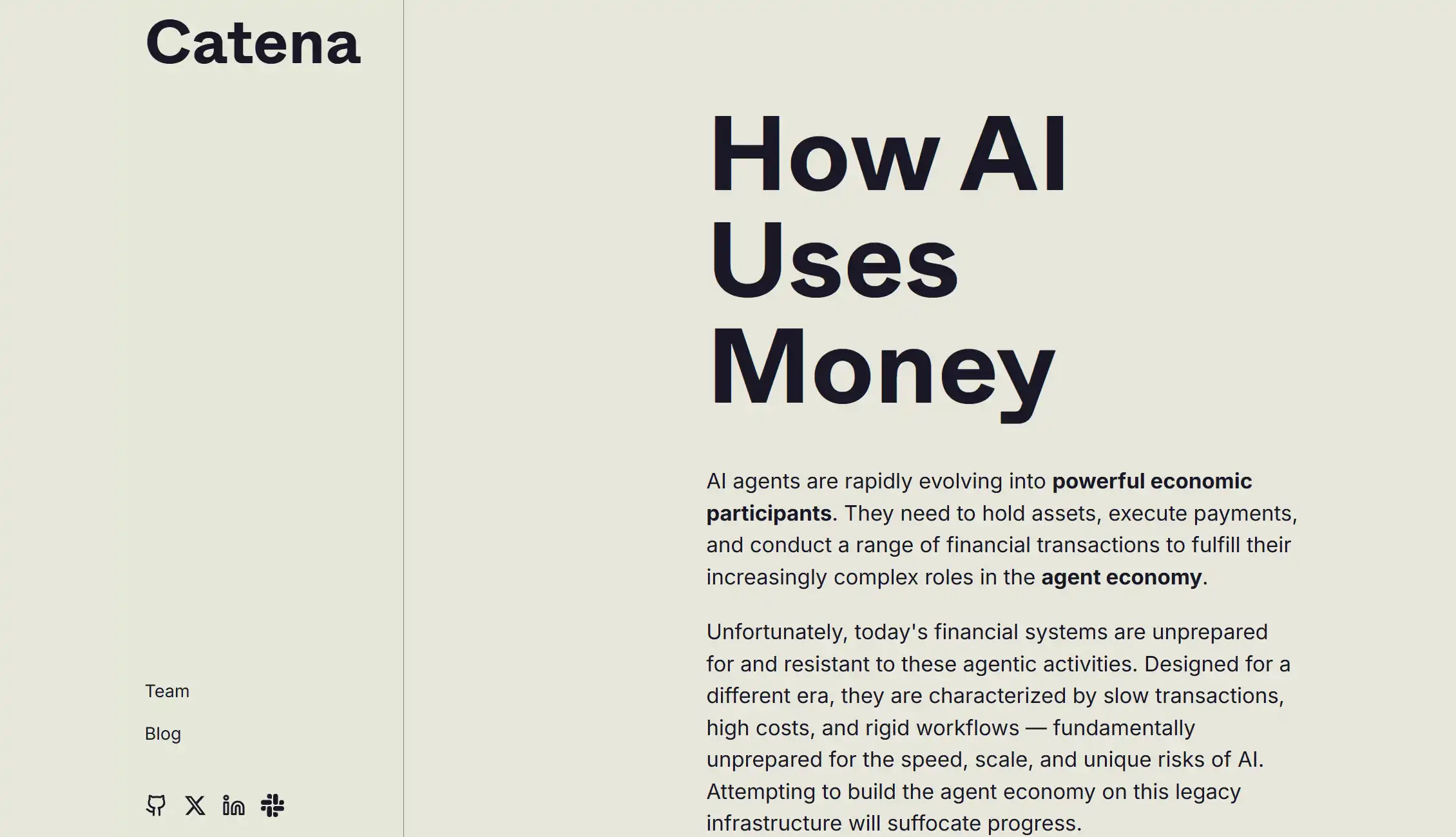
Catena Labs is a fintech startup that aims to "build an AI-native bank from scratch," focusing on providing tailored financial infrastructure for AI agents, such as smart payments, identity verification, low-cost settlements, etc. The company plans to establish the first fully regulated AI-native financial institution.
The traditional payment rails assume that there is a human at one end of each transaction, resulting in delays such as 3-day ACH transfers and high fees for credit card payments (up to 3%).
All current traditional financial systems are still stuck in the "human-to-human" phase, where the system flags automated activities as fraud, leading to manual review. This slows down the pace of innovation and limits the actual capabilities of AI agents.
Catena wants to enable "AI-to-AI" interactions, allowing your AI assistant to directly help you with account opening, transfers, financial management, and even doing business with other AIs. Software agents should be able to instantly and securely make payments and receive rewards.
It operates in the AI + fintech space, focusing on AI-driven financial services and decentralized identity, a field that is currently being aggressively pursued by big capital.
From USDC to AI Banking: Circle Co-founder Takes Another Swing
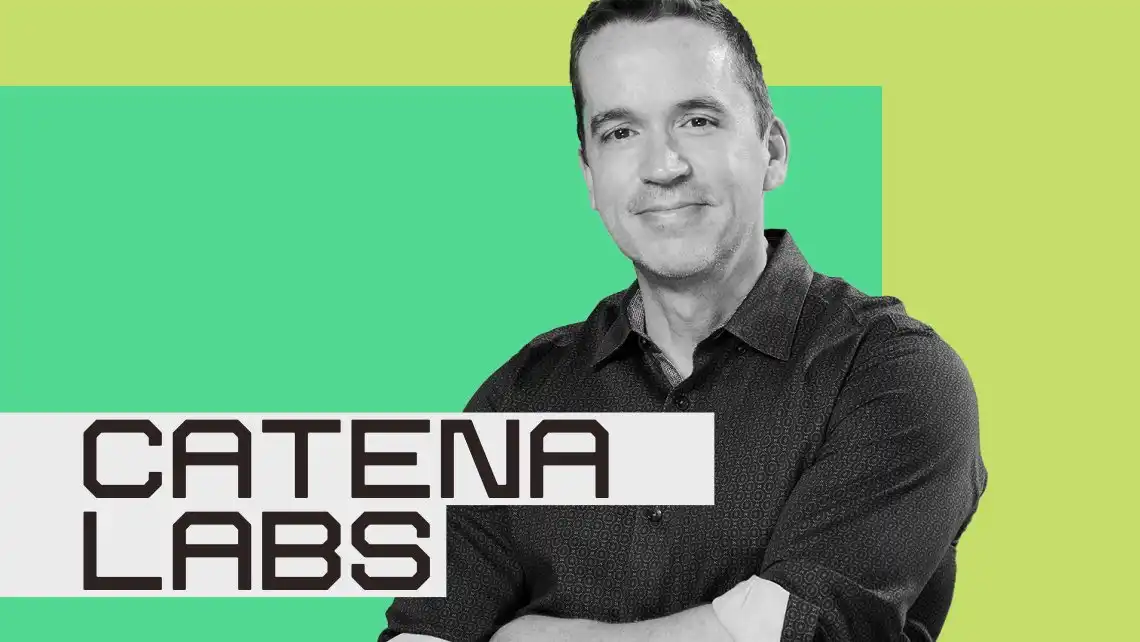
Catena Labs was founded by Circle co-founder Sean Neville and was initially established in 2021 with a focus on exploring AI and decentralized identity. In 2023, it formally shifted its focus to building an "AI-native financial system."
Neville was formerly an engineer at Adobe and a co-founder of Circle Internet Group, Inc., leading the design and development of USDC. By April 2025, Circle had submitted an IPO application with a valuation of approximately $5 billion.
In early 2020, Neville stepped down from his operational role at Circle but remained a board member. After leaving Circle, he delved into AI, firmly believing that we are entering an AI-native web era, which also became the foundation of Catena Labs.
In 2021, Neville, along with Matt Venables (Co-founder and CTO of Catena Labs), established a technology lab to explore emerging technologies such as AI and decentralized identity. Catena Labs was born out of this vision.
Currently, Catena Labs has only 9 members, all from world-class teams at Meta, Google, Jump Crypto, and Protocol Labs. Their official website allows direct submission of resumes, indicating an active effort to recruit talent globally.
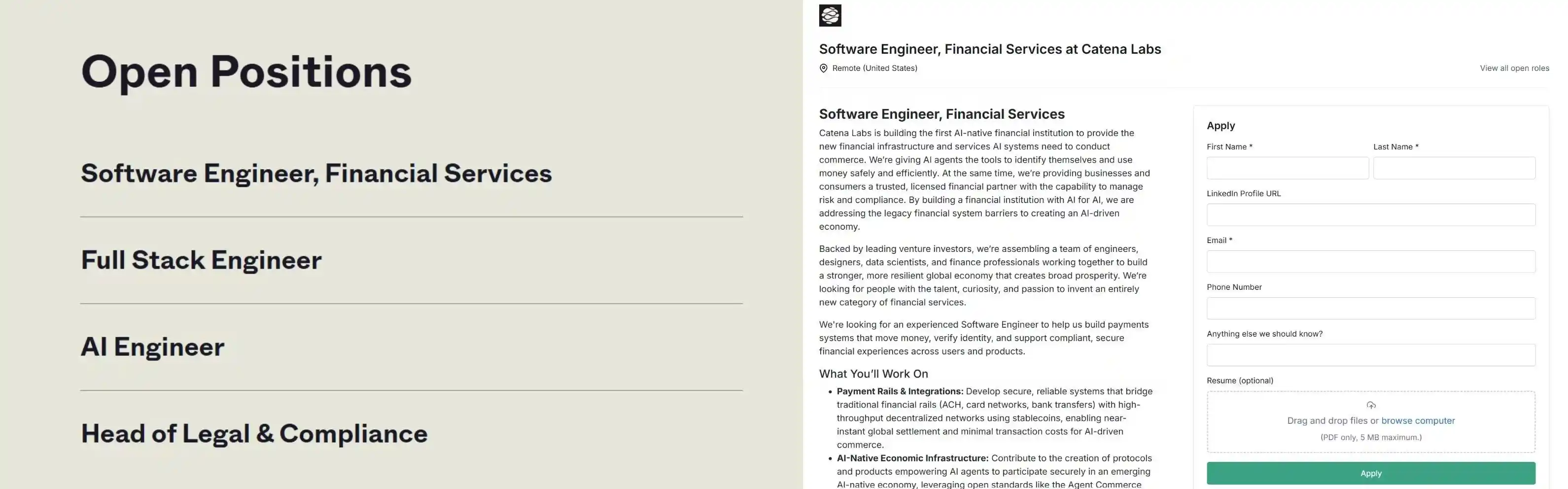
Currently, Catena Labs has developed an open-source protocol that allows AI to act as a user's "bank representative." The company explicitly states that it is not issuing cryptocurrency or stablecoins at the moment, but investors will receive equity with accompanying token warrants.
Redefining the Financial System with AI
Jim Breyer, Founder and CEO of Breyer Capital, said, "Neville is uniquely qualified to lead the creation of the first AI-native bank. Integrating AI into commerce requires rebuilding the financial infrastructure. Legacy systems do not always keep up, which is why Catena is so intriguing."
Furthermore, Neville predicts that future financial transactions will be entirely executed by AI agents. The project also envisions AI not only engaging in chat and drawing but also actively "earning, spending, and managing money," becoming independent economic participants.
While Catena Labs has not yet launched a coin or product, they have just open-sourced the Agent Commerce Kit (ACK), which is a financial protocol framework designed specifically for AI, with a focus on two key aspects—AI agent identity verification and automatic payments.
What Catena Labs aims to address is the various unfriendliness of traditional finance towards AI—slow payments, high costs, and lack of automation compatibility. ACK represents their first step: using stablecoins for fast settlements, employing standardized protocols for identity verification, and ultimately enabling AI to have its own "bank account" and "financial services" just like a human.
Currently, they have not disclosed specific product plans but have mentioned that in the future, they will open up through APIs and other means to developers and businesses to build an AI-driven financial ecosystem. Although still in development, judging from the direction of the ACK framework, their goal is to rewrite the underlying logic of the entire financial system with AI.
Summary
Catena Labs is a highly promising early-stage project operating in the hot intersection of AI and FinTech. Co-founders Sean Neville and Matt Venables, leveraging their successful experiences at Circle and USDC, lead a lean team of only 9 individuals. They have secured an $18 million seed funding round led by a16z.
Their AI-native vision, open-source protocol (ACK), and flexible integration with stablecoins showcase their industry foresight. Although specific products have not yet been launched, their strong funding background and industry support give them significant competitiveness in the AI-driven financial sector.
In the future, Catena Labs' development will depend on the speed of product deployment and the effectiveness of ecosystem building.
You may also like

The 17-Year Mystery Will Be Solved, Who is Satoshi Nakamoto?

5 Minutes to Make AI Your Second Brain

Uniswap is trapped in an innovation dilemma

What is the key to competition in crypto banking?

The flow of stablecoins and the spillover effects in the foreign exchange market

After two years, Hong Kong's first batch of stablecoin licenses finally issued: HSBC, Standard Chartered make the cut
The person who helped TAO rise by 90% has now single-handedly crashed the price again today

3-Minute Guide to Participating in the SpaceX IPO on Bitget

Top 5 Cryptos to Buy in 2026 Q1: A ChatGPT Deep Dive Analysis
Explore the top 5 cryptos to buy in Q1 2026 including BTC, ETH, SOL, TAO, and ONDO. See price outlooks, key narratives, and institutional catalysts shaping the next market move.

How to Earn $15,000 with Idle USDT Before Altcoin Season 2026
Wondering if altcoin season is coming in 2026? Get the latest market update, and learn how to turn your idle stablecoins waiting for entry into extra rewards up to 15,000 USDT.
Can You Win Joker Returns Without Large Trading Volume? 5 Mistakes New Players Make In WEEX Joker Returns Season 2
Can small traders win WEEX Joker Returns 2026 without huge volume? Yes—if you avoid these 5 costly mistakes. Learn how to maximize card draws, use Jokers wisely, and turn small deposits into 15,000 USDT rewards.

Altcoin Season 2026: 4 Stages to Profit (Before the Crowd FOMO In)
Altcoin Season 2026 is starting — discover the 4 key stages of capital rotation (from ETH to PEPE) and how to position before the peak. Learn which tokens will lead each phase and avoid missing the rally.

Will Alt season come in 2026? 5 Tips to Spot the Next 100x Crypto Opportunities
Will altcoin season arrive in 2026? Discover 5 rotation stages, early signals smart traders watch, and the key crypto sectors where the next 100x altcoin opportunities may emerge.

The bear market has arrived, and cryptocurrency ETF issuers are also getting involved

The richest man had a quarrel with his former boss

BTC Firm Above 70K! Saylor’s "Institutional Logic" vs. Moon’s "Retail Faith": Who is Really Harvesting the Market?
Bitcoin is holding firm above the $70,000 support level following a massive short squeeze that liquidated $427 million. As the "Four-Year Cycle" narrative shifts, the market is split: Michael Saylor’s cold, institutional "indiscriminate stacking" vs. Carl Moon’s high-energy retail "hopium." This article decodes these two polar-opposite strategies for the 2026 bull run and reveals how WEEX’s institutional-grade liquidity and AI trading tools empower every type of investor to convert market volatility into profit.

The Girl Who Created the SBTI Test: A Story of a Doomed Cyber Love, an E-Widow Ratfolk



 App
App