
- Buy Crypto
- Markets
 Futures
- Spot
- Copy Trade
- Earn
- More
After incubating Coinbase for 14 years, YC finally decided to disburse investment funds using USDC

Original Article Title: "From Investing in Coinbase to Using USDC: YC Waited 14 Years"
Original Article Author: angelilu, Foresight News
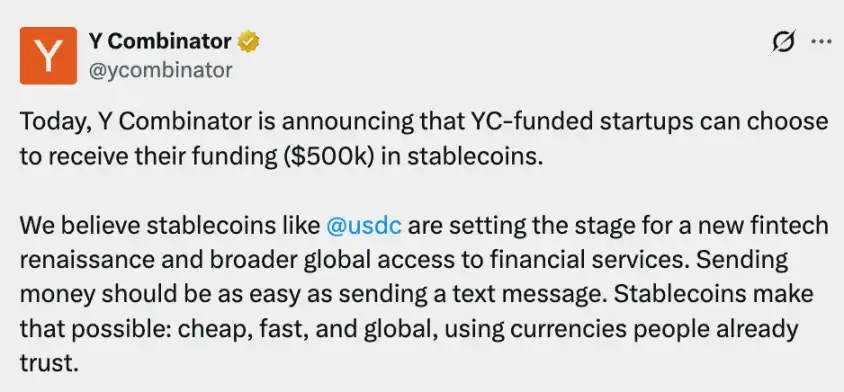
The "top startup accelerator" Y Combinator (YC), which has successfully incubated Airbnb, Stripe, and Coinbase, announced on February 3 that starting in Spring 2026, its funded startups can choose to receive a $500,000 investment in the form of the USDC stablecoin. This is also the first time YC has officially announced providing investment in the form of a stablecoin.
From Spectator to Participant
In 2012, when YC invested in Coinbase, the price of Bitcoin was only between $5 and $13. Over the following 14 years, YC, although continuously investing in nearly 100 crypto companies, still transferred investment funds through traditional bank transfers.
An important reason for YC's change was the passage of the "GENIUS Act" in July 2025 in the United States. This law established a federal regulatory framework for stablecoins, requiring 1:1 reserve backing and providing holders with redemption rights. With the advent of compliance certainty, the biggest barrier for top institutions to adopt cryptocurrency was removed. Just 7 months later, YC announced the stablecoin payment option.
The true significance of this move is that YC started to "use" stablecoins themselves. When an institution is willing to migrate its core business processes to new technology, that is a true vote of confidence. From an investor to a user, from a spectator to a participant, YC completed a thorough role transition in 14 years.

Why Choose a Stablecoin?
The first benefit of investing with stablecoins is efficiency. Imagine an Indian startup wanting to receive a $500,000 investment from YC. If using traditional wire transfer, they might need to pay thousands of dollars in fees and wait 3 to 7 days; with USDC, the cost is almost zero, and the funds arrive instantly.
Furthermore, YC's decision is also based on a practical judgment: the new generation of entrepreneurs are already "Crypto Native." YC stated in its announcement that the practical application of stablecoins is growing in its portfolio companies, especially in markets like India and Latin America.
Startups, including Aspora and DolarApp, have been using stablecoins to help customers in regions where traditional banking infrastructure is limited or costly to more efficiently transfer and store funds. To align with this trend, YC specifically emphasized supporting stablecoins on three blockchains: Ethereum, Base, and Solana, allowing global entrepreneurs to choose the most suitable payment path.
Why Choose USDC?
Keen observers have noted that YC's mention of stablecoin usage was not generic but a specific callout to use USDC. While USDC's market capitalization is lower than USDT, it is issued by Circle, a U.S.-based company, and is regulated by the U.S. Federal Reserve and various state agencies. As a benchmark of Silicon Valley venture capital, YC must ensure that every cent complies with U.S. regulatory requirements.
Let's not forget that YC invested in Coinbase back in 2012, and Coinbase is one of the co-founders of USDC. Additionally, Nemil Dalal, the YC partner responsible for YC's crypto business, previously served as Coinbase's product lead. This "kinship" relationship may also naturally lead YC to have more trust in and support for the USDC ecosystem.

Venture Capital's "Nokia Moment"
In the crypto venture capital (Crypto VC) circle, the use of stablecoins is not new, with players like Paradigm or a16z Crypto having long used them in a "special" capacity. However, YC's breakthrough lies in the fact that it is the "godfather of mainstream venture capital," with over 90% of its investment projects focusing on AI, enterprise services, or consumer goods, rather than cryptocurrency companies.
Previously, venture capitalists often used stablecoins as a "last resort" because founders couldn't open a USD account. But now, YC actively includes this option in every founder's standard contract template. Whether you are working on a large-scale model or in biopharmaceuticals, if you wish, you can directly receive USDC. This procedural, standardized action signifies that the venture capital industry is experiencing its "Nokia moment"—where traditional transfer methods are being disrupted.
Will Other VCs Follow Suit?
Currently, the attitudes of top Silicon Valley VCs toward crypto are diverging. a16z crypto represents the "radicals" and, in early 2026, raised $15 billion, focusing on investments in AI and the crypto space. YC, on the other hand, represents the "pragmatists," starting from payments, not radical but extremely sound.
More traditional VCs may still be on the sidelines, but history provides a clear reference point. Traditional financial institutions typically take 3 to 5 years to move from skepticism to embrace: both Goldman Sachs and J.P. Morgan have gone from calling it a "fraud" to launching related businesses.
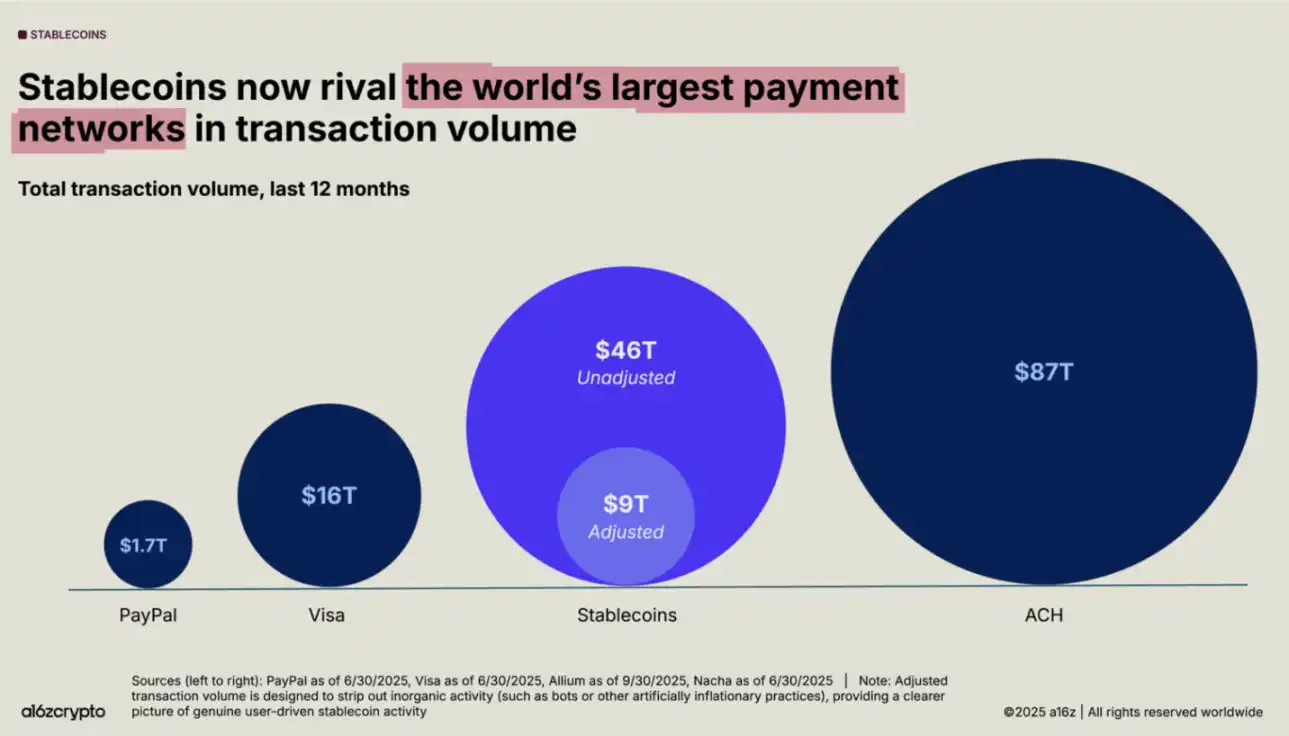
According to an a16z report, currently 90% of financial institutions are integrating stablecoins. The transaction volume of stablecoins in 2025 has reached $46 trillion, nearly triple that of Visa. The market predicts that the circulation of stablecoins will surpass $1 trillion in 2026. Behind these numbers is an irreversible trend. YC's decision may just be a node in the stablecoin wave.
What Is YC Looking for in Entrepreneurs?
Currently, YC's Spring 2026 Startup Program is now open for applications, and the incubation program will take place in San Francisco from April to June. The application deadline is Pacific Time 12:00 on February 10, and applications submitted before the deadline will receive results by March 13.
YC's "Fintech 3.0" initiative launched in September 2025 in partnership with Base and Coinbase Ventures, emphasizes funding on-chain startup projects in the following areas: stablecoin applications, tokenization and transactions (new credit markets, on-chain capital formation, new trading interfaces), Apps and Agents (including social, financial, collaborative, gaming, etc.).
14 years ago, YC invested in Coinbase was a bet on the future; 14 years later, YC's use of USDC is about becoming the future.
You may also like

AI within artillery range
“The cloud” is a metaphor, but the data center isn’t.

March 4th Market Key Intelligence, How Much Did You Miss?

Taking Stock of Crypto's Washington Power Players: Who is Advocating for US Crypto Regulation?

DDC Enterprise Limited Announces 2025 Unaudited Preliminary Financial Performance: Record Revenue Achieved, Bitcoin Treasury Grows to 2183 Coins
On March 4, 2026, DDC Enterprise Limited (NYSE American: DDC) today announced preliminary, unaudited full-year financial performance for the year ended December 31, 2025. The company expects to achieve record revenue and record positive adjusted EBITDA, primarily driven by continued growth in its core consumer food business and overall margin improvement. The final audited financial report is expected to be released in mid-April 2026.
Revenue: Expected to be between $39 million and $41 million, reaching a new company high.
Organic Growth: Excluding the impact of the company's strategic contraction of its U.S. operations, core revenue is expected to grow 11% to 17% year over year.
Gross Profit Margin: Expected to be between 28% and 30%, reflecting continued operational efficiency improvements.
Adjusted EBITDA: The company expects to achieve a positive full-year result in 2025, a significant improvement from a $3.5 million loss in 2024, mainly due to rigorous cost controls and a higher-margin sales mix.
In 2025, DDC's core consumer food business maintained strong operational performance.
The company also disclosed Core Consumer Food Business Adjusted EBITDA, a metric that further excludes costs related to its Bitcoin reserve strategy and non-cash fair value adjustments related to its Bitcoin holdings from adjusted EBITDA to more accurately reflect the core business performance.
In 2025, Core Consumer Food Business Adjusted EBITDA is expected to be between $5.5 million and $6 million.
In the first half of 2025, DDC initiated a long-term Bitcoin accumulation strategy, holding Bitcoin as its primary reserve asset.
As of December 31, 2025: The company holds 1,183 BTC.
As of February 28, 2026: Holdings increased to 2,118 BTC
Today's additional purchase of 65 BTC brings the company's total holdings to 2,183 BTC
DDC Founder, Chairman, and CEO Norma Chu stated, "We are proud to have closed 2025 with record revenue and positive adjusted EBITDA, demonstrating the steady growth of the company's consumer food business and the ongoing improvement in profitability. We are building a disciplined, growth-oriented food platform and strategically allocating capital to Bitcoin assets with a long-term view, aligning with our core beliefs. We believe that this dual-track model of 'Steady Consumer Business + Strategic Bitcoin Reserve' will help DDC create lasting long-term value for shareholders."
For the full year 2025, the company defines "Adjusted EBITDA" (a non-GAAP financial measure) as: Net income / (loss) excluding the following items:· Interest expense· Taxes· Foreign exchange gains/losses· Long-lived asset impairment· Depreciation and amortization· Non-cash fair value changes related to financial instruments (including Bitcoin holdings)· Stock-based compensation
DDC Enterprise Limited (NYSE: DDC) is actively implementing its corporate Bitcoin Treasury strategy while continuing to strengthen its position as a leading global Asian food platform.
The company has established Bitcoin as a core reserve asset and is executing a prudent, long-oriented accumulation strategy. While expanding its portfolio of food brands, DDC is gradually becoming one of the public company pioneers in integrating Bitcoin into its corporate financial architecture.

Uncovering YZi Labs 229 Investment: Over 18% of the portfolio is already inactive, with an average project transparency score of 78

The business of crypto VC is becoming promising

China's AI Compute Power Counterstrike

Global Assets Plunge: Hormuz, Chips, and a South Korean Holiday

Bloomberg has reported twice, Hyperliquid once again in Wall Street's radar

Trump Backs Crypto Bill, SEC Halts Leveraged ETF, What Is the English-Speaking Crypto Community Talking About?

OpenClaw Floods Into Polymarket, Some Making Tens of Thousands Per Month
Understanding Trump's "Warfare Playbook": Ten Signals Investors Must Know

Iranian Missile Heading Toward UAE, Claude Also Within Range
Successive Core Team "Heroes" Depart, Has Aave's DAO Dream Crumbled?

Is This the Year of the Robot? A Deep Dive into Robotics Projects
When AI Takes Over Money: Bitcoin Becomes the "First Choice," Fiat Is Left Out

AI Trading in Live Markets: 4 Lessons From a WEEX Hackathon Top 10 Finalist
AI trading meets real markets. Explore 4 lessons from a WEEX Hackathon Top 10 finalist on surviving volatility, trusting AI models, and building smarter crypto trading systems.

MegaETH Co-founder: 48 Hours After Leaving Dubai, I Reassessed the Entire Crypto Space
AI within artillery range
“The cloud” is a metaphor, but the data center isn’t.
March 4th Market Key Intelligence, How Much Did You Miss?
Taking Stock of Crypto's Washington Power Players: Who is Advocating for US Crypto Regulation?
DDC Enterprise Limited Announces 2025 Unaudited Preliminary Financial Performance: Record Revenue Achieved, Bitcoin Treasury Grows to 2183 Coins
On March 4, 2026, DDC Enterprise Limited (NYSE American: DDC) today announced preliminary, unaudited full-year financial performance for the year ended December 31, 2025. The company expects to achieve record revenue and record positive adjusted EBITDA, primarily driven by continued growth in its core consumer food business and overall margin improvement. The final audited financial report is expected to be released in mid-April 2026.
Revenue: Expected to be between $39 million and $41 million, reaching a new company high.
Organic Growth: Excluding the impact of the company's strategic contraction of its U.S. operations, core revenue is expected to grow 11% to 17% year over year.
Gross Profit Margin: Expected to be between 28% and 30%, reflecting continued operational efficiency improvements.
Adjusted EBITDA: The company expects to achieve a positive full-year result in 2025, a significant improvement from a $3.5 million loss in 2024, mainly due to rigorous cost controls and a higher-margin sales mix.
In 2025, DDC's core consumer food business maintained strong operational performance.
The company also disclosed Core Consumer Food Business Adjusted EBITDA, a metric that further excludes costs related to its Bitcoin reserve strategy and non-cash fair value adjustments related to its Bitcoin holdings from adjusted EBITDA to more accurately reflect the core business performance.
In 2025, Core Consumer Food Business Adjusted EBITDA is expected to be between $5.5 million and $6 million.
In the first half of 2025, DDC initiated a long-term Bitcoin accumulation strategy, holding Bitcoin as its primary reserve asset.
As of December 31, 2025: The company holds 1,183 BTC.
As of February 28, 2026: Holdings increased to 2,118 BTC
Today's additional purchase of 65 BTC brings the company's total holdings to 2,183 BTC
DDC Founder, Chairman, and CEO Norma Chu stated, "We are proud to have closed 2025 with record revenue and positive adjusted EBITDA, demonstrating the steady growth of the company's consumer food business and the ongoing improvement in profitability. We are building a disciplined, growth-oriented food platform and strategically allocating capital to Bitcoin assets with a long-term view, aligning with our core beliefs. We believe that this dual-track model of 'Steady Consumer Business + Strategic Bitcoin Reserve' will help DDC create lasting long-term value for shareholders."
For the full year 2025, the company defines "Adjusted EBITDA" (a non-GAAP financial measure) as: Net income / (loss) excluding the following items:· Interest expense· Taxes· Foreign exchange gains/losses· Long-lived asset impairment· Depreciation and amortization· Non-cash fair value changes related to financial instruments (including Bitcoin holdings)· Stock-based compensation
DDC Enterprise Limited (NYSE: DDC) is actively implementing its corporate Bitcoin Treasury strategy while continuing to strengthen its position as a leading global Asian food platform.
The company has established Bitcoin as a core reserve asset and is executing a prudent, long-oriented accumulation strategy. While expanding its portfolio of food brands, DDC is gradually becoming one of the public company pioneers in integrating Bitcoin into its corporate financial architecture.


 App
App