
Base's 2025 Report Card: Revenue Grows 30X, Solidifies L2 Leadership





Original Title: Are you Based? Base's Outlook for 2026
Original Author: AJC, Messari
Original Translator: Tim, PANews
In 2025, Base further solidified its position as the Ethereum L2 leader across various performance metrics. Among these, revenue remains the most telling indicator of its dominance in the overall L2 ecosystem.
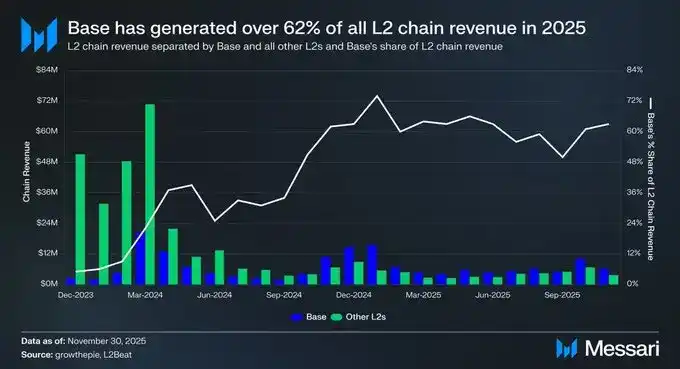
Despite a significant drop in L2's total revenue from its 2024 peak, Base continues to command a significant share of the L2 market. In December 2023, Base's on-chain revenue was $2.5 million, accounting for only 5% of L2's total revenue of $53.7 million. One year later, Base's on-chain revenue grew to $14.7 million, representing 63% of L2's total revenue of $23.5 million in December 2024. This trend persisted into 2025, with Base achieving $75.4 million in revenue year-to-date, accounting for 62% of L2's total revenue of $120.7 million.
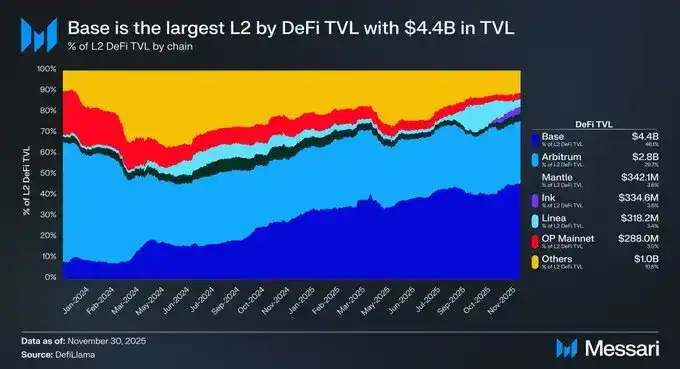
Base's leadership is not only evident at the revenue level; its DeFi TVL has also become a frontrunner in the L2 race. After surpassing Arbitrum One in January 2025, Base's current $46.3 billion DeFi TVL accounts for 46% of the entire L2 market. Of particular note, Base's DeFi TVL share has steadily increased throughout 2025, rising from 33% at the beginning of the year to the current level.
Base's most significant advantage over other L2 solutions lies in its distribution channel, a critical advantage that speaks for itself. According to Coinbase's latest 10-Q filing, with 9.3 million monthly active trading users in the third quarter, Base can directly reach a large and onboarded user base, which is challenging for other L2 networks to achieve. While most L2s must acquire users through incentives or third-party integrations, Base, thanks to its direct connection to the largest U.S. centralized exchange, enjoys a natural distribution advantage.
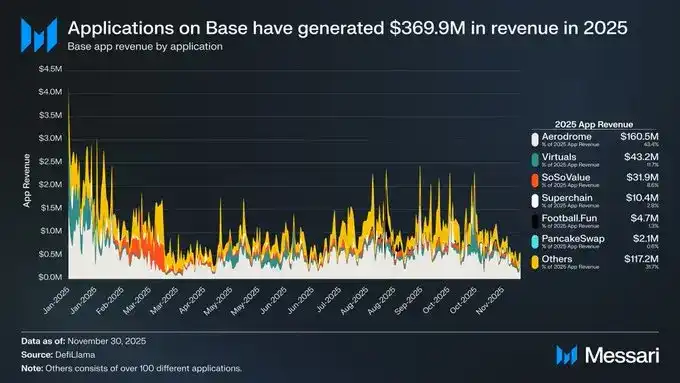
Base has also stood out for the ecosystem's application of scalable development and tangible value creation. This year, applications within the Base ecosystem have generated $369.9 million in revenue. Notably, application revenue is primarily concentrated in Aerodrome, which contributed $160.5 million, accounting for 43% of total application revenue. However, the top DEX on Base was not the only successful application in 2025.
The AI Agent Launch Platform Virtuals has achieved $43.2 million in revenue, accounting for 12% of the Base ecosystem's total revenue from applications; meanwhile, the recently launched sports prediction app Football.Fun has also generated $4.7 million in revenue. These data indicate that a diverse set of revenue-generating products has been established on Base across multiple sectors, and the ecosystem's vibrancy does not rely on a single application or use case.
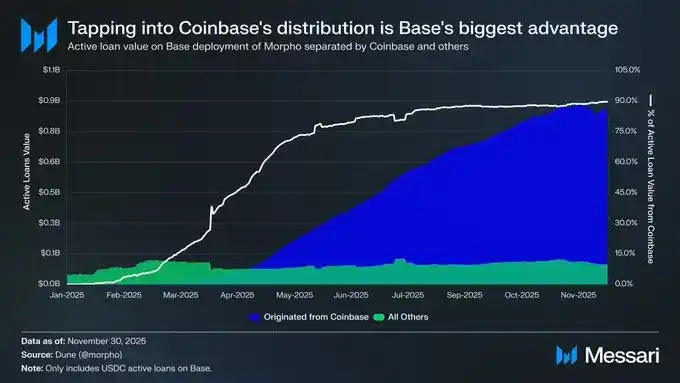
This distribution advantage was best exemplified in the Coinbase and Morpho collaboration case. This partnership allows Coinbase users to borrow USDC directly on the platform using cryptocurrency as collateral. While the user experience is embedded within the Coinbase website, collateral management and loan execution are carried out on-chain through Morpho deployed on Base. This lending product was launched less than a year ago, but its adoption rate has been quite high.
Coinbase users have borrowed $866.3 million through Morpho, currently representing 90% of active loans on Morpho on the Base network. Concurrently, Morpho's TVL on the Base chain has grown by 1906% over the year, surging from $48.2 million to $966.4 million. Base's distribution advantage means on-chain activity can serve as a byproduct for Coinbase's product usage. This user onboarding channel is not available to other L2 networks, leading them to rely mainly on incentive programs to attract liquidity and users to the DeFi ecosystem.

Although Base chain's DeFi TVL has continued to grow since 2025, and on-chain revenue remains stable, user on-chain behavior has started to shift. Based on daily filtered user statistics (referring to the number of unique addresses conducting at least two transactions in a specific contract in a day and spending more than 0.0001 gas), USDC has now become the most widely used application on the Base chain, with an average of 83,400 daily users in November, a 233% year-on-year increase from 25,100 users in the same period last year.
Meanwhile, retail and DEX interaction has significantly decreased. The daily filtered user count for Uniswap and Aerodrome has dropped by 74% and 49%, respectively. However, it is more noteworthy that DEX trading volume on the Base chain hit a record high in 2025, indicating that activity on Uniswap and Aerodrome is increasingly concentrated among traders with larger fund sizes and higher transaction volumes.
Base 2026 Key Initiative: Base App
Leveraging Coinbase's natural advantage, Base enjoys a luxury condition that other chains find hard to reach. It has established a solid moat in terms of user base, liquidity, and application ecosystem. Base leads in revenue on the L2 network, has the deepest DeFi TVL in the field, and continues to receive on-chain user traffic from Coinbase. In other words, unlike most L2 networks still struggling to establish themselves or attract users, Base has long surpassed this stage of development.
With this moat, Base's focus has shifted beyond core L2 network metrics to the creator economy sector. If this market opportunity is seized, the potential total market size is estimated to be close to $5 trillion. To seize this market direction, Base's core strategy is focused on the Base App. This "super app" aims to integrate asset custody, trading, social, and wallet core functions into one. Unlike most crypto wallets, the Base App features several innovative functions beyond basic asset management:
· Social feed based on Farcaster and Zora;
· Direct messaging and group chat functionality through XMTP (supporting interaction with other users and AI agents like Bankr);
· Built-in mini-app discovery feature, allowing users to directly access and use various mini-apps within the Base App.

The Base App launched an internal beta in July, initially only available to users invited through a whitelist. Nevertheless, the Base App has shown significant growth. A total of 148,400 users have created accounts, with accelerated registrations in November, seeing a 93% increase month-over-month. User retention is also strong, with 6,300 weekly active users (a 74% increase) and 10,500 monthly active users (a 7% increase). Although not explicitly confirmed, the Base App is likely to conclude its internal testing phase this month, paving the way for a full public launch before the new year.

The most critical goal of the on-chain economy Base is trying to build is to enable creators to directly profit from their created content. Content created in the Base App is tokenized by default (although users can opt out of this feature), turning each post into a tradable market. Creators can earn a share of the transaction fees generated by the content, specifically 1% of each transaction.
In the future, users will also be able to mint creator tokens for their accounts directly within the Base App, opening up another monetization avenue (this feature is currently in early testing). At a technical level, both creator tokens and content tokens are tokenized based on the Zora protocol. As of now, creators have cumulatively earned $6.1 million through Zora's tokenization model, with an average monthly payout of $1.1 million since July.
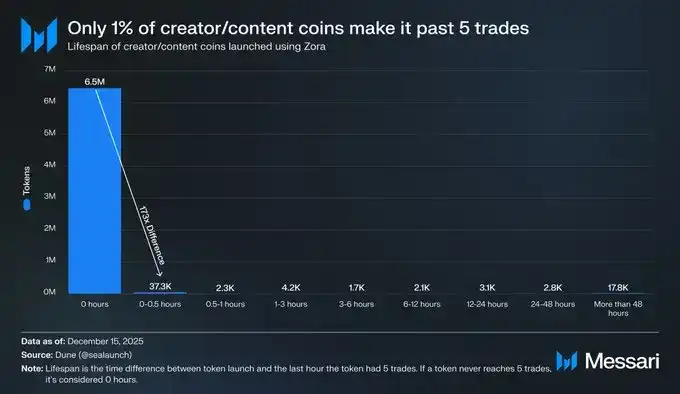
As of now, the total number of creators and content tokens tokenized through Zora has exceeded 6.52 million. Among them, 6.45 million (about 99% of the total) have failed to achieve five transactions. Only 17.8 thousand tokens (0.3% of the total) remain transactional after 48 hours of issuance.
Before interpreting this data, one must understand a fundamental fact: the vast majority of content published on the Internet is inherently worthless. From this perspective, the fact that 99% of tokens have not garnered market attention may simply reflect the natural distribution of online content, rather than a structural flaw in the Base model. What truly matters are the tokens that survive beyond 48 hours. We believe that a creator or content token being able to continue trading after 48 hours of issuance signals the genuine value of the creator or content itself.
In other words, Base has so far made little impact on the creator economy. Only 17.8 thousand creator and content tokens show ongoing activity, which is a mere drop in the ocean compared to the vast daily output of online content. Pessimists may deem this model unviable, but optimists believe that while Base has essentially achieved near-zero penetration in the creator economy, there is significant room for growth through optimizations in content distribution, content discovery, and functional tools. In any case, increasing the number of tokens that can survive beyond 48 hours should be a key focus for Base in 2026.
Lastly, Base may possess the most effective incentive mechanism in the crypto market: tokens. In September of this year, Base confirmed that it is exploring token issuance but has not yet disclosed specific details regarding allocation, utility, or potential launch dates. The most notable aspect of the Base token is not the token itself but its use cases. Unlike most L2s, Base does not rely on tokens to attract liquidity. Instead, it can use tokens to incentivize on-chain creator participation, rewarding behaviors that drive user engagement, content creation, and social activities rather than short-term trading.
In conclusion, leveraging its established L2 core ecosystem, Base is advancing through distribution channels, product coverage, and potential token incentives, exploring consumer and creator-oriented use cases. If this strategy succeeds, Base will establish a moat around the social and creator ecosystem. This moat exhibits higher user stickiness compared to DeFi TVL and stablecoin balances, areas where other L2 solutions have not yet ventured.
You may also like

Mastercard Launches Agent Pay for AI, Plans to Record AI Agent Payment Authorizations on Polygon
Mastercard launched Agent Pay for AI, a new payment protocol designed to help AI agents make small payments such as pay-per-use access to data and APIs. The system plans to record human-granted AI agent permissions on Polygon, focusing on verifiable authorization, identity, and payment controls.

Curve Deploys Llamalend v2 on Optimism With 250,000 OP Incentives
Curve launched Llamalend v2 on Optimism with 250,000 OP incentives from the Optimism Foundation. The upgrade expands Llamalend beyond its earlier crvUSD-focused model, adding broader collateral support, LlamaRisk market reviews, and the ability to use Curve LP tokens as collateral.

Raydium Old Liquidity Pool Reportedly Exploited, With $1.34 Million Moved to Ethereum and Tornado Cash
An old Raydium liquidity pool was reportedly exploited for around $1.34 million in USDC, RAY, and wSOL, with the stolen funds bridged to Ethereum and deposited into Tornado Cash. The incident highlights the tail risks of legacy DeFi pools, old contracts, and cross-chain fund laundering paths.

Kalshi Executive Challenges “SBF Backed AI Unicorns” Narrative, Says Leopold Aschenbrenner Was Key Figure
Kalshi executive John Wang questioned the “SBF backed AI unicorns” narrative, saying Leopold Aschenbrenner was the key figure behind major AI investment decisions.

Pantera Capital Partner: How Tokenization is Restructuring the Private Equity and Early Investment Ecosystem?

New York Proposes Stricter Stablecoin Issuer Rules Aligned With Federal GENIUS Act
NYDFS proposed stricter stablecoin issuer rules aligned with the GENIUS Act, covering reserves, custody, redemption timelines, audits, and capital buffers.
Every exchange is a "Universal Exchange."

The counterattack of traditional finance: Alliance chains are quietly reviving

CryptoQuant Says Bitcoin Profitable Supply Is Near 45% Pressure Zone as On-Chain Data Points to Market Repricing
CryptoQuant said Bitcoin’s profitable supply is nearing the 45% pressure zone, signaling rising market stress, unrealized losses, and a possible on-chain repricing phase.

Bitcoin Falls Below 200-Week Moving Average as On-Chain Data Shows Over Half of Supply in Loss
Bitcoin dropped below its 200-week moving average as on-chain data showed over 50% of circulating supply is now in loss, signaling rising market stress.

CFTC Reportedly Plans New Prediction Market Rules Focused on Manipulation Risk and Public Interest Review
The CFTC is reportedly preparing new prediction market rules focused on manipulation risk, public interest review, and retail trader protections.

Meet the new WEEX trial fund—your gateway to greater profits

WEEX Labs Lands at Dutch Blockchain Week: A Disruptive Crypto × AI Conversation Sets Sail in Amsterdam
SK Hynix Reportedly Plans U.S. ADR Listing as Early as August, With SEC Approval Possible in Late June
SK Hynix may pursue a U.S. ADR listing as early as August, with SEC approval reportedly possible in late June amid strong AI chip supply chain demand.

SpaceX vs Tesla vs xAI: Which Elon Musk Trade Has the Biggest Upside in 2026?
OpenAI Reveals It Has Confidentially Submitted an S-1 to the SEC, Keeping the Door Open for a Future IPO
On June 9, according to an OpenAI announcement, the company recently confidentially submitted a draft S-1 registration statement to the U.S. Securities and Exchange Commission (SEC), beginning the preliminary compliance process for a potential initial public offering. OpenAI said it chose to disclose this proactively because it expected the news might leak; however, the company has not yet set a specific listing timeline, and related arrangements may still take some time.
Latest research from 13 top universities including Cornell University: The current state, challenges, and misconceptions of the fusion of Crypto and AI
Deconstructing Anthropic: The Best AI Company, Possibly Also a Type of Organizational Invention
Mastercard Launches Agent Pay for AI, Plans to Record AI Agent Payment Authorizations on Polygon
Mastercard launched Agent Pay for AI, a new payment protocol designed to help AI agents make small payments such as pay-per-use access to data and APIs. The system plans to record human-granted AI agent permissions on Polygon, focusing on verifiable authorization, identity, and payment controls.
Curve Deploys Llamalend v2 on Optimism With 250,000 OP Incentives
Curve launched Llamalend v2 on Optimism with 250,000 OP incentives from the Optimism Foundation. The upgrade expands Llamalend beyond its earlier crvUSD-focused model, adding broader collateral support, LlamaRisk market reviews, and the ability to use Curve LP tokens as collateral.
Raydium Old Liquidity Pool Reportedly Exploited, With $1.34 Million Moved to Ethereum and Tornado Cash
An old Raydium liquidity pool was reportedly exploited for around $1.34 million in USDC, RAY, and wSOL, with the stolen funds bridged to Ethereum and deposited into Tornado Cash. The incident highlights the tail risks of legacy DeFi pools, old contracts, and cross-chain fund laundering paths.
Kalshi Executive Challenges “SBF Backed AI Unicorns” Narrative, Says Leopold Aschenbrenner Was Key Figure
Kalshi executive John Wang questioned the “SBF backed AI unicorns” narrative, saying Leopold Aschenbrenner was the key figure behind major AI investment decisions.
Pantera Capital Partner: How Tokenization is Restructuring the Private Equity and Early Investment Ecosystem?
New York Proposes Stricter Stablecoin Issuer Rules Aligned With Federal GENIUS Act
NYDFS proposed stricter stablecoin issuer rules aligned with the GENIUS Act, covering reserves, custody, redemption timelines, audits, and capital buffers.


