Bear Market New Chain's 14x God Tier Coin, How to Play Bigcoin?

The GameFi project Bigcoin just launched on the "Penguin Chain" Abstract the day before yesterday. In fact, this project has garnered a lot of discussion in the English-speaking community since its inception in the English-speaking world. A look at the price chart makes it clear why:
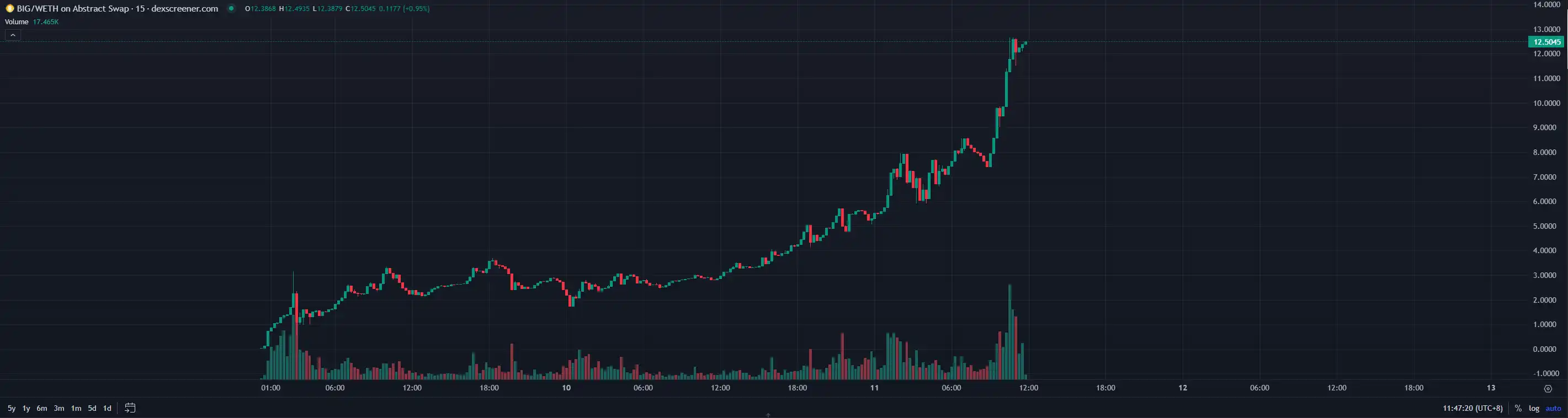
At the beginning, foreigners jokingly called it a "Pixiu scheme." Looking at the extended timeline, it has been a consistent upward trend.
Starting from yesterday, the enthusiasm for this project has gradually spread to the Chinese community. How exactly does this project work? In an environment where GameFi/blockchain games have not been a major market focus for a long time, how did it, as a "mining coin" produced by GameFi, stand out and skyrocket 12 times?
Mechanism Introduction
You can tell from the project's name, Bigcoin, that its mechanism is broadly based on mimicking Bitcoin mining.
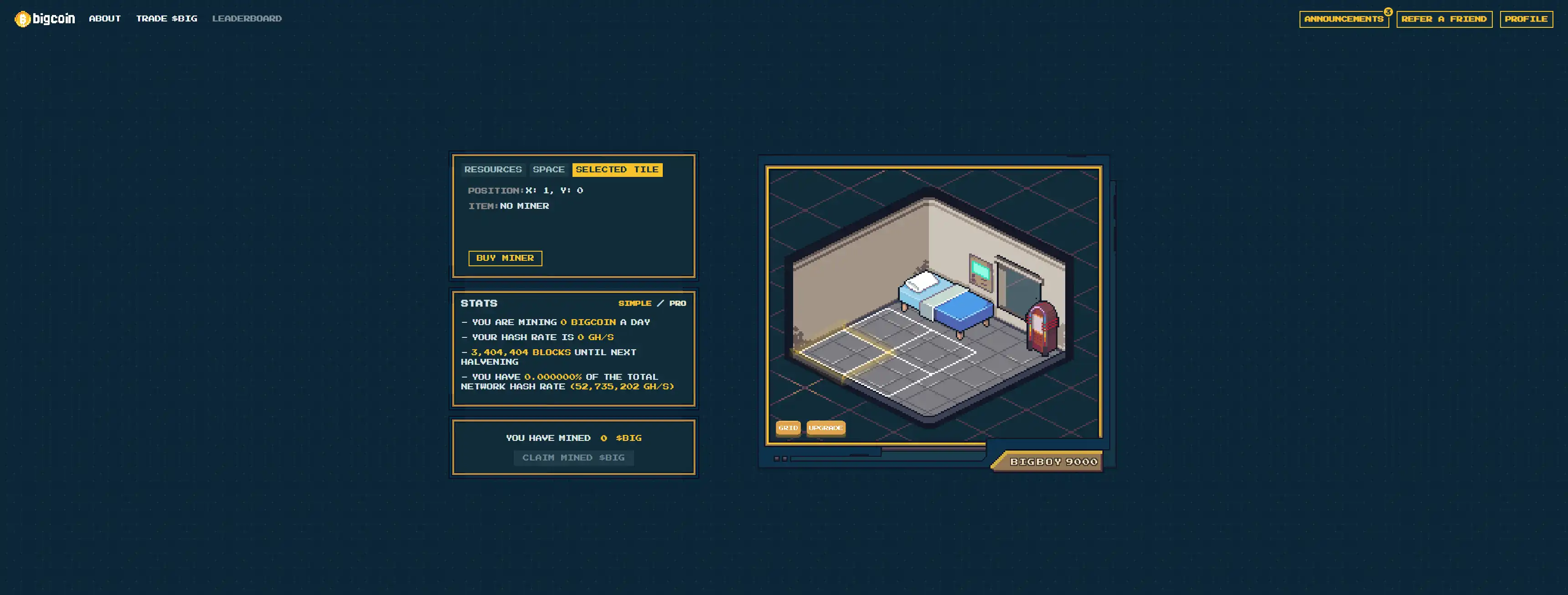
Bigcoin has a total supply just like Bitcoin of 21 million coins, with an initial block reward of 2.3 $BIG. Every 4.2 million Abstract network blocks, the reward halves once, approximately every 53.5 days. Of course, in reality, the "mining" process is not actually using real computational power like Bitcoin; this is simply a process within a virtual game.
Upon entering the game, players need to spend 0.01 ETH to buy a "mine" to start playing. Buying a "mine" comes with a free "miner," and following the game's instructions to deploy the miner in the mine will start producing the in-game currency $BIG. Every block, all players will definitely receive a $BIG reward, and the reward formula is "Player Hashpower/Total Hashpower of All Players * Block Reward."
If you want to mine faster, you must spend $BIG. Although the initial "mine" has 4 slots for placing miners, it only has 28 power units, which can only support 2 of the cheapest "Raspberry Pro" miners priced at 20 $BIG to operate.
Therefore, to earn more $BIG in the game, you not only need to spend $BIG to buy higher-level "miners" to increase your "hashpower," but also upgrade your "mine" to be able to place more and higher-level "miners." Mine upgrades will have a 24-hour cooldown in the future.
All $BIG used for in-game upgrades will have 75% burned, and 2.5% of the mined coins will be distributed as a commission reward.
Highlights
If the game simply copied the Bitcoin mining concept without any changes, it would be quite boring. However, it incorporates many clever ideas that introduce a lot of unpredictable variables to make the gameplay more interesting than just "mining in a game."
The game introduces a "mining machine elimination mechanism." Similar to the history of Bitcoin mining development, old mining machines will be phased out by newer, more powerful ones. In the game, mining machines will also dynamically adjust based on the game's output. In yesterday's update, old mining machines could be sold at 90% of the purchase price, allowing players to exchange them for new machines or take profits.
Of course, this profit-taking mentioned here has a strong first-mover advantage. For example, the author of this text bought two 80 $BIG mining machines when the game was just launched, and at that time, the price of $BIG was only around $1. When the author redeems 154 $BIG today, the price of $BIG has risen to $5.5. In the long run, defining this as a "free exit mechanism" is more reasonable because the price fluctuation of $BIG is hard to predict, and as more players enter the game and halving events occur, the $BIG produced at the same cost will decrease.
The project team clearly came prepared. When the game was first launched, the entry cost was 0.005 ETH, perhaps to avoid an influx of too many "freeloaders," the entry cost was raised. Also, the cost of upgrading the mining farm for the first time yesterday was 1600 $BIG, but after the update, it was adjusted to 70 $BIG. This adjustment may compensate for early adopters who upgraded early; otherwise, those whales who spent 1600U upgrading the mining farm would be at a loss.
The game also has a "Prop Shop," and it is currently unknown what effect purchasing items from it and placing them in the mining farm will have.
Lastly, this project has received noticeable support from Abstract's official team. Before the game went live, the official Abstract account was already paying attention to it. Luca Netz not only appeared in the comments section of Bigcoin's tweet but also directly tweeted about the project:

Strategy
Overall, this is a whale's game. Naturally, the strategy for whales is to reinvest to maximize $BIG production. For whales, besides profiting from $BIG, there is an expectation of harvesting a large amount of Abstract XP (related to future Abstract token airdrops). A similar case is On-chain Heroes, where previously, the leading figure @0xtsider received a reward of 84994 XP within a week. At that time, to participate in On-chain Heroes, one needed to spend at least 0.5 ETH to purchase an NFT for in-game staking.
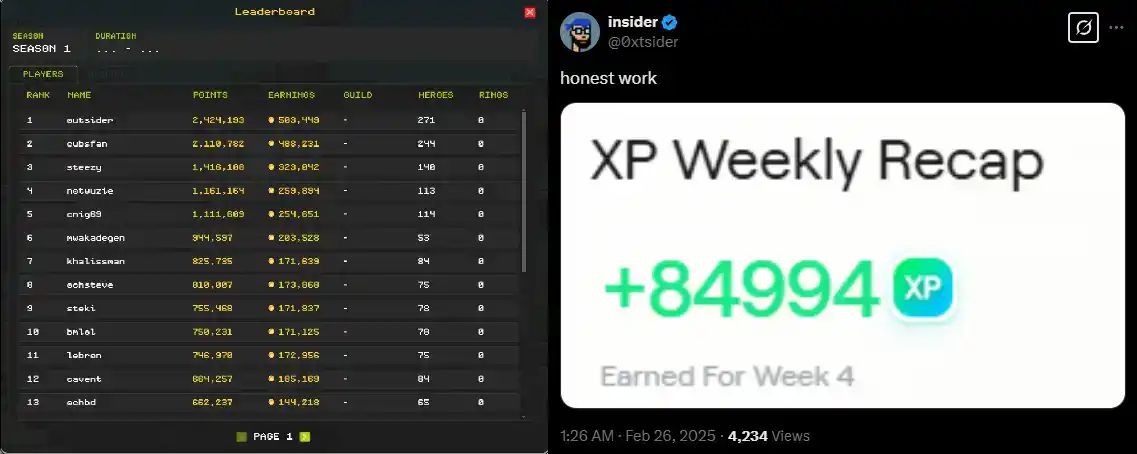
The distribution mechanism of Abstract XP is opaque, but the official team will allocate XP based on the weekly activity of ecosystem applications. Currently, the $BIG pool holds nearly 640 ETH, and the trading volume in just 2 days has reached close to $11 million. With the high activity levels leading up to the start of On-chain Heroes Season 2, Bigcoin is very likely to have the highest XP allocation weight.
For ordinary retail investors, a more suitable strategy would be to enter with the lowest possible cost, use free mining machines to break even, and also earn some Abstract XP.
However, it is crucial to note that to earn Abstract XP, you must use the Abstract Global Wallet (AGW) to connect and participate in the game. This is not a browser extension wallet but a web-based wallet. You can register using an email address or link through extension wallets like MetaMask to register. (Official Website Link)
Conclusion
Abstract's development strategy on this chain is very different in the current market. While other chains may encourage users to participate in testnets or issue bundled token NFTs for hype, Abstract can be said to be an "attention development-oriented" chain, focusing mainly on "live streaming" and GameFi.
The user base of Abstract consists mainly of English-speaking NFT players. Although the NFT assets on this chain perform mediocrely, the older NFT player community tends to be more interested in things that have been carefully crafted, even though they know the "game" very well. This is the key to the success that On-chain Heroes and the current Bigcoin have achieved on Abstract, attracting attention in the market.
Through numerous GameFi/Blockchain Game projects, the Chinese community has captured more of the previous blockchain game players and airdrop interactive players. If the chain conducts a TGE in mid-year, the author still holds relatively high expectations for its market performance.
You may also like
A pre-announced harvesting case: After the cryptocurrency price dropped by 99%, the public chain Saga exited to transform into AI
Ethereum Foundation Report: A Basic Guide to Ethereum for Governments and Financial Institutions
Portugal 2-1 Croatia: Ronaldo's 20-Year Knockout-Stage Drought Ends With a Debt Finally Collected
Portugal beat Croatia 2-1 in the 2026 global football championship's knockout rounds as Ronaldo scored his first-ever knockout-stage goal, Gonçalo Ramos struck a stoppage-time winner, and VAR ruled out a late equalizer for offside.
Bitcoin Price Prediction July 2026: Will BTC Recover to $70K or Drop Below $55K?
A South Korean company that learned the strategy of hoarding coins, from a bull market to delisting?
Where is Zhao Changpeng's billion-dollar investment going? YZi Labs' investment landscape fully revealed
Semiconductor stocks plummet, yet Anthropic wants to create a 2nm chip
WEEX API Broker Program: Turn Your Trading Platform Into a Revenue Engine
How to choose between buying discounted ETH, Bitmine, and SharpLink?
Do you want to buy CRCL?
Wosh: Inflation has cooled in recent weeks, AI is reshaping the economy, and forward guidance has lost its necessity
The most secretive AI winner
Looking at Stripe's ambitions and the future of stablecoins from OUSD
From Pump.fun to Collector Crypt: Has Solana's income throne changed hands?
Dan Bin's latest speech: Don't miss out on a great era
Robinhood launches its own blockchain, no longer wanting to be a tenant on others' chains
Why Tokenized Stocks Are Booming in 2026 While Crypto Is Still Struggling
Former ByteDance employee's account: How I started with two Pinduoduo hard drives and made six times the profit with Seagate to achieve financial freedom?
A pre-announced harvesting case: After the cryptocurrency price dropped by 99%, the public chain Saga exited to transform into AI
Ethereum Foundation Report: A Basic Guide to Ethereum for Governments and Financial Institutions
Portugal 2-1 Croatia: Ronaldo's 20-Year Knockout-Stage Drought Ends With a Debt Finally Collected
Portugal beat Croatia 2-1 in the 2026 global football championship's knockout rounds as Ronaldo scored his first-ever knockout-stage goal, Gonçalo Ramos struck a stoppage-time winner, and VAR ruled out a late equalizer for offside.
Bitcoin Price Prediction July 2026: Will BTC Recover to $70K or Drop Below $55K?
A South Korean company that learned the strategy of hoarding coins, from a bull market to delisting?
Where is Zhao Changpeng's billion-dollar investment going? YZi Labs' investment landscape fully revealed