
- Buy Crypto
- Markets
 Futures
- Spot
- Copy Trade
- Earn
- More
Bitcoin briefly fell below $71,000, how much HODL faith is left in the crypto community?

Original Title: "Bitcoin Dips Below $72,000, How Much Faith Is Left in the Crypto Space?"
Original Author: Yang Chen, Wall Street News
Bitcoin dipping below the $72,000 mark (Update: Bitcoin has now dipped below $71,000) has brought the "faith" issue in the crypto market to the forefront. Against the backdrop of a sharp decline in global risk appetite, investors are reevaluating Bitcoin's position in the market turbulence, and the narrative of crypto assets as a hedge is being questioned.
According to Bloomberg, Bitcoin on Wednesday dipped to $71,739 in New York's closing, marking the first dip below $72,000 in about 15 months. Compared to its peak in October last year, Bitcoin has retraced over 42%, with a year-to-date decline of around 17%, falling to its lowest level since November 6, 2024.
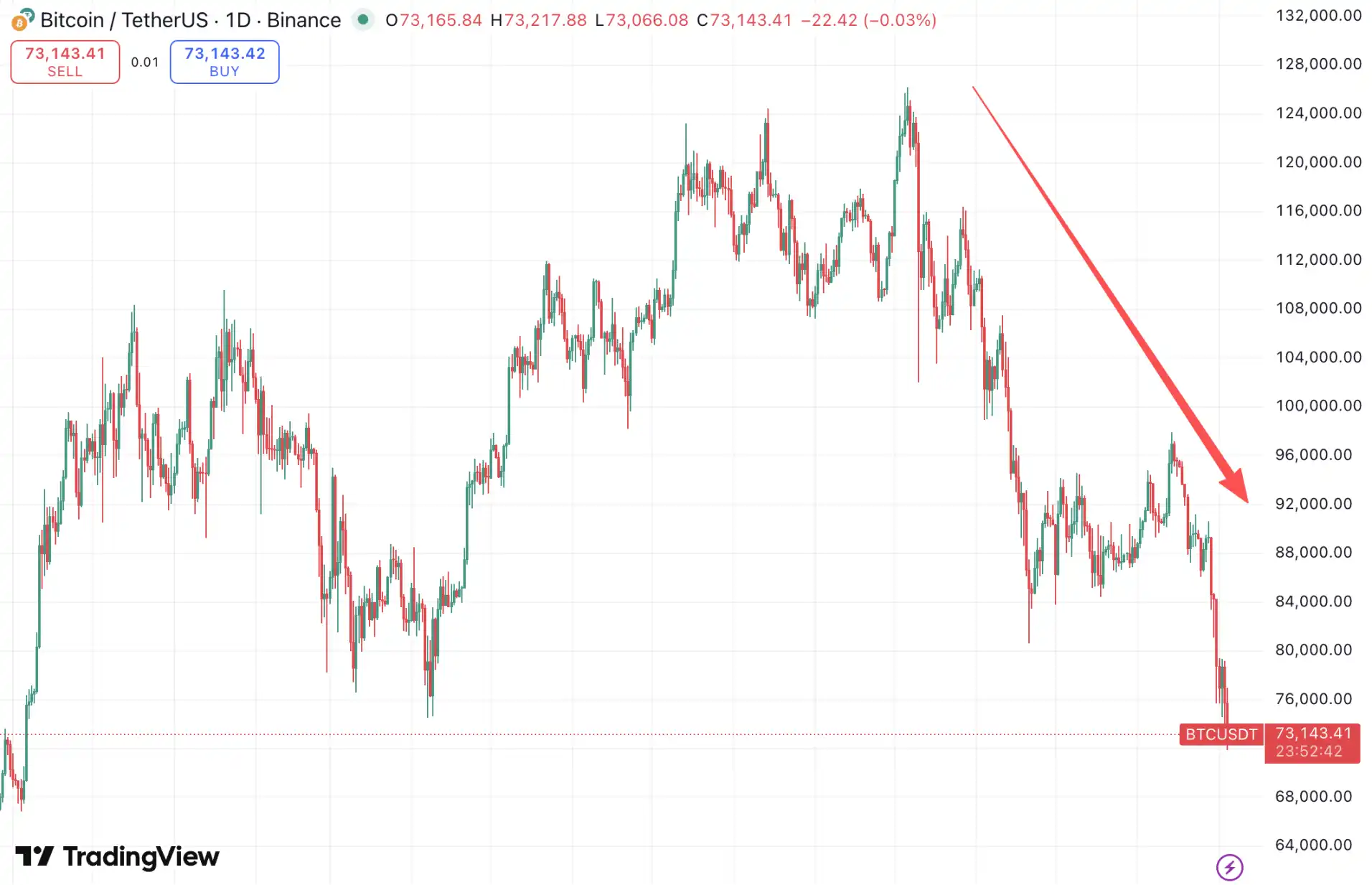
This round of decline is no longer just a deleveraging within the crypto market but is due to broader cross-asset pressure. On Wednesday, global markets experienced synchronous selling, with the Nasdaq 100 index dropping over 2%, sectors more sensitive to interest rates such as software and chips were generally under pressure, dragging Bitcoin down along with them.
On an emotional level, a "crisis of faith" is brewing. Shiliang Tang, managing partner at Monarq Asset Management, stated that the market is undergoing a "crisis of faith."
Andrew Tu, Head of Business Development at Efficient Frontier, also noted that market sentiment in the crypto space is currently at "extreme fear," and if $72,000 is breached, Bitcoin could drop to $68,000 or even fall back to the low range before the initial bounce in early 2024.
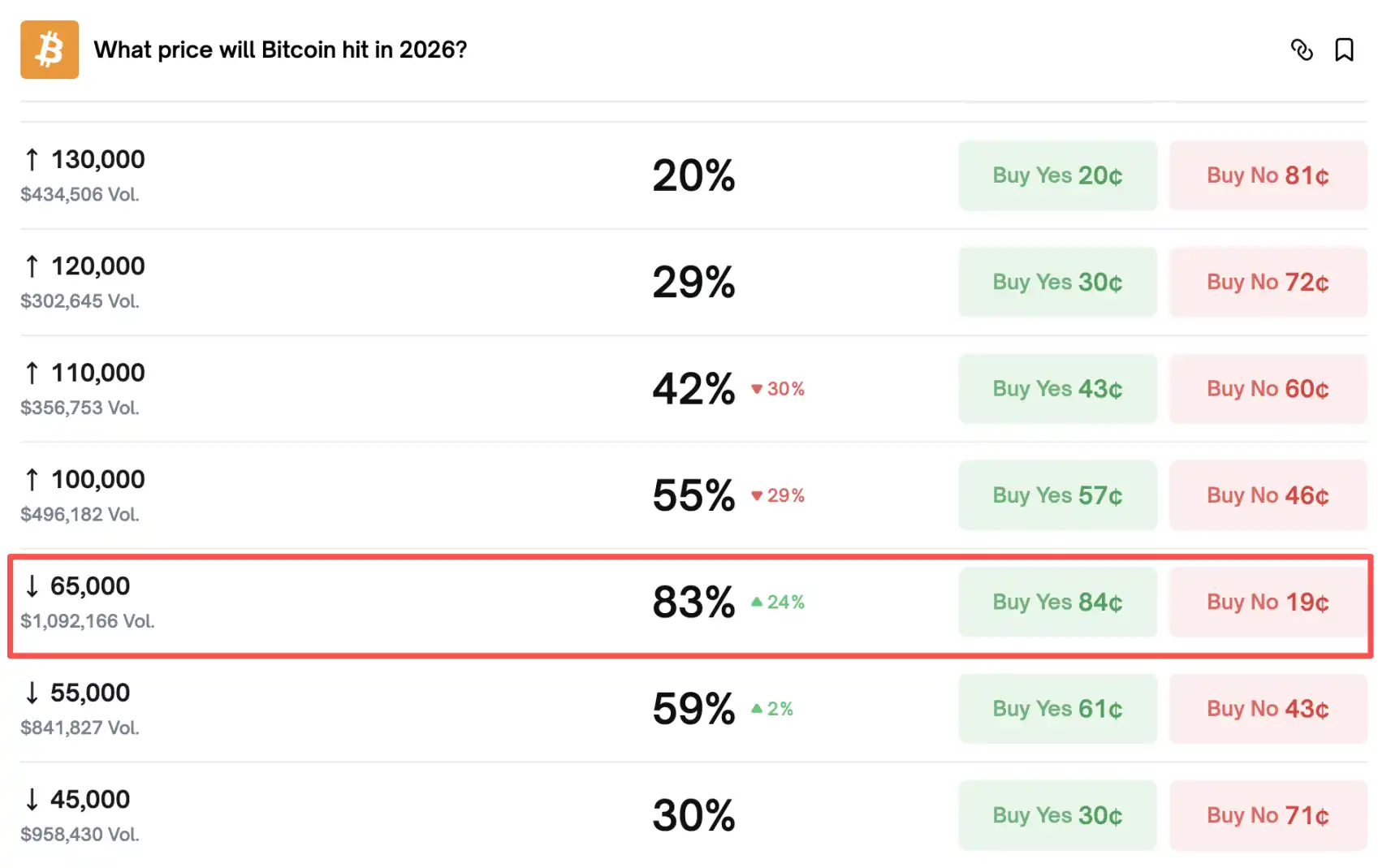
According to Polymarket, there is an 83% probability that Bitcoin will drop to $65,000 this year, and the probability of falling below $55,000 has risen to about 59%.
Risk Aversion Sudden Turn, Bitcoin Labelled as "High-Volatility Risk Asset"
According to Bloomberg, the pressure on Bitcoin on Wednesday was related to broader cross-asset tension rather than solely being driven by internal crypto asset liquidation. This is significant for investors because as the market entered a phase of synchronous selling, Bitcoin did not demonstrate resilience independent of risky assets but rather resembled a high-volatility long tail risk asset.
The Nasdaq 100 Index experienced a daily decline of over 2%, dragging down sectors such as software and semiconductors. On the same trading day, Bitcoin dropped below a key psychological level, reinforcing its market perception as being correlated with risk appetite.
With a 42% Retreat from Peak, the Crypto Market Evaporated Over $460 Billion in a Week
Price retracement is rapidly transmitting through market cap contraction. According to CoinGecko data, the total market capitalization of crypto assets has shrunk by around $1.7 trillion since last October's peak. In just the past week, the crypto market cap has decreased by over $460 billion.
As the largest cryptocurrency, Bitcoin's magnitude and speed of decline have a "anchoring effect" on market sentiment. When Bitcoin's year-to-date decline widens to around 17%, risk control, margin management, and fund redemption pressure often rise simultaneously, further intensifying overall volatility.
How the "Crisis of Faith" Emerges: From Liquidation Shock to Sentiment Dissipation
Market participants' expressions indicate that emotional shifts are becoming a core variable. The "crisis of faith" as described by Shiliang Tang points to investors' simultaneous doubts about the long-term narrative and short-term pricing mechanism of crypto assets.
More importantly, there has been a shift in the driving force behind the decline. According to Bloomberg, the earlier downward phase was more driven by crypto-specific liquidation, while Wednesday's pressure came from broader cross-market tension.
This means that even if the internal leverage unwinding in the crypto market comes to a halt, as long as external risk assets remain under pressure, Bitcoin may still lack an independent catalyst for a rebound.
72000 as a Short-Term Watershed, Market Predicts a Fall to 65000 by Year-End
Many traders view $72,000 as a key short-term price level. Andrew Tu points out that if this level cannot hold, Bitcoin is "likely" to fall to $68,000 and may revisit the low range before the initial rebound in early 2024.
According to Polymarket, Bitcoin has an 83% probability of falling to $65,000 this year, while the likelihood of dropping below $55,000 has risen to around 59%.
The funding side is also sending out mixed signals. According to Bloomberg compilation data, a U.S.-listed Bitcoin spot ETF recorded around $562 million in net inflows on Monday, but quickly turned into net outflows of $272 million on Tuesday, indicating that incremental funds are not stable.
Amid price declines and fund flow fluctuations, skepticism in the market about Bitcoin's role as a "safe-haven asset in times of pressure" is on the rise.
You may also like

AI within artillery range
“The cloud” is a metaphor, but the data center isn’t.

March 4th Market Key Intelligence, How Much Did You Miss?

Taking Stock of Crypto's Washington Power Players: Who is Advocating for US Crypto Regulation?

DDC Enterprise Limited Announces 2025 Unaudited Preliminary Financial Performance: Record Revenue Achieved, Bitcoin Treasury Grows to 2183 Coins
On March 4, 2026, DDC Enterprise Limited (NYSE American: DDC) today announced preliminary, unaudited full-year financial performance for the year ended December 31, 2025. The company expects to achieve record revenue and record positive adjusted EBITDA, primarily driven by continued growth in its core consumer food business and overall margin improvement. The final audited financial report is expected to be released in mid-April 2026.
Revenue: Expected to be between $39 million and $41 million, reaching a new company high.
Organic Growth: Excluding the impact of the company's strategic contraction of its U.S. operations, core revenue is expected to grow 11% to 17% year over year.
Gross Profit Margin: Expected to be between 28% and 30%, reflecting continued operational efficiency improvements.
Adjusted EBITDA: The company expects to achieve a positive full-year result in 2025, a significant improvement from a $3.5 million loss in 2024, mainly due to rigorous cost controls and a higher-margin sales mix.
In 2025, DDC's core consumer food business maintained strong operational performance.
The company also disclosed Core Consumer Food Business Adjusted EBITDA, a metric that further excludes costs related to its Bitcoin reserve strategy and non-cash fair value adjustments related to its Bitcoin holdings from adjusted EBITDA to more accurately reflect the core business performance.
In 2025, Core Consumer Food Business Adjusted EBITDA is expected to be between $5.5 million and $6 million.
In the first half of 2025, DDC initiated a long-term Bitcoin accumulation strategy, holding Bitcoin as its primary reserve asset.
As of December 31, 2025: The company holds 1,183 BTC.
As of February 28, 2026: Holdings increased to 2,118 BTC
Today's additional purchase of 65 BTC brings the company's total holdings to 2,183 BTC
DDC Founder, Chairman, and CEO Norma Chu stated, "We are proud to have closed 2025 with record revenue and positive adjusted EBITDA, demonstrating the steady growth of the company's consumer food business and the ongoing improvement in profitability. We are building a disciplined, growth-oriented food platform and strategically allocating capital to Bitcoin assets with a long-term view, aligning with our core beliefs. We believe that this dual-track model of 'Steady Consumer Business + Strategic Bitcoin Reserve' will help DDC create lasting long-term value for shareholders."
For the full year 2025, the company defines "Adjusted EBITDA" (a non-GAAP financial measure) as: Net income / (loss) excluding the following items:· Interest expense· Taxes· Foreign exchange gains/losses· Long-lived asset impairment· Depreciation and amortization· Non-cash fair value changes related to financial instruments (including Bitcoin holdings)· Stock-based compensation
DDC Enterprise Limited (NYSE: DDC) is actively implementing its corporate Bitcoin Treasury strategy while continuing to strengthen its position as a leading global Asian food platform.
The company has established Bitcoin as a core reserve asset and is executing a prudent, long-oriented accumulation strategy. While expanding its portfolio of food brands, DDC is gradually becoming one of the public company pioneers in integrating Bitcoin into its corporate financial architecture.

Uncovering YZi Labs 229 Investment: Over 18% of the portfolio is already inactive, with an average project transparency score of 78

The business of crypto VC is becoming promising

China's AI Compute Power Counterstrike

Global Assets Plunge: Hormuz, Chips, and a South Korean Holiday

Bloomberg has reported twice, Hyperliquid once again in Wall Street's radar

Trump Backs Crypto Bill, SEC Halts Leveraged ETF, What Is the English-Speaking Crypto Community Talking About?

OpenClaw Floods Into Polymarket, Some Making Tens of Thousands Per Month
Understanding Trump's "Warfare Playbook": Ten Signals Investors Must Know

Iranian Missile Heading Toward UAE, Claude Also Within Range
Successive Core Team "Heroes" Depart, Has Aave's DAO Dream Crumbled?

Is This the Year of the Robot? A Deep Dive into Robotics Projects
When AI Takes Over Money: Bitcoin Becomes the "First Choice," Fiat Is Left Out

AI Trading in Live Markets: 4 Lessons From a WEEX Hackathon Top 10 Finalist
AI trading meets real markets. Explore 4 lessons from a WEEX Hackathon Top 10 finalist on surviving volatility, trusting AI models, and building smarter crypto trading systems.

MegaETH Co-founder: 48 Hours After Leaving Dubai, I Reassessed the Entire Crypto Space
AI within artillery range
“The cloud” is a metaphor, but the data center isn’t.
March 4th Market Key Intelligence, How Much Did You Miss?
Taking Stock of Crypto's Washington Power Players: Who is Advocating for US Crypto Regulation?
DDC Enterprise Limited Announces 2025 Unaudited Preliminary Financial Performance: Record Revenue Achieved, Bitcoin Treasury Grows to 2183 Coins
On March 4, 2026, DDC Enterprise Limited (NYSE American: DDC) today announced preliminary, unaudited full-year financial performance for the year ended December 31, 2025. The company expects to achieve record revenue and record positive adjusted EBITDA, primarily driven by continued growth in its core consumer food business and overall margin improvement. The final audited financial report is expected to be released in mid-April 2026.
Revenue: Expected to be between $39 million and $41 million, reaching a new company high.
Organic Growth: Excluding the impact of the company's strategic contraction of its U.S. operations, core revenue is expected to grow 11% to 17% year over year.
Gross Profit Margin: Expected to be between 28% and 30%, reflecting continued operational efficiency improvements.
Adjusted EBITDA: The company expects to achieve a positive full-year result in 2025, a significant improvement from a $3.5 million loss in 2024, mainly due to rigorous cost controls and a higher-margin sales mix.
In 2025, DDC's core consumer food business maintained strong operational performance.
The company also disclosed Core Consumer Food Business Adjusted EBITDA, a metric that further excludes costs related to its Bitcoin reserve strategy and non-cash fair value adjustments related to its Bitcoin holdings from adjusted EBITDA to more accurately reflect the core business performance.
In 2025, Core Consumer Food Business Adjusted EBITDA is expected to be between $5.5 million and $6 million.
In the first half of 2025, DDC initiated a long-term Bitcoin accumulation strategy, holding Bitcoin as its primary reserve asset.
As of December 31, 2025: The company holds 1,183 BTC.
As of February 28, 2026: Holdings increased to 2,118 BTC
Today's additional purchase of 65 BTC brings the company's total holdings to 2,183 BTC
DDC Founder, Chairman, and CEO Norma Chu stated, "We are proud to have closed 2025 with record revenue and positive adjusted EBITDA, demonstrating the steady growth of the company's consumer food business and the ongoing improvement in profitability. We are building a disciplined, growth-oriented food platform and strategically allocating capital to Bitcoin assets with a long-term view, aligning with our core beliefs. We believe that this dual-track model of 'Steady Consumer Business + Strategic Bitcoin Reserve' will help DDC create lasting long-term value for shareholders."
For the full year 2025, the company defines "Adjusted EBITDA" (a non-GAAP financial measure) as: Net income / (loss) excluding the following items:· Interest expense· Taxes· Foreign exchange gains/losses· Long-lived asset impairment· Depreciation and amortization· Non-cash fair value changes related to financial instruments (including Bitcoin holdings)· Stock-based compensation
DDC Enterprise Limited (NYSE: DDC) is actively implementing its corporate Bitcoin Treasury strategy while continuing to strengthen its position as a leading global Asian food platform.
The company has established Bitcoin as a core reserve asset and is executing a prudent, long-oriented accumulation strategy. While expanding its portfolio of food brands, DDC is gradually becoming one of the public company pioneers in integrating Bitcoin into its corporate financial architecture.


 App
App