
- Buy Crypto
- Markets
 Futures
- Spot
- Copy Trade
- Earn
- More
Bitcoin Miner Canaan Has 180 Days to Escape Nasdaq Delisting — Will It Survive?

Key Takeaways
- Canaan, a prominent Bitcoin mining hardware manufacturer, faces potential delisting from Nasdaq after failing to maintain a minimum bid price of $1 for 30 consecutive days.
- The company has been given a 180-day compliance period, ending in July 2026, to rectify its stock price and avoid delisting.
- Despite significant revenue growth in 2025 due to hardware sales and self-mining, Canaan is still grappling with financial losses and negative profit margins.
- Canaan’s market position is challenged by declining investor confidence, rising operational costs, and competitive pressures within the crypto mining hardware sector.
WEEX Crypto News, 2026-01-19 11:59:52
Canaan, one of the leading companies in the cryptocurrency mining hardware space, finds itself in a precarious situation as it grapples with the looming threat of being delisted from the Nasdaq Stock Market. The company’s situation sheds light on the challenges faced by publicly traded crypto-centric firms, highlighting the interplay between poor equity performance and strict market regulations.
Nasdaq has notified Canaan that its shares have failed to meet the minimum bid price of $1 for a continuous period of 30 business days, triggering a compliance period that extends until July 13, 2026. This notice, while serious, does not immediately affect the listing or trading of Canaan’s American depositary shares, which will remain active on the Nasdaq Global Market throughout this period.
Canaan’s Stock Performance and Compliance Challenges
As of now, Canaan’s shares are trading at a concerning $0.79, placing them well within what is commonly referred to as penny stock territory. The company must manage a stock closing price at or above $1 for at least ten consecutive business days to regain compliance with Nasdaq’s listing requirements.
Should Canaan fail to achieve this before the July deadline, there may be an opportunity for an additional grace period, provided it meets other listing criteria and submits a plausible action plan, potentially including options like a reverse stock split. Nevertheless, the trajectory of the stock reflects broader trends: despite occasional short-term upticks, the overall direction is sharply downward, with the stock losing over half its value in the past year.
Investors have seen previous rallies, notably in October 2025, when Canaan announced its largest hardware purchase in three years—a contract for 50,000 Avalon A15 Pro mining rigs. Yet, the positive momentum from such operational successes often fades quickly, as ongoing concerns about liquidity and long-term viability curb sustained investor enthusiasm. A significant blow to investor confidence came in December when Streeterville Capital, once Canaan’s largest institutional holder, divested its entire stake, compounding concerns regarding liquidity, dilution risk, and the company’s profitability outlook.
Financial Performance and Profitability Prospects
Canaan’s financial narrative is a tale of rapid growth counterbalanced by persistent financial strain. Despite notable revenue gains in 2025—primarily driven by hardware sales and its own mining activities—the company remains burdened by losses. The third quarter of 2025 saw revenue surge more than 2.5 times the prior year, reaching an impressive $150.5 million. Yet, the bottom line remained in the red with a net loss of $27.7 million.
Operating and net margins continue to be troublingly negative, and analysts have predicted that consistent profitability may remain elusive until at least 2027. Despite achieving record adjusted EBITDA in mid-2025 and bolstering its cash reserves to $119 million by the close of the third quarter, Canaan is still contending with high cash burn rates and significant financial risk.
From an operational perspective, Canaan has been on an aggressive expansion path. By the end of 2025, its deployed hashrate had surged to almost 10 exahash per second, and its treasury of cryptocurrencies had grown to a record 1,750 BTC, coupled with substantial ETH holdings. However, rising electricity costs, the compression of post-halving rewards, and intense competition among hardware manufacturers continue to exert pressure on margins, posing challenges for the company’s profitability.
Despite these adversities, Canaan’s management remains optimistic about the company’s value. In December, they announced a $30 million share buyback program, signaling their belief that the stock is undervalued. However, this move has yet to translate into an increase in the share price sufficient to push it past Nasdaq’s critical threshold, due in large part to the lack of sustained profitability and steady investor interest.
Canaan Amidst Industry-Wide Challenges
Canaan is not the solitary player in the crypto industry wrestling with the threat of Nasdaq delisting. Other companies that operate within or alongside the cryptocurrency market also face similar compliance challenges. Amongst these is KindlyMD, a healthcare and Bitcoin treasury firm, which revealed in December that it, too, had fallen below Nasdaq’s compliance requirements and was given until June 2026 to rectify its standing.
This broader industry context underscores the volatility and regulatory hurdles that crypto-centric public companies must navigate. The market’s ebb and flow, shaped by fluctuating investor sentiment and external economic pressures, renders maintaining compliance with stock exchange standards a formidable task.
Looking forward, Canaan’s capacity to weather this storm will hinge on its strategic decision-making in the coming months. From operational efficiencies and cost management to investor relations and capital deployment, the steps taken by Canaan’s management will be critical in determining whether the company can meet Nasdaq’s requirements and secure its market position.
The Path Ahead: Strategic Implications for Canaan
The path that Canaan takes from here will be crucial in shaping its future and potential recovery. Operating in an industry characterized by rapid technological advancements and intense competition, Canaan’s strategic choices will need to reflect both agility and foresight.
Firstly, addressing the immediate Nasdaq compliance issue requires assertive action. Options on the table include bolstering investor confidence through transparent communication, possibly undertaking strategic partnerships or mergers, and continued innovation in mining technology to maintain a competitive edge.
Moreover, Canaan’s continued investment in its mining infrastructure and capability enhancements, such as improvements in energy efficiency and scaling up hashrate capacity, will be vital. Such initiatives could not only improve cost-effectiveness but also position the company advantageously for any future upticks in Bitcoin and cryptocurrency markets.
Additionally, the potential introduction of more diversified product lines or services could mitigate revenue volatility and strengthen Canaan’s resilience against market fluctuations. Diversification, while complex, could open new avenues for growth and reduce the company’s reliance on a single revenue stream.
Conclusion
Ultimately, Canaan stands at a pivotal crossroads. As it grapples with the imminent challenge of averting Nasdaq delisting, the company’s approach to exploiting its strengths, mitigating its weaknesses, and seizing new opportunities will dictate its trajectory. This ongoing saga is a testament to the broader dynamics at play in today’s crypto market, where innovation, regulation, and market perception intersect to define the fortunes of industry players.
FAQ Section
What is the current status of Canaan’s Nasdaq listing?
Canaan has been notified by Nasdaq that it has until July 13, 2026, to meet compliance standards after its shares traded below the $1 mark for 30 consecutive business days. The listing is not immediately affected but requires corrective action to avoid delisting.
How is Canaan planning to address its financial challenges?
Canaan plans to address its financial issues by enhancing its product offerings, improving operational efficiencies, and potentially executing a share buyback. Additionally, the company may consider strategic partnerships or restructuring to stabilize its financial standing.
What impact did the 2025 Avalon A15 Pro mining rigs purchase have on Canaan?
The purchase of 50,000 Avalon A15 Pro mining rigs marked Canaan’s largest hardware acquisition in three years. However, while the acquisition initially boosted investor confidence, the positive impact on its stock price was not sustained, highlighting ongoing volatility in the market.
Are other crypto companies facing similar delisting threats?
Yes, other companies in the crypto-adjacent sector, such as KindlyMD, are also facing delisting warnings from Nasdaq due to similar compliance challenges, reflecting wider industry pressures and regulatory demands.
What are some potential strategies Canaan could employ to regain market trust?
To regain market trust, Canaan might focus on enhancing transparency with investors, optimizing its operational efficiency, and exploring diversification into new product lines. These strategies could bolster market perception and investor confidence, helping improve the company’s stock performance.
You may also like

Wall Street Shorts ETH: Vitalik is aware and has front-run, while Tom Lee remains oblivious

Social Capital CEO: How Equity Tokenization is Reshaping Capital Markets from US Stocks to SpaceX?

CoinGecko Report: Surge of 346% vs Dip of 20.8%, The Wild Rise of DEX

a16z: The Real Opportunity of Stablecoins Lies Not in Disruption but in Filling Gaps

Mining Exodus: Someone Holds $12.8 Billion AI Order

March 6 Market Key Intelligence, How Much Did You Miss?

a16z: The True Opportunity of Stablecoins is in Complementing, Not Disrupting

Predict LALIGA Matches, Shoot Daily & Win BTC, USDT and WXT on WEEX
The WEEX × LALIGA campaign brought together football excitement and crypto participation through a dynamic interactive experience. During the event, users predicted matches, completed trading tasks, and took daily shots to compete for rewards including BTC, USDT, WXT, and exclusive prizes.

Ray Dalio Dialogue: Why I'm Betting on Gold and Not Bitcoin

Who Took the Money in the AI Era? A Must-See Investment Checklist for HALO Asset Trading
Wall Street Bears Target Ethereum: Vitalik In the Know Takes Flight, Tom Lee Remains Bullish
Pump.fun Hacker Steals $2 Million, Receives 6-Year Prison Sentence, Opts for 'Self-Detonation'

6% Annual Percentage Yield as Musk Declares War on Traditional Banks
36 years, 4 wars, 1 script: How does capital price the world in conflict?

Mining Companies' Great Migration: Some Have Already Secured $12.8 Billion in AI Orders
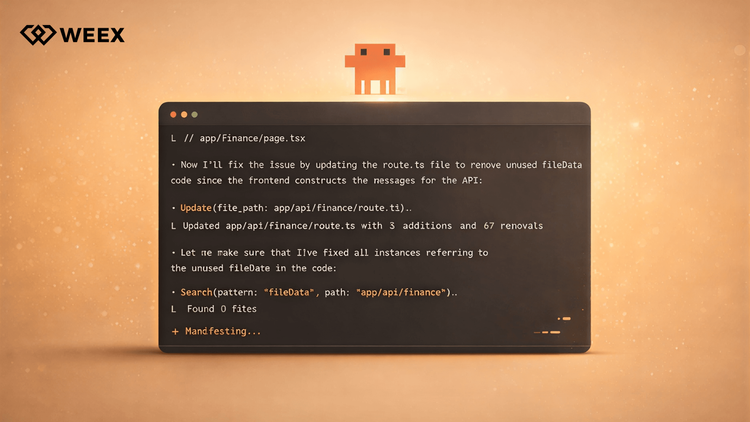
What Is Vibe Coding? How AI Is Changing Web3 & Crypto Development
What is vibe coding? Learn how AI coding tools are lowering the barrier to Web3 development and enabling anyone to build crypto applications.
The parent company of the New York Stock Exchange strategically invests in OKX: The intentions behind the $25 billion valuation

WEEX P2P update: Country/region restrictions for ad posting
To improve ad security and matching accuracy, WEEX P2P now allows advertisers to restrict who can trade with their ads based on country or region. Advertisers can select preferred counterparty locations for a safer, smoother trading experience.
I. Overview
When publishing P2P ads, advertisers can now set the following:
Allow only counterparties from selected countries or regions to trade with your ads.
With this feature, you can:
Target specific user groups more precisely.Reduce cross-region trading risks.Improve order matching quality.
II. Applicable scenarios
The following are some common scenarios:
Restrict payment methods: Limit orders to users in your country using supported local banks or wallets.Risk control: Avoid trading with users from high-risk regions.Operational strategy: Tailor ads to specific markets.
III. How to get started
On the ad posting page, find "Trading requirements":
Select "Trade with users from selected countries or regions only".Then select the countries or regions to add to the allowlist.Use the search box to quickly find a country or region.Once your settings are complete, submit the ad to apply the restrictions.
When an advertiser enables the "Country/Region Restriction" feature, users who do not meet the criteria will be blocked when placing an order and will see the following prompt:
If you encounter this issue when placing an order as a regular user, try the following solutions.
Choose another ad: Select ads that do not restrict your country/region, or ads that allow users from your location.Show local ads only: Prioritize ads available in the same country as your identity verification.
IV. Benefits
Compared with ads without country/region restrictions, this feature provides the following improvements.
Aspect
Improvement
Trading security
Reduces abnormal orders and fraud risk
Conversion efficiency
Matches ads with more relevant users
Order completion rate
Reduces failures caused by incompatible payment methods
V. FAQ
Q1: Why are some users not able to place orders on my ad?
A1: Their country or region may not be included in your allowlist.
Q2: Can I select multiple countries or regions when setting the restriction?
A2: Yes, multiple selections are supported.
Q3: Can I edit my published ads?
A3: Yes. You can edit your ad in the "My Ads" list. Changes will take effect immediately after saving.


 App
App