
Bitwise Chief Investment Officer: Why Has Gold Outperformed Bitcoin by So Much?


Original Article Title: "Bitwise: Gold's Price Surge Will Far Outpace BTC, Signaling BTC's Own 'Golden Moment' by 2025"
Original Article Author: Matt Hougan, Chief Investment Officer at Bitwise
Original Article Translation: Golden Finance
The current crypto market has two core questions regarding Bitcoin:
1. Why has gold's price performance far exceeded Bitcoin's?
2. With ETFs and corporations buying heavily, why is Bitcoin's price still stagnant?
In fact, by carefully answering the first question, the answer to the second question will also emerge — and this answer paints an extremely bullish picture of Bitcoin's future.
Next, I will analyze this in detail.
Question One: Why Has Gold's Price Performance Far Exceeded Bitcoin's?
Currently, although gold prices have experienced a pullback, they have seen a rapid rise this year, with a 57% increase in 2025, moving towards the second-best annual performance in history when priced in US dollars. At the same time, Bitcoin has been stagnant near the $110,000 mark, with its price remaining relatively flat since May.
This has left investors who view Bitcoin as "digital gold" feeling frustrated, but there is a simple explanation behind this: the difference stems from the actions of various central banks.
Since the US froze Russian-held US Treasuries following Russia's invasion of Ukraine, central banks around the world have begun to significantly increase their gold holdings. According to Metals Focus data, central bank gold purchases have nearly doubled since the outbreak of the Russia-Ukraine conflict, from an annual average of about 467 tons to approximately 1000 tons today, a scale that is roughly twice the estimated gold ETP (Exchange-Traded Product) purchase volume.
Bitcoin has not been able to benefit from this treatment. While some central banks are researching Bitcoin, none have actually made purchases. Therefore, it is logical that Bitcoin has not followed the rise in gold prices if central banks are the main driver behind this gold price increase.
This view is not new. Institutions and individuals such as Morgan Stanley, JPMorgan, and Mohamed El-Erian have all pointed out that central bank gold purchases are a key driver of the surge in gold prices.
Question Two: Why, Despite ETFs and Corporations Buying Heavily, is Bitcoin's Price Still Stagnant?
How is this related to the second question?
The answer is: highly related.
The biggest mystery in the Bitcoin market is that, despite ETFs and corporations buying in large quantities, its price remains relatively stable. Since the introduction of the Bitcoin ETF in January 2024, ETFs and corporations have accumulated 1.39 million bitcoins, while the new supply of the Bitcoin network during the same period is less than a quarter of this amount. Although the price of Bitcoin has risen by 135% since then, performing well, many are still wondering: shouldn't it have gone even higher?
I also had the same question: who is selling Bitcoin in large quantities? What is preventing it from breaking through the $200,000 mark?
The current rise in the price of gold provides the answer.
See the table below, which shows the annual gold purchase volume of central banks from 2010 to 2024. Central bank gold purchases in 2021 were 467 tons, rising to 1,080 tons in 2022, and has since remained at this high level (forecasts indicate that demand in 2025 will be slightly lower than in 2024).
Central Bank Gold Purchase Volume 2010-2024 (tons):
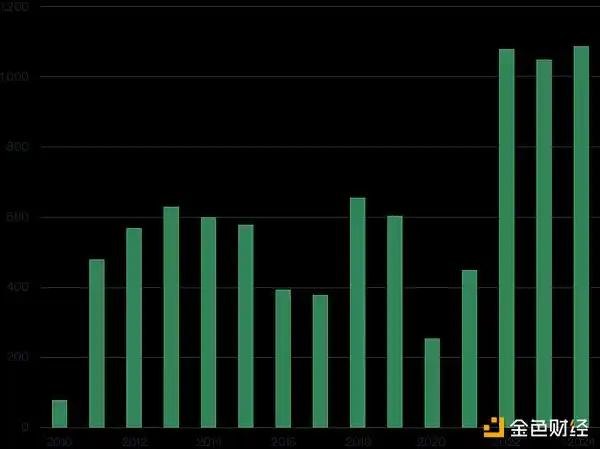
Source: World Gold Council
In short, although central bank gold purchases have been a key catalyst for this year's rise in gold prices, such purchases did not start this year, but rather in 2022.
This also provides an answer to the current situation of Bitcoin.
When central bank gold purchases started to increase significantly in 2022, the pace of the gold price rise was relatively slow: the average price in 2022 was $1,800, rising to $1,941 in 2023 (only an 8% increase), and reaching $2,386 in 2024 (a 23% increase). It was only this year that the price of gold saw an explosive surge, rising by almost 60% to around $4,200.
In other words: central banks started purchasing gold in 2022, and the gold price didn't experience a parabolic rise until 2025.
I believe the logic of the situation is very clear: in any market, there is a part of investors sensitive to price changes — these investors often take action when the price rises or falls by 10%-15%. When central banks started buying gold in large quantities in 2022, driving the gold price up, these investors would sell gold as demand increased. However, eventually, this selling pressure would be exhausted, and the price would then rise significantly.
I suspect Bitcoin is currently in a similar stage.
As mentioned earlier, since 2024 when ETFs and corporations began buying heavily, the price of Bitcoin has risen 2.3 times. During this period, price-sensitive holders take the opportunity to sell and exit.
But as the example of the gold price shows, there will come a day when these selling pressures will be exhausted. As long as the joint buying trend of ETFs and corporations continues (which I believe is highly probable), Bitcoin will experience its "2025 Gold Moment."
My advice is: be patient.
Do not envy the sharp rise in the price of gold, but take it as a sign—it may be showing us the future direction of Bitcoin.
You may also like

Bitcoin Market Analysis 2026: Can BTC Reach $150K by Year-End?

STRC unanchored by 11%, can the perpetual motion machine of Strategy still operate?

Bitcoin ETF Outflows Hit a Record $4.4 Billion: What Are Traders Doing With Their Cash?

WEEX App Just Got Smarter – New Tabs for Faster Trades & Easy Asset Management

Blockchain Capital Partner: The Core Secret of Arbitrage

WEEX All-New Search Features: Find, Trade & Earn Faster Than Ever

Will MicroStrategy fall into a death spiral? What will the macro trend be in the second half of the year?

Morning Report | Illinois signs the strictest digital asset tax law in the U.S.; RWA tokenization market size surpasses $43 billion, institutions accelerate the migration of on-chain assets

Full version of the debut Q&A! Federal Reserve Chairman Waller: Sticking to the 2% inflation target, establishing five special working groups, individual did not submit the dot plot

From Disruptor to Shadow Market: The Crypto Market is Becoming a Colony of Traditional Finance
Dalio's important long article: How to position in the current market environment?

OKX Star analyzes Binance's competitive advantages: when regulation levels the playing field, competition has just begun

New gameplay for participating in initial offerings on cryptocurrency exchanges
Why Is Bitcoin Down Today? What the Hawkish FOMC Means for SpaceX, Gold and Nasdaq

DeepSeek Financing Story

Morning Report | DeepSeek completes over $7 billion in financing, with a valuation exceeding $50 billion; Musk's personal wealth has surpassed the total market value of Bitcoin
Cursor, why did you get on Musk's spaceship?
In the name of charity, for the benefit of the family: How the Trump family turned charity into profit?
Bitcoin Market Analysis 2026: Can BTC Reach $150K by Year-End?
STRC unanchored by 11%, can the perpetual motion machine of Strategy still operate?
Bitcoin ETF Outflows Hit a Record $4.4 Billion: What Are Traders Doing With Their Cash?
WEEX App Just Got Smarter – New Tabs for Faster Trades & Easy Asset Management
Blockchain Capital Partner: The Core Secret of Arbitrage
WEEX All-New Search Features: Find, Trade & Earn Faster Than Ever


