
- Buy Crypto
- Markets
 Futures
- Spot
- Copy Trade
- Earn
- More
BRC20 Ecosystem Revitalization? A New Dawn or an Illusion

Original Article Title: "BRC20 Ecological Recovery? A New Prelude or an Illusion"
Original Article Author: ChandlerZ, Foresight News
On February 24, after a long period of low-level operation, Bitcoin on-chain Gas fees experienced a significant increase, rising from an average of 1-2 satoshis/byte to over 12 satoshis/byte for high priority transactions. A few weeks ago, the Bitcoin mempool was fully cleared for the first time in nearly two years, but the number of unconfirmed transactions has since risen back to over 100,000.
According to Geniidata's data monitoring, in the past 24 hours, on-chain minting activity has shown a highly concentrated feature, mainly focusing on the MASK project.
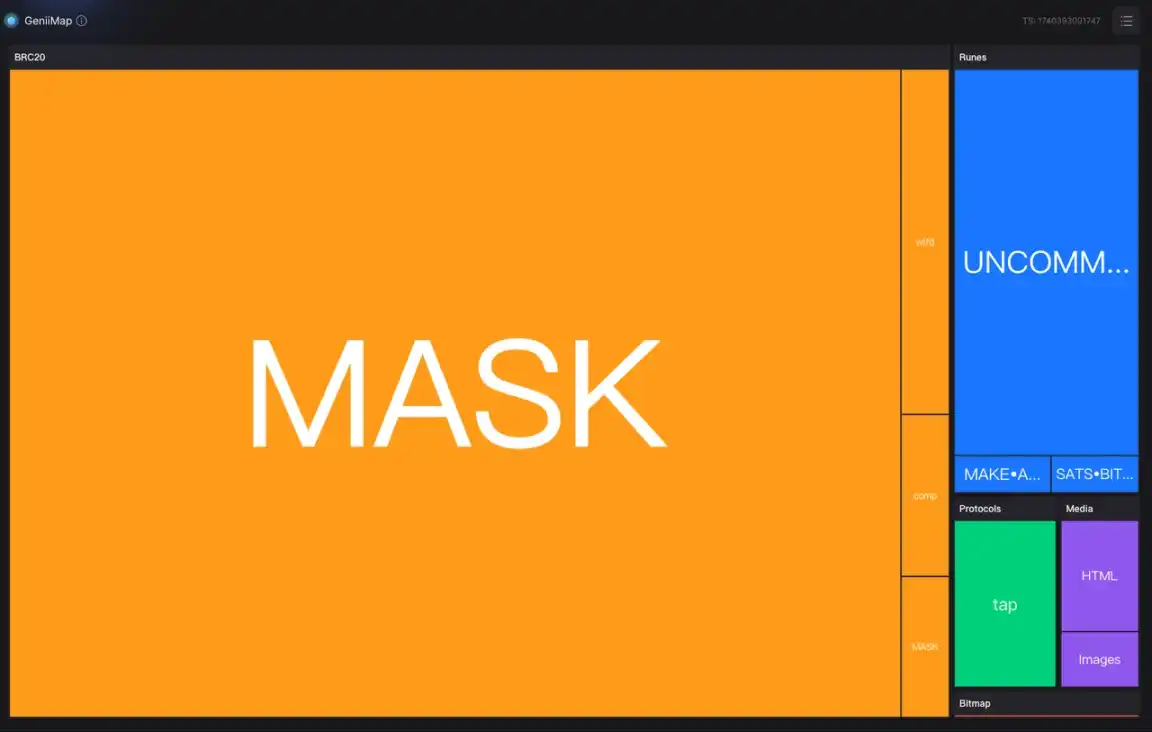
The total minting volume of MASK is 2.1 million tokens, with each token containing 10 coins. The current market price is around $0.18, with a total market value of approximately $3.06 million. As of the latest data, the minting progress of this project has reached 82.69%, and this increased activity has sparked widespread discussions in the market about the possibility of a new round of revival in the BRC-20 ecosystem.
From a deeper market logic perspective, the current crypto market is at a unique moment. As the conspiracy theories of the Solana and BSC ecosystems are widely questioned, the somewhat "fair" BRC-20 seems to have rekindled market attention. However, the market's memory has not faded with time, and the previous intense fluctuations in the Bitcoin ecosystem still cast a shadow over the market.
Watch Him Build a Tower High, Watch Him Watch It Fall
According to The Block data, starting from April 20, 2023, driven by the BRC-20 ecosystem, the number of transactions on the BTC network began to sharply rise, almost doubling in less than a month. The increase in transaction fees was even steeper, rising nearly tenfold in less than half a month. During the peak activity of the BRC-20 ecosystem, over 70% of on-chain transactions on the Bitcoin network were related to BRC-20 projects.
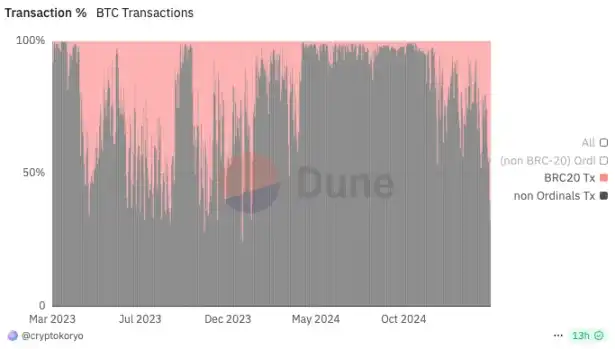
Behind this prosperous facade lies a fragile ecosystem foundation. After entering 2024, the Bitcoin ecosystem gradually fell into a downturn, a transformation that actually reflects the deep-seated challenges of the Bitcoin application layer. Although the market once had high hopes for the Bitcoin ecosystem, believing that innovation based on the script protocol could inject new vitality into the Bitcoin network, the actual development trajectory has deviated significantly from expectations.
Looking back at the development process of the BRC 20 ecosystem, we have to face a harsh reality. Most early popular projects experienced significant price retracements. ORDI dropped from a high of $87 to $11, Sats fell from 0.00000086 to 0.00000012, and other projects, including NFTs in the Bitcoin ecosystem, saw price drops of up to 90%, with many having already "returned to zero," leaving only a few projects with a strong grassroots culture.
This phenomenon is not accidental but rather the outward manifestation of deep-seated market structural issues. The BRC 20 protocol, from its design inception, embraced "true fairness" as a core principle. Through a fully transparent on-chain mechanism that eliminated reserves and scientist mechanisms, it aimed to provide all market participants with a truly equal opportunity to participate. While this design theoretically achieved the highest level of decentralization, it revealed significant limitations in practice.
The Paradox of Fairness and Market Control
From a market structure perspective, the scientist mechanism and initial chip distribution system in traditional crypto projects are essentially market regulation tools. Although these mechanisms are often criticized as manifestations of centralization, they play an indispensable role in maintaining market stability. Through these mechanisms, project teams can control market fluctuations to a certain extent, providing necessary price support for the project's long-term development.
However, the fully open minting mechanism in the BRC 20 ecosystem, while maximizing participation fairness, also resulted in highly dispersed chip structures. In the absence of effective price support mechanisms, market volatility tends to be more pronounced. In such scenarios, shifts in market sentiment can easily trigger chain reactions, leading to rapid price declines.
A deeper issue lies in the motivation of large funds to participate. In traditional crypto projects, large funds can influence market trends through various mechanisms to generate profits. However, under the inscription mechanism of BRC 20, this operational space is greatly reduced. When these so-called "whales" or "institutions" find it challenging to establish effective chip control, they naturally turn to other markets that offer easier fund management opportunities. This creates a paradox: the pursuit of absolute fairness may paradoxically lead to market instability, ultimately harming the interests of all participants. In such cases, the market needs to find a balance between complete fairness and necessary market stability.
The resurgence of the MASK project to some extent demonstrates that the market's yearning for a fair mechanism has not completely faded, regardless of whether this project still remains a "meteor." However, establishing an effective market stability mechanism while maintaining basic fairness remains a core challenge facing the entire crypto ecosystem. This requires innovation at the protocol design level and may involve introducing new mechanisms to balance decentralization and market stability, two seemingly contradictory goals.
You may also like

Conversation between Tom Lee and "The Big Short" Author: AI has detected bubble signal, crypto correction due to gold liquidity being "siphoned off"

The true reason for Claude's ban, Kraken accessing the Federal Reserve payment system, What is the English community paying attention to?

「Buying the Dip」 of 400,000 BTC: Is $74,000 a Rebound or a Reversal?

OpenClaw, Another Batch of Middle Class Jobless

Morning News | Backpack will launch on-chain IPO subscription service; Predict.fun strategically acquires on-chain prediction platform Probable; SoFi partners with Mastercard for strategic cooperation

Inventorying the Washington power in the crypto space, who is speaking out for U.S. crypto legislation?

650 million dollars, 1.5 billion dollars, 2 billion dollars, the crypto VC landscape has changed!

Why prediction markets are the largest untapped collateral pool in DeFi

500% XAUT Staking, Zero-Fee Gold Futures and $100K Rewards: Why Traders Are Turning to WEEX for Tokenized Gold
Explore WEEX's $100,000+ gold campaign featuring 500% XAUT staking, zero-fee gold contracts, and $30,000 PAXG rewards. Trade tokenized gold today.

AI within artillery range
“The cloud” is a metaphor, but the data center isn’t.

March 4th Market Key Intelligence, How Much Did You Miss?

Taking Stock of Crypto's Washington Power Players: Who is Advocating for US Crypto Regulation?

DDC Enterprise Limited Announces 2025 Unaudited Preliminary Financial Performance: Record Revenue Achieved, Bitcoin Treasury Grows to 2183 Coins
On March 4, 2026, DDC Enterprise Limited (NYSE American: DDC) today announced preliminary, unaudited full-year financial performance for the year ended December 31, 2025. The company expects to achieve record revenue and record positive adjusted EBITDA, primarily driven by continued growth in its core consumer food business and overall margin improvement. The final audited financial report is expected to be released in mid-April 2026.
Revenue: Expected to be between $39 million and $41 million, reaching a new company high.
Organic Growth: Excluding the impact of the company's strategic contraction of its U.S. operations, core revenue is expected to grow 11% to 17% year over year.
Gross Profit Margin: Expected to be between 28% and 30%, reflecting continued operational efficiency improvements.
Adjusted EBITDA: The company expects to achieve a positive full-year result in 2025, a significant improvement from a $3.5 million loss in 2024, mainly due to rigorous cost controls and a higher-margin sales mix.
In 2025, DDC's core consumer food business maintained strong operational performance.
The company also disclosed Core Consumer Food Business Adjusted EBITDA, a metric that further excludes costs related to its Bitcoin reserve strategy and non-cash fair value adjustments related to its Bitcoin holdings from adjusted EBITDA to more accurately reflect the core business performance.
In 2025, Core Consumer Food Business Adjusted EBITDA is expected to be between $5.5 million and $6 million.
In the first half of 2025, DDC initiated a long-term Bitcoin accumulation strategy, holding Bitcoin as its primary reserve asset.
As of December 31, 2025: The company holds 1,183 BTC.
As of February 28, 2026: Holdings increased to 2,118 BTC
Today's additional purchase of 65 BTC brings the company's total holdings to 2,183 BTC
DDC Founder, Chairman, and CEO Norma Chu stated, "We are proud to have closed 2025 with record revenue and positive adjusted EBITDA, demonstrating the steady growth of the company's consumer food business and the ongoing improvement in profitability. We are building a disciplined, growth-oriented food platform and strategically allocating capital to Bitcoin assets with a long-term view, aligning with our core beliefs. We believe that this dual-track model of 'Steady Consumer Business + Strategic Bitcoin Reserve' will help DDC create lasting long-term value for shareholders."
For the full year 2025, the company defines "Adjusted EBITDA" (a non-GAAP financial measure) as: Net income / (loss) excluding the following items:· Interest expense· Taxes· Foreign exchange gains/losses· Long-lived asset impairment· Depreciation and amortization· Non-cash fair value changes related to financial instruments (including Bitcoin holdings)· Stock-based compensation
DDC Enterprise Limited (NYSE: DDC) is actively implementing its corporate Bitcoin Treasury strategy while continuing to strengthen its position as a leading global Asian food platform.
The company has established Bitcoin as a core reserve asset and is executing a prudent, long-oriented accumulation strategy. While expanding its portfolio of food brands, DDC is gradually becoming one of the public company pioneers in integrating Bitcoin into its corporate financial architecture.

Uncovering YZi Labs 229 Investment: Over 18% of the portfolio is already inactive, with an average project transparency score of 78

The business of crypto VC is becoming promising

China's AI Compute Power Counterstrike

Global Assets Plunge: Hormuz, Chips, and a South Korean Holiday



 App
App