
- Buy Crypto
- Markets
 Futures
- Spot
- Copy Trade
- Earn
- More
Caroline Ellison was released today. What role did she play in the FTX collapse back then?

Original Title: ''Queen Caroline': The 'Fake Charity Nerd Girl' Behind The FTX Collapse'
Original Authors: David Jeans, Sarah Emerson, Richard Nieva, Michael del Castillo, Forbes
Original Translation: Katie Gu, Odaily Planet Daily
BlockBeats Note: This article was first published on November 19, 2022. Today (January 21), according to the latest records from the Federal Bureau of Prisons, Caroline Ellison, former Co-CEO of Alameda Research, will conclude her community confinement and be formally released.
In 2024, she was sentenced to 2 years of federal imprisonment by a U.S. court. In October 2025, she was transferred from a Connecticut federal prison to community confinement. In December 2025, Caroline Ellison reached a final settlement with the U.S. SEC and was simultaneously hit with a 10-year ban on executive and director roles.
For a long time, Caroline's personal image has been shrouded under the label of 'SBF's ex-girlfriend.' However, in the collapse of the FTX empire, the role played by this math genius is far more complex than her personal relationships. This article provides an in-depth analysis of her family background, growth path, and the true footnote she left in the history of crypto's earth-shattering downfall. The original article is as follows:
FTX, in addition to SBF, has kept one of its key figures, Caroline Ellison, Co-CEO of Alameda, enigmatic. (Just today, an FTX spokesperson said FTX has fired Gary Wang, Caroline Ellison, and Nishad Singh.) Caroline Ellison is a risk-loving math genius and Harry Potter fan. She is also a significant player in the FTX collapse and the new darling of the alt-right.
In 2021, Caroline Ellison was asked if she had any advice for her younger self, to which she replied candidly and concisely: 'I would tell my younger self not to be so risk-averse and to trust myself more.' This was her comment in the previously unpublished Forbes 30 Under 30 Rich List application.
A year later, this statement was interpreted as the "epitaph" of one of the recent largest financial disasters, a disaster that Caroline herself was involved in leading. The Alameda led by Caroline is a core part of FTX's business landscape.
It is alleged that it was Alameda's speculative investments using FTX customer deposits that siphoned off billions of dollars without users' knowledge. It was also Alameda that concealed this scheme as the hedge fund ensured that its assets traded on FTX bypassed its own balance sheet. In a bankruptcy filing, FTX estimates it will have over a million creditors seeking compensation. They are reported to have been persuaded to put their life savings into the platform. Documents also show that Alameda Research issued three personal loans to FTX executives, with SBF borrowing $1 billion. While SBF owned 90% of the trading firm, it was Caroline Ellison who took the helm when both FTX and Alameda collapsed.
Little public information is available about Caroline, but through conversations with eight people who knew her and unpublished details from her October interview with Forbes last year, we pieced together an image of a quiet math nerd who rose through the ranks in the crypto world until FTX's bankruptcy. Over a few years, Caroline wholeheartedly participated in SBF's "bacchanal" of a financial frenzy, leading her into an ever-expanding whirlpool of bullshit, deceit, and despair. She did not respond to a request for comment on this article.
"There are many who are very intelligent but may not excel in the chaotic world of trading—especially in cryptocurrency." —Caroline Ellison, May 2022
Caroline Ellison was once a "star student." Ruth Ackerman, a math professor who taught Caroline at Stanford University ten years ago, described her as "smart, focused, and very mathematically gifted." She finds it unbelievable that Caroline got involved in one of the largest fraud cases of the past decade.
Ackerman said in an interview with Forbes, "I found out because people started contacting me on LinkedIn to have me revoke my endorsement of her computer science skills."
Now, as the tragedy of FTX's bankruptcy increasingly captures public attention, with multiple U.S. agencies, including the SEC and the Department of Justice, announcing investigations, Caroline seems to be heading towards a nadir, her adventurous nature leading to catastrophic consequences.
She stated in a podcast episode in May, "Being able to face risks head-on is very important. Many people are very smart but may not excel in the chaotic trading world, especially in the cryptocurrency space."
"Their goal is to maximize wealth. They have never lived in a world without risk." — Early Alameda Employee
In March 2018, while working at the quantitative trading firm Jane Street, Caroline Ellison was approached by a former colleague with a proposition that would change her life.
While having coffee in California, SBF recommended to her to join the new cryptocurrency hedge fund Alameda Research he was spearheading, which would leverage Bitcoin's price differences across various countries. SBF described it as a perfect arbitrage opportunity. This trade would help him achieve his goal of making billions and donating to charity.
Caroline shared in an unpublished interview with Forbes in October 2021, "I thought it sounded exciting at the time, but I really loved Jane Street, so leaving was a tough decision."
However, Caroline stepped out of her comfort zone and formally entered the cryptocurrency space.
SBF, the mastermind behind Alameda and FTX, spent two years at Alameda before creating FTX, establishing what he saw as a modern cryptocurrency exchange. When SBF decided to leave Alameda and focus all his energy on the rapidly growing FTX, Caroline took over as Alameda's co-CEO.
FTX's dramatic implosion, from being "asset rich" to bankruptcy within four days, shifted focus to Alameda's $10 billion assets and allegations that the company used FTX customer deposits for risky investments. Several once industry stalwart cryptocurrency companies now face a similar fate. While daily headlines have accused him of years of misconduct, the spotlight has shifted from SBF to his inner circle, bringing Caroline into the public eye as a rare female leader in a male-dominated industry.
In recent days, Caroline has faced intense criticism from cryptocurrency supporters, blaming her for Alameda's downfall. Amid the harsh critique, a group of people has come to her defense. A supporter of Caroline told Forbes that many of those defending Caroline are congregating on the peer-to-peer platform Urbit created by computer scientist Curtis Yarvin. They believe Caroline is a scapegoat and claim that former co-CEO Sam Trabucco was the hidden hand behind Alameda's internal collapse. Trabucco did not respond to a request for comment.
「It feels like we really don't know what we're doing.」 — Caroline Ellison upon joining Alameda
Caroline's father, Glenn Ellison, currently serves as the head of the Economics Department at MIT, and her mother, Sara Fischer Ellison, is a lecturer in the same department. She grew up in a digitally charged atmosphere in the suburbs of Boston. While other kids were playing with LEGO blocks, Caroline was learning Bayesian statistics before middle school. One year, instead of a birthday card, she gifted her father a research paper on the pricing of stuffed toys. In a previous interview with Forbes, Caroline said, "I definitely got exposed to a lot more economics earlier than most people."
Caroline is a natural mathematician, having participated in multiple math competitions for women. But her interests extend far beyond math. In her senior year of high school, she also received accolades in the Linguistics Olympiad. She is an avid reader and mentioned that her parents read her the first Harry Potter book at age 3, and she read the second book by herself at age 5. She claims to be a student of Ravenclaw, representing wisdom and wit.
In 2012, when Caroline arrived at Stanford University as a math major, her career aspirations were already well defined. While adjusting to university life, she posted daily reflections on Tumblr.
When asked by Forbes last year what she didn't learn in school that has been helpful to her in the real world, she replied, "Pretty much everything. Like taxes."
She did learn one thing — a philosophy known as effective altruism. Popular in Silicon Valley, the movement calls on individuals to maximize their impact on the world using data. It was pioneered by a group of philosophers, including Will MacAskill. SBF said it was he who convinced himself to use his earnings for good, and he later joined the charity arm of the FTX Future Fund, resigning just last week. At Stanford, Caroline joined the campus Effective Altruism club and became its vice president.
Now, there are questions arising about whether Caroline, SBF, and their cohorts truly believe in the principles of effective altruism or if it's an effective way to mask their alleged misconduct. In a private chat published by Vox on Wednesday, a journalist asked SBF if his ethical statements were "mostly a front," to which SBF admitted. Caroline, at one point, seemed to have renamed her blog to "Pseudo-Philanthropic Shut-In," perhaps showing a sense of ironic self-awareness.
“For us, having two people able to take ultimate responsibility for things is a good thing.” — Caroline Ellison, serving as Co-CEO of Alamedia alongside Sam Trabucco
After graduating from Stanford, Caroline became a trader at Jane Street, where she met SBF. They bonded over their shared interests in effective altruism.
In 2018, SBF convinced her to join Alameda, and Caroline realized she had walked into a chaotic startup. In an interview with Forbes, Caroline said, “We truly had no idea what we were doing.” There, she also met SBF’s close friends Nishad Singh, Gary Wang, and soon-to-join Sam Trabucco, who would all take on executive roles alongside SBF. They shared a common interest in effective altruism.
By the end of 2018, SBF moved the company’s headquarters from Berkeley, California to Hong Kong. According to a former employee, SBF believed the city offered a good regulatory environment and with companies like Binance and Crypto.com based there, Hong Kong was the obvious choice for Alameda. Over the next few months, the team shuttled between six WeWork spaces across the city, including one office dedicated solely to storing couches.
But SBF’s next move was already in motion, and with initial funding from Binance, he launched FTX in 2019. As Caroline immersed herself in Alameda and quickly became a standout figure in the crypto space, Caroline began to shine at the trading firm, eventually rising to become Co-CEO of Alameda alongside Trabucco in the summer of 2021. With daily trading volumes of around $5 billion, this role propelled Caroline to the forefront of the industry.
Soon after, Caroline and Trabucco were featured on the Forbes 30 Under 30 list. In an interview at the time, she said, “For us, having two people able to take ultimate responsibility for things is a good thing.”
“I think I’ve been quite fortunate in a lot of ways.” — Caroline Ellison, May 2022
Over the past two weeks, there have been various speculations about the relationship between Caroline and SBF, but SBF confirmed it in an interview with The New York Times, stating that the two are no longer involved. A report by CoinDesk mentioned that Caroline had been on multiple dates with SBF, they were roommates at one point, and their relationship was somewhat close, although the specifics remain unclear.
A few years ago, Caroline posted on Tumblr in an ambiguous serious tone, saying, "After exploring open relationships, she believed that everyone should have a ranking of their partners, people should know their place in the ranking, and higher-ranking should entail a vicious power struggle."
Just as ambiguous as executive relationships, the relationship between Alameda and FTX is also ambiguous, quickly overshadowing its sister company FTX. SBF has courted investors such as Sequoia Capital, NEA, and Lightspeed Venture Partners, FTX's customer deposits surged, surpassing 1 million users. Yet, sometimes even investors are unaware of Alameda's role.
According to FTX staff and employees of companies doing business with the exchange and Alameda, as Alameda gradually fades from people's view, Caroline has almost become invisible. A co-CEO of a project funded by Alameda told Forbes, "Despite having an investment relationship with the trading firm, they have never interacted with her. Moreover, in most cases, Caroline seems happy to stay behind the scenes.
According to a former Alameda employee, in April of this year when Trabucco stepped down as co-CEO, Caroline found herself with sole control of Alameda, and Trabucco left just a few months after publicly announcing his departure in August. On Twitter, Trabucco mentioned that the co-CEO role was "exhausting" and that he had recently "not been working at all." The former Susquehanna trader, who graduated from MIT a year after SBF, stated that in the past few months, he had "significantly reduced" his role and was about to leave.
Months later, everything began to fall apart. Last week, Binance CEO CZ announced that Binance would acquire FTX to rescue it from a liquidity crisis. However, following due diligence, Binance quickly pulled out of the deal, citing "improper handling of customer funds and alleged investigations by U.S. authorities." In just a few days, SBF's empire faced collapse, with several of his entities filing for bankruptcy, including Alameda.
Currently, the US SEC and Justice Department, as well as Bahamian local authorities, are investigating the matter. Regarding how Alameda lost all customer funds, FTX is alleged to have transferred funds to support the ailing firm. Reportedly, SBF's luxury penthouse in the Bahamas is set to be sold for $40 million. Caroline, once a key figure behind SBF, is now bearing the brunt of the blame.
There are online rumors that Caroline plans to flee from Hong Kong to Dubai, as Dubai has no extradition treaty with the US, but her current whereabouts are unknown. Her last public statement was two tweets on November 6, defending the company's balance sheet against external criticism.
6 months ago, during an interview with the crypto podcast El Momento, Caroline was asked if she would "make any changes" if she could go back in time. At that time, the so-called cryptocurrency winter had already begun to have a chilling effect on many companies and markets, but FTX still had solvency.
She laughed and said, "I would definitely stay the same. I feel like I've been quite fortunate in a way. I don't think if I went back, took a different path, it would lead to such a good outcome."
Original Article Link
You may also like

Social Capital CEO: How Equity Tokenization is Reshaping Capital Markets from US Stocks to SpaceX?

CoinGecko Report: Surge of 346% vs Dip of 20.8%, The Wild Rise of DEX

a16z: The Real Opportunity of Stablecoins Lies Not in Disruption but in Filling Gaps

Mining Exodus: Someone Holds $12.8 Billion AI Order

March 6 Market Key Intelligence, How Much Did You Miss?

a16z: The True Opportunity of Stablecoins is in Complementing, Not Disrupting

Predict LALIGA Matches, Shoot Daily & Win BTC, USDT and WXT on WEEX
The WEEX × LALIGA campaign brought together football excitement and crypto participation through a dynamic interactive experience. During the event, users predicted matches, completed trading tasks, and took daily shots to compete for rewards including BTC, USDT, WXT, and exclusive prizes.

Ray Dalio Dialogue: Why I'm Betting on Gold and Not Bitcoin

Who Took the Money in the AI Era? A Must-See Investment Checklist for HALO Asset Trading
Wall Street Bears Target Ethereum: Vitalik In the Know Takes Flight, Tom Lee Remains Bullish
Pump.fun Hacker Steals $2 Million, Receives 6-Year Prison Sentence, Opts for 'Self-Detonation'

6% Annual Percentage Yield as Musk Declares War on Traditional Banks
36 years, 4 wars, 1 script: How does capital price the world in conflict?

Mining Companies' Great Migration: Some Have Already Secured $12.8 Billion in AI Orders
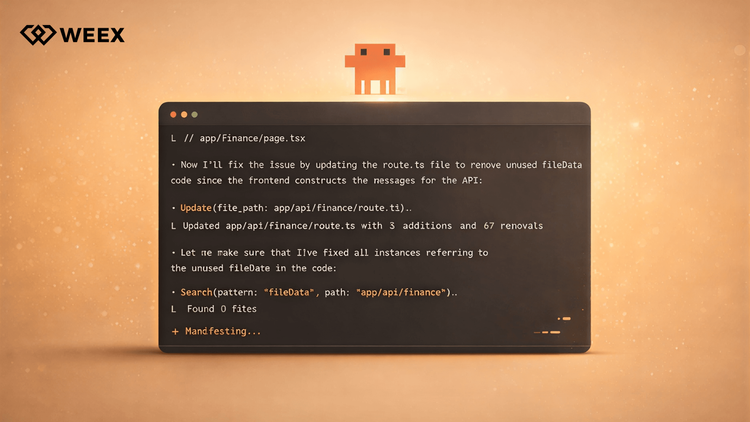
What Is Vibe Coding? How AI Is Changing Web3 & Crypto Development
What is vibe coding? Learn how AI coding tools are lowering the barrier to Web3 development and enabling anyone to build crypto applications.
The parent company of the New York Stock Exchange strategically invests in OKX: The intentions behind the $25 billion valuation

WEEX P2P update: Country/region restrictions for ad posting
To improve ad security and matching accuracy, WEEX P2P now allows advertisers to restrict who can trade with their ads based on country or region. Advertisers can select preferred counterparty locations for a safer, smoother trading experience.
I. Overview
When publishing P2P ads, advertisers can now set the following:
Allow only counterparties from selected countries or regions to trade with your ads.
With this feature, you can:
Target specific user groups more precisely.Reduce cross-region trading risks.Improve order matching quality.
II. Applicable scenarios
The following are some common scenarios:
Restrict payment methods: Limit orders to users in your country using supported local banks or wallets.Risk control: Avoid trading with users from high-risk regions.Operational strategy: Tailor ads to specific markets.
III. How to get started
On the ad posting page, find "Trading requirements":
Select "Trade with users from selected countries or regions only".Then select the countries or regions to add to the allowlist.Use the search box to quickly find a country or region.Once your settings are complete, submit the ad to apply the restrictions.
When an advertiser enables the "Country/Region Restriction" feature, users who do not meet the criteria will be blocked when placing an order and will see the following prompt:
If you encounter this issue when placing an order as a regular user, try the following solutions.
Choose another ad: Select ads that do not restrict your country/region, or ads that allow users from your location.Show local ads only: Prioritize ads available in the same country as your identity verification.
IV. Benefits
Compared with ads without country/region restrictions, this feature provides the following improvements.
Aspect
Improvement
Trading security
Reduces abnormal orders and fraud risk
Conversion efficiency
Matches ads with more relevant users
Order completion rate
Reduces failures caused by incompatible payment methods
V. FAQ
Q1: Why are some users not able to place orders on my ad?
A1: Their country or region may not be included in your allowlist.
Q2: Can I select multiple countries or regions when setting the restriction?
A2: Yes, multiple selections are supported.
Q3: Can I edit my published ads?
A3: Yes. You can edit your ad in the "My Ads" list. Changes will take effect immediately after saving.



 App
App