
- Buy Crypto
- Markets
 Futures
- Spot
- Copy Trade
- Earn
- More
Circle: Not Every Company Can Issue a Stablecoin

Original Article Title: The Stablecoin Trap: Issuing a Stablecoin Without the Infrastructure to Run One
Original Author: Kash Razzaghi, Circle
Translation: Peggy, BlockBeats
Editor's Note: With regulatory clarity and institutional entry, stablecoins are evolving from a technical tool into critical financial infrastructure. This article points out that issuing a stablecoin is not a simple technical choice but a long-term strategic decision involving trust, liquidity, and compliance capabilities. Most projects falter before achieving scale, naturally converging the market around a few mature networks. For most businesses, the real question is not "whether to issue a coin" but "how to effectively use a stablecoin to create growth opportunities for the business."
Below is the original article:
Over the past few months, I have repeatedly engaged in a familiar type of conversation with executives of some of the world's largest companies. They have shown a strong interest in stablecoins that enable near-instantaneous, cross-border transfer, such as digital dollars and euros like USDC and EURC. Many of them are also pondering: Should we issue our own stablecoin?
This impulse is understandable. This market has already reached a significant scale with sustained growth momentum. In 2025, the total market value of stablecoins increased from around $205 billion on January 1, 2025, to over $300 billion by December 31, 2025. USDC issued by Circle remains one of the core assets in this category, closing the year-end of 2025 with a market cap exceeding $75 billion.
But before truly entering the space, every business should first ask itself a question: Do you simply want to use a stablecoin for your business, or do you intend to genuinely engage in the "stablecoin issuance" business?
This is not a technical issue but a strategic one: Does issuing currency belong to the core of your business model?
Relatively speaking, creating a stablecoin on the blockchain is actually the easiest part. Essentially, it is merely a software engineering practice: to write and deploy a blockchain-based token contract. As long as there is an engineering team, or in some cases, with the help of white-label partners, a token can go live in a relatively short amount of time. However, once the product is operational, stablecoin operation means supporting a 24/7 financial infrastructure.
To operate a trusted, regulated stablecoin that can meet the expectations of institutions, regulators, and millions of users, real-time reserve management across different market cycles is necessary. This includes daily reconciliation with multiple banking partners, independent audits, and compliance and regulatory reporting across multiple jurisdictions. This requires building a round-the-clock compliance, risk management, fund management, and liquidity operation system with clear upgrade and contingency mechanisms under pressure scenarios with zero tolerance for errors. These capabilities are by no means something that can be "outsourced once and then ignored"; as scale grows, they continuously accumulate, amplify in cost, complexity, and reputational risk.
From a systemic perspective, each new closed-loop stablecoin further fragments liquidity and trust. Each issuer is duplicating efforts to build reserves, compliance systems, and redemption channels, weakening the stablecoin's overall depth and resilience in times of stress. In contrast, integrating with USDC from day one combines liquidity, standards, and operational capabilities into a widely adopted unified network.
For corporate executives evaluating this decision, the operational differences between these two paths become particularly clear:
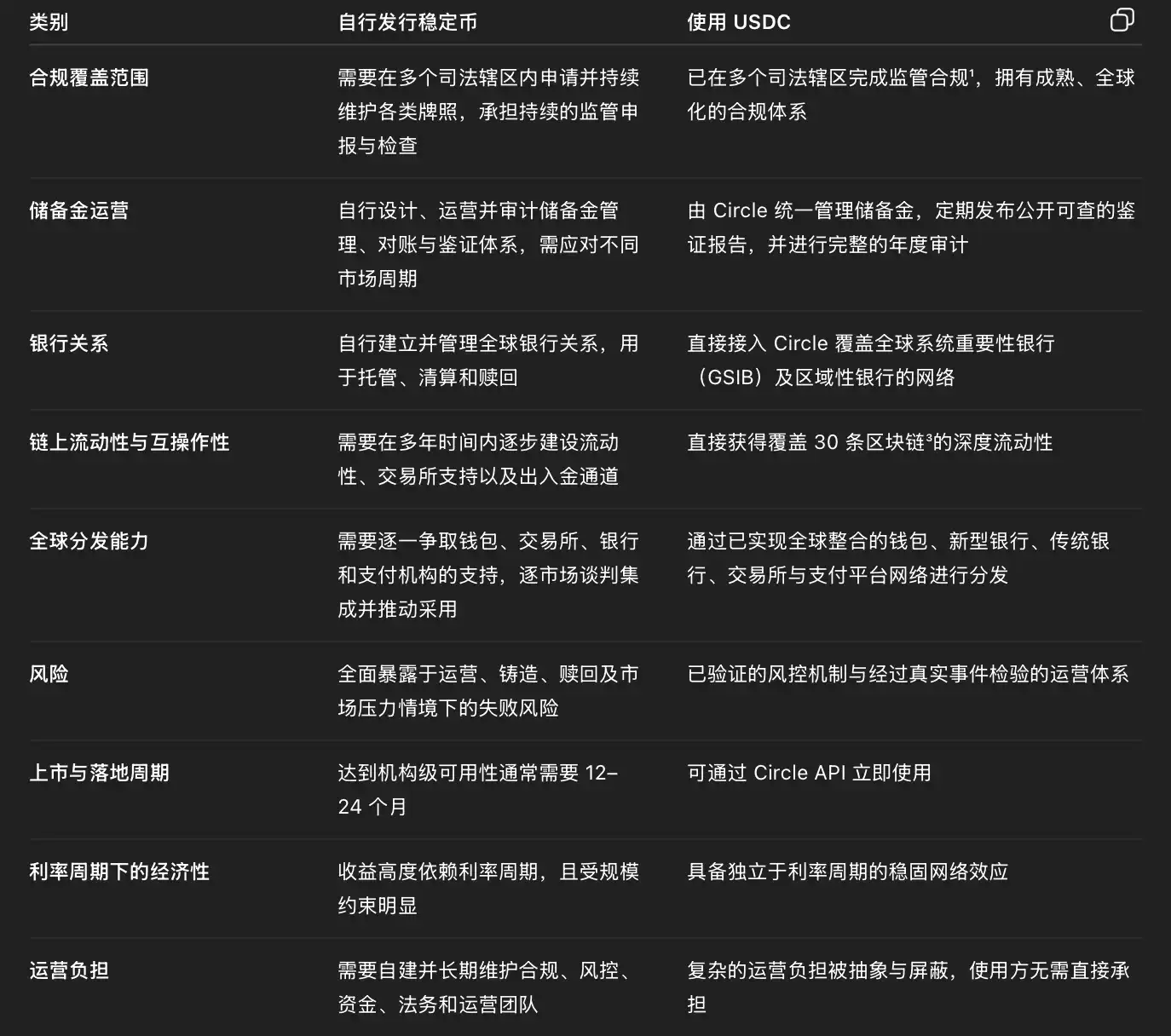
The Temptation of Shortcuts
Currently, from fintech companies, payment institutions to crypto projects, a large number of newcomers are exploring or directly launching their stablecoins. The growth of the stablecoin market in 2025 reflects both a gradually clearer regulatory environment and rising institutional interest. However, despite hundreds of stablecoin projects being launched, about 95% have never truly achieved persistent, global scale.
Some believe they can replicate the same economic returns without bearing heavy operational costs. The reality is not so romantic. Whether issuing on their own or through white-label services, you enter an industry where trust, liquidity, and scale are a matter of life and death.
Sometimes, the cost of mistakes is even measured in the "trillions." According to media reports earlier this year, a certain issuer accidentally minted $300 trillion in tokens due to an operational error. Although it was fixed within minutes, it was enough to make headlines. In another instance, a well-known stablecoin briefly depegged during a market volatility, once again illustrating that even small infrastructure flaws can be magnified and cascaded under pressure.
These events remind us that the ability of a stablecoin to hold its ground depends on operational rigor under high-pressure environments. Both the market and policymakers are closely watching.
Trust is the True Network Effect
Anyone can create a token on the blockchain. In fact, there are already thousands—most minted in minutes and just as quickly forgotten. Even in the stablecoin sub-market, with over 300 projects launched, only a handful truly carry almost all real-world usage and value; while the vast majority, about 95%, have never truly succeeded.
The difference lies not in technology but in scale and trust. The real challenge of stablecoins begins during the expansion phase: how to sustain liquidity, redemption, compliance, and system availability as transaction volumes grow across markets and cycles.
You can mint a token in minutes, but you can't mint trust in minutes. Trust comes from transparency, scale, and cross-market cycle consistency in redemption, accruing over time. This is why the stablecoin market ultimately consolidates in the hands of a few issuers — and why as of January 30, 2026, USDC has settled over $600 trillion in historical volume.
Instead of Reinventing the Wheel, Choose to Collaborate
For most businesses, the right question is not "How do we issue our stablecoin?" but "How do we integrate a stablecoin into our business to unlock new growth?"
With USDC and EURC, businesses can embed digital dollars and euros today, gaining near-instant settlement, global coverage, and cross-chain interoperability across dozens of blockchains without dealing with the complexity of reserve management and regulatory compliance.
Co-Writing the Next Chapter
The stablecoin industry is entering a new phase. Policymakers are setting clearer rules, institutions are raising their standards, and the market is gradually converging on a simple consensus: trust, liquidity, and compliance are the true moats.
The goal is not to have more stablecoins but to have fewer but better stablecoins — capable of meeting current needs with shared liquidity, transparent reserves, and cross-cycle verified performance.
For institutions crafting a stablecoin strategy, the first step should not be deciding "what to mint" but deciding "who to mint with." If you want to leverage stablecoins for your business without becoming a stablecoin issuer, the enduring choice is clear: talk to Circle, use USDC.
You may also like

US & Canada Crypto Tax Season 2026: Official Tax Reporting Support from WEEX × KoinX
Prepare for US & Canada crypto tax season 2026. Learn how to export your WEEX transaction history and access official reporting support through our partnership with KoinX.

Conversation between Tom Lee and "The Big Short" Author: AI has detected bubble signal, crypto correction due to gold liquidity being "siphoned off"

The true reason for Claude's ban, Kraken accessing the Federal Reserve payment system, What is the English community paying attention to?

「Buying the Dip」 of 400,000 BTC: Is $74,000 a Rebound or a Reversal?

OpenClaw, Another Batch of Middle Class Jobless

Morning News | Backpack will launch on-chain IPO subscription service; Predict.fun strategically acquires on-chain prediction platform Probable; SoFi partners with Mastercard for strategic cooperation

Inventorying the Washington power in the crypto space, who is speaking out for U.S. crypto legislation?

650 million dollars, 1.5 billion dollars, 2 billion dollars, the crypto VC landscape has changed!

Why prediction markets are the largest untapped collateral pool in DeFi

500% XAUT Staking, Zero-Fee Gold Futures and $100K Rewards: Why Traders Are Turning to WEEX for Tokenized Gold
Explore WEEX's $100,000+ gold campaign featuring 500% XAUT staking, zero-fee gold contracts, and $30,000 PAXG rewards. Trade tokenized gold today.

AI within artillery range
“The cloud” is a metaphor, but the data center isn’t.

March 4th Market Key Intelligence, How Much Did You Miss?

Taking Stock of Crypto's Washington Power Players: Who is Advocating for US Crypto Regulation?

DDC Enterprise Limited Announces 2025 Unaudited Preliminary Financial Performance: Record Revenue Achieved, Bitcoin Treasury Grows to 2183 Coins
On March 4, 2026, DDC Enterprise Limited (NYSE American: DDC) today announced preliminary, unaudited full-year financial performance for the year ended December 31, 2025. The company expects to achieve record revenue and record positive adjusted EBITDA, primarily driven by continued growth in its core consumer food business and overall margin improvement. The final audited financial report is expected to be released in mid-April 2026.
Revenue: Expected to be between $39 million and $41 million, reaching a new company high.
Organic Growth: Excluding the impact of the company's strategic contraction of its U.S. operations, core revenue is expected to grow 11% to 17% year over year.
Gross Profit Margin: Expected to be between 28% and 30%, reflecting continued operational efficiency improvements.
Adjusted EBITDA: The company expects to achieve a positive full-year result in 2025, a significant improvement from a $3.5 million loss in 2024, mainly due to rigorous cost controls and a higher-margin sales mix.
In 2025, DDC's core consumer food business maintained strong operational performance.
The company also disclosed Core Consumer Food Business Adjusted EBITDA, a metric that further excludes costs related to its Bitcoin reserve strategy and non-cash fair value adjustments related to its Bitcoin holdings from adjusted EBITDA to more accurately reflect the core business performance.
In 2025, Core Consumer Food Business Adjusted EBITDA is expected to be between $5.5 million and $6 million.
In the first half of 2025, DDC initiated a long-term Bitcoin accumulation strategy, holding Bitcoin as its primary reserve asset.
As of December 31, 2025: The company holds 1,183 BTC.
As of February 28, 2026: Holdings increased to 2,118 BTC
Today's additional purchase of 65 BTC brings the company's total holdings to 2,183 BTC
DDC Founder, Chairman, and CEO Norma Chu stated, "We are proud to have closed 2025 with record revenue and positive adjusted EBITDA, demonstrating the steady growth of the company's consumer food business and the ongoing improvement in profitability. We are building a disciplined, growth-oriented food platform and strategically allocating capital to Bitcoin assets with a long-term view, aligning with our core beliefs. We believe that this dual-track model of 'Steady Consumer Business + Strategic Bitcoin Reserve' will help DDC create lasting long-term value for shareholders."
For the full year 2025, the company defines "Adjusted EBITDA" (a non-GAAP financial measure) as: Net income / (loss) excluding the following items:· Interest expense· Taxes· Foreign exchange gains/losses· Long-lived asset impairment· Depreciation and amortization· Non-cash fair value changes related to financial instruments (including Bitcoin holdings)· Stock-based compensation
DDC Enterprise Limited (NYSE: DDC) is actively implementing its corporate Bitcoin Treasury strategy while continuing to strengthen its position as a leading global Asian food platform.
The company has established Bitcoin as a core reserve asset and is executing a prudent, long-oriented accumulation strategy. While expanding its portfolio of food brands, DDC is gradually becoming one of the public company pioneers in integrating Bitcoin into its corporate financial architecture.

Uncovering YZi Labs 229 Investment: Over 18% of the portfolio is already inactive, with an average project transparency score of 78

The business of crypto VC is becoming promising

China's AI Compute Power Counterstrike

Global Assets Plunge: Hormuz, Chips, and a South Korean Holiday
US & Canada Crypto Tax Season 2026: Official Tax Reporting Support from WEEX × KoinX
Prepare for US & Canada crypto tax season 2026. Learn how to export your WEEX transaction history and access official reporting support through our partnership with KoinX.


 App
App