
- Buy Crypto
- Markets
 Futures
- Spot
- Copy Trade
- Earn
- More
Cross-chain Collaboration: Tom Lee Invests $200 Million, Joins Forces with Global Top Streamer Mr. Beast

Original Title: "Global Top Streamer MrBeast, Becomes a Trump Card for Tom Lee"
Original Author: Seed.eth, Reposted by BitpushNews
$200 million, that's the figure just announced today.
BitMine Immersion Technologies (BMNR), chaired by Wall Street's renowned analyst Tom Lee, announced an investment to acquire a stake in the holding company behind global top streamer MrBeast, known as Beast Industries. Simultaneously, Beast Industries mentioned in an official statement that the company will explore how to "integrate DeFi into the upcoming financial services platform."
If you only read the news, this seems like another familiar cross-over: traditional, crypto, influencer, entrepreneurship. On one side, you have the YouTube powerhouse with over 4 billion cumulative subscriptions, where a single video can organically tip the algorithm in your favor. On the other side, you have the top stream analyst on Wall Street who excels in narrating the crypto story, adept at weaving blockchain's grand concepts into a balance sheet, making everything seem natural.

MrBeast's Journey Here
Looking back at MrBeast's early videos, it's hard to connect them to today's $5 billion valued Beast Industries.
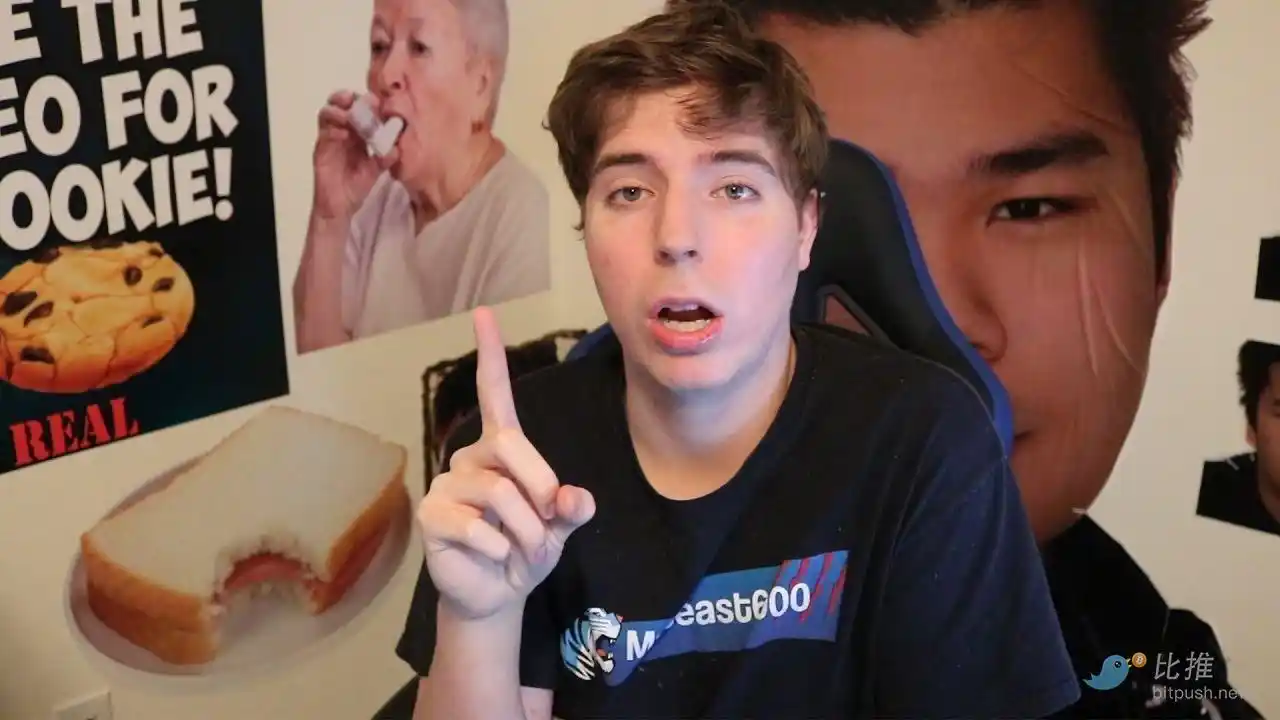
In 2017, shortly after graduating from high school, Jimmy Donaldson uploaded a video of himself counting from 1 to 100,000 consecutively for 44 hours - the "Counting to 100,000 Challenge!" The content was so simple to the point of being almost childish, with no plot, no edits, just one person facing the camera, repeating numbers over and over, yet it became the turning point of his content career.
At that time, he was not yet 19 years old, with channel subscriptions of only about 13,000. After the video was released, it quickly surpassed a million views, becoming the world's first phenomenal case of dissemination.
Later, in an interview, he recalled that time and said:
"I didn't actually want to be popular at the time; I just wanted to know if I was willing to devote all my time to something that no one else wanted to do, would the result be different."
Jimmy Donaldson successfully rose to fame, becoming the well-known MrBeast. But more importantly, from that moment on, he formed an almost obsessive belief: attention is not a gifted reward but something earned through effort and perseverance.
Running YouTube as a Business, Not a Creation Platform
Many creators, after gaining popularity, choose to "play it safe": reduce risk, increase efficiency, and turn content into a stable cash flow.
MrBeast chose the opposite path.
In multiple interviews, he repeatedly emphasized one thing:
"Most of the money I make is put into the next video."
This is the core of his business model.
By 2024, his main channel's subscriber count had exceeded 460 million, with total video views surpassing 100 billion. But behind this success is extremely high cost:
- The production cost of a single flagship video has been consistently between $3-5 million annually;
- Certain large-scale challenges or charity projects can cost over $10 million;
- His show "Beast Games" on Amazon Prime Video, he described the first season as "completely out of control" and admitted in interviews that it incurred losses of tens of millions of dollars.
When he made these statements, he showed no remorse:
"At this level, you can't save money and still expect to win."
This statement can almost be seen as the key to understanding Beast Industries.
Beast Industries: $4 Billion Annual Revenue, but Thin Profits
By 2024, MrBeast consolidated all his businesses under the name Beast Industries.
From publicly available information, this company has far exceeded the scope of a "creator's side hustle":
- Annual revenue exceeding $4 billion;
- Business spanning content production, fast-moving consumer goods retail, licensed merchandise, and tool products;
- After the latest round of funding, the market generally expects its valuation to be around $5 billion.
But it's far from easy.
MrBeast's YouTube main channel and Beast Games brought great exposure, but almost ate up all the profits.
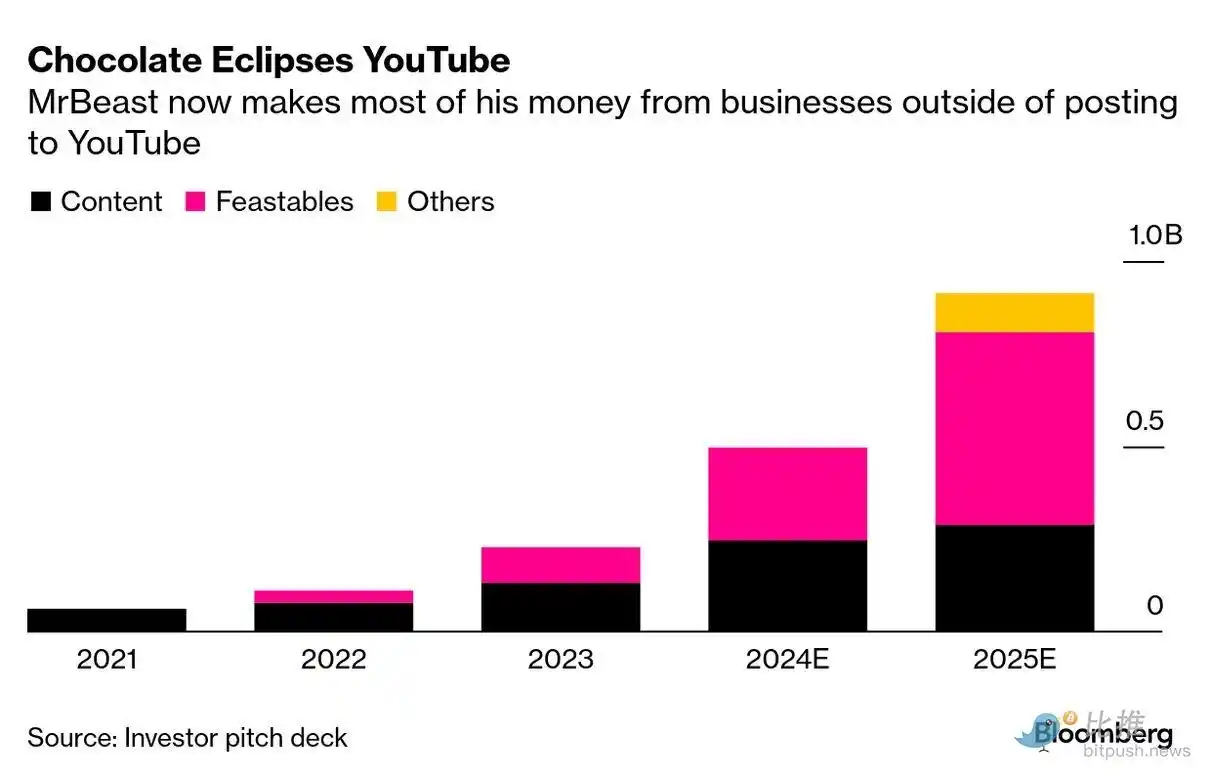
In stark contrast to the content is his chocolate brand, Feastables. Public data shows that in 2024 Feastables had sales of around $250 million, contributing over $20 million in profit. This marked Beast Industries' first stable, replicable cash flow business. By the end of 2025, Feastables had entered over 30,000 physical retail stores in North America (including Walmart, Target, 7-Eleven, etc.), covering the United States, Canada, and Mexico, significantly enhancing the brand's offline sales capabilities.
MrBeast has admitted on several occasions that the cost of video production is increasing, making it "increasingly hard to break even." However, he still insists on investing a large amount of funds into content production, as he sees it not simply as paying for videos but as buying traffic for the entire business ecosystem.
The core barrier of the chocolate business is not production but the ability to reach consumers. While other brands need to spend a fortune on advertising exposure, he just needs to release a video. Whether the video itself is profitable is no longer important. As long as Feastables continue to sell, this business loop will continue to operate.
“I'm Actually a Pauper”
In early 2026, MrBeast self-proclaimed himself a pauper in an interview with The Wall Street Journal, sparking discussions:
“I'm basically in a 'negative cash' state right now. They all say I'm a billionaire, but there's not much money in my bank account.”

This statement is not for show but a natural result of his business model.
MrBeast's wealth is highly concentrated in unlisted equity; although holding slightly over 50% of Beast Industries' shares, the company continues to expand with almost no dividends; he even deliberately avoids keeping cash.
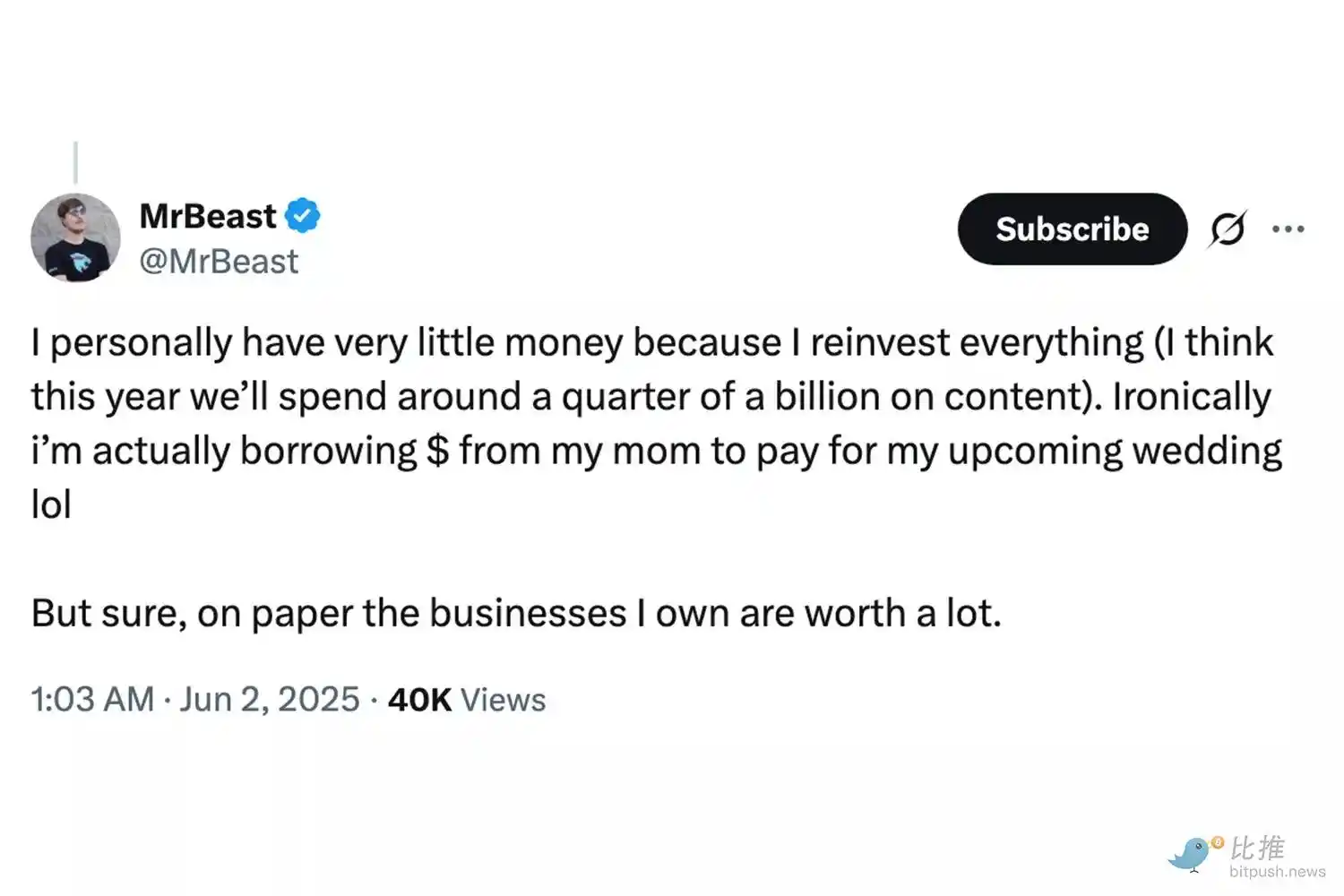
In June 2025, he confessed on social media that because he had put all his savings into video production, he even had to borrow money from his mother to pay for the wedding.
As he later put it more bluntly:
“I don’t look at my bank account balance — it would affect my decision-making.”
And his foray extended beyond content and consumer goods.
In fact, during the NFT boom of 2021, blockchain records show that he had bought and traded multiple CryptoPunks, some of which were sold for a price as high as 120 ETH each (equivalent to hundreds of thousands of dollars at the time).
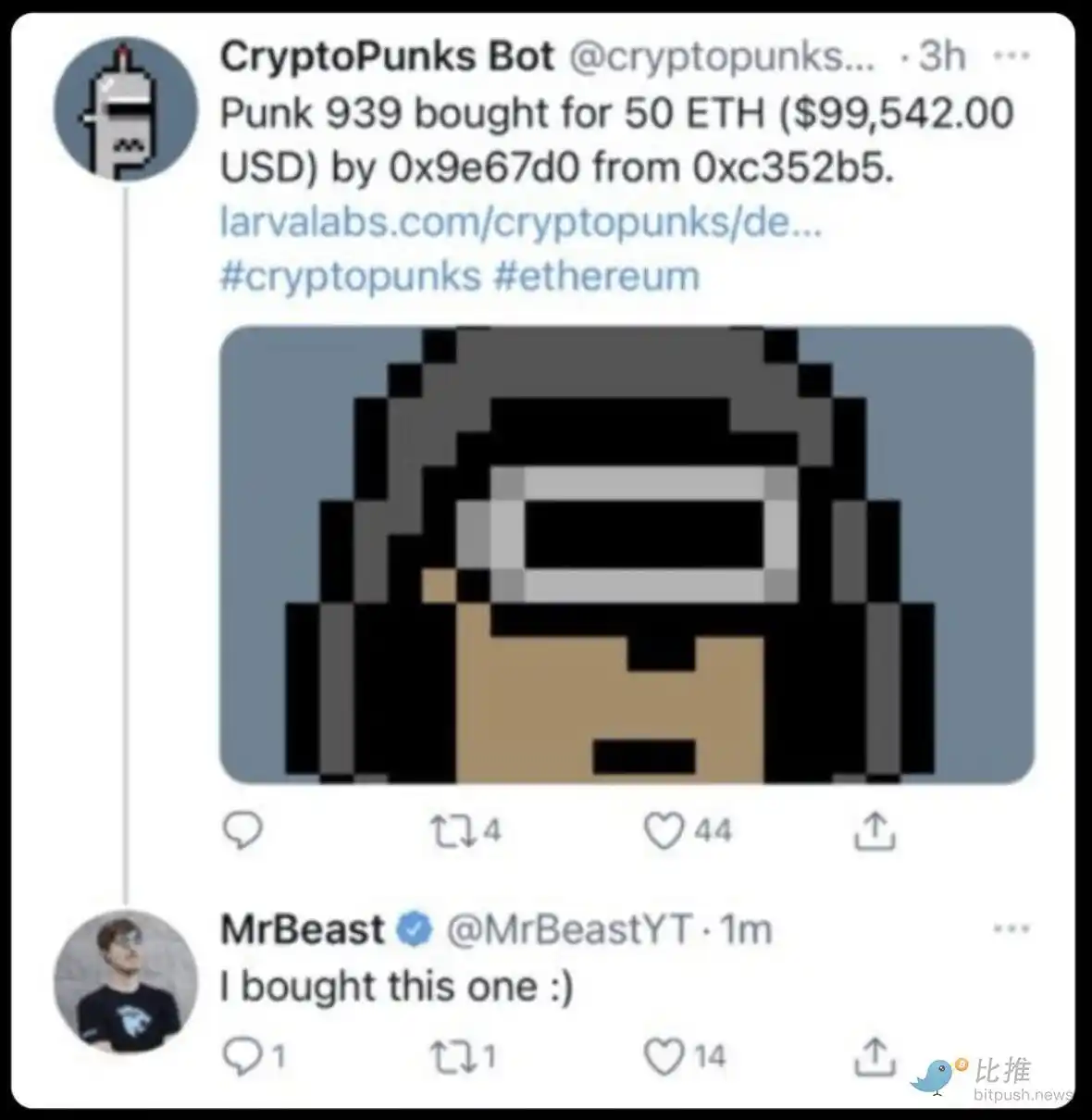
However, as the market entered a correction phase, his attitude shifted to caution.
The real turning point came when “Mr. Beast” himself found his business model reaching a critical juncture.
When one person holds the world’s top traffic funnel but has been in a prolonged state of high expenditure, cash flow strain, and expansion reliant on financing, finance stops being just an investment option and becomes a must-restructure infrastructure.
The proposition that Beast Industries internally debated in recent years gradually became clear: how to transform users from mere “content viewers and product buyers” to participants in a long-term, stable, and sustainable economic relationship?
This was precisely the direction that traditional internet platforms had been trying for years: payment systems, accounts, credit systems. And at this juncture, with the emergence of Tom Lee and BitMine Immersion (BMNR), this path led to a more structured possibility.
Teaming Up with Tom Lee to Build the Underlying DEFI
In Wall Street, Tom Lee has always played the role of a “narrative architect.” From early on explaining the value proposition of Bitcoin to emphasizing Ethereum’s strategic significance on a corporate balance sheet, he excels at translating technology trends into financial language. BMNR’s investment in Beast Industries is not a pursuit of internet celebrity hype but a bet on the programmable future of attention gateways.
So, what does DeFi mean in this context?
Current public information is extremely restrained: no issuance of a coin, no yield promises, and no fan-exclusive financial products. But the expression “integrating DeFi into a financial services platform” points to several possibilities:
- A lower-cost payment and settlement layer;
- A programmable account system for creators and fans;
- Asset record and ownership structure based on decentralized mechanisms.
The imaginative space is vast, but the challenges of reality are also clear. In the current market, whether it is a native DeFi project or a traditional institution exploring transformation, most have not yet truly established a sustainable model. If a differentiated path cannot be found in this intense competition, the complexity of financial operations may erode the core capital accumulated over many years: fan loyalty and trust. After all, he has publicly stated many times:
"If one day what I do harms the audience, then I would rather do nothing."
This statement may be repeatedly tested in every future financial attempt.
So, when the world's most powerful attention machine seriously begins to build financial infrastructure, will it become a new generation platform, or an "overly brave" cross-border move?
The answer will not be revealed quickly.
But one thing he understands better than anyone else: the greatest capital is not past glory, but the right to "start over."
After all, he is only 27 years old.
You may also like

Wall Street Shorts ETH: Vitalik is aware and has front-run, while Tom Lee remains oblivious

Social Capital CEO: How Equity Tokenization is Reshaping Capital Markets from US Stocks to SpaceX?

CoinGecko Report: Surge of 346% vs Dip of 20.8%, The Wild Rise of DEX

a16z: The Real Opportunity of Stablecoins Lies Not in Disruption but in Filling Gaps

Mining Exodus: Someone Holds $12.8 Billion AI Order

March 6 Market Key Intelligence, How Much Did You Miss?

a16z: The True Opportunity of Stablecoins is in Complementing, Not Disrupting

Predict LALIGA Matches, Shoot Daily & Win BTC, USDT and WXT on WEEX
The WEEX × LALIGA campaign brought together football excitement and crypto participation through a dynamic interactive experience. During the event, users predicted matches, completed trading tasks, and took daily shots to compete for rewards including BTC, USDT, WXT, and exclusive prizes.

Ray Dalio Dialogue: Why I'm Betting on Gold and Not Bitcoin

Who Took the Money in the AI Era? A Must-See Investment Checklist for HALO Asset Trading
Wall Street Bears Target Ethereum: Vitalik In the Know Takes Flight, Tom Lee Remains Bullish
Pump.fun Hacker Steals $2 Million, Receives 6-Year Prison Sentence, Opts for 'Self-Detonation'

6% Annual Percentage Yield as Musk Declares War on Traditional Banks
36 years, 4 wars, 1 script: How does capital price the world in conflict?

Mining Companies' Great Migration: Some Have Already Secured $12.8 Billion in AI Orders
What Is Vibe Coding? How AI Is Changing Web3 & Crypto Development
What is vibe coding? Learn how AI coding tools are lowering the barrier to Web3 development and enabling anyone to build crypto applications.
The parent company of the New York Stock Exchange strategically invests in OKX: The intentions behind the $25 billion valuation

WEEX P2P update: Country/region restrictions for ad posting
To improve ad security and matching accuracy, WEEX P2P now allows advertisers to restrict who can trade with their ads based on country or region. Advertisers can select preferred counterparty locations for a safer, smoother trading experience.
I. Overview
When publishing P2P ads, advertisers can now set the following:
Allow only counterparties from selected countries or regions to trade with your ads.
With this feature, you can:
Target specific user groups more precisely.Reduce cross-region trading risks.Improve order matching quality.
II. Applicable scenarios
The following are some common scenarios:
Restrict payment methods: Limit orders to users in your country using supported local banks or wallets.Risk control: Avoid trading with users from high-risk regions.Operational strategy: Tailor ads to specific markets.
III. How to get started
On the ad posting page, find "Trading requirements":
Select "Trade with users from selected countries or regions only".Then select the countries or regions to add to the allowlist.Use the search box to quickly find a country or region.Once your settings are complete, submit the ad to apply the restrictions.
When an advertiser enables the "Country/Region Restriction" feature, users who do not meet the criteria will be blocked when placing an order and will see the following prompt:
If you encounter this issue when placing an order as a regular user, try the following solutions.
Choose another ad: Select ads that do not restrict your country/region, or ads that allow users from your location.Show local ads only: Prioritize ads available in the same country as your identity verification.
IV. Benefits
Compared with ads without country/region restrictions, this feature provides the following improvements.
Aspect
Improvement
Trading security
Reduces abnormal orders and fraud risk
Conversion efficiency
Matches ads with more relevant users
Order completion rate
Reduces failures caused by incompatible payment methods
V. FAQ
Q1: Why are some users not able to place orders on my ad?
A1: Their country or region may not be included in your allowlist.
Q2: Can I select multiple countries or regions when setting the restriction?
A2: Yes, multiple selections are supported.
Q3: Can I edit my published ads?
A3: Yes. You can edit your ad in the "My Ads" list. Changes will take effect immediately after saving.


 App
App