Cryptocurrency Market Experiencing "Choppy Accumulation": XRP Bandwidth Indicator Dips Below Annual Threshold, Whale Holdings Movement Suggests Shift in Market Direction



Original Title: XRP Resembles a Compressed Spring Poised for a Significant Price Move as Key Volatility Indicator Mirrors 2024 Patterns
Original Author: Omkar Godbole
Original Translation: Daisy, Mars Finance
XRP resembles a compressed spring, ready for a significant price move, as a key volatility indicator mirrors patterns from 2024. A technical indicator based on standard deviation suggests XRP and BTC may be in for another round of intense volatility.
Key Points:
The price action of XRP and Bitcoin appears like a compressed spring, signaling a potential major price swing. The Bollinger Bandwidth of these two cryptocurrencies has dropped to the lowest level since October 2024, indicating a buildup of market energy. While a contracting Bollinger Band may suggest an uptrend, it could also precede a sell-off, as seen after the FTX crash in October 2022.
The price trajectories of XRP and Bitcoin (BTC) resemble a tightly compressed spring that could unleash energy and see a rebound at any moment.
This signal comes from a key volatility indicator—the Bollinger Bandwidth. Bollinger Bands are volatility ranges set based on an asset's 20-period moving average (SMA) with an upper and lower boundary of two standard deviations (±2σ). The bandwidth measures the space between these ranges as a percentage of the 20-day moving average.
On XRP's 4-hour candlestick chart (each candle representing 4 hours of price action), the Bollinger Bandwidth has narrowed to the lowest level since October 2024. The 4-hour candlestick is popular in the 24/7 cryptocurrency market, with traders often using it to analyze and predict short-term price movements. Bitcoin's 4-hour candlestick chart also shows a similar Bollinger Bandwidth pattern to XRP.
The long-standing market consensus is that a narrowing Bollinger Bandwidth (reflecting a period of market calm) is like a compressed spring, often signaling a significant market movement on the horizon.
During these periods of market calm, energy continues to accumulate, and once the direction is clear, it will be released dramatically, often leading to a sharp price increase or decrease. The sharp rise of XRP and Bitcoin in November to December 2023 occurred after a long period of sideways movement, with the Bollinger Bands narrowing to a level similar to the current one.
However, narrowing of the bands does not always signal a bullish trend; it can also precede a sell-off. For example, in October 2022, the Bollinger Bands narrowing foretold a significant volatility, and the subsequent FTX collapse caused a steep market decline.
It is currently uncertain whether this "spring compression" will trigger a bullish move or lead to a downward spiral for these two tokens. Federal Reserve Chairman Jerome Powell's recent hawkish comments and the sell-off behavior of some whales lean more towards the latter.
Stay vigilant!
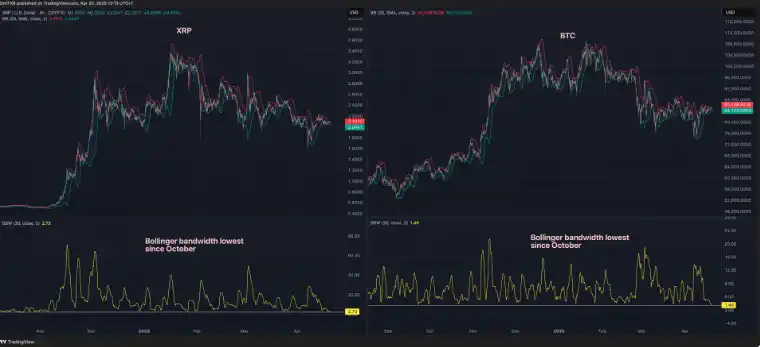
XRP and BTC with Bollinger bandwidth. (TradingView/CoinDesk)
You may also like
Blaming the desolation of the cryptocurrency world on the rise of AI is a form of intellectual laziness
The impact of OUSD on Circle, Tether, and Paxos: not a single negative factor, but a more complex reshaping of competition
A valuation of 8 billion dollars, doubling in 8 months! What makes the crypto-friendly bank Erebor Bank stand out?
340 billion valuation: Li Yanhong's largest IPO, a seat in Kunlunxin's shares is hard to come by
Stablecoins are the "royalists" of the crypto world: Open USD brings the old currency system into play
Cape Verde 2-3 Argentina: The Underdog Team That Stunned the World in Defeat
Cape Verde's run ended in a 3-2 defeat to Argentina, but their journey — three unbeaten draws, one heroic goalkeeper, and a fight that pushed the defending champions to the brink — is the kind of story markets recognize too: small caps can rattle blue chips long before anyone expects it.
Semiconductor stocks plummet, yet Anthropic wants to create a 2nm chip
Where is Zhao Changpeng's billion-dollar investment going? YZi Labs' investment landscape fully revealed
Ethereum Foundation Report: A Basic Guide to Ethereum for Governments and Financial Institutions
A pre-announced harvesting case: After the cryptocurrency price dropped by 99%, the public chain Saga exited to transform into AI
When American giants collectively "defect" from Chinese AI models
BIS Report Compliance Observation: The Real Risks of Stablecoins, Not Just "Depegging"
Portugal 2-1 Croatia: Ronaldo's 20-Year Knockout-Stage Drought Ends With a Debt Finally Collected
Portugal beat Croatia 2-1 in the 2026 global football championship's knockout rounds as Ronaldo scored his first-ever knockout-stage goal, Gonçalo Ramos struck a stoppage-time winner, and VAR ruled out a late equalizer for offside.
Bitcoin Price Prediction July 2026: Will BTC Recover to $70K or Drop Below $55K?
A South Korean company that learned the strategy of hoarding coins, from a bull market to delisting?
WEEX API Broker Program: Turn Your Trading Platform Into a Revenue Engine
How to choose between buying discounted ETH, Bitmine, and SharpLink?
Wosh: Inflation has cooled in recent weeks, AI is reshaping the economy, and forward guidance has lost its necessity
Blaming the desolation of the cryptocurrency world on the rise of AI is a form of intellectual laziness
The impact of OUSD on Circle, Tether, and Paxos: not a single negative factor, but a more complex reshaping of competition
A valuation of 8 billion dollars, doubling in 8 months! What makes the crypto-friendly bank Erebor Bank stand out?
340 billion valuation: Li Yanhong's largest IPO, a seat in Kunlunxin's shares is hard to come by
Stablecoins are the "royalists" of the crypto world: Open USD brings the old currency system into play
Cape Verde 2-3 Argentina: The Underdog Team That Stunned the World in Defeat
Cape Verde's run ended in a 3-2 defeat to Argentina, but their journey — three unbeaten draws, one heroic goalkeeper, and a fight that pushed the defending champions to the brink — is the kind of story markets recognize too: small caps can rattle blue chips long before anyone expects it.