Decentralized Discord? Will Towns' new a16z funding break the curse of on-chain social?





Original Article Title: "Decentralized Discord? Towns Receives Further Investment from a16z, Can It Break the On-Chain Social Curse?"
Original Article Author: 1912212.eth, Foresight News
On April 11, the Web3 social protocol Towns Protocol completed a $10 million Series B funding round, with a16z crypto leading the round. This round of funding was led by a16z crypto, with Coinbase Ventures participating for the first time, and Benchmark continuing to invest. Back in February 2023, Towns had already completed a $25.5 million Series A funding round, also led by a16z.
In the current crypto market downturn where funding in niche projects has almost disappeared and even funding in popular projects has significantly decreased, many funds are playing it safe and reluctant to invest. Why is a16z still betting on the underdog social track? What exactly does Towns bring to the table?
Real-Time Messaging App Open-Source Protocol
The Towns Protocol is an open-source protocol for building decentralized real-time messaging applications. It consists of an EVM-compatible L2 chain, decentralized off-chain flow nodes, deployed on Base. Towns allows users to create programmable communication use cases in a permissionless manner, referred to as Spaces. These Spaces are ownable, support on-chain subscriptions (membership), an extensible reputation system, and end-to-end message encryption.
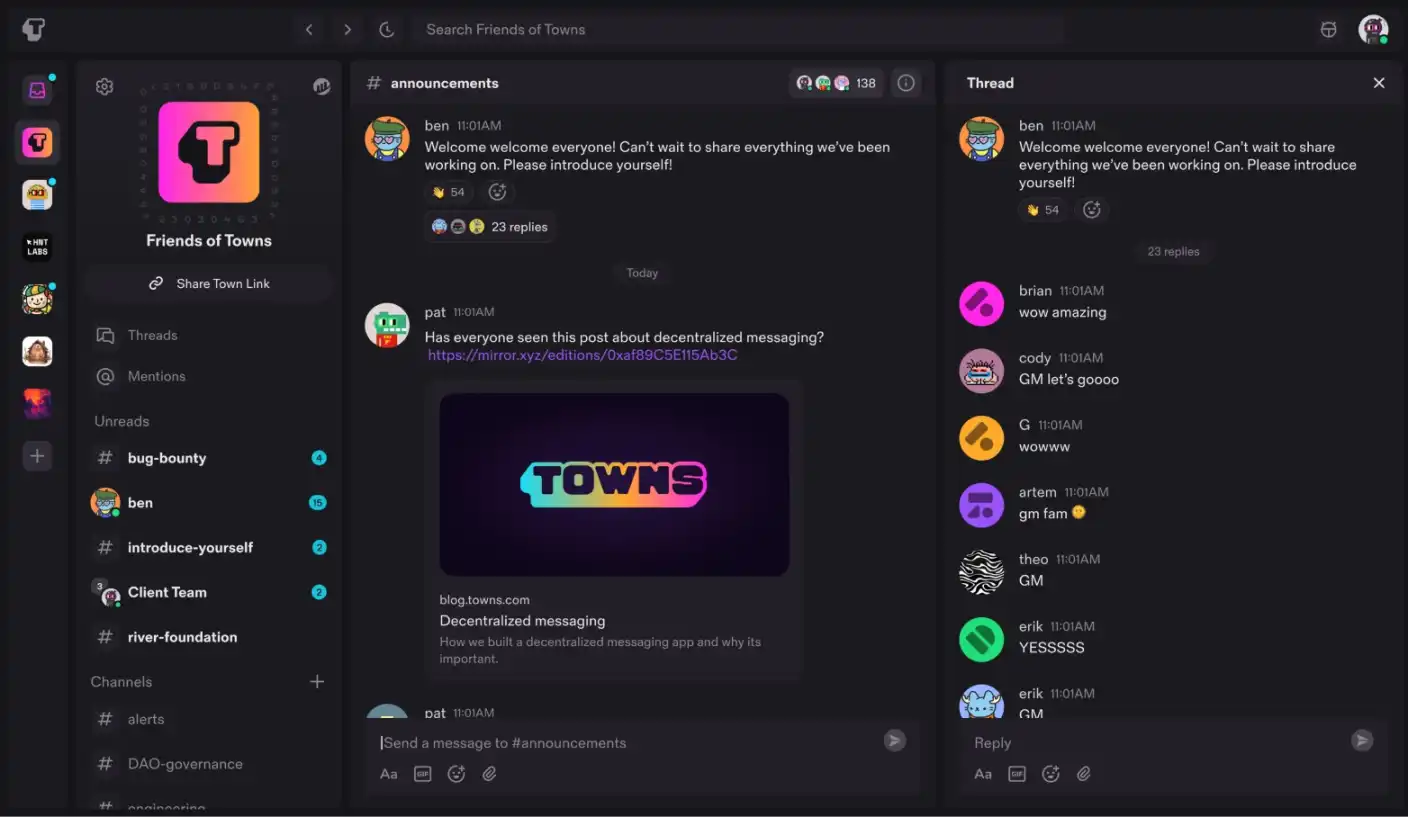
The Towns Protocol ecosystem aims to empower people to create, manage, and participate in digital communities in a secure and permissionless manner. Its primary goal is to provide a powerful, secure, and decentralized platform that gives people full control over their data, privacy, and interactions in these digital spaces while safeguarding their reputation.
The Towns Messaging Protocol is the core infrastructure for verifying and transmitting encrypted messages between users. It introduces an innovative approach to achieving secure, private group message delivery. The protocol is designed to seamlessly operate within blockchain infrastructure, leveraging the robustness of decentralized technology to provide a high-quality permissionless messaging experience.
Read/write access is protected on Base, allowing Towns to make trade-offs in liveliness, enabling it to send messages to thousands of participants at a speed comparable to existing centralized social networks. The Towns Protocol was initially built for a broad chat application scenario, including the chat business logic, but in the future, the protocol will be abstracted to serve as the foundational layer for any form of encrypted message delivery use case.
What Are the Key Features?
The Towns ecosystem consists of three main components. Firstly, the Towns Chain, a Layer 2 blockchain solution (built on OP-Stack) that serves as the foundation of the Towns Messaging Protocol, providing a consensus mechanism and security. Secondly, the Flow Nodes, responsible for managing message flow within the protocol, handling tasks such as message validation, storage, and encryption. And thirdly, the Permission Management, used to oversee user permissions and access control within the space, ensuring the security and organization of the communication environment.
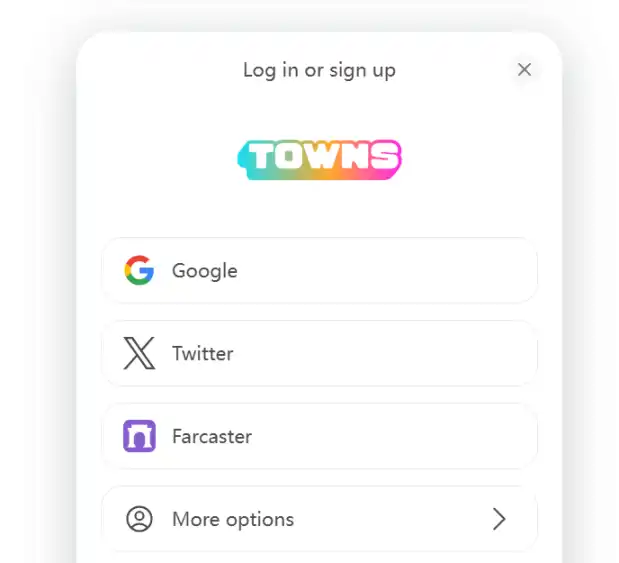
Its interface style is similar to Discord, but Towns has its own unique features. Its login interface supports Google and Twitter accounts and even includes integration with competitors like Farcaster, eliminating the need for a native wallet.
An Application Chain Designed for Social Networking
The Towns Protocol is an application chain designed specifically for social networking, protecting read/write permissions on Base. The application chain can make trade-offs in terms of liveliness, allowing it to quickly send messages to thousands of participants, similar to existing centralized social networks.
Ownable Communication Space
Space creators truly own the spaces they create, which exist as on-chain assets.
Programmable Space
Spaces are deployed on-chain via a programmable interface, allowing for custom rules such as who can read/write and integration with any other EVM-compatible external contract.
On-Chain Membership with Built-in Protocol Fees
Users need to hold a valid membership token to send and receive messages within a space. The membership pricing includes protocol fees to cover network operating costs.
On-Chain Social Graph
Membership tokens and spaces can be discovered on-chain, forming a transparent social network structure.
Scalable Reputation System
Towns' communication spaces are programmable, allowing members to maintain reputation scores specific to a space peer-to-peer, which can be discovered on-chain.
End-to-End Encrypted Messaging
Ensures secure and private communication through advanced encryption technology, protecting the security of messages between the sender and authorized users.
Tokenomics
As per its official documentation, the Towns token is deployed on the Ethereum mainnet with an initial token supply of 10 billion tokens. The Towns token serves multiple purposes within the Towns Protocol ecosystem, including delegation to node operators, space address delegation, and participation in governance.
The Towns token can be delegated to node operators, who are a critical part of the network operation. To receive DAO approval and commence operations, node operators must obtain a minimum token delegation to ensure they have sufficient vested interest in the success and security of the network. Token delegation can point directly to a node operator's address or to any valid space address within the network. The space can then redirect the delegated tokens received to specific node operators, providing flexibility in delegation strategies. Apart from its role in delegation and network operation, the Towns token also plays a significant role in Towns DAO governance. Token holders can participate in the decision-making process, influencing the direction and policies of the DAO.
Concerning the inflation mechanism, the Towns token has an initial annual inflation rate of 8%, set to linearly decrease over 20 years to eventually reach a 2% inflation rate. Inflation rewards are distributed evenly among all active node operators at the end of each period, which occurs biweekly. Therefore, the biweekly allocation of inflation rewards is calculated using the following formula: (annual inflation rate / 26).
Regarding reward distribution fees, each node operator has the autonomy to set the percentage fee for their services. This fee is deducted from the total inflation reward for that operator's node. After deducting the node operator's fee, the remaining inflation reward is proportionally distributed to the operator's delegators. Towns will also introduce its staking feature in the future.
Currently, Towns has not disclosed any information regarding airdrops.
Summary
The CEO of Towns Protocol is Ben Rubin. He is an experienced entrepreneur, having been the co-founder and CEO of the popular video social networking app Houseparty and the live streaming app Meerkat.

(Rubin as the Middleman)
Rubin is known for his achievements in building innovative online communities and real-time communication tools, with his career focusing on enhancing user connection and interaction through technology.
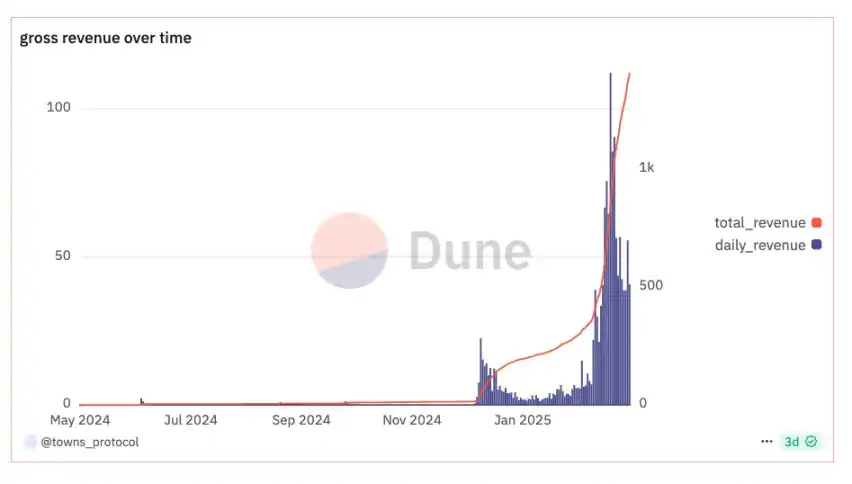
According to his official introduction, Towns currently has nearly 1 million members, with consumer spending through spatial conversations exceeding $500,000. Its protocol revenue has also been steadily growing since the beginning of this year.
The Web3 social track has witnessed numerous protocols' meteoric rises and falls—they have dazzlingly debuted with promises to disrupt the status quo, only to quickly fade away due to technical bottlenecks, user attrition, or ecosystem insularity. In the midst of a sluggish crypto market, how to attract more users to create and join group chats, and how to incentivize user retention, remain real challenges that social protocols have to face.
You may also like
BIS Report Compliance Observation: The Real Risks of Stablecoins, Not Just "Depegging"
When American giants collectively "defect" from Chinese AI models
A pre-announced harvesting case: After the cryptocurrency price dropped by 99%, the public chain Saga exited to transform into AI
Ethereum Foundation Report: A Basic Guide to Ethereum for Governments and Financial Institutions
Portugal 2-1 Croatia: Ronaldo's 20-Year Knockout-Stage Drought Ends With a Debt Finally Collected
Portugal beat Croatia 2-1 in the 2026 global football championship's knockout rounds as Ronaldo scored his first-ever knockout-stage goal, Gonçalo Ramos struck a stoppage-time winner, and VAR ruled out a late equalizer for offside.
Bitcoin Price Prediction July 2026: Will BTC Recover to $70K or Drop Below $55K?
A South Korean company that learned the strategy of hoarding coins, from a bull market to delisting?
Where is Zhao Changpeng's billion-dollar investment going? YZi Labs' investment landscape fully revealed
Semiconductor stocks plummet, yet Anthropic wants to create a 2nm chip
WEEX API Broker Program: Turn Your Trading Platform Into a Revenue Engine
How to choose between buying discounted ETH, Bitmine, and SharpLink?
Do you want to buy CRCL?
Wosh: Inflation has cooled in recent weeks, AI is reshaping the economy, and forward guidance has lost its necessity
The most secretive AI winner
Looking at Stripe's ambitions and the future of stablecoins from OUSD
From Pump.fun to Collector Crypt: Has Solana's income throne changed hands?
Dan Bin's latest speech: Don't miss out on a great era
Robinhood launches its own blockchain, no longer wanting to be a tenant on others' chains
BIS Report Compliance Observation: The Real Risks of Stablecoins, Not Just "Depegging"
When American giants collectively "defect" from Chinese AI models
A pre-announced harvesting case: After the cryptocurrency price dropped by 99%, the public chain Saga exited to transform into AI
Ethereum Foundation Report: A Basic Guide to Ethereum for Governments and Financial Institutions
Portugal 2-1 Croatia: Ronaldo's 20-Year Knockout-Stage Drought Ends With a Debt Finally Collected
Portugal beat Croatia 2-1 in the 2026 global football championship's knockout rounds as Ronaldo scored his first-ever knockout-stage goal, Gonçalo Ramos struck a stoppage-time winner, and VAR ruled out a late equalizer for offside.
Bitcoin Price Prediction July 2026: Will BTC Recover to $70K or Drop Below $55K?