
- Buy Crypto
- Markets
 Futures
- Spot
- Copy Trade
- Earn
- More
Delphi Digital's Top 10 Predictions for 2026: Perp DEX Eats Wall Street, AI Agents Usher in Era of Autonomous Trading

Original Title: 10 Predictions for 2026
Original Source: Delphi Digital
Original Translation: Plain Blockchain
Perpetual Decentralized Exchange (Perp DEXs) will become the new Wall Street, AI Agents will achieve autonomous trading, and trading platforms will evolve into "super apps." Here are the core predictions from the report:
1. AI Agents Begin Autonomous Trading
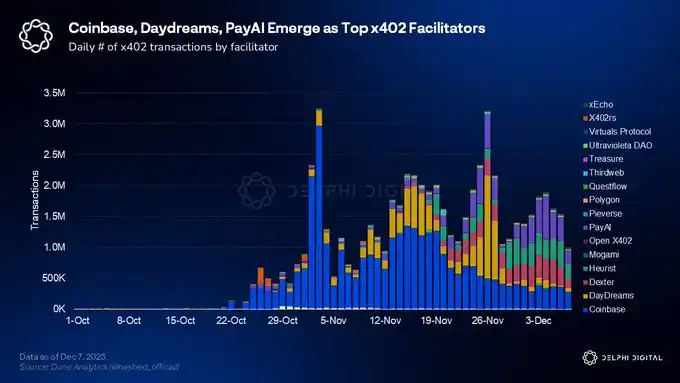
The x402 protocol allows any API to set access permissions through cryptocurrency payments. When an AI Agent needs a service, it can make instant payments with stablecoins, consume a shopping cart, or subscribe. The ERC-8004 standard increases trust by establishing reputation (including performance history and staking collateral). The combination of these two forms the autonomous agent economy. Users can delegate travel plans, and the AI Agent will automatically subcontract to miner search agents, complete data fees through x402 payments, and book on-chain tickets, all without human intervention.
2. Perp DEXs Swallow Traditional Finance
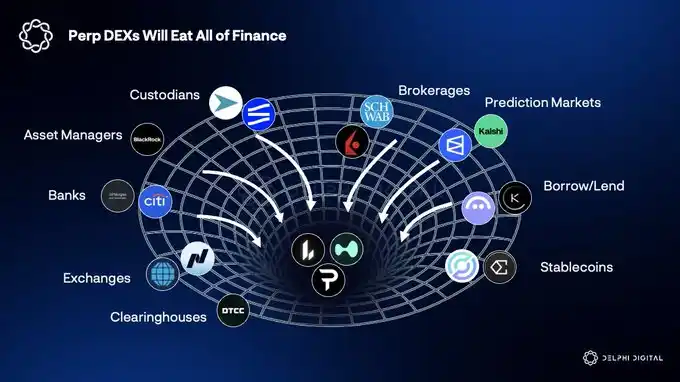
Traditional finance is expensive due to fragmentation: trading on exchanges, settling in New York, and custody in banks. Blockchain will compress all of this into a single smart contract. Hyperliquid is currently building the restructuring feature. Perp DEXs may simultaneously act as a merchant, exchange, custodian, bank, and Manhattan Exchange. Dockyards such as Aster_DEX, Lighter_xyz, and paradex are rapidly catching up.
3. Prediction Markets Upgrade to Traditional Financial Infrastructure

Interactive Brokers (IBKR) Chairman Thomas Peterffy sees prediction markets as a real-time information layer for portfolios. Early demand focused on weather consistency in energy, logistics, and insurance risks. 2026 will usher in new categories: stock event markets for financial performance, macro value indicator markets like CPI and Fed decisions, and cross-asset relative markets. Traders holding Tokenized Apple (AAPL) stock can hedge earnings risks with simple binary contracts or engage in complex options. Prediction markets will become tier-one derivatives.
4. Ecosystem Recaptures Stablecoin Issuer Revenue
Last year, Coinbase alone earned over $900 million in USDC reserve revenue through the issuance channel. Public blockchains like Solana, BSC, and Arbitrum generate approximately $800 million in total annual fees, yet have over $30 billion of idle USDC and USDT locked up on their networks. This trend is shifting. Hyperliquid secured USDH reserve revenue through bidding. Ethena's "Stablecoin Instant Service" model is being adopted by Sui, MegaETH, and Jupiter. The specific flow of lost revenue back to the issuer is being reclaimed by platforms creating demand.
5. DeFi Cracks Undercollateralized Borrowing
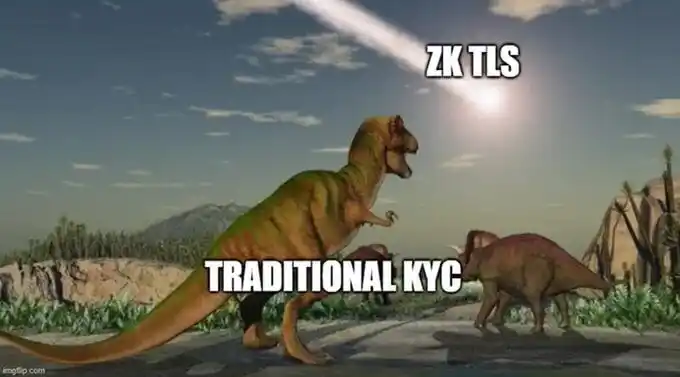
While DeFi borrowing protocols have massive Total Value Locked (TVL), almost all require overcollateralization. zkTLS (Zero-Knowledge Transport Layer Security) is the breakthrough: users can prove they have sufficient bank balance without revealing identity accounts. 3jane offers instant USDC undercollateralized credit based on verified Web2 financial data and dynamically adjusts interest rates through real-time monitoring. This framework can also provide direct funding based on AI agent performance history (credit score). Maple Finance, Centrifuge, and USDai have been at the forefront in this area. 2026 will be the year undercollateralized debt shifts from experiments to infrastructure.
6. Onchain FX Seeks Product-Market Fit
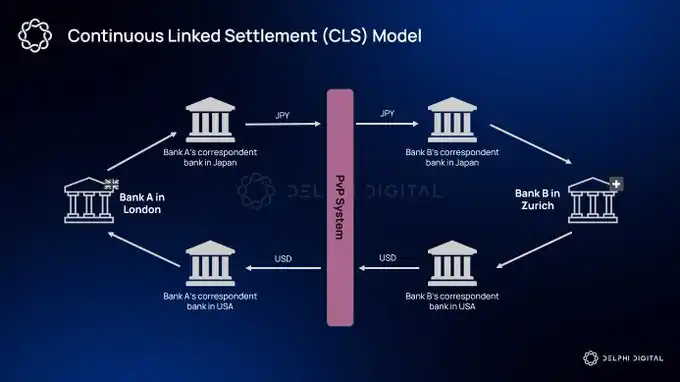
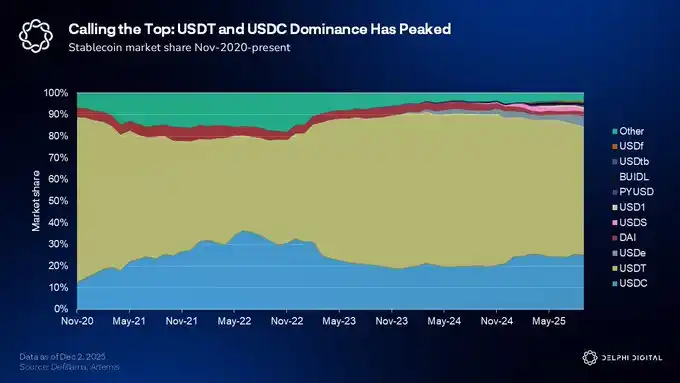
USD stablecoins represent 99.7% of the supply, but this may be the peak of their dominance. The traditional forex market is massive but riddled with frictions, leading to low settlement efficiency. Onchain FX eliminates intermediaries by tokenizing all currencies as on-chain assets, paving the way for emerging market currency pairs to thrive, as traditional forex there is most expensive and inefficient. These overlooked areas are where cryptocurrency demonstrates its most significant value proposition.
7. Gold and Bitcoin Lead the Currency Debasement Trade
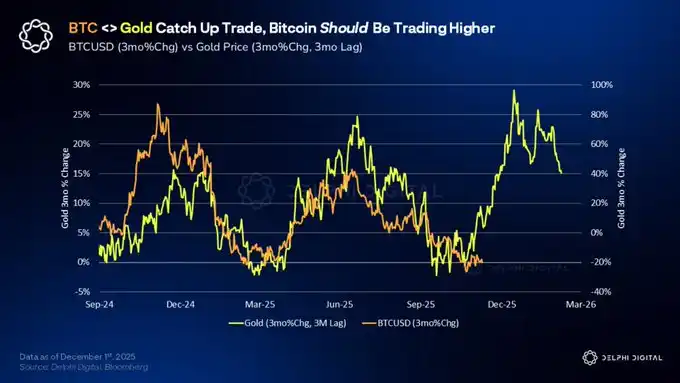
Gold, after being bullish, surged by 60%. Despite gold hitting an all-time high, central banks around the world still bought over 600 tons. The macro background supports continued strength: global interest rate cuts, ongoing fiscal deficits, and global M2 hitting an all-time high. Gold usually outperforms Bitcoin by three to four months. With devaluation becoming a key theme around 2026, both gold and Bitcoin will attract safe haven inflows.
8. Trading Platforms Evolve into "Super Apps" (Everything Apps)
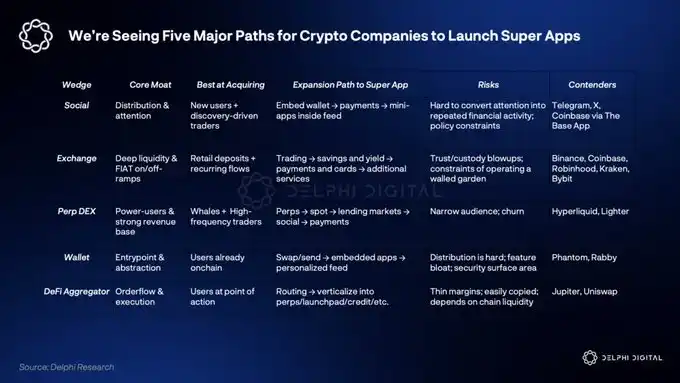
Coinbase, Robinhood, Binance, and Kraken no longer function solely as trading platforms. Coinbase acts as the platform, Base App as the interface, and USDC provides revenue supplementation. Robinhood's Gold members grew by 77%, becoming a retention engine. Binance has over 270 million users, with a payment volume of $250 billion. As the cost of decentralization decreases, platforms with users will gain the most value. In 2026, winners will start to pull away.
9. Privacy Infrastructure Catching Up with Market Demand
Privacy is under immense pressure: the EU passed the "Chat Control Act," and cash transactions are limited to €10,000. Privacy infrastructure is on the rise. payy_link launches a private encryption card, SeismicSys offers protocol-level encryption for fintech, and KeetaNetwork achieves anonymous KYC. If there is no public payment track, stablecoin adoption will reach mass awareness.
10. Altcoins Embrace Decentralization (Non-Uniform Rise)
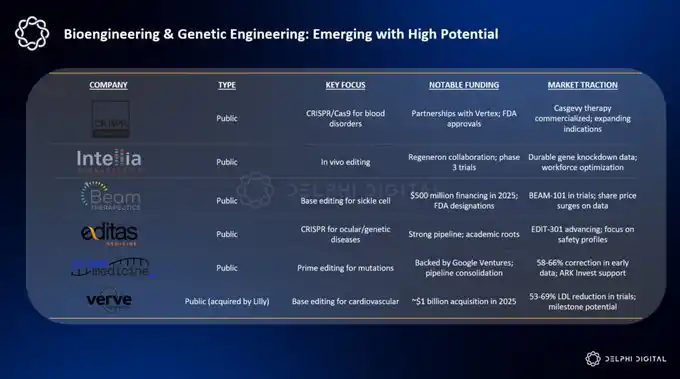
The "uniform rise" bull market will not return. Over $30 billion in token unlocks are pausing at the top and facing competition from AI, robotics, and biotech funding. Capital will flock to structural demand: tokens with ETF inflows, protocols with real income and buybacks, and applications with clear product-market fit. Winners will focus on teams that have built moats in real economic activities.
Conclusion
Cryptocurrency is entering a new phase: institutionalization has arrived. Prediction markets, on-chain lending, agent-based economics, and stablecoin infrastructure represent a true paradigm shift. Cryptocurrency is becoming the infrastructure layer of the global financial system.
You may also like

Wall Street Shorts ETH: Vitalik is aware and has front-run, while Tom Lee remains oblivious

Social Capital CEO: How Equity Tokenization is Reshaping Capital Markets from US Stocks to SpaceX?

CoinGecko Report: Surge of 346% vs Dip of 20.8%, The Wild Rise of DEX

a16z: The Real Opportunity of Stablecoins Lies Not in Disruption but in Filling Gaps

Mining Exodus: Someone Holds $12.8 Billion AI Order

March 6 Market Key Intelligence, How Much Did You Miss?

a16z: The True Opportunity of Stablecoins is in Complementing, Not Disrupting

Predict LALIGA Matches, Shoot Daily & Win BTC, USDT and WXT on WEEX
The WEEX × LALIGA campaign brought together football excitement and crypto participation through a dynamic interactive experience. During the event, users predicted matches, completed trading tasks, and took daily shots to compete for rewards including BTC, USDT, WXT, and exclusive prizes.

Ray Dalio Dialogue: Why I'm Betting on Gold and Not Bitcoin

Who Took the Money in the AI Era? A Must-See Investment Checklist for HALO Asset Trading
Wall Street Bears Target Ethereum: Vitalik In the Know Takes Flight, Tom Lee Remains Bullish
Pump.fun Hacker Steals $2 Million, Receives 6-Year Prison Sentence, Opts for 'Self-Detonation'

6% Annual Percentage Yield as Musk Declares War on Traditional Banks
36 years, 4 wars, 1 script: How does capital price the world in conflict?

Mining Companies' Great Migration: Some Have Already Secured $12.8 Billion in AI Orders
What Is Vibe Coding? How AI Is Changing Web3 & Crypto Development
What is vibe coding? Learn how AI coding tools are lowering the barrier to Web3 development and enabling anyone to build crypto applications.
The parent company of the New York Stock Exchange strategically invests in OKX: The intentions behind the $25 billion valuation

WEEX P2P update: Country/region restrictions for ad posting
To improve ad security and matching accuracy, WEEX P2P now allows advertisers to restrict who can trade with their ads based on country or region. Advertisers can select preferred counterparty locations for a safer, smoother trading experience.
I. Overview
When publishing P2P ads, advertisers can now set the following:
Allow only counterparties from selected countries or regions to trade with your ads.
With this feature, you can:
Target specific user groups more precisely.Reduce cross-region trading risks.Improve order matching quality.
II. Applicable scenarios
The following are some common scenarios:
Restrict payment methods: Limit orders to users in your country using supported local banks or wallets.Risk control: Avoid trading with users from high-risk regions.Operational strategy: Tailor ads to specific markets.
III. How to get started
On the ad posting page, find "Trading requirements":
Select "Trade with users from selected countries or regions only".Then select the countries or regions to add to the allowlist.Use the search box to quickly find a country or region.Once your settings are complete, submit the ad to apply the restrictions.
When an advertiser enables the "Country/Region Restriction" feature, users who do not meet the criteria will be blocked when placing an order and will see the following prompt:
If you encounter this issue when placing an order as a regular user, try the following solutions.
Choose another ad: Select ads that do not restrict your country/region, or ads that allow users from your location.Show local ads only: Prioritize ads available in the same country as your identity verification.
IV. Benefits
Compared with ads without country/region restrictions, this feature provides the following improvements.
Aspect
Improvement
Trading security
Reduces abnormal orders and fraud risk
Conversion efficiency
Matches ads with more relevant users
Order completion rate
Reduces failures caused by incompatible payment methods
V. FAQ
Q1: Why are some users not able to place orders on my ad?
A1: Their country or region may not be included in your allowlist.
Q2: Can I select multiple countries or regions when setting the restriction?
A2: Yes, multiple selections are supported.
Q3: Can I edit my published ads?
A3: Yes. You can edit your ad in the "My Ads" list. Changes will take effect immediately after saving.


 App
App