
Doubling in a single day won't make up for a 98% crash - Did Parcl's 'Polymarket Story' Hold Up?

Original Title: "Hard to Conceal 98% Plummet Even with Daily Doubling, Polymarket Won't Be Parcl's Lifesaver"
Original Author: Sanqing, Foresight News
On January 5th, the real estate RWA protocol Parcl partnered with the prediction market giant Polymarket. This collaboration will introduce Parcl's daily house price index to Polymarket's newly launched real estate prediction market series. The two parties will introduce prediction products centered around the housing market, with settlement based on Parcl's published house price index.

Image - Parcl Twitter Announcement of Partnership with Polymarket (Translated)
Polymarket will be responsible for listing and operating the market, while Parcl will provide independent index data. Encouraged by this news, the PRCL token showed strong performance on the day. According to Bitget's market data, PRCL reached a daily high of 0.05217 USDT, marking a 94.21% daily increase, with an intraday peak increase of approximately 138%.
The Lingering "Airdrop Fiasco"
For many long-time users, the name Parcl is associated with "betrayal." Despite the project team stating in their technical papers that their mission was to "break the asymmetry of real estate data and empower users," the token issuance in April 2024 became a turning point in community trust.
After a long-running point system activity, PRCL opened below the listing price, and in the following days, over $120 million was withdrawn from the protocol, leading to a TVL drop of over 60%.
Over time, Parcl's token performance has been significantly disconnected from its narrative, with the PRCL token price falling below $0.02 by the end of 2025, a drop of approximately 97.6% from the April 2024 peak of $0.737.
Now, it is attempting to "whitewash" its identity through a partnership with Polymarket, rebranding itself as a high-quality real estate data platform and oracle.
Is the Daily Updated House Price Index Genuine?
Parcl's selling point is its House Price Index published by Parcl Labs, providing "daily updated" city-level house price data. In its whitepaper, Parcl claims that its data has a high correlation of 0.98 with the traditional Case-Shiller index.
Lack of Transparency in Data Source. The team emphasizes a 24/7 operational data retrieval process to maintain a high-quality, real-time real estate data ecosystem. However, the specific details of original data providers and weighting are not disclosed in the documentation.
Reliance of Data Source on Listing Information. Parcl's real-time nature relies heavily on active listing information rather than just sales transactions.
Listed prices often reflect seller optimism, usually higher than the actual transaction price. This data structure may cause the index to appear more aggressive during market upswings or exhibit larger fluctuations during volatile periods.
Lack of Independent Validation and Institutional Endorsement. While Parcl has outlier filtering mechanisms (such as sampling only the 35th to 65th percentiles), the daily update mechanism is heavily reliant on real-time input of massive amounts of data.
Compared to widely referenced indices like the Case-Shiller Index used by institutions such as the Federal Reserve, Parcl currently relies mainly on self-attestation and endorsements from partners.
Low Transaction Activity
Internal Platform Data: Based on the platform's records over the past six months, only a few markets have transaction volumes in the millions: namely Austin (12.95M), Chicago (3.85M), Miami Beach (2.94M), and Brooklyn (2.2M).
However, most markets have holdings below ten thousand dollars, with only a few maintaining levels in the hundreds of thousands, such as Austin at 321K, Brooklyn at 360K, and Chicago peaking at around 950K.
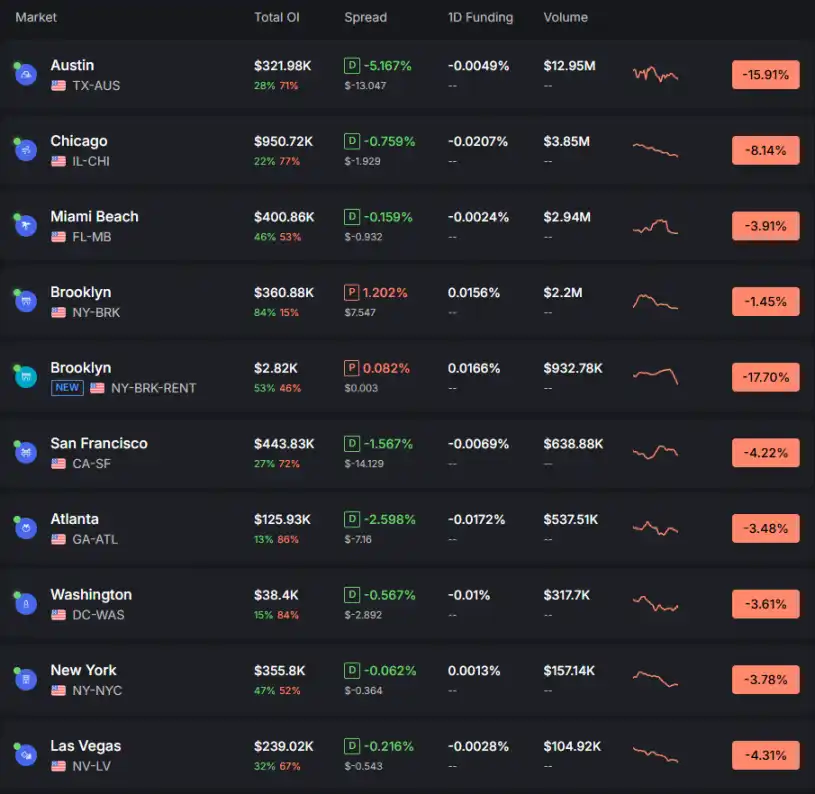
Figure - Top 10 Markets by Transaction Volume in the Past Six Months on Parcl
Polymarket Market Performance: Polymarket has currently launched six real estate prediction markets, including Los Angeles, San Francisco, Austin, Miami, New York, and a nationwide U.S. market.
Despite leveraging Polymarket's significant platform traffic, actual engagement is very low. The market with the highest volume currently is San Francisco, with a transaction volume of only about 11K at the time of writing, while other market transactions are even quieter.
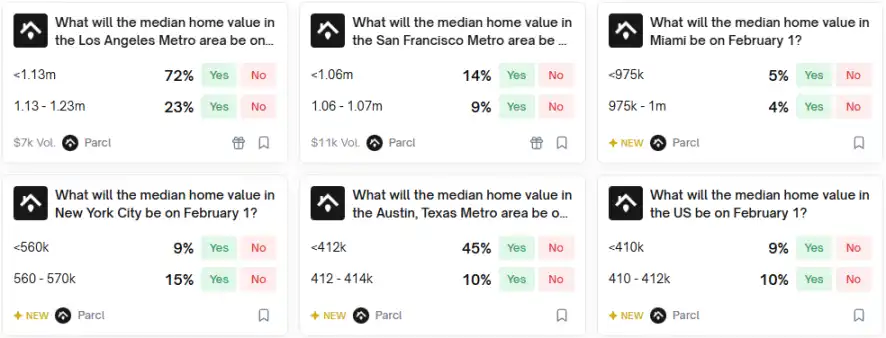
Figure - Polymarket Real Estate Prediction Market
The Regulatory Minefield of the "Dangerous Game"
While the collaboration aims to enhance the transparency of prediction markets, products tied to real estate indices are bound to play a "dangerous game" on thin ice.
Due to the nature of such products as event contracts, Polymarket, upon re-entering the U.S. market, must strictly adhere to CFTC compliance requirements regarding consumer protection and market integrity.
These markets transform housing price fluctuations into bettable agreements, a nature that regulatory bodies like the CFTC may easily deem as unlicensed binary options or financial derivatives.
Given the societal sensitivity of real estate data, the impact of such markets on the pricing power of actual housing prices may become one of the factors policy-makers consider when assessing the need for regulatory intervention. The real-time nature of real estate data may also involve compliance with state privacy or data protection regulations.
Furthermore, the proposed "Public Trust Act for the 2026 Financial Prediction Market" sets higher transparency requirements for the market. As real estate price indices are highly correlated with interest rate adjustments, housing regulations, and other policy changes, the platform would face institutional pressures to prevent insider trading and conflicts of interest.
Additionally, the operational fairness of the Polymarket real estate prediction market inherently depends on the verifiability of the Parcl index. Based on the CFTC's guidelines for event contracts, settlement rules must have an independent verification mechanism to mitigate the risk of data manipulation.
You may also like

Galaxy Deep Research Report: How Hyperliquid's HIP-4 Upgrade Changes the Landscape of Prediction Markets?

ZachXBT: Humanity private key leak and abnormal surge in H token should be viewed separately
On June 9, according to related disclosures, on-chain investigator ZachXBT posted an update on Humanity’s roughly $31 million security incident, saying that after further analyzing fund flows, he currently tends to believe the project team was not involved in an “inside job” or a self-staged attack. According to him, the official explanation about the private key leak was broadly accurate, but before the token unlock, the price of H had been artificially pushed higher, and the hacker later took advantage of that market environment; therefore, the private key leak and the earlier abnormal price pumping should be regarded as two separate and independent events. This reframing has shifted the market’s understanding of the nature of the incident. Earlier discussion around Humanity had focused on whether the team directly participated in the attack or used the security incident to cover up internal operations. ZachXBT’s latest remarks shift the focus from “whether it was self-theft” to “whether there were pre-unlock market structure issues.” He also questioned whether the team may have.

Morning Report | OpenAI has submitted an S-1 registration statement draft to the U.S. SEC; Morpho completes $175 million financing

Morning Report | BitMine increased its holdings by 126,971 ETH last week; trader Eugene announced his exit from the crypto market

Wang Chuan: How can one not feel anxious after the neighbor Old Wang made thirty times profit by investing in storage stocks? (Seven) - A quarter-century cycle

Cryptocurrency CEXs are flocking to sell US stocks, and traditional brokerages are facing an "uninvited guest."
$75 billion in foreign capital has fled, and South Korean retail investors have absorbed it all using leverage

Japan’s Three Megabanks Plan Joint Stablecoin Issuance in Fiscal 2026
MUFG, SMBC, and Mizuho reportedly plan to jointly issue fiat-pegged stablecoins in fiscal 2026, signaling Japan’s growing push into bank-led digital payment infrastructure.

Humanity Discloses H Token Dual-Chain Attack Details, With Losses on Ethereum and BSC Exceeding $36 Million
Humanity said the H token attack across Ethereum and BSC caused more than $36 million in losses after leaked ProxyAdmin keys enabled malicious contract upgrades and token minting.
White House Discusses CLARITY Act With Law Enforcement Ahead of Senate Vote
The White House discussed the CLARITY Act with law enforcement ahead of a Senate vote, focusing on illicit finance risks and developer protections.

Bitcoin Trading Guide 2026: Strategies for Experienced Traders

What Is XAUT and PAXG? Why Tokenized Gold Is Booming in 2026

Will the SpaceX IPO Hurt Bitcoin? Here's What Traders Are Watching

Foreign selling in the South Korean stock market accelerates, with cumulative net sales reportedly reaching $75 billion this year
On June 9, The Kobeissi Letter, citing Goldman Sachs data, reported that global investors are selling South Korean stocks at an unusually rapid pace. In the latest trading session, foreign investors sold about $801 million worth of Kospi constituent stocks again; total foreign outflows last week reached about $10 billion, and the market has been in net foreign selling on nearly every trading day over the past month. According to the data cited in the report, foreign investors have sold about $75 billion worth of South Korean stocks so far this year. Meanwhile, South Korean retail and institutional investors together recorded roughly $69 billion in net buying over the same period, suggesting that the market’s main buying support has come from domestic capital rather than returning overseas funds. The information currently disclosed still mainly comes from The Kobeissi Letter’s retelling and Goldman Sachs data summaries, while public details on the statistical period and the specific definition of “selling” remain relatively limited.

Fortune Warns of Strategy’s Financing Structure Risks as Bitcoin Premium Narrows
Fortune warned that Strategy’s Bitcoin treasury model faces growing financing risks as MSTR’s net asset premium narrows and preferred stock dividend pressure increases.

Ferrari Challenge Le Mans: Carl Moon to Dominate in WEEX Livery

Sahara AI Responds to SAHARA’s Sharp Drop: No Contract or Product Security Issues Found, Internal Investigation Underway
Sahara AI responded to SAHARA’s 60% price drop, saying no token contract or product security issues have been found and an internal investigation is underway.

WEEX Deposit/Withdrawal Dynamic Island: Your Asset Status, Always in Sight
Galaxy Deep Research Report: How Hyperliquid's HIP-4 Upgrade Changes the Landscape of Prediction Markets?
ZachXBT: Humanity private key leak and abnormal surge in H token should be viewed separately
On June 9, according to related disclosures, on-chain investigator ZachXBT posted an update on Humanity’s roughly $31 million security incident, saying that after further analyzing fund flows, he currently tends to believe the project team was not involved in an “inside job” or a self-staged attack. According to him, the official explanation about the private key leak was broadly accurate, but before the token unlock, the price of H had been artificially pushed higher, and the hacker later took advantage of that market environment; therefore, the private key leak and the earlier abnormal price pumping should be regarded as two separate and independent events. This reframing has shifted the market’s understanding of the nature of the incident. Earlier discussion around Humanity had focused on whether the team directly participated in the attack or used the security incident to cover up internal operations. ZachXBT’s latest remarks shift the focus from “whether it was self-theft” to “whether there were pre-unlock market structure issues.” He also questioned whether the team may have.
Morning Report | OpenAI has submitted an S-1 registration statement draft to the U.S. SEC; Morpho completes $175 million financing
Morning Report | BitMine increased its holdings by 126,971 ETH last week; trader Eugene announced his exit from the crypto market
Wang Chuan: How can one not feel anxious after the neighbor Old Wang made thirty times profit by investing in storage stocks? (Seven) - A quarter-century cycle
Cryptocurrency CEXs are flocking to sell US stocks, and traditional brokerages are facing an "uninvited guest."


