Each to Their Own, Every Public Blockchain Has Its Purpose


Original Title: "The Public Chain Fate Has Secretly Marked Its Purpose for You"
Original Source: Deep Tide TechFlow
The future of the industry, the future of public chains, remains undecided.
Looking back on the last market cycle, the biggest play can actually be summarized as PVP. Go PVP here, go PVP there, go PVP on any chain that still has some heat and narrative.
As we enter 2025, these chains have also entered the stage of stock competition --- from the hundred-chain war for the title of Ethereum killer a few years ago, to now most chains being labeled as "not even good enough for dogs," the remaining ones are also striving to solve their own survival problems.
Not only are the junior players PVPing, these chains are also PVPing. It's just that each chain seems to want to replicate Solana's excitement, but no matter how they toss and turn, they cannot replicate Solana's Meme frenzy.
One place nurtures one person, and perhaps one public chain can only do one thing. Every surviving public chain has already had its purpose secretly marked.
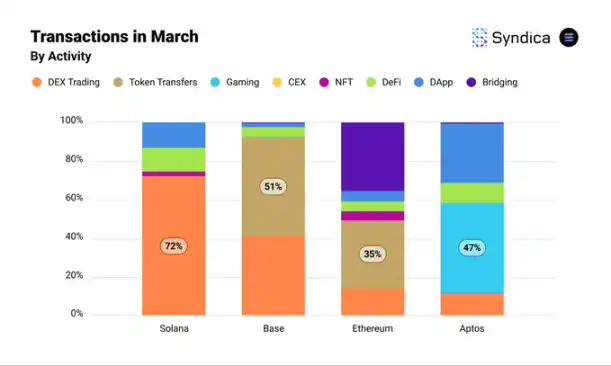
Recently, an overseas news and research institution Syndica (@Syndica_io) released a March L1/L2 Data Insight Report, making this sense of fate more tangible through numbers:
· In all Solana transactions, 72% are related to decentralized exchanges (DEXes), obviously in line with your impression of "fighting dogs."
· Base has 51% of transactions used for token transfers;
· ETH has nearly 40% of transactions used for cross-chain transfers (shown as the purple bars in the above image)
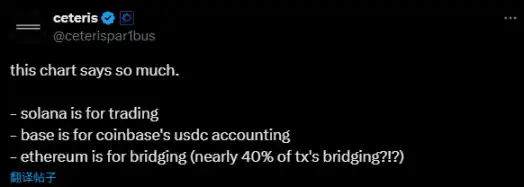
Delphi Digital's Research Lead @ceterispar1bus, when faced with this set of data, directly pointed out the essence:
Solana is for transactions, Base is for Coinbase's USDC accounting, Ethereum is for cross-chain asset transfers
As the industry has come to this point today, projects are no longer simply competing technically, but finding their own "anchor" --- a purpose positioning that makes perfect sense.
It's an Identity Tag, But More Importantly, It's Fate
On the surface, the use case of a public blockchain seems to be chosen by users and the market. However, upon deeper reflection, it appears more like the result of the covert pricing of resources and background.
Summarizing the identity tags of three public blockchains:
Solana is a transaction hotbed, Base has become Coinbase's "chief accountant," and Ethereum has been hijacked by bridges, accelerating asset outflows. Behind the current state of each chain, there are both technical and non-technical driving forces.
Let's start with Solana.
In 2025, Solana's on-chain ecosystem remains the liveliest meme transaction hotbed in the industry. The DEX trading volume in its ecosystem has securely held the top spot for two consecutive months, with a commanding market share lead. Since October 2024, Solana has been minting over 500,000 MEME coins every month, resembling an endless "meme dog party."
The junior devs are enthusiastic about sitting idle and finding angles, traders are busy monitoring pools and front-running, and those who have played with memes mention Solana, with their first reaction being, "Isn't this chain just a big casino?"
Solana's high throughput (TPS is 12 times that of Base) and low cost (a high percentage of transactions below $0.01) form the foundation of its transaction hotbed. According to the Syndicate report, Solana leads in small trades (under $100), making it suitable for high-frequency meme coin trading.
When it comes to decentralization, the practical and sensory aspects may not be that important. More crucial is the startup advantage based on resource endowment.
From 2019 to 2023, Solana received investment support from a16z, Multicoin Capital, and others, attracting DeFi and meme coin developers through grants and incubators. Solana's Breakpoint conference also often serves as an inspiration for meme coins. Do you remember two years ago when Toly wore a green cartoon dragon costume at the conference, igniting subsequent attention to the phenomenon-level meme SillyDragon?
Founders actively shape their image, intentionally or unintentionally implying a certain meme connection, which has gradually become a common practice today. Community culture has also "reserved" its meme soil, turning Solana into a "grassroots player" paradise. Through social media (such as X) and meme coin competitions, Solana has become a playground for "grassroots players," and successes like PEPE, BONK, and POPCAT have formed positive feedback loops.
User mindset is boxed in: "Solana=Transactions," and all kinds of shady Devs have flocked in, making Pumpfun's appearance seem natural.

Let's talk about Base.
There are also Memes on Base, and in the recent wave of AI Agent hype, there is no lack of standout tokens in the ecosystem. However, this seems more like a result of previous Solana fund overflow and low PvP difficulty arbitrage behavior. Data from March shows that 51% of transactions on Base are token transfers, with a deeper reason being the relationship between Coinbase and Circle.
In 2018, Coinbase and Circle jointly established the Centre Consortium, an organization specifically responsible for issuing and managing USDC. As joint initiators, Coinbase and Circle not only promoted the widespread adoption of USDC but also established operational standards for USDC through Centre. Base, as Coinbase's "brainchild," became the preferred channel for USDC transfers.
Furthermore, recent IPO filings from Circle indicate that Coinbase and Circle have a clear revenue-sharing agreement on USDC—Coinbase takes 50% of the residual income from USDC reserves. This means that every time Coinbase settles a USDC transaction or promotes the use of USDC, they get a piece of the pie.
Base's low cost and high efficiency are ideal for this "bookkeeping" need—whether it's internal fund transfers at Coinbase or user USDC transactions, Base can efficiently record and manage these on-chain activities, such as transaction records, liquidity management, and settlement operations. This "bookkeeping" not only reduces Coinbase's operating costs but also generates direct revenue through USDC income sharing.
Looking at the ecosystem culture, Base is more inclined to serve institutions and compliant users. Coinbase's 100+ million users are mostly "legitimate players," so developers naturally wouldn't choose Base to hold wild "meme parties." Base was strategically designated as the "accountant" of USDC by Coinbase and Circle from its inception, firmly locked within this duo's interest chain.
Speaking of Ethereum, it is undoubtedly a disappointing old topic. Nearly 40% of the transactions are related to cross-chain bridging, turning Ethereum into a "transit station" for other blockchains.
The price of ETH seems more like being roasted over the fire, gradually losing its moisture. Although Ethereum is still the leader in DeFi, with a TVL dominance of over 60% (Syndica data), the community's negative sentiment is spreading. Ethereum's "bridging destiny" is technically driven by high Gas fees. When the market is bullish, regular users are already overwhelmed, and they can only transfer assets to a lower-cost chain through cross-chain bridges; not to mention when the market is bearish and there is nothing to do.
Furthermore, ETH's mainnet throughput is limited, far behind Solana's high performance, and the low transaction efficiency further increases the demand for cross-chain transactions. A deeper-rooted reason comes from the diversion of historical status.
As the earliest smart contract platform, Ethereum has accumulated the most assets and dApps, naturally becoming a hub for cross-chain bridging. The ecological path dependence has led DeFi projects and funds to concentrate on Ethereum, but the high costs force users to go out, making bridging a "necessary choice." At the same time, the rise of Layer 2 has diverted users, multiple rounds of adjustments by the Ethereum Foundation, accusations of Vitalik not focusing on the main task alongside women, and the plummeting coin price where even breathing seems to be wrong...
The dream is the "world computer," but the reality is the "ATM." Its destiny seems to be locked by network effects and market changes, transforming from the DeFi overlord into an asset transfer station. Ethereum's breakout path is likely to be more challenging than Solana and Base.

Accept Destiny, Find Anchors
In the public chain competition of 2025, it is no longer the frenzy of a hundred-chain war but a calm game of existing resources. The survival path of the public chain ultimately lies in "accepting destiny, finding anchors." Transactions can be anchors, the circulation of stablecoins can be anchors, and even cross-chain can be anchors. However, the solidification of "anchors" also means that the imaginative space of the public chain is compressed.
Can Solana shake off the label of the "Meme Casino"? Can Base break free from the "bookkeeper" framework? Can Ethereum break out of the "transit station"? These questions do not have definitive answers. But ironically, most P players are not concerned about these issues.
They simply go to whichever chain is trending to "fight," or they go to whichever chain has arbitrage opportunities to "earn." The battle of public chains is actually just the background behind every passerby eager to cash in and fantasize about a thousandfold return. Perhaps only the arrival of the next cycle can provide a true answer—who can attract incremental gains, who can find new "anchors."
The future of the industry, the future of public blockchains, still hangs in the balance.
You may also like
Stablecoins are the "royalists" of the crypto world: Open USD brings the old currency system into play
Semiconductor stocks plummet, yet Anthropic wants to create a 2nm chip
Where is Zhao Changpeng's billion-dollar investment going? YZi Labs' investment landscape fully revealed
Ethereum Foundation Report: A Basic Guide to Ethereum for Governments and Financial Institutions
A pre-announced harvesting case: After the cryptocurrency price dropped by 99%, the public chain Saga exited to transform into AI
When American giants collectively "defect" from Chinese AI models
BIS Report Compliance Observation: The Real Risks of Stablecoins, Not Just "Depegging"
Portugal 2-1 Croatia: Ronaldo's 20-Year Knockout-Stage Drought Ends With a Debt Finally Collected
Portugal beat Croatia 2-1 in the 2026 global football championship's knockout rounds as Ronaldo scored his first-ever knockout-stage goal, Gonçalo Ramos struck a stoppage-time winner, and VAR ruled out a late equalizer for offside.
Bitcoin Price Prediction July 2026: Will BTC Recover to $70K or Drop Below $55K?
A South Korean company that learned the strategy of hoarding coins, from a bull market to delisting?
WEEX API Broker Program: Turn Your Trading Platform Into a Revenue Engine
How to choose between buying discounted ETH, Bitmine, and SharpLink?
Wosh: Inflation has cooled in recent weeks, AI is reshaping the economy, and forward guidance has lost its necessity
From Pump.fun to Collector Crypt: Has Solana's income throne changed hands?
Dan Bin's latest speech: Don't miss out on a great era
Robinhood launches its own blockchain, no longer wanting to be a tenant on others' chains
Why Tokenized Stocks Are Booming in 2026 While Crypto Is Still Struggling
Looking at Stripe's ambitions and the future of stablecoins from OUSD
Stablecoins are the "royalists" of the crypto world: Open USD brings the old currency system into play
Semiconductor stocks plummet, yet Anthropic wants to create a 2nm chip
Where is Zhao Changpeng's billion-dollar investment going? YZi Labs' investment landscape fully revealed
Ethereum Foundation Report: A Basic Guide to Ethereum for Governments and Financial Institutions
A pre-announced harvesting case: After the cryptocurrency price dropped by 99%, the public chain Saga exited to transform into AI
When American giants collectively "defect" from Chinese AI models