
- Buy Crypto
- Markets
 Futures
- Spot
- Copy Trade
- Earn
- More
ERC-8004: The Rise of Digital Assets and the Machine Economy

Original Article Title: DIGITAL ASSETS: ERC-8004 and the Rise of the Machine Economy
Original Article Author: Laurence Smith, Fintech Blueprint
Translation: Peggy, BlockBeats
Editor's Note: In the wave of AI and blockchain integration, the release of ERC-8004 marks the entrance of the machine economy into the "Trust Era." Led by the Ethereum Foundation's dAI team and Consensys, this protocol, launched in collaboration with heavyweight institutions such as MetaMask, Google, and Coinbase, provides on-chain identity, reputation, and verification mechanisms for AI agents for the first time, breaking the long-standing isolation of autonomous software from each other.
This article delves into how ERC-8004 constructs an open infrastructure for agent discovery and collaboration, and explores its potential in emerging AI crypto ecosystems such as Tempo and Thinking Machines. With over a hundred teams already starting to build, ERC-8004 is not only a technical standard but also the trust foundation of the machine economy.
The following is the original content:
ERC-8004: A Protocol Standard for Establishing Trust Among AI Agents
Last week, the Ethereum Foundation's dAI team and Consensys released the ERC-8004 protocol, which allows AI agents to discover, validate, and transact with each other. Signatories include MetaMask, Ethereum Foundation, Google, Coinbase, EigenLayer, ENS, and The Graph.
Until now, autonomous software, including robots, models, or smart contracts, has been operating independently. The emergence of frameworks such as A2A (Agent-to-Agent) and MCP (Model Context Protocol) has enabled agents to communicate with each other.
A2A provides a shared language for software agents to send structured messages; while MCP, introduced by Anthropic, allows AI models to exchange context and coordinate tasks. These two have contributed to achieving interoperability but still lack a "trust" mechanism. That is, they cannot determine a agent's true identity, whether its record is reliable, or if its output is verifiable.
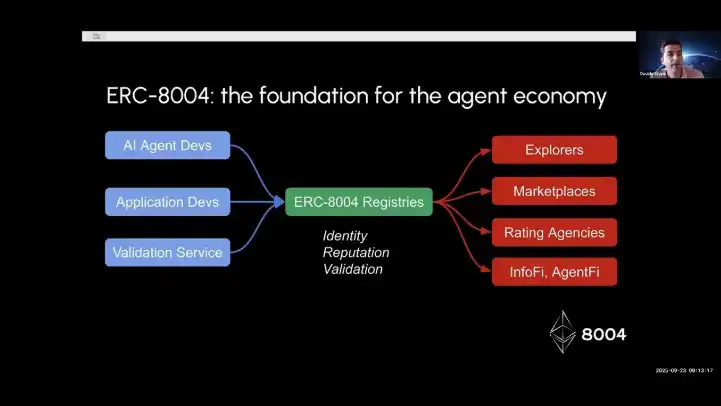
ERC-8004 introduces a set of neutral on-chain registries that address this issue through on-chain identity, reputation, and verification mechanisms.
Each agent receives a portable on-chain identity, an ERC-721 token representing a machine NFT. This token points to a registration file describing the agent's name, skills, wallet, and endpoint. Because it is standardized and based on neutral infrastructure, it can be indexed by any marketplace or browser.
Agents can leave feedback for each other, tag by task, and associate it with Proof of Economic Payment (x402 – short for EIP-402, a cryptographic receipt that binds on-chain payments to off-chain interactions). For higher trust use cases, validators can confirm outputs through hardware enclaves, proof-of-stake mechanisms, or zkML verification. In short, this is an open rating and auditing layer for autonomous agents.
This standard lays the foundation for machine-to-machine economic activity. It builds a world without human intermediaries, allowing agents to trust each other in negotiation, transactions, and collaboration. It extends the logic of disintermediation in blockchain's currency and contract space to AI agents, removing platform middlemen between them.
Reportedly, over a hundred teams are already building according to this specification.
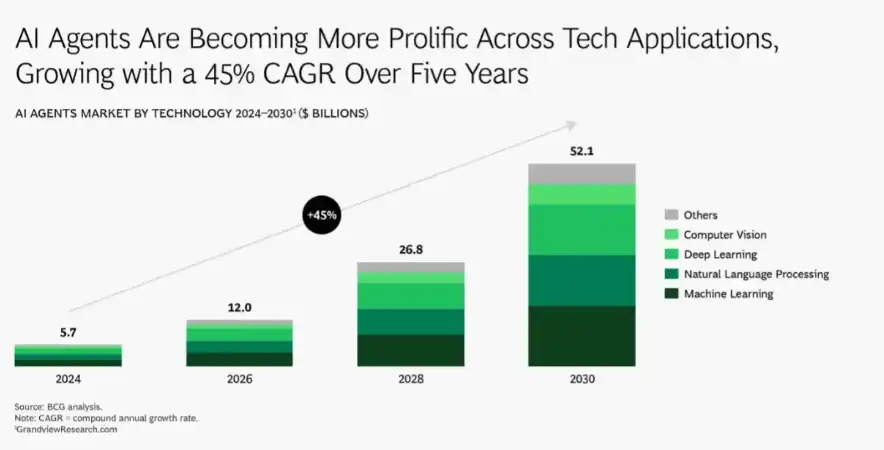
Massive Investments in AI and Crypto Infrastructure
The release of ERC-8004 comes at a time when the AI economic infrastructure is receiving massive investments. Payment-focused Layer 1 blockchain Tempo recently raised $5 billion, reaching a valuation of $50 billion; AI startup Thinking Machines, founded by former OpenAI executives, raised $20 billion, reaching a valuation of $120 billion.
We are witnessing the largest funding rounds in the history of AI and crypto convergence.
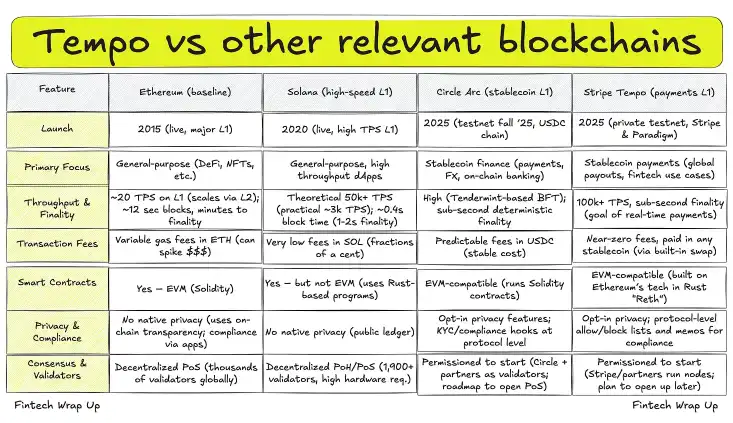
Tempo is building a closed payment network optimized for stablecoins and real-world finance. This essentially mirrors the enterprise version of Ethereum's vision: a high-throughput, low-cost global transaction settlement channel. In Tempo's world, agents can process payments at machine speeds, but its internal private ecosystem is governed by its validators and fee model.
ERC-8004 can provide an open discovery and reputation layer for this ecosystem. Tempo does not need to define which agents or merchants can transact but can integrate the ERC-8004 registry so that any verified agent with a public on-chain identity can access its payment network. This will transition Tempo from a closed settlement layer to a programmable settlement layer, achieving interoperability with the broader Ethereum agent economy.
Thinking Machines operates on a higher level. Although its ultimate goal is not yet clear, its existing products focus on training models to enhance their robustness and flexibility. This contributes to the deployment of autonomous agents on the internet that can reason, collaborate, and transact. Currently, these agents still exist in closed, vertically integrated environments.
By adopting ERC-8004, Thinking Machines can build training tools for an open economy: each model or agent can be discovered and verified on-chain, possess an ERC-721 identity token, and establish real economic reputation through x402 verified interactions. In practical terms, this means a Thinking Machines agent can contract with a data provider agent on Ethereum, pay through Tempo or another chain, and report results back to the chain without human intervention.
In essence, ERC-8004 can unlock a programmable market. It empowers autonomous agents to contract, settle, and build reputation on-chain, which is precisely what DeFi is all about serving humanity.
For fintech, the short-term impact is minimal; few companies will overnight replace APIs with agents. However, once agents can prove identity, reputation, and payment, they can handle various tasks from credit scoring to transaction execution without requiring platform intermediaries.
You may also like

Particle Founder: The entrepreneurial insights I have gained the most from in the past year

Huang Renxun's latest podcast transcript: The future of Nvidia, the development of embodied intelligence and agents, the explosion of inference demand, and the public relations crisis of artificial intelligence

OKX Ventures Research Report: AI Agent Economic Infrastructure Research Report (Part 1)

The migration of settlement rights: B18 and the institutional starting point of on-chain banks

From Tencent and Circle: Looking at the Simple and Difficult Questions of Investment

The second half of stablecoins no longer belongs to the crypto circle

Cursor "Shell" Kimi Controversy Reversed: From Copyright Infringement Allegations to Authorized Collaboration, China's Open Source Model Once Again Becomes a Global AI Foundation

The Real Reason Tokens Don't Sell: 90% of Crypto Projects Overlook Investor Relations

Is the income of pump.fun real, earning a million dollars a day despite the market downturn?

The real reason why tokens are not selling: 90% of crypto projects neglect investor relations

Who is the true winner of the "Tokenization" narrative?

Moss: The Era of AI-Traded by Anyone | Project Introduction

Chip Smuggling Case Exposes Regulatory Loophole | Rewire News Evening Update

How a Structured AI Crypto Trading Bot Won at the WEEX Hackathon
Ritmex demonstrates how disciplined risk control and structured signals can make an AI crypto trading bot more stable and reliable on WEEX, highlighting the importance of combining execution discipline with scalable AI trading systems.

Old Indicator Fails, Three Major New Signals Emerge: BTC True Bottom May Still Be Below $60K

Meeting OpenClaw Founder at a Hackathon: What Else Can Lobsters Do?
Huang Renxun's Latest Podcast Transcript: NVIDIA's Future, Embodied Intelligence and Agent Development, Soaring Demand for Inferencing, and AI's PR Crisis
How a Structured AI Crypto Trading Bot Won at the WEEX Hackathon
Crypto_Trade shows how structured inputs and controlled adaptability can build a more stable and reliable AI crypto trading bot within the WEEX AI Trading Hackathon, highlighting a practical path toward scalable AI trading systems.


 App
App