
Exploring BTC On-Chain Data: Initial "Trend Decay" Signal Emerges


Original Author: Murphy, On-chain Data Analyst
Initial Signal of Stage-wise "Trend Decay" Identified for the First Time!
Preface
Looking back at this cycle, it has been very different from the past in many ways. For example, for the first time in a bull market cycle, we experienced a macro contraction combined with a significant election rally, for the first time we broke the previous all-time high before the halving, for the first time a spot ETF was formally recognized by traditional capital, for the first time there is hope of becoming a financial reserve asset in developed countries, bringing us endless expectations for the future...
Against this backdrop, I, like all of you, am extremely excited. However, I am well aware that while belief is essential, fundamentally I am a player. I did not enter the crypto space as a tourist but to make money; I am also a trend investor, not a cross-cycle investor, and everything I do is aimed at increasing the amount of BTC in my wallet, not just increasing its USD value.
I believe that any financial asset, trend, and cycle always objectively exist. It is fundamentally a relationship of supply and demand, a shift in sentiment, capital seeking profit, and above all, human nature! Therefore, I study on-chain data in the hope of analyzing the factors that influence trend and cycle shifts, making rational judgments, guiding trades, and allowing myself to earn money with a higher certainty than opening blind boxes.
That is, to grasp the trend, increase BTC holdings, and better prepare to embrace the boundless opportunities of the crypto market's future!
Main Content
Following BTC's historic high of $73,000 on March 13, 2024, a prolonged 7-month oscillating downtrend began, until a trend reversal occurred after testing the $60,000 psychological support on October 10, ushering in a new uptrend. Over the next 2 months from October to December, the data consistently showed a strong trend without any signs of decay.
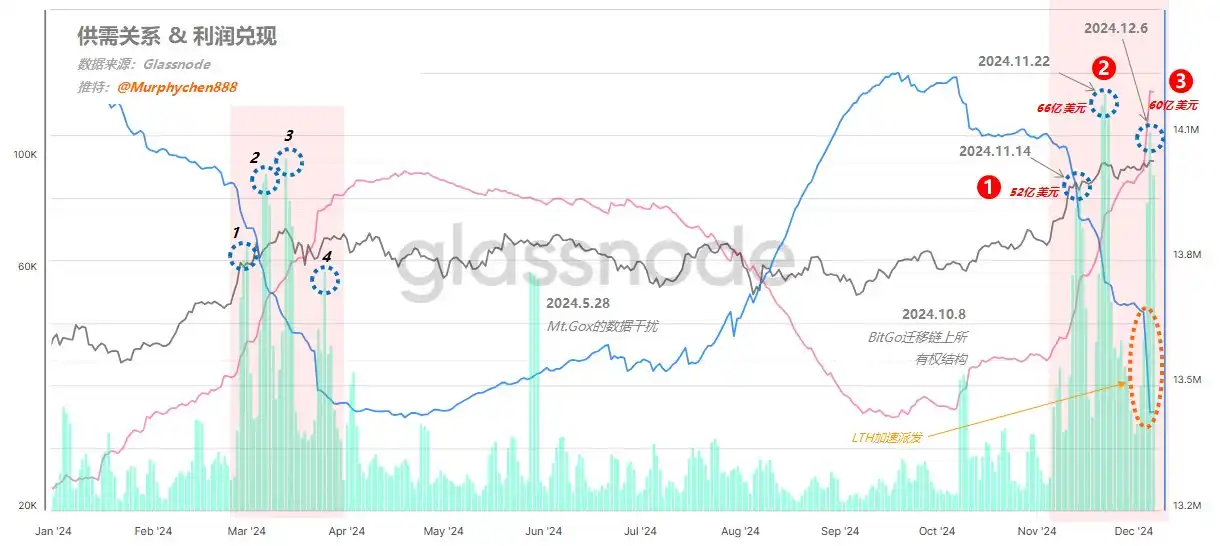
On November 8, I wrote an article titled "Escape the Top Series 6" (link at the end of the article), mainly discussing the application method and underlying logic of data related to "Supply and Demand Relationship & Profit Realization." The final conclusion was that when the following "three elements" appeared simultaneously after BTC broke the previous all-time high, it could be used as a basis to judge a stage-wise peak:
1. Long-Term Holders (LTH) accelerating distribution, possibly nearing completion;
2. Massive profit-taking exits occurring at the same time;
3. As the price rises, the peak of profit-taking exits is decreasing.
(Figure 1)
As shown in Figure 1, long-term holders (LTH) began their second large-scale distribution behavior in this hot cycle starting from October 7th. This indicates an increasing market demand capable of absorbing excess supply. On November 14th, the first wave of massive profit-taking exits occurred, totaling $5.2 billion (labeled 1 in Figure 1), with BTC's price at $87,000 that day. As I have analyzed in a previous tweet, historically, when LTHs start distributing and the first wave of massive profits is realized, it is usually not the relative peak, making it not an ideal selling point.
Indeed, on November 22nd, the second wave of massive profit-taking exits worth $6.6 billion (labeled 2 in Figure 1) appeared, with BTC's price at $98,900. This time, a higher price emerged along with higher profit-taking, showcasing the characteristics of a strong trend. Therefore, on November 24th, I tweeted again: "Don't rush! Patience is needed now more than ever."
On December 6th, the third wave of massive profit-taking exits amounting to $6 billion (labeled 3 in Figure 1) occurred, which was smaller in scale compared to the second wave, with BTC's price at $99,900. This marked the first instance in this trend cycle where all three elements of the "triad of judgment" were met. That is, 1. LTH accelerated distribution, 2. accompanied by massive profit-taking exits, and 3. the price was higher but the peak profit was lower.
When all 3 conditions are met simultaneously, it indicates a sign of attenuation in the current strong trend!
In my data analysis system, I never draw conclusions easily based on the appearance of a single indicator or signal. To confirm the above, I need to integrate and observe several other data points (due to the limit on the number of images in tweets, I will not include the data chart from the previous cycle in the following analysis, only the current one).
1. Capital Inflow Situation
(Figure 2)
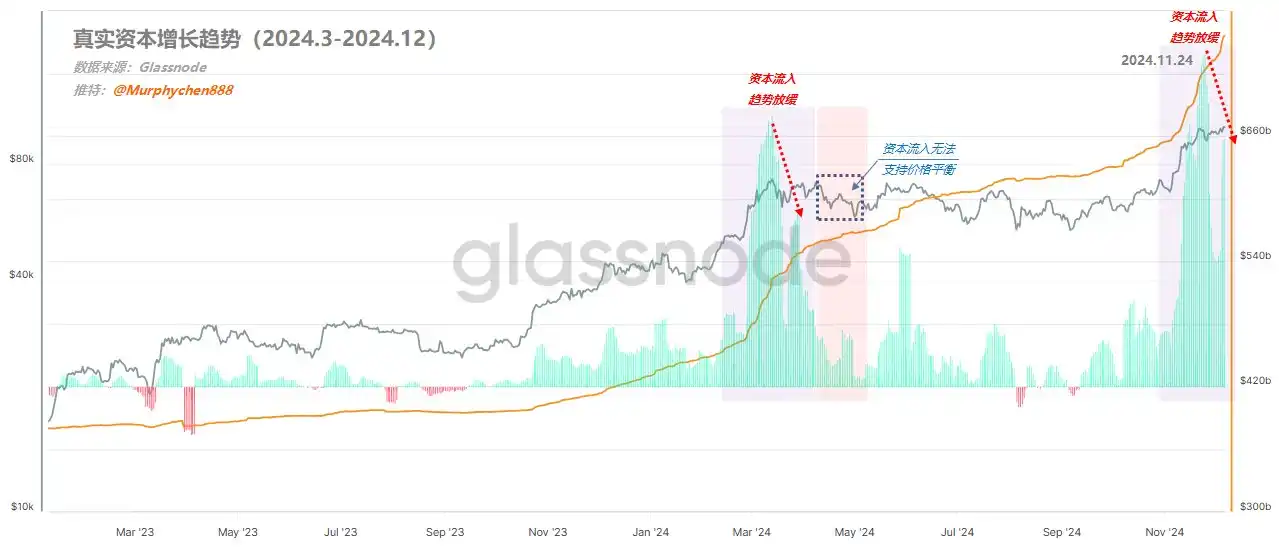
As shown in Figure 2, whenever the trend of incoming real capital begins to slow down, the momentum of BTC price growth will start to weaken. Until the capital inflow cannot sustain the price balance, a retracement will follow as expected. Similar situations have occurred in May 2021, November 2021, and April of this year.
During this trend from November 24th to December 7th, the overall scale of capital inflows is gradually decreasing. Although the price has not experienced a sharp correction, if another peak of capital inflow (higher than the previous high) does not occur in the short term, this downward trend will gradually affect the momentum of BTC price growth.
2. Evaluation of New Demand
(Chart 3)
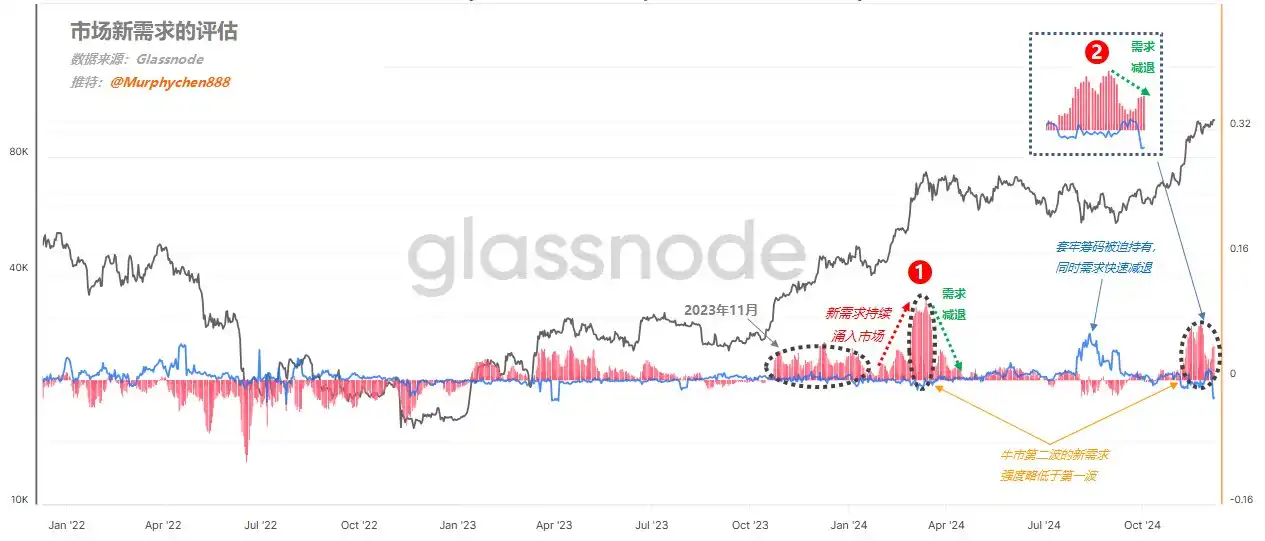
As shown in Chart 3, the sudden surge in the bottom red waveform indicates a large amount of new demand entering the market in the short term. With the continuous influx of demand, BTC usually experiences a strong uptrend; similar situations have occurred in May 2017, November 2020, October 2021, and November 2023.
When the demand begins to wane, BTC will enter a consolidation period; if there is no new demand entering in the short term, the trend will gradually shift, and the market will enter a pullback phase (as indicated in Chart 3).
The sudden rise in the bottom blue line in the chart indicates that the short-term chips trapped at a high level have turned into long-term chips due to passive holding, which will represent the most emotionally unstable long-term holders in the future. Once the price rises again, they will become the primary selling pressure in the market.
Currently, we observe a decrease in market demand (as indicated in Chart 3), and this overall demand scale of this wave is slightly lower than in March of this year, only far surpassing March in sentiment.
3. Market Sentiment Dominance
(Chart 4)
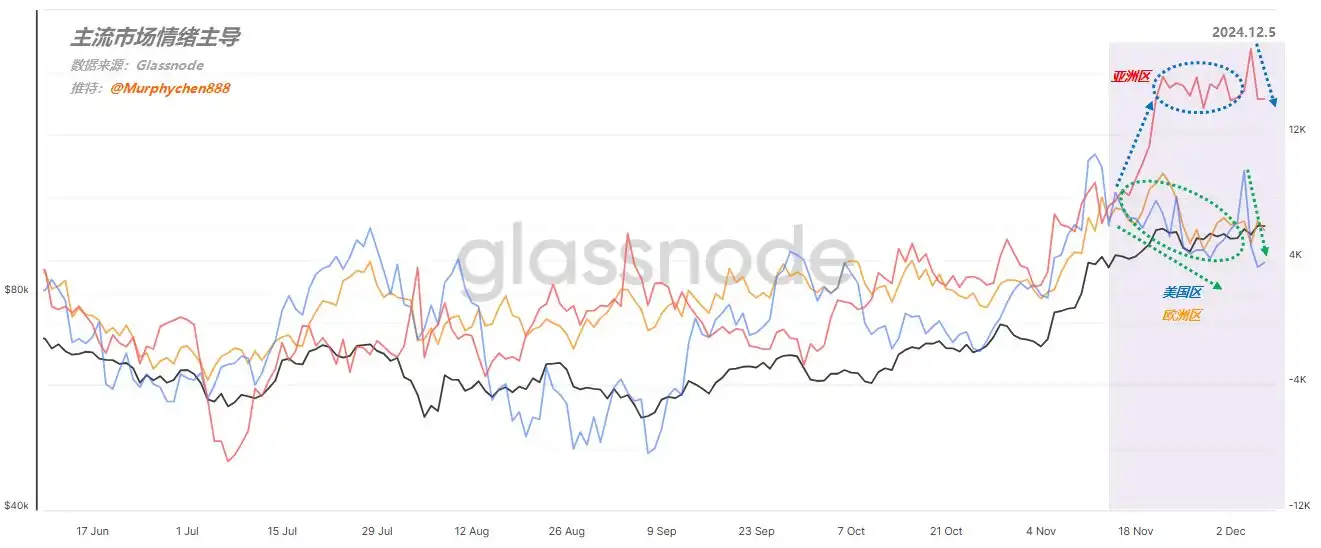
We can clearly see who is dominating the current market from Chart 4. The red line is much higher than the blue and yellow lines, indicating that Asian investors are the main driving force. American investor sentiment only experienced a rapid rebound on December 5th, but unfortunately, it quickly returned to its original level the next day; European sentiment has remained flat throughout. After all, with the Christmas holiday approaching, the gradual withdrawal of sentiment dominance by European and American investors is understandable.
However, what we hope to see is whether the peak of capital inflow can be restored and whether continuous new demand can sustainably enter the market, providing fundamental support for BTC price growth. Ultimately, it still depends on American investors.
Final Thoughts
The shrinking of new demand, slowing capital inflow, accelerated distribution by Long-Term Holders (LTH), and a peak in profit-taking not as high as before... From observations of multiple data points, the conclusion that this round's trend in the "Supply-Demand Relationship & Profit-Taking" data is showing signs of decay is traceable and substantiated.
Seeing a signal does not necessarily mean an immediate pullback; sometimes, there may even be another push higher because market sentiment tends to have inertia.
What will I do? — Of course, I will start executing a phased profit-taking plan. This signal is the "sell point" I have been waiting for. During a bear market cycle, buy orders are phased in at several "buy points" based on indicator signals. Similarly, in a bull market cycle, there cannot be only a single "sell point." The key is to plan well and seize each occurrence of a "sell point."
What if my judgment is wrong? — There is no trading system in the world that is flawless and never makes mistakes. As long as it aligns with one's risk preference and profit expectation, is logical, executable, and can form a closed loop, it is a good system. Understanding goes only this far; money beyond understanding cannot be earned.
However, it is important to note that data cannot predict the future! It is also possible that the comprehensive data mentioned above may suddenly undergo a fundamental reversal due to some event, causing metrics such as capital inflow, new demand, emotion-driven forces, and profit-taking to start turning upwards again. In that case, pause the "phased profit-taking" plan and patiently wait for the next signal indication.
This is just my personal plan, which may not be correct, and certainly does not mean you should do the same. Everyone has different holding amounts, risk preferences, and understandings of the top range. My sharing is for data reference only and not investment advice!!
You may also like

Morning Report | OpenAI has submitted an S-1 registration statement draft to the U.S. SEC; Morpho completes $175 million financing

Galaxy Deep Research Report: How Hyperliquid's HIP-4 Upgrade Changes the Landscape of Prediction Markets?

Latest research from 13 top universities including Cornell University: The current state, challenges, and misconceptions of the fusion of Crypto and AI

Deconstructing Anthropic: The Best AI Company, Possibly Also a Type of Organizational Invention

Every exchange is a "Universal Exchange."

The counterattack of traditional finance: Alliance chains are quietly reviving
Pantera Capital Partner: How Tokenization is Restructuring the Private Equity and Early Investment Ecosystem?

Mastercard Launches Agent Pay for AI, Plans to Record AI Agent Payment Authorizations on Polygon
Mastercard launched Agent Pay for AI, a new payment protocol designed to help AI agents make small payments such as pay-per-use access to data and APIs. The system plans to record human-granted AI agent permissions on Polygon, focusing on verifiable authorization, identity, and payment controls.

Curve Deploys Llamalend v2 on Optimism With 250,000 OP Incentives
Curve launched Llamalend v2 on Optimism with 250,000 OP incentives from the Optimism Foundation. The upgrade expands Llamalend beyond its earlier crvUSD-focused model, adding broader collateral support, LlamaRisk market reviews, and the ability to use Curve LP tokens as collateral.

Raydium Old Liquidity Pool Reportedly Exploited, With $1.34 Million Moved to Ethereum and Tornado Cash
An old Raydium liquidity pool was reportedly exploited for around $1.34 million in USDC, RAY, and wSOL, with the stolen funds bridged to Ethereum and deposited into Tornado Cash. The incident highlights the tail risks of legacy DeFi pools, old contracts, and cross-chain fund laundering paths.
Kalshi Executive Challenges “SBF Backed AI Unicorns” Narrative, Says Leopold Aschenbrenner Was Key Figure
Kalshi executive John Wang questioned the “SBF backed AI unicorns” narrative, saying Leopold Aschenbrenner was the key figure behind major AI investment decisions.

New York Proposes Stricter Stablecoin Issuer Rules Aligned With Federal GENIUS Act
NYDFS proposed stricter stablecoin issuer rules aligned with the GENIUS Act, covering reserves, custody, redemption timelines, audits, and capital buffers.

CryptoQuant Says Bitcoin Profitable Supply Is Near 45% Pressure Zone as On-Chain Data Points to Market Repricing
CryptoQuant said Bitcoin’s profitable supply is nearing the 45% pressure zone, signaling rising market stress, unrealized losses, and a possible on-chain repricing phase.

Bitcoin Falls Below 200-Week Moving Average as On-Chain Data Shows Over Half of Supply in Loss
Bitcoin dropped below its 200-week moving average as on-chain data showed over 50% of circulating supply is now in loss, signaling rising market stress.

CFTC Reportedly Plans New Prediction Market Rules Focused on Manipulation Risk and Public Interest Review
The CFTC is reportedly preparing new prediction market rules focused on manipulation risk, public interest review, and retail trader protections.

Meet the new WEEX trial fund—your gateway to greater profits

WEEX Labs Lands at Dutch Blockchain Week: A Disruptive Crypto × AI Conversation Sets Sail in Amsterdam
SK Hynix Reportedly Plans U.S. ADR Listing as Early as August, With SEC Approval Possible in Late June
SK Hynix may pursue a U.S. ADR listing as early as August, with SEC approval reportedly possible in late June amid strong AI chip supply chain demand.
Morning Report | OpenAI has submitted an S-1 registration statement draft to the U.S. SEC; Morpho completes $175 million financing
Galaxy Deep Research Report: How Hyperliquid's HIP-4 Upgrade Changes the Landscape of Prediction Markets?
Latest research from 13 top universities including Cornell University: The current state, challenges, and misconceptions of the fusion of Crypto and AI
Deconstructing Anthropic: The Best AI Company, Possibly Also a Type of Organizational Invention
Every exchange is a "Universal Exchange."
The counterattack of traditional finance: Alliance chains are quietly reviving


