
From Web2 to Web3, Why Every Company Will Become a Crypto Company?


Original Article Title: Every company will be a crypto company
Original Article Author: @0x3van, Crypto Researcher
Article Translation: Translated by LawMotion Deep
Editor's Note: The article explores how the crypto industry, through the integration of stablecoins, blockchain, and zkTLS, is transforming every company into a crypto company, driving crypto technology towards mainstream adoption. With stablecoins as the payment layer, blockchain as a new balance sheet asset, and zkTLS as the data bridge between Web2 and Web3, collectively providing cost efficiency and user incentive mechanisms for enterprises, disrupting the traditional financial model, and ultimately achieving widespread adoption.
The following is the original content (slightly reorganized for readability):
In 2022, I collaborated with a fintech company to develop Banking as a Service and embedded financial products. In the days and weeks following the FTX collapse, what shocked me the most was the schadenfreude expressed by those around me. Observers from the outside seemed almost jubilant that this industry they perceived as a scam had finally collapsed.
At the same time, I found myself frustrated with these same individuals who were merely building user interface wrappers, slightly extending those barely innovative traditional banking rails.
Yet, working in fintech was also productive. After all, payments and financial services are also at the core of blockchain, and fintech shares the same goal as blockchain in providing a banking experience to more people.
So why is this important? The crypto industry has been building financial infrastructure for years and now feels poised to transform global finance. We have a fast scalable L1 and $233 billion stablecoins, but crypto seems largely confined to the existing "native" user-referential ecosystem.
So... how does blockchain go mainstream? This article explores the integration of three elements.
· Stablecoins as the payment layer
· Blockchain as a new balance sheet asset
· zkTLS as the data bridge
This will make every company a crypto company, bringing crypto to the masses.

Temperature Check - Current Sentiment
In September 2023, Matt Huang wrote an article titled "Casino on Mars," in which he balancedly outlined how speculation is a powerful tool that drives true innovation. The casino acted as a Trojan horse, introducing a new financial system.
A few months ago, Jody Alexander jokingly said on Steady Lads that within the new financial system, there's just another casino.

This exchange encapsulated much of the prevailing pessimism this cycle. Despite significant strides in regulation and institutional adoption, at times it feels like the industry hasn't moved forward all that much.
Since the last cycle, countless teams have attempted to define consumer crypto and build applications that people might actually use in real life. What does the world of crypto-driven apps that dominate app store rankings look like? We may not know until it happens, but evidently, we're not there yet.
It must be acknowledged that this persistent mental model—where we have to lure users into our casino and then use financial innovation as a Trojan horse—has failed to drive mainstream adoption.
New Balance Sheet
While consumers seem to enter only through pumpfun and trendy casinos, the adoption story for enterprises, corporations, and institutions is starkly different.
Historically, fintech companies relied on banks as balance sheet providers. Today, firms can receive credit, deposit funds, and transfer money without touching traditional banking interfaces. However, the backend of these products still ultimately relies on banks—licensed or chartered financial institutions—as the balance sheet provider for these services.
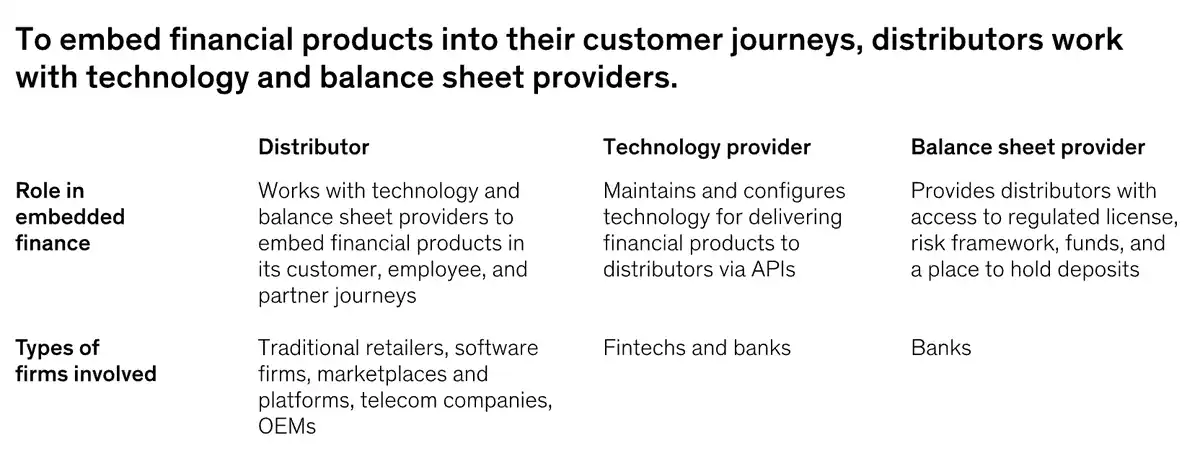
McKinsey Report on Embedded Finance
However, this story is beginning to change. Stablecoins have proven to be a killer app for crypto, with large Web2 companies adopting blockchain for payments, settlements, and transfers.

Stablecoin Growth Continues
The stack of digital banks is complex, relying on countless APIs to integrate each layer as a service, while blockchain has provided a unified public state with fast, 24/7, global settlement.
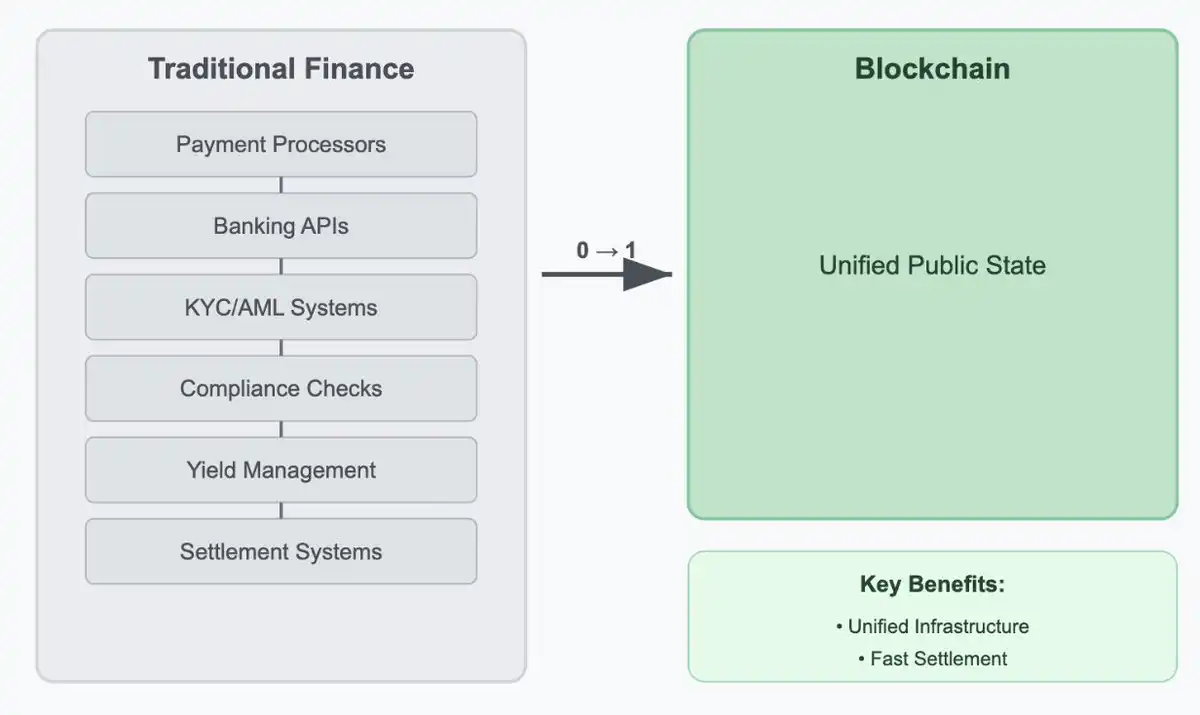
Claude Provides Chart
Some examples:
· SpaceX: When SpaceX receives payments from Starlink customers in emerging markets, they convert these into stablecoins via a Bridge, so they don't have to deal with wire transfers and forex risks.
· Scale AI: Scale AI compensates contract workers in the global data labeling network through the stablecoin rail.
· Ramp: Ramp pioneered the use of stablecoins from an internal corporate finance perspective. They were one of the first non-crypto companies to allocate a meaningful portion of their corporate treasury to USDC to capture traditional bond yields while maintaining high liquidity.

I was recently asked why stablecoins are so hyped but not widely adopted in the "real world" — yet they represent about 10% of the volume on the two largest global remittance corridors and are growing rapidly.
Consumer Cryptography
Now that we have established that traditional enterprises are using stablecoins and blockchain to manage their finances, pay workers, and receive payments, all reducing cross-border friction. While these use cases will continue to proliferate, there is no killer mainstream application yet beyond payments/stablecoins.
A persistent challenge, or perhaps a fallacy, of crypto is the expectation that mainstream users will come to crypto platforms rather than crypto capabilities reaching mainstream users.
Instead of luring users with casinos and hoping to Trojan-horse them, why not integrate crypto directly into users' existing behaviors?
So far, the path to broader adoption has been overly reliant on misconceptions about how financial services traditionally disseminate. The earliest forms of credit came from consumer companies themselves, local shopkeepers, and later department stores offering loans to ordinary consumers to purchase groceries, equipment, or clothing.
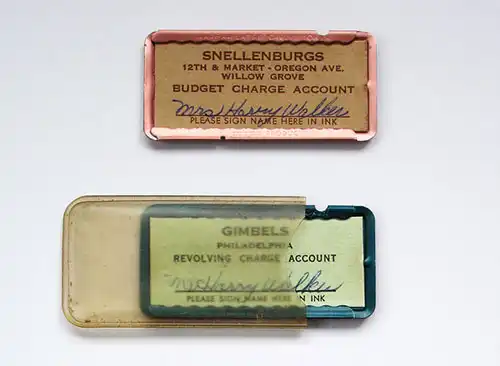
So, if blockchain becomes the balance sheet of the next wave of user-facing financial products, who will be the distributors? Why would they choose to utilize these cryptographic rails?
Just as finance has embedded financial products into non-financial customer experiences, I believe the path to mass adoption of crypto lies in embedding its capabilities into platforms people already use every day:
· Retail and e-commerce: Distribution channels for stablecoin payments and credit products
· Social media and content: Stablecoins for creator monetization, tipping, and subscription models
zkTLS
While stablecoins have reduced friction in cross-border payments, why should users care? For those who have not yet felt the need that stablecoins (dollarized products) address, why should they join in?
For those who have not felt the pain points of traditional financial products, crypto needs to meet users where they are and provide a 10x better experience. Fortunately, another use case of crypto is its excellence in coordinating economic incentives and rewarding users with richer data. However, in the Web2 world, how can companies obtain both verifiable and private data?
Enter... zkTLS.
Simply put, zkTLS is the bridge for Web2 data. zkTLS extends the standard TLS protocol (securing all HTTPS connections) through cryptographic proofs:
1. You access a website through a secure TLS connection
2. zkTLS generates a zero-knowledge proof to verify specific data
3. This proof only reveals the content you choose to share, keeping everything else private
4. Other applications can verify this proof to confirm the authenticity of the information.
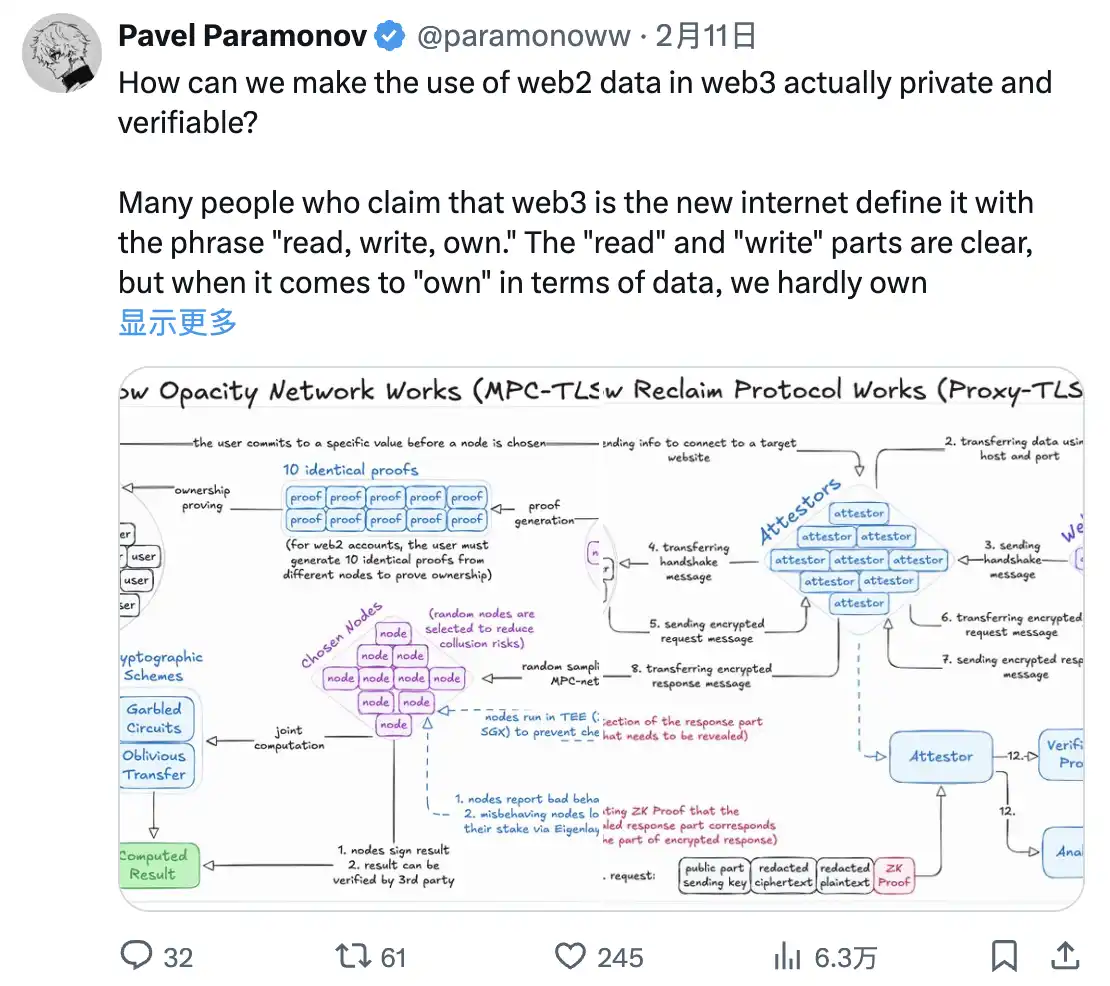
How do we make the use of Web2 data in web3 truly private and verifiable?
While consumer applications may use blockchain + stablecoins for payments, to really engage users, they will need zkTLS to access context and information.

If you could build applications that respond to real user context without touching their private data? Enter zktls
While businesses already have cost incentives to adopt stablecoins, they will need zkTLS to obtain more profound insights about users and reward them to create enthusiastic fans.
Obtaining verified private information from applications users already use can turn every existing consumer company into a crypto-powered distribution channel. Instead of forcing users into crypto, allow consumer companies to reward users for participating in their existing daily activities.
The transformational power of zkTLS lies in its ability to unlock previously impossible richer, more personalized experiences. Traditional Web2 platforms operate in siloed environments, unable to validate user information across different contexts without invasive data collection or creating permissioned APIs between various parties.
Importantly, zkTLS fundamentally changes how consumer companies compete for users. Previously, platforms could only reward users for behavior within their ecosystem. With zkTLS, they can identify and reward value in any part of a user's digital life. This greatly expands the possibilities for customer acquisition.
We have already seen this in action. Click below to see a great list of examples:
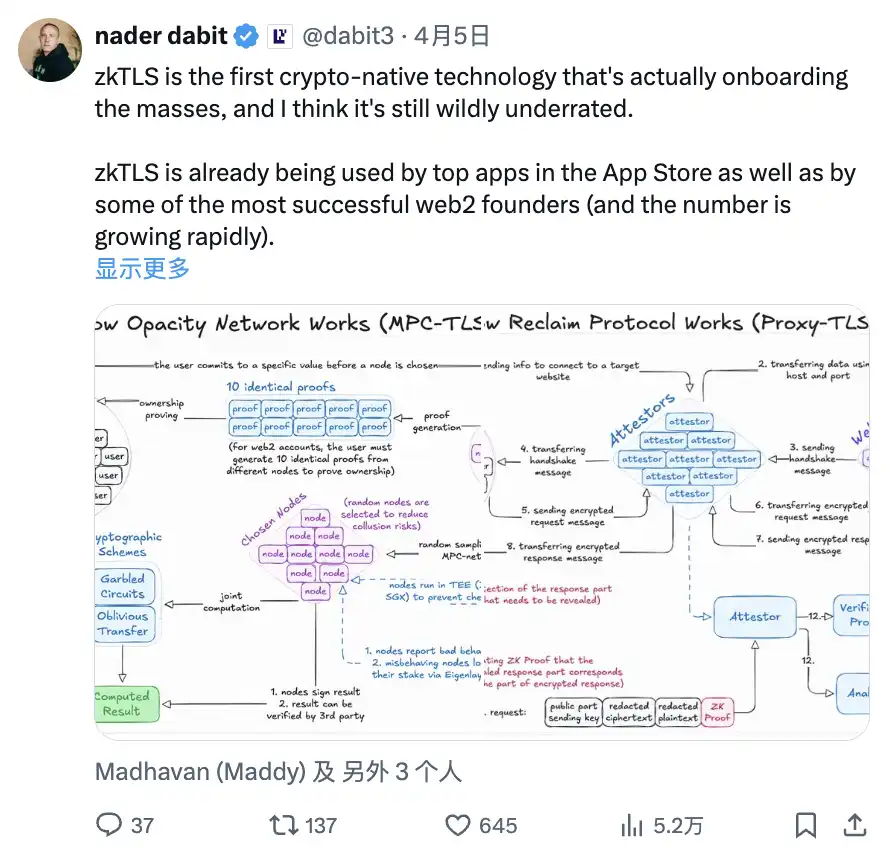
zkTLS is the first truly consumer-friendly native cryptographic technology, which I believe is still severely underrated. zkTLS has already been adopted by top-tier apps in app stores and some of the most successful web2 founders (and this number is rapidly growing)
One use case I often think about is @earnos_io. Through @OpacityNetwork, EarnOS tackles the human-proof problem in internet advertising. As the internet becomes increasingly plagued with fraudulent bot activity, the current cost-per-click model for companies and advertisers is also beginning to crumble.
In this new world, how do consumer companies acquire customers? zkTLS provides Web2 companies with deeper insights from any other Web2 platform. Stablecoins provide the track to reward individuals based on this information.
This is the path for every company to become a crypto company. Blockchain, as the core financial infrastructure, offers simple profit-uplifting opportunities for customers. But they can also provide unprecedented growth and new customer engagement capabilities.
You may also like

Semiconductor stocks plummet, yet Anthropic wants to create a 2nm chip
Where is Zhao Changpeng's billion-dollar investment going? YZi Labs' investment landscape fully revealed
Ethereum Foundation Report: A Basic Guide to Ethereum for Governments and Financial Institutions
A pre-announced harvesting case: After the cryptocurrency price dropped by 99%, the public chain Saga exited to transform into AI
When American giants collectively "defect" from Chinese AI models
BIS Report Compliance Observation: The Real Risks of Stablecoins, Not Just "Depegging"
Portugal 2-1 Croatia: Ronaldo's 20-Year Knockout-Stage Drought Ends With a Debt Finally Collected
Portugal beat Croatia 2-1 in the 2026 global football championship's knockout rounds as Ronaldo scored his first-ever knockout-stage goal, Gonçalo Ramos struck a stoppage-time winner, and VAR ruled out a late equalizer for offside.
Bitcoin Price Prediction July 2026: Will BTC Recover to $70K or Drop Below $55K?
A South Korean company that learned the strategy of hoarding coins, from a bull market to delisting?
WEEX API Broker Program: Turn Your Trading Platform Into a Revenue Engine
How to choose between buying discounted ETH, Bitmine, and SharpLink?
Wosh: Inflation has cooled in recent weeks, AI is reshaping the economy, and forward guidance has lost its necessity
From Pump.fun to Collector Crypt: Has Solana's income throne changed hands?
Dan Bin's latest speech: Don't miss out on a great era
Robinhood launches its own blockchain, no longer wanting to be a tenant on others' chains
Why Tokenized Stocks Are Booming in 2026 While Crypto Is Still Struggling
Looking at Stripe's ambitions and the future of stablecoins from OUSD
Do you want to buy CRCL?
Semiconductor stocks plummet, yet Anthropic wants to create a 2nm chip
Where is Zhao Changpeng's billion-dollar investment going? YZi Labs' investment landscape fully revealed
Ethereum Foundation Report: A Basic Guide to Ethereum for Governments and Financial Institutions
A pre-announced harvesting case: After the cryptocurrency price dropped by 99%, the public chain Saga exited to transform into AI
When American giants collectively "defect" from Chinese AI models
BIS Report Compliance Observation: The Real Risks of Stablecoins, Not Just "Depegging"