
$Ghibli Market Cap Hits New High, Studio Ghibli's "Unofficial CEOs" in Panic


Similar to the DeepSeek effect, ChatGPT's new feature has caused many users who had already abandoned OpenAI to hurriedly renew their memberships, just to experience the transformation of images into Studio Ghibli style. Last night, even the official White House social account transformed a news image into a Ghibli style to ride the trend.
Related Reading: "$Ghibli Surges 100x in Half a Day, GPT-4o's New Feature Sweeps the Internet with 'Miyazaki Style'"
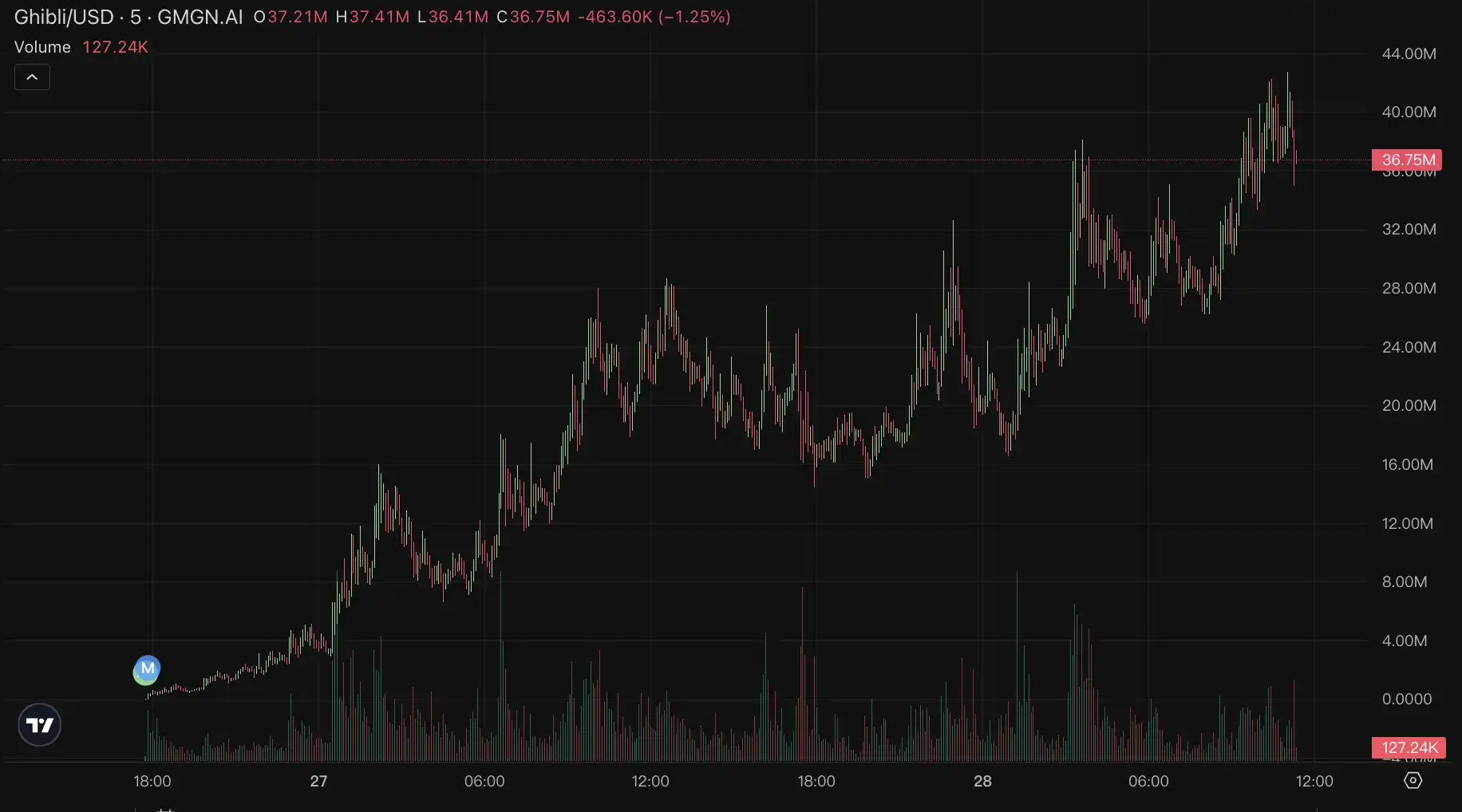
Meanwhile, the Solana ecosystem meme coin $Ghibli has exceeded 40m, reaching a historic high, becoming one of the few "golden dogs" in the lackluster market.
Is This Considered Copyright Infringement?
Following the wildfire popularity of the Ghibli style, OpenAI co-founder Sam Altman expressed surprise at this level of popularity. He said, "I spent the last decade toiling away at AI, trying to help achieve superintelligence to cure cancer and the like. For the first 7.5 years, almost no one cared, and then for the next two and a half years, anything we did would elicit disgust from everyone. Then one day you wake up to hundreds of messages, with countless people telling you that you've been depicted as a Ghibli-style pretty boy."
Ghibli refers to the Japanese Studio Ghibli animation studio, renowned worldwide for producing high-quality, delicately styled animated films. Prominent anime directors Hayao Miyazaki, Isao Takahata, and others founded the studio in 1985, with well-known works such as "Castle in the Sky," "My Neighbor Totoro," "Spirited Away," and "How Do You Live?"
People have been rendering their avatars or meaningful photos into Ghibli style using ChatGPT. In this process, many argue that AI's actions constitute copyright infringement. These voices believe that Miyazaki and Studio Ghibli themselves had to sell themselves to Japanese television networks due to a lack of successors, with each movie barely breaking even at the box office. Meanwhile, the world's leading AI company freely enjoys global acclaim using their style.
"To be honest, witnessing the Ghibli AI trend gives me a strong sense of societal death — the thought that Miyazaki worked so hard to preserve the uniqueness of his works, yet so many of you easily turn decades of artistic dedication into a joke just because you don't truly appreciate it is truly hard to accept."
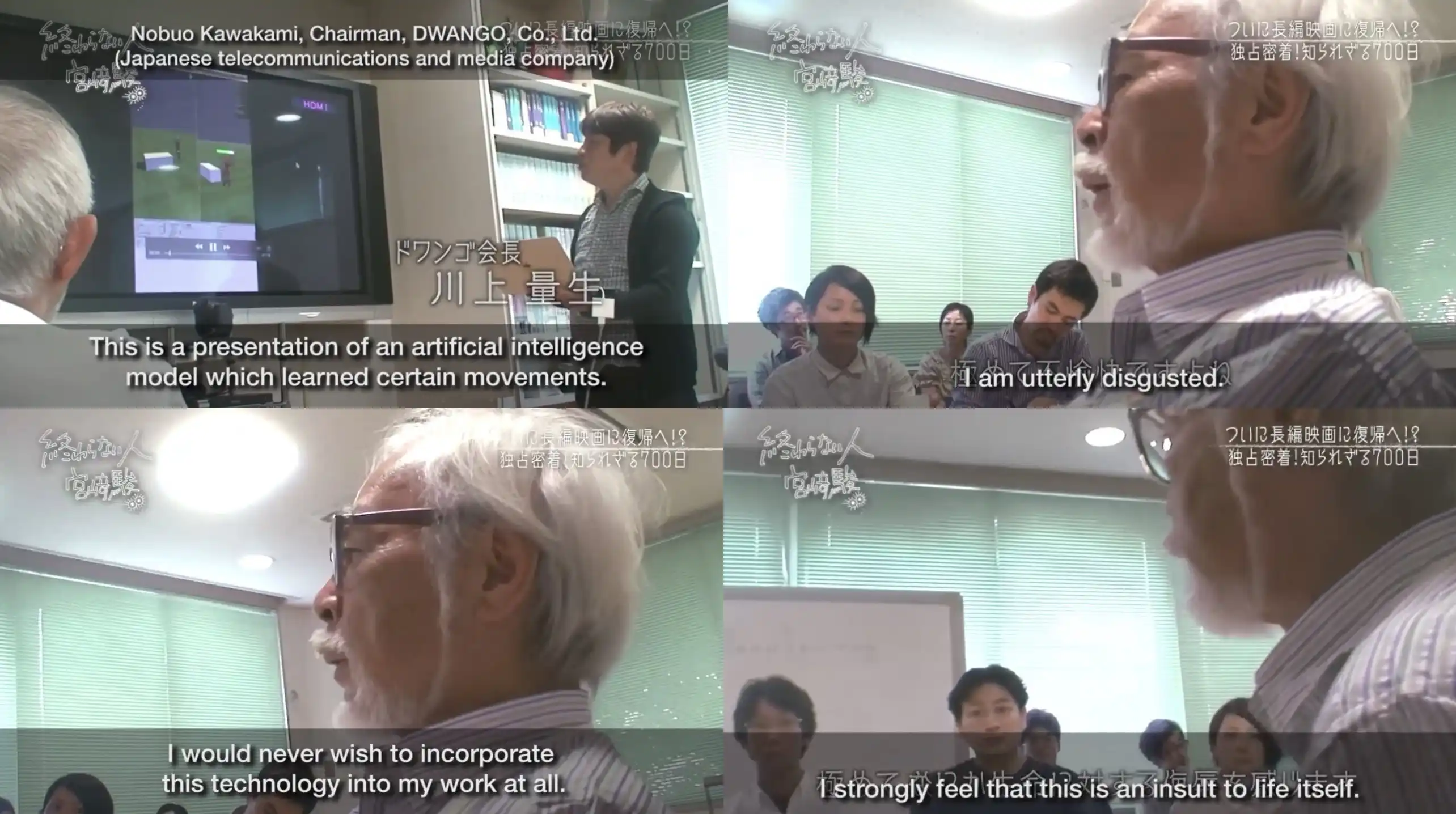
Or perhaps bring up Miyazaki's expressed disgust for AI technology to denounce OpenAI's ethics. The most widely circulated statement is Miyazaki's strong aversion to using this technology in his creations, stating in a demonstration of AI generation, "I feel extreme disgust and am completely unwilling to use this technology in my work. I firmly believe that this is an insult to life itself."
In fact, the widely circulated video presents Hayao Miyazaki discussing a 3D model of a crawling zombie, which he considered a disrespectful depiction of disabled individuals, and did not mention modern AI-generated images.
Someone also forged a letter from a Studio Ghibli legal representative claiming infringement for an AI-generated Studio Ghibli-style app, stating that Studio Ghibli is the sole rightful owner of all related intellectual property, including but not limited to visual style, character imagery, thematic elements, and trademarks.
Some in the community jokingly suggested that the most likely cause of $Ghibli's crash would be Hayao Miyazaki saying, "I hate what Open AI is doing."
However, some "pure love party" members defused this situation with Miyazaki's own words:
“Have you ever worried about the studio's future?”
“The future is clear; the studio will fall apart. I can already see it.”
“But what's the use of worrying? It's inevitable.”
“Studio Ghibli is just a name I randomly picked from a plane. It's just a name.”
“Very beautiful.”
Is Blockchain the Solution?
AI-generated image products from companies like ChatGPT have allowed many people to experience the fun of AI technology, but they have also left many creatives feeling helpless. Media companies like The New York Times have previously sued OpenAI, Midjourney, and others, alleging that they trained their AI models on copyrighted works without proper attribution or payment.
Intellectual property lawyer Evan Brown from Neal & McDevitt interpreted that products like the GPT-4o native image generator are currently in a legal gray area. In copyright law, artistic style is not explicitly protected, which means that if OpenAI only generates images that look like Studio Ghibli films, it may not be illegal.
However, Brown also indicated that OpenAI likely achieved this level of similarity by training on millions of frames from Studio Ghibli animated movies. Courts worldwide are still dealing with the crucial issue of whether training AI models on copyrighted works falls under fair use.
Currently, Studio Ghibli and its parent company, Nippon TV, have not yet responded to this wave of AI-generated content.
Last night, Web3 IP protocol Story founder Jason published an article suggesting that Studio Ghibli may have missed out on millions in revenue if a new creative market could be established where each time AI borrowed a creator's style to generate content, the creator would receive compensation without the need for litigation or disputes.
He stated, "Imagine if Studio Ghibli could earn $0.1 every time its style was used by AI, they could earn a substantial income in just one day. Not only would AI creation remain free and unimpeded, but creators' rights would also be protected. This is a win-win, positive-sum situation."
However, this attempt to find a balance between AI's creative freedom and artists' rights still faces significant challenges. For example, there is currently no legal system that recognizes on-chain protocols as a substitute for copyright law, how to define the "Ghibli style" as a codified standard, or whether commercial companies like OpenAI would choose to adopt blockchain protocols for profit-sharing.
Multicoin co-founder Kyle Samani retweeted Jason's tweet, stating, "In this age of abundance, intellectual property is a concept of the past."
Indeed, the traditional copyright system is no longer suited to the era of generative AI. Copyright is an 18th-century institutional design primarily aimed at addressing the explosive growth in publishing and content dissemination at the time. But now, even if a model did not use a particular style during training, it can generate content in almost any style just from prompts words—indicating that we are already in a completely different world.
Conversely, the current generative AI models theoretically can generate all pleasing musical note combinations known to humans. If someone were to claim copyright over all these, hardly anyone would be able to create music in the future.
Therefore, we need a new mechanism where individuals can directly contribute their data and creativity and receive appropriate rewards based on their originality and the extent to which they expand the model's capabilities.
As Jason discussed in the comments, there is a need for a creative-centric "traceability mechanism" and "incentive mechanism," all built on a blockchain infrastructure to gain recognition by maintaining alignment with the traditional system's legitimacy, much like stablecoins do today.
You may also like

Looking at Stripe's ambitions and the future of stablecoins from OUSD
Do you want to buy CRCL?
Wosh: Inflation has cooled in recent weeks, AI is reshaping the economy, and forward guidance has lost its necessity
The most secretive AI winner
Former ByteDance employee's account: How I started with two Pinduoduo hard drives and made six times the profit with Seagate to achieve financial freedom?
MiCA reshuffle begins, Binance temporarily bids farewell to the EU
How does Gate redo "buying and selling stocks" from the cryptocurrency world to the stock market?
Visa and Mastercard join 140 giants to launch a new stablecoin, but the impact on the market landscape may still be limited
Circle CEO responds to OUSD's challenge: Stablecoins are a winner-takes-all business, and we will not slow down
Argentina vs Cape Verde: When a Record-Breaking Legend Meets an Unbreakable Underdog
WEEX exclusive pre-match analysis of Argentina vs Cape Verde, exploring Messi-led Argentina’s dominance and Cape Verde’s historic defensive breakout, with a breakdown of volatility, structure, and match dynamics.
WEEX Launches Depth Chart for Spot Trading
Raising interest rates to protect STRC and selling coins to maintain credit, this time the strategy has chosen the two most expensive paths
Morning Report | Samsung announces a 265.5 trillion won investment plan, focusing on semiconductor and AI computing power data centers; Vitalik publishes an article detailing the entire technology tree behind the confusion protocol (iO) mainline
In the era of AI, what is left of Bitcoin?
NeoSoul announced plans to integrate with the OKX Agentic Wallet, promoting AI agents' participation in the on-chain economy
Why Is Bitcoin Lagging Stocks in 2026? AI Stocks, ETF Outflows, and the Nasdaq Rally Explained
What you bought on CEX is really not US stocks: Analyzing the 94% liquidation monopoly and the evaporation of equity under a five-layer pipeline
In such a crowded cross-border payment arena, where is the next stop for the future?
Looking at Stripe's ambitions and the future of stablecoins from OUSD
Do you want to buy CRCL?
Wosh: Inflation has cooled in recent weeks, AI is reshaping the economy, and forward guidance has lost its necessity
The most secretive AI winner
Former ByteDance employee's account: How I started with two Pinduoduo hard drives and made six times the profit with Seagate to achieve financial freedom?
MiCA reshuffle begins, Binance temporarily bids farewell to the EU