
Harsh Reality: Unpacking the Three Major Contradictions of the Current Airdrop Market





Original Article Title: "Harsh Reality: The Three Major Contradictions of the Current Airdrop Market"
Original Article Author: 0x Director, Crypto KOL
2024 Airdrop Data Spreadsheet:
https://docs.google.com/spreadsheets/d/10l-dsjtrFiFAPBGmUNqwVZSviJ4O0lRypEd4Oc9tCZU/edit?gid=0#gid=0
Foreword
The current airdrop market has entered a naked scramble for interests. While project teams tacitly allow data manipulation to attract funding, they also engage in large-scale cleansing before the airdrop; meanwhile, airdrop hunters are desperately playing in the dilemma of "you may not get anything if you hunt, but you'll definitely get nothing if you don't." This game without a referee has exposed the most acute contradiction in the airdrop market—the rift between data bubble and real value, and the conflict between short-term gains and long-term ecosystem.
The Director used airdrop data from 100 projects in 2024 to reveal the latest trends and dark rules of airdrops—who is harvesting? Who is being harvested?
1. Project Team Goal Conflict
Core Contradiction: Data Growth Demand (Creating a Bubble) vs. Controlling Token Outflow (Eliminating the Bubble)
"We are well aware that over 80% of the addresses are from studios, but we have to rely on them for ecosystem bootstrapping."
—CTO of a certain L2 protocol
Project teams face a dilemma before TGE:
· Left Hand Creating a Bubble: Allowing studios to batch inflate metrics to create on-chain data prosperity (TVL/trading volume/user count) to attract funding;
· Right Hand Bursting the Bubble: Conducting address filtering before the airdrop, performing large-scale cleansing;
1. Airdrop Type Data Analysis
The Director compiled airdrop rules for 100 projects in 2024 and outlined the percentage of various types of airdrops:
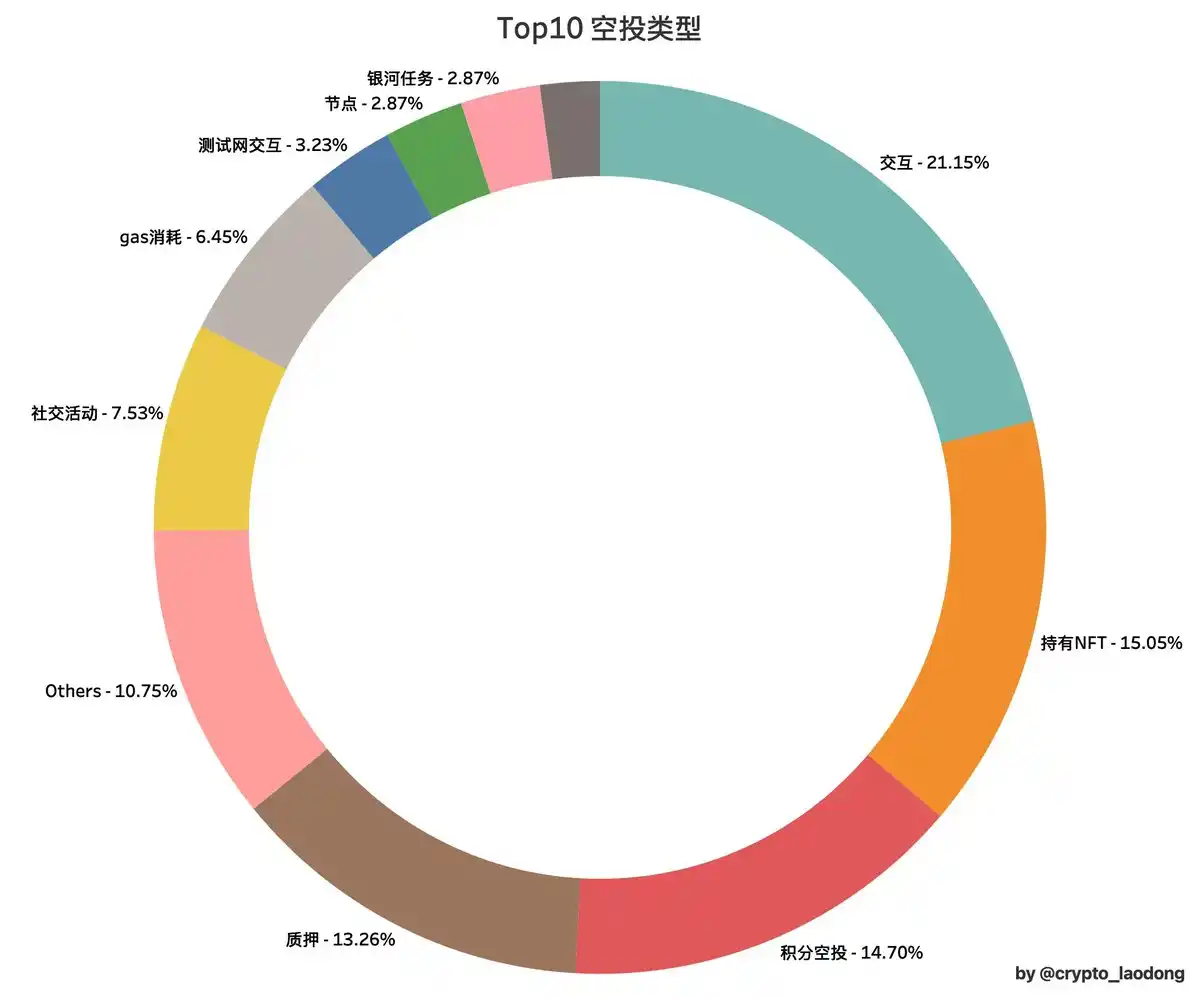
Based on project data analysis, Interaction, NFT Holding, and Points Airdrops constitute the current market's three mainstream mechanisms.
· Interactive Airdrop: The main airdrop method, mainly focused on testnets and mainnets, where projects use a series of tasks, such as Odyssey events, to increase on-chain interaction data and TVL to attract funding. However, excessive interaction can lead to address washing by the project team. For example, 803,000 addresses on LayerZero were identified as witches, 40% of addresses on Linea were identified as witches, and high-frequency interactive users on StarkNet were flagged as bots;
· NFT Holding Airdrop: Secondly, NFTs, OAT, etc., are often used as airdrop vouchers, with most of them requiring continuous tasks to be performed to obtain them, or in the form of whitelisting requiring spending funds to mint. These types of NFTs are usually tradable on-chain, which also poses potential insider trading risks, is difficult to identify, and has concentrated chip control (e.g., FUEL and Berachain's NFTs, with unreasonable airdrop distribution ratios);
· Points-based Airdrop: Currently the mainstream method, different from tokens, points belong to centralized data, are susceptible to tampering, and lack transparency. They can be infinitely inflated and have rules that can be arbitrarily adjusted, casting doubt on the fairness of the airdrop. For example, ME (points of witch addresses are directly reset, and the exchange rate is also different), and Linea (LXP is an SBT, which is another form of points, and holders may ultimately not receive the airdrop). Points-based airdrops also face serious suspicions of insider trading (e.g., EigenLayer's snapshot incident, Blast's points inflation, and IO's controversies over "point shrinkage and point theft," all have possible suspicions of insider trading);
Other types of airdrops such as staking, developer rewards, voting, etc., are also different ways for projects to select airdrop recipients. However, the lack of transparency in the rules, insider trading, and privileged information cast doubt on the fairness of airdrops.
2. Market Games and Project Strategy Choices
The current market is a zero-sum game, with a limited cake. It is impossible to satisfy oneself, VCs, users, and exchanges at the same time. Therefore, project teams must engage in dynamic games to allocate benefits and extract value. Faced with the contradiction of airdrop incentives, project teams usually adopt two typical strategies:
· Sunshine Type: Suitable for small projects or projects with generous rewards, such as HYPT, where there is virtually no screening, and every address is rewarded. These projects are generally blind airdrops with no clear airdrop rules, making it impossible to determine the odds and difficult to attract a large number of studios;
· Strict Screening Type: Suitable for large projects, usually filtering users based on points, interaction frequency, rankings, witch checks, etc., using a last-place elimination system. For example, SCR (only addresses with 200 points or more qualify for the airdrop), Runes (screening through holding inscriptions and NFTs), ZKSync and StarkNet (multi-condition screening), LayerZero (witch reporting system). Although these strategies improve the precision of reward distribution, they also increase participation uncertainty, putting rug pullers in a passive position in the rules game;
2. Participant's Inner Conflict
Core Conflict: To Rug Pull or Not to Rug Pull
Participants also face a dilemma:
· To Rug Pull or Not to Rug Pull If they completely abstain from participating in the project, they will definitely miss out on airdrop rewards. To strive for potential gains, many users have to actively engage in various tasks and activities, investing a significant amount of time and resources, thereby further intensifying market saturation and participant anxiety;
· Even If They Rug Pull, It's Not Guaranteed to Succeed Even with significant investment, there is no guarantee of receiving the rewards. User input does not necessarily correlate with output, as project teams use various means to filter addresses. The complex screening mechanisms lead many participants to lose their airdrop eligibility due to strategic errors or being misjudged as negative actors.
Excessive Competition and Investment Risks
In their quest for limited rewards, users are forced to "rug pull" a large amount of data and activity. However, at the same time, the intricate and opaque rules and strict screening criteria make it difficult for participants to predict their actual returns;
By 2024, out of 100 projects, 32 will explicitly witch-hunt. The screening criteria of most project teams are not disclosed publicly, and the audit process is a black-box operation, entirely controlled by the project teams. Users are like lambs to the slaughter, arbitrarily judged. The following chart analyzes the types of negative actors:
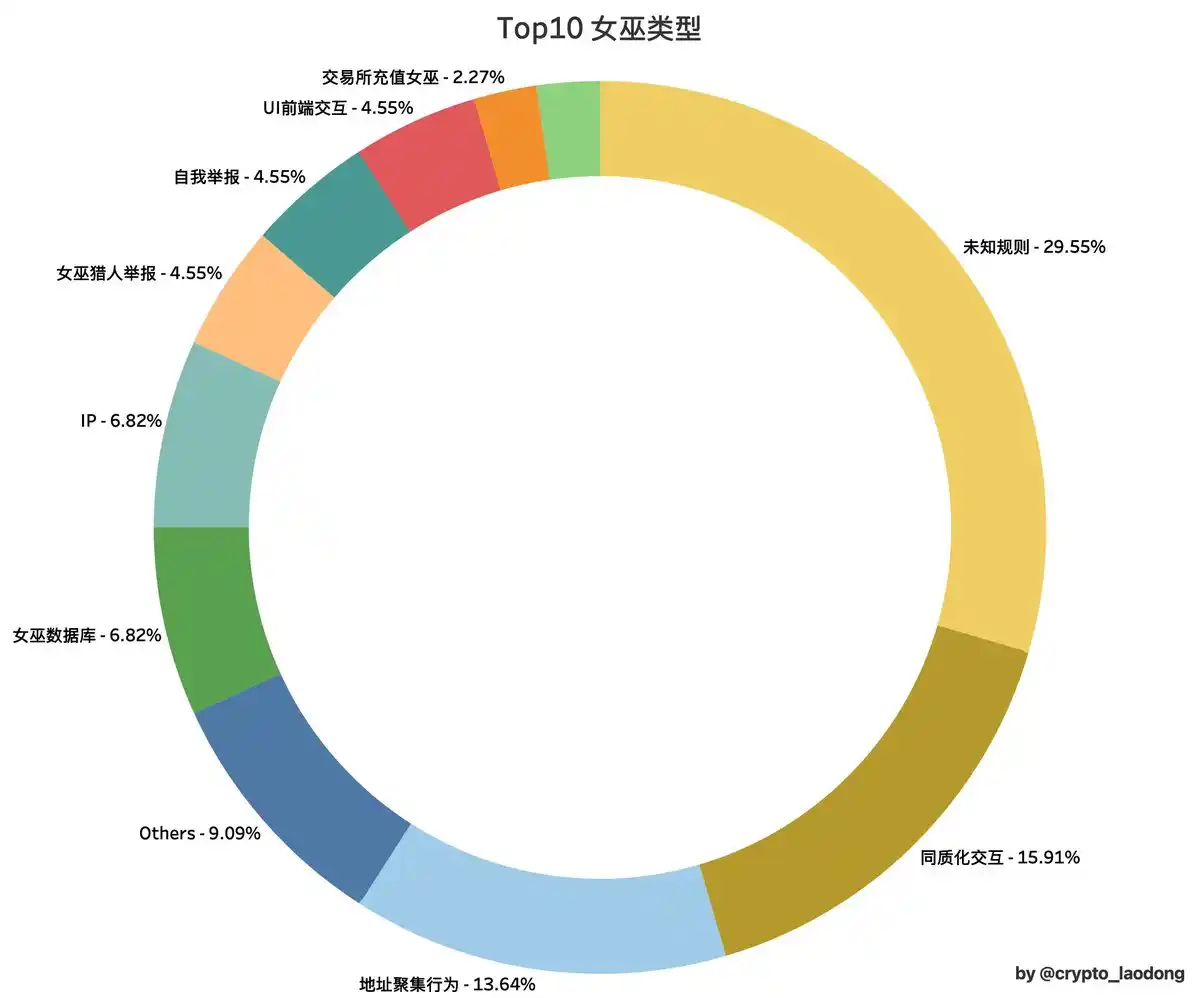
The core criteria for witch-hunting by project teams include:
· Homogeneous Interactions: A large number of identical operation patterns are the main reasons for being identified as negative actors;
· Address Aggregation Behavior: Multiple addresses executing similar operations at the same time and in the same environment are easily identifiable and liquidated;
· IP, Device, Front-end Interaction: More and more project teams analyze user behavior through front-end data, making simple strategies like changing IP addresses or devices ineffective;
To survive in this airdrop game, relying solely on funds and luck is far from enough. It also requires more sophisticated interaction strategies, stronger technical support, higher anti-detection capabilities, and continuous investment and perseverance.
3. Project Team's Conflict with Rug Pullers
The Core Contradiction: A Loss for One is a Loss for All VS A Win for One is a Win for All
In the airdrop incentive game, a "symbiotic" relationship has been formed between the project team and the airdrop hunters, where their fates are closely intertwined:
· Mutual Prosperity: When both parties achieve a relatively balanced incentive mechanism, it can attract a sufficient amount of active data while ensuring ecosystem quality. Both the project team and users can benefit from it;
· Mutual Loss: If either party becomes unbalanced, whether it is due to the project team's improper airdrop strategy or the airdrop hunters excessively gaming the system, it will ultimately have a negative impact on the entire ecosystem, and both parties will find it difficult to thrive independently.
Dynamic Game:
· When participating in airdrop activities, project teams usually set certain thresholds. For example, Linea's Proof of Humanity (POH) certification or IP whitelist thresholds. When the project team sets a loose participation threshold, airdrop hunters can participate in large numbers, leading to a sudden surge in data in the short term. However, once this bubble effect is cleaned up by strict filtering mechanisms, the entire ecosystem may face the dilemma of severe disconnection between data and actual user activity. For example, after LayerZero announced the completion of the snapshot, the number of active on-chain addresses plummeted steeply;
· Conversely, when designing the rules, project teams raise the participation threshold to ensure that only truly active users contributing real value can receive rewards. Although such a high threshold prevents a sudden surge in the number of participants, it leads to a healthy and stable growth of active on-chain addresses, avoiding the creation of a data bubble.
The essence of an airdrop is the dynamic game of interests between the project team and users. For airdrop hunters, to consistently receive rewards, they must strategize meticulously, improve interaction quality, and even build long-term value; for the project team, they should not deliberately pursue funding, aim for a large user base, or focus on short-term prosperity. Instead, their core task should be how to build a long-term sustainable ecosystem and truly provide value support.
You may also like

A company that was on the verge of bankruptcy has just surpassed Bitcoin in market value

B.AI partners with MiniMax to launch a limited-time free experience of M3, enabling zero-threshold implementation of Agentic productivity through full-stack infrastructure

The second half of the computing power battle: Intel CEO Pat Gelsinger reveals how AI is reshaping the global semiconductor supply chain

WEEX Live mode: Monitor 20 trading pairs at once and trade like a pro

Morning Report | Secret Network loses $4.67 million due to cross-chain vulnerability; Michael Saylor releases Bitcoin Tracker information again, may disclose increased holdings data next week

Kalshi's biggest competitor is not Polymarket
WEEX Makes Affiliate Access Easier on the Web and in the App
Customize Your Spot Trading Page: Drag Modules and Move the Order Panel Where You Want It

Perp DEX: The Next Generation Exchange "War"

10 Counterintuitive Insights on Latin American Payments

The AI gamble of mining companies: Valuations enter a phase of differentiation, and it's hard to turn the tide

A letter from Alliance to entrepreneurs: Written on the occasion of Cursor selling for 60 billion dollars
Stablecoins Finally Find Real Returns: On-Chain Reinsurance Re Explained | Interview with Re Founder Karan Saroya

The impossible triangle is simply a pseudo problem

Will MicroStrategy fall into a death spiral? What will the macro trend be in the second half of the year?

Blockchain Capital Partner: The Core Secret of Arbitrage
STRC unanchored by 11%, can the perpetual motion machine of Strategy still operate?

Bitcoin Market Analysis 2026: Can BTC Reach $150K by Year-End?
A company that was on the verge of bankruptcy has just surpassed Bitcoin in market value
B.AI partners with MiniMax to launch a limited-time free experience of M3, enabling zero-threshold implementation of Agentic productivity through full-stack infrastructure
The second half of the computing power battle: Intel CEO Pat Gelsinger reveals how AI is reshaping the global semiconductor supply chain
WEEX Live mode: Monitor 20 trading pairs at once and trade like a pro
Morning Report | Secret Network loses $4.67 million due to cross-chain vulnerability; Michael Saylor releases Bitcoin Tracker information again, may disclose increased holdings data next week
Kalshi's biggest competitor is not Polymarket


