
How to Build a Potential AI Agent Project in a Bear Market?


Original Title: The AI Agent Playbook for Builders
Original Author: Defi0xJeff, Founder of steak studio
Original Translation: zhouzhou, BlockBeats
Editor's Note: This article discusses the correct way to build a crypto AI agent, emphasizing that the agent should complement the core product by changing the user journey to enhance product value, rather than relying solely on the token. Entrepreneurs should focus on solving real-world problems, building a sustainable core product, and then using agents and tokens for promotion and monetization.
The following is the original content (slightly reorganized for easier comprehension):
The market has experienced multiple pullbacks, with liquidity gradually becoming scarcer. Recently launched successful new agents have a maximum market cap of around $10 million.
By "successful," I mean the product has achieved Product-Market Fit (PMF), provided value to actual users, and has started (or is about to start) generating revenue. This is very different from three to four months ago when agents with PMF could have market caps exceeding $1 billion, especially if they positioned themselves as agent+framework/launchpad tokens. For example, AVA as a 3D agent not only serves as an agent itself but also derives value from the launchpad and supported projects through its sensory layer.
Old Playbook: Agent as Framework
The previous approach was to launch an agent to showcase its capabilities, attract developers looking to build their own agents, and require these developers to hold/burn/pay agent tokens to access the framework. The issue was that the crypto community assigned too high a premium to framework tokens, and these "framework agents" often lacked differentiation. In many cases, they did not even have a product—they were just talking on Twitter, hoping for token price appreciation.
The first version of agents treated the conversational agent itself as a product, which is unique in the crypto space as we value community building more—similar to founder-led marketing (founders gaining attention through constant chatter). Having agents constantly chatter for your project to increase visibility seemed like a good idea—it worked well when first launched in November 2024, lasting a month. But now, with 420,690 agents constantly chattering, most agents seem immature, repetitive, and frankly annoying.
Playbook: Agent as a Business
Here is how you should think about launching an agent — launching an agent means you will be operating a startup while managing up to three products:
1. Core Product (Real Business)
Your core product should solve a real-world problem. It should not just be a conversational agent but a true product.
Example:
· Improve sports betting odds prediction models to help users win more in sports betting (e.g., crypto community AskBillyBets).
· Develop a crypto asset prediction model that enables better trading, minimizes impermanent loss, and maximizes liquidity provider returns (e.g., crypto communities Cod3xOrg, gizatechxyz, and Almanak).
· Aggregate insights from top alpha sources (such as Cookie, Kaito, Nansen, Messari, Aixbt, CG, Dexscreener, and Bubblemaps) into an AI agent research search engine to aid investment decisions (currently, no team is solving this problem — we need an AI agent like Perplexity).
The core product should be the top priority before any team launches a token. You need to ensure there is actual demand in the market and users are willing to pay for it. Otherwise, you will fall into the "crypto valley," the consequences of which may be more severe than traditional startups:
· High operational costs.
· Token-funded customer acquisition costs (CAC).
· Token price crash → Reputation collapse → No one cares about your project.
If your token crashes, it becomes a curse. Most people won't care about your project regardless of how strong your core product is or how much progress you've made.
Instead of relying on token incentives, focus on attracting customers through your product. Find a balance between growth and revenue-generating business models.
The playbook of the crypto community KaitoAI is a good case study:
· They built an enterprise product — a crypto search engine focused on social/emotion/narrative and charged users, projects, and the ecosystem, providing real value.
· They launched the Mindshare Dashboard, becoming the standard for tracking narratives and trends.
· They intensified their efforts by introducing the Yapper Leaderboard, allowing KOLs to spontaneously share it as a status symbol.
· They further rolled out NFT WL and KAITO airdrop, incentivizing Twitter engagement through actual rewards.
This approach is not easy to replicate, but the lesson is: first find PMF, generate revenue, get people excited before launching the token. Once you have attention (hype) and revenue, you can move to the next level.
Similarly, communication is crucial. Many projects have strong products but poor communication skills. If no one knows what you are doing, no one will care.
2. Token (Alignment Tool)
We have transitioned from "VC coins" to "fair launch," celebrating tokens with high circulation and low FDV. But fair launch is not entirely fair—every token strategy has its trade-offs.
If the token you launch has a high circulation and low FDV structure, you will not be able to raise funds from VCs and angels (because of undervaluation). However, you can use the token as a marketing tool to kickstart ideation sharing.
Many teams will launch two types of tokens:
· Protocol Token → Kickstarts Ideation Sharing.
· Ecosystem Token → Raises funding from VCs and angels at a higher valuation.
But this creates an expectation mismatch—communities expect airdrops, and when the ecosystem token is released, capital moves from the protocol token to the ecosystem token, leading to a collapse in the protocol token price. Managing the core product + protocol token + ecosystem token while ensuring value accrual for each token is very complex.
In an ideal world, there should be a token that accumulates all the value from the core product. Historically, projects that could generate revenue and funnel it back into the token (through buybacks or revenue distribution) have been able to survive long-term.
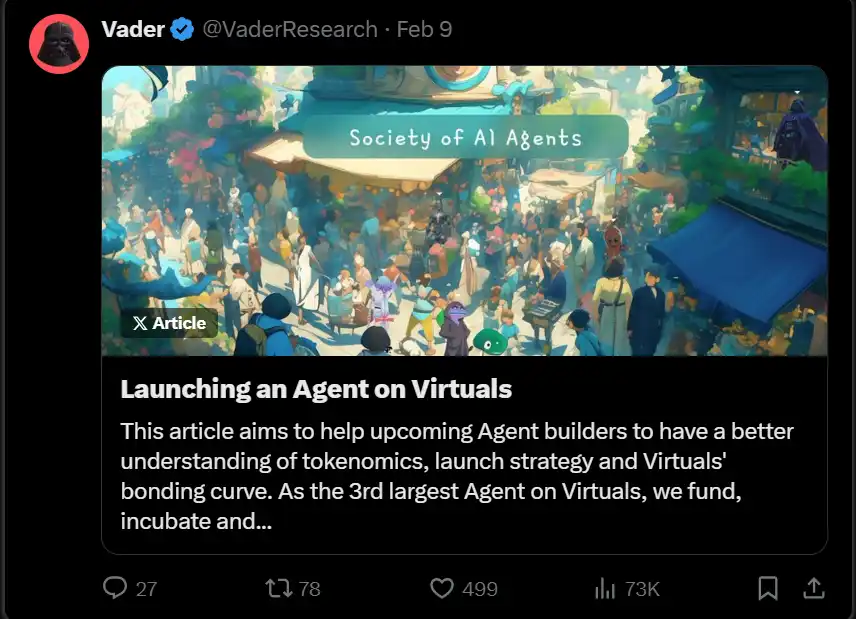
Tokens should complement the core product, not be a necessity. To delve deeper into protocol token strategy, please refer to the crypto community VaderResearch's analysis of the protocol token playbook for the crypto community at virtuals io.
3. Agent (Supplementary Product)
「Agent」 refers to conversational agents built using frameworks like ElizaOS, G.A.M.E, ARC, Pippin, etc. While these agents integrate on-chain/off-chain capabilities, they should be supplementary products to the core product.
Agents should enhance the value of the core product by altering the user's path:
Instead of having users actively seek out and use your product, let the agent bring the product to them.
This could mean:
· Showcasing the product directly on Twitter through text/video.
· Having the agent act as an AI companion, changing the user's interaction style (similar to ChatGPT's abstraction).
· Using the agent as the interface itself, executing tasks in the background.
Of course, there are exceptions. An example is the aixbt agent—it provides real-time social and sentiment analysis from Twitter, allowing users to access real-time Alpha signals ahead of others. Aixbt, by consistently providing Alpha, showcases the terminal's capability and has become the No. 1 KOL in CT. In this case, the agent itself is the product.
However, this model is extremely challenging to replicate. Most projects should focus on strengthening the core product first.
A successful product-first case study is cookiedotfun:
· Starting with a free AI agent dashboard to attract users.
· Transitioning to a freemium model by locking COOKIES to unlock advanced insights.
· Monetizing through providing API for projects and agents.
· Launching agentcookiefun to directly bring insights to Twitter.
Summary
In 2020-21, launching a token required mastering Solidity. But now platforms like pumpdotfun make it easy to tokenize anything.
This shift in mindset—people no longer focusing on building real products but directly launching tokens—is a "garbage in, garbage out" approach, leading capital to quickly move to the next "garbage." We need to change this.
To build sustainable projects, agent projects should be treated as startups. Instead of seeking funding between CT, VCs, and angel investors, it's better to build projects with long-term value—not for the next 6 months but for the next 6 years.
Innovation, solving real-world problems, building real businesses — not just creating the next speculative meme coin farm.
The future of the crypto AI agent depends on this.
You may also like

The large models in the United States are moving towards closure in the name of security

Morning Report | CoinEx becomes a key hub for Iran to evade sanctions, involving over $3.8 billion in funds; Kalshi seeks a new round of financing, with a valuation potentially rising to $40 billion

From the white-haired stock god to the billionaire fund mogul, the smart people shorting Nvidia are all getting rich using the same framework

Why do cryptocurrency projects always like to change their names?

Global Launch: As predictions become the most scarce asset in the AI era, Manadia is defining the next generation of the value internet

Who is footing the bill for the $64 billion accounting frenzy?
I never expected that the first application of AI x Crypto would be in security auditing

What is your view on Binance's competitive advantages?

ETH has entered a non-consensus phase, and the turning point is approaching!
The shift in the cloud of the air: from despising stablecoins a year ago to the high-profile entry of capital today
The survival dilemma of small and medium exchanges behind the withdrawal anomalies exposed by AscendEX
Why Is Bitcoin Falling Below $60K? 5 Key Market Drivers Explained
Bitcoin has dropped sharply amid ETF outflows, Strategy stock weakness, AI stock rallies, and changing Fed expectations. Explore the key forces driving BTC’s latest correction and what traders should watch next.

Bitcoin vs. Gold in 2026: Which Asset Performs Better in Different Markets?

Morning News | The draft amendment to the People's Bank of China Law aims to clarify the legal status of digital renminbi; South Korea will transfer about 40 unregistered virtual asset service providers to law enforcement agencies
The cryptocurrency industry has entered the "Show Me" era: merely relying on vision is no longer enough

Interpreting the Ethereum Foundation's new structure: Reaffirming self-sovereignty amid institutional trends
Former SpaceX engineer reconstructs the financial execution system using first principles
Standard Chartered Bank sings a 50x rhapsody again, aiming for AAVE to reach 3500 USD
The large models in the United States are moving towards closure in the name of security
Morning Report | CoinEx becomes a key hub for Iran to evade sanctions, involving over $3.8 billion in funds; Kalshi seeks a new round of financing, with a valuation potentially rising to $40 billion
From the white-haired stock god to the billionaire fund mogul, the smart people shorting Nvidia are all getting rich using the same framework
Why do cryptocurrency projects always like to change their names?
Global Launch: As predictions become the most scarce asset in the AI era, Manadia is defining the next generation of the value internet
Who is footing the bill for the $64 billion accounting frenzy?


