
- Buy Crypto
- Markets
 Futures
- Spot
- Copy Trade
- Earn
- More
I don't even dare to play DeFi anymore, just look at these four safe investments with a stable 10% APY.

The market is in a state where it's hard to distinguish between a bull and a bear, and everyone is afraid to trade coins. Putting money into DeFi for yield farming, only to find out that DeFi has also suffered a smart contract exploit.
Therefore, this time, let's not talk about those projects promising returns of tens or even hundreds of percentage points, nor encourage fancy strategies. The BlockBeats team has selected a few pools that are relatively stable in the current market, with APY around 10%, and have been validated over time both on-chain and off-chain. These are all viable options in the current market.
Overall, the BFUSD pool on Binance still stands out in terms of comprehensive advantages, including yield rate, mechanism design, use case expansion, and risk structure, compared to similar products.
Binance: BFUSD (11%)
The APY of BFUSD's pool fluctuates dynamically with funding rates and hedging strategies, averaging around 4%-7% recently and currently standing at approximately 6.34% in actual APY. Earnings are distributed daily without the need for additional purchases; holding the asset is sufficient to automatically claim rewards.
Perhaps to commemorate the one-year anniversary of BFUSD's launch, Binance recently introduced an additional yield activity. During this period, participants can enjoy an additional 5% bonus on top of the base APY.
This means that eligible users can enjoy a comprehensive APY of around 11% within the specified limit.
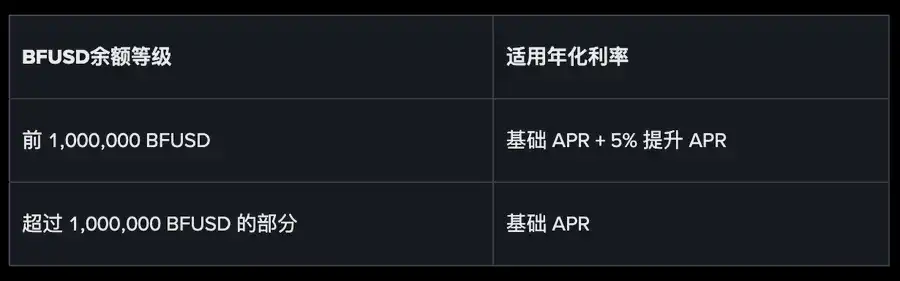
There are two participation requirements: holding BFUSD in a futures account or a unified account and maintaining a minimum open position of 1,000 USD in a USDT-margined or coin-margined futures account. Binance will take multiple random snapshots of users' open positions each trading day and determine eligibility based on the lowest snapshot value. The activity has been extended until December 2.
Another attractive feature is that in the "cross-margin" mode, BFUSD can be directly used as collateral for futures trading, enhancing capital efficiency while earning rewards.
Each account has a cap of 1 million BFUSD for additional earnings. However, the cap for sub-accounts is calculated independently, allowing users with larger capital to maximize their gains through multiple accounts and sub-accounts.
After all, this is Binance; the security level is relatively high, it involves stablecoin yield farming, and currently offers the highest return among these four options, making it worth considering.
Sky: sUSDS (9.4%)
The Sky Protocol's sUSDS savings pool currently offers an APY of 4.50%, with earnings coming from its core Sky Savings Rate (SSR) mechanism. Across the entire product matrix, including sUSDS savings (4.50%), SparkLend lending (3.55%), and traditional DAI DSR (1.25%), these three together form Sky's stable income system.
The current Total Value Locked (TVL) in the protocol is $59.3 billion and has achieved multi-chain deployment.
Among these options, the Sky Savings Rate (sUSDS) still offers the optimal risk-to-reward ratio. The current APY is 4.50%, and DeFiLlama's predictive model shows that it is likely to remain above 3.60% in the next four weeks. The TVL of this pool is $37.37 billion, indicating a robust scale. Users need to hold USDS before depositing to receive sUSDS.
Specific ways to acquire USDS include: upgrading DAI to USDS at a 1:1 ratio (fee-free); exchanging USDC or USDT through the PSM mechanism; or directly swapping ETH for USDS on the CoW Protocol. Once authorized, deposit the USDS into the savings pool to automatically mint sUSDS and start earning interest.
In addition to the base yield, the protocol also offers SKY token rewards (STR) as an additional source of income. The current additional APY for this portion is 4.91%, also calculated based on the sUSDS amount. If stacked together, the theoretical total yield can reach approximately 9.41% (4.50% base yield + 4.91% SKY reward).
To participate, deposit sUSDS into the designated farm to start receiving SKY rewards. However, please note that SKY rewards need to be claimed manually, and there is price fluctuation risk of the token, which may impact the actual yield.
Lista: slisBNB (10.8%)
It goes without saying the significant position of Lista DAO on the BNB Chain, Lista DAO has built a relatively complete DeFi ecosystem on the chain, with the most core product being the slisBNB staking pool. The current APY of this pool is approximately 10.8%, and the overall protocol has a total locked value of $18.3 billion.
In addition, Lista also provides a lending pool, stablecoin CDP minting, and various liquidity mining pools, with returns ranging from 2% to 15%, covering a wide range of strategies from conservative to aggressive.
The core asset, slisBNB, currently has a TVL of around $1.2 billion. It maintains a 1:1 redemption relationship with BNB, and its price continues to appreciate as staking rewards accumulate. All slisBNB tokens are fully backed by real BNB staked on validator nodes, following a non-custodial mechanism that offers relatively high security and transparency. The protocol deducts a 5% fee from staking rewards for treasury income, which has a minimal impact on users' overall APY.
The base BNB validator staking reward is approximately between 7%–8%; after deducting fees, Lista further enhances the overall yield through LISTA token incentives, stabilizing the final APY at around 10.8%; all earnings are automatically reinvested in the slisBNB price, requiring no manual action from users, additional staking, or reward claiming—holding automatically leads to growth.
The operational process is also quite simple. Users only need to connect their wallet, deposit BNB, and the system will automatically mint slisBNB and start generating returns. There is no need for additional actions; earnings will continue to accumulate and be reflected in the token price.
Jupiter: JupSOL (6.58%)
As the largest DEX aggregator in the Solana ecosystem, Jupiter, with JupSOL, has become one of the most core staking pools on-chain. Currently, JupSOL offers an annualized yield of about 6.58%, with a total locked volume of approximately $2.91 billion in the entire Jupiter-related ecosystem.
In addition to JupSOL staking, Jupiter also features a lending market, perpetual contract liquidity pools (JLP), aggregated trade routing, etc., and supports direct entry into the ecosystem through jup.ag, while stacking JUP governance token rewards, forming a complete Solana-side financial network.
Among all products, JupSOL is the most core and stable. Its earnings mainly come from SOL validator staking rewards, averaging between 5%–7%, with technical support provided by the Sanctum infrastructure, no lock-up period, and the freedom to use in DeFi at any time. JupSOL's earnings continuously roll over in an auto-compounding manner, re-staking every hour, allowing holders to continuously receive incremental returns. Additionally, a portion of deposits from Jupiter Perps will be automatically staked to enhance the overall pool's yield structure. Users only need to connect their Solana wallet, exchange SOL for JupSOL, and can immediately start accumulating returns. Of course, this is assuming you can withstand a SOL price drop.
Furthermore, Jupiter's lending market offers another, more strategic avenue for earning yield. Assets such as USDC, USDT, USDG/USDS, SOL, JUP, and major assets like ETH and WBTC can participate in depositing or borrowing, with deposit APY ranging from 4% to 7%, while borrowing rates adjust dynamically based on utilization. The platform allows for higher loan-to-value ratios, with the highest LTV among stablecoins reaching up to 95%, suitable for leverage cycling: users can deposit USDC, borrow SOL, then swap SOL back to USDC in a continuous loop to amplify yield potential, but risks will also be proportionally increased. For those preferring stability, the JupSOL staking currently offers a better choice with an APY of 6.58%.
You may also like

Full text of the Federal Reserve's decision: Maintain interest rates unchanged and expect one rate cut within the year, with Governor Mulan casting a dissenting vote

Guarding billions in assets, yet unable to sustain itself: Tally bids a dignified farewell after five years

SEC’s Stance on Crypto Assets: Most Not Considered Securities
Key Takeaways: The SEC’s new interpretation categorizes most crypto assets as non-securities under federal law. This move aims…

South Korea’s New Crypto Seizure Guidelines After Asset Mismanagement Incidents
Key Takeaways: South Korea’s National Police Agency (KNPA) has drafted guidelines for crypto seizure, with a focus on…

Institutional Confidence in Crypto’s 2026 Growth Trajectory
Key Takeaways: A significant 73% of institutional investors plan to increase their crypto holdings by 2026. Exchange-traded products…

Ethereum Reduces Bridge Times by 98% with Fast Confirmation Rule
Key Takeaways: Ethereum introduces the Fast Confirmation Rule (FCR) aiming to cut bridge times from L1 to L2…

Crypto Firms Advocate DeFi Education in US Colleges
Key Takeaways: Twenty-one crypto organizations have called on US colleges to integrate decentralized finance (DeFi) into their curricula…

RedotPay Reorganizes Amidst Funding Tries and IPO Goals
Key Takeaways: RedotPay is facing leadership changes and concerns over its connections with mainland China while eyeing a…

Bitcoin ETF Streak Nears October Highs While Inflows Lag Behind
Key Takeaways: US spot Bitcoin ETFs have continued their inflow streak for seven straight days, accumulating $1.2 billion…
Connecticut Suspends Bitcoin Depot as Revenue Prospects for 2026 Worsen
Key Takeaways: Connecticut halts Bitcoin Depot’s operations, citing regulatory breaches related to the Money Transmission Act. Bitcoin Depot…

DAO Governance Platform Tally Shuts Down Due to Market Challenges
Key Takeaways: Tally, after operating for five years, is shutting down due to a lack of viable business…
Trump Memecoin Shows Volatility Amid Mar-a-Lago Event
Key Takeaways: TRUMP memecoin holders surpassed 83 wallets with over one million tokens after a luncheon announcement with…
Bitcoin Surge in Australian E-commerce Faces Banking Hurdles: In-depth Analysis
Key Takeaways: Cryptocurrency usage in Australia for purchasing goods and services doubled from 6% to 12% in 2026.…

Meta Shuts Down Horizon Worlds VR for Mobile-Centric Strategy
Key Takeaways: Meta is transitioning Horizon Worlds from a VR to a mobile-centric platform starting June 2026. The…

Bitcoin Exchange Inflows Surge Amidst $75,000 Resistance
Key Takeaways: Bitcoin inflows to exchanges have spiked to 6,100 BTC, hinting at potential selling pressure. The large…
Bitrefill Identifies Lazarus Group Behind Cyberattack and Stolen Funds
Key Takeaways: Bitrefill suffered a cyberattack on March 1, likely orchestrated by the infamous Lazarus Group using sophisticated…
Coin Center Advocates for Rulemaking Over No-Action Letters in Crypto Regulation
Key Takeaways: Coin Center challenges the SEC’s reliance on no-action letters, promoting a shift toward comprehensive rulemaking in…
On the eve of the Fed meeting, are traders starting to bet on a rate hike?
Full text of the Federal Reserve's decision: Maintain interest rates unchanged and expect one rate cut within the year, with Governor Mulan casting a dissenting vote
Guarding billions in assets, yet unable to sustain itself: Tally bids a dignified farewell after five years
SEC’s Stance on Crypto Assets: Most Not Considered Securities
Key Takeaways: The SEC’s new interpretation categorizes most crypto assets as non-securities under federal law. This move aims…
South Korea’s New Crypto Seizure Guidelines After Asset Mismanagement Incidents
Key Takeaways: South Korea’s National Police Agency (KNPA) has drafted guidelines for crypto seizure, with a focus on…
Institutional Confidence in Crypto’s 2026 Growth Trajectory
Key Takeaways: A significant 73% of institutional investors plan to increase their crypto holdings by 2026. Exchange-traded products…
Ethereum Reduces Bridge Times by 98% with Fast Confirmation Rule
Key Takeaways: Ethereum introduces the Fast Confirmation Rule (FCR) aiming to cut bridge times from L1 to L2…


 App
App