
"Is the 'Big Pullback' Just Getting Started?"

Original Article Title: "Is the 'Great Pullback' Just Beginning?"
Original Article Author: Bootly, via BitpushNews
Bitcoin has once again experienced its most intense pullback of the year, dropping from around $90,000 in a single day to near $83,600. Alongside the price plunge, over $500 million in long positions were liquidated, pushing the market's fear index close to "extreme fear" once again.
What seemed like a sudden crash actually conceals a deeper structural change. Macro liquidity is shifting, derivative leverage is accumulating, and the technicals have already seen a mid-term breakdown, with these three forces almost simultaneously pressing down on Bitcoin.
The previous rally seemed to have priced in the entire market's expectations for the "rate cut cycle" in advance; now, the market is repricing—reevaluating what price true liquidity is willing to pay for Bitcoin.
The "Overextended Effect" of Bitcoin's Rally is Starting to Show
If you observe Bitcoin's trend this year on a longer time frame, you will notice a clear phenomenon: since the approval of the spot ETF, the rapid surge has been both faster and larger in scale than any previous rally.
This "excessively steep" market movement is known in macroeconomics as expectation overshooting: the market prematurely prices in all future easing, growth, or capital inflows, and when the actual conditions do not materialize immediately, prices are more prone to free fall.
The pullback from the high of over $125,000 to the $80,000s is not just a routine technical correction but more like a backlash against this year's excessive optimism.
The first signal of this backlash comes from the ETF world.
In November, Bitcoin spot ETFs saw a net outflow as high as $3.5 billion, marking the worst-performing month since February. ETFs, as a major allocation tool for traditional funds, often represent the stance of "smart money" with their inflows and outflows. The consecutive outflows now indicate that the pace of external incremental funding has slowed.
At the same time, Kaiko's data also shows that Bitcoin's order book "market depth" (a measure of how resilient its price is to large trades causing fluctuations) has been hovering around $568.7 million over the past weekend, lower than the peak of $766.4 million in early October, plummeting nearly 30% in the past month. Any large trades will bring about greater price swings—and with leveraged trading at a high scale, this has become a hidden trigger point.
The Stronger the Rate Cut Expectation, the More Market Jitters
Every significant Bitcoin price fluctuation cannot be ignored in the macro background.
At first glance, the market has priced in the probability of a December rate cut by the Federal Reserve to nearly 90%, which should be a bullish signal for risk assets. However, in reality, the current "rate cut expectation" is different from before—it is more like the market pressuring the central bank to send a dovish signal.
The issue is that a rate cut itself cannot immediately bring new liquidity.
With inflation still not returning to the 2% target, the Federal Reserve's true easing space is very limited. Therefore, the market is beginning to doubt: Will there be enough new money in the future to drive risk appetite assets back up? This doubt usually does not show up in economic data but is often answered first by high-volatility assets.
A more sensitive trigger comes from Japan.
This week, Bank of Japan officials made a rare statement that they might consider a rate hike, quickly raising global concerns about a possible reversal of the "yen carry trade"—if investors have to cover the yen instead of continuing to borrow yen to buy U.S. stocks or crypto assets, then the global risk market could enter a period of "passive deleveraging."
Market sentiment is much more fragile under macro disturbances, and as the forefront risk asset, Bitcoin is the first to bear the brunt.
Looking back at an interesting change: just a few days before the drop, most traders in the Myriad prediction market still believed that Bitcoin "would first hit $100,000"; but after the downturn, this expectation instantly reversed, with nearly half now betting on "first falling back to $69,000."
This drastic shift in sentiment is the most typical feature of the crypto market:
During an uptrend, the market is willing to believe in any positive news; but once a rapid downturn occurs, the market will immediately embrace the most pessimistic narrative.
Technical Analysis Enters the Mid-Term Bearish Zone
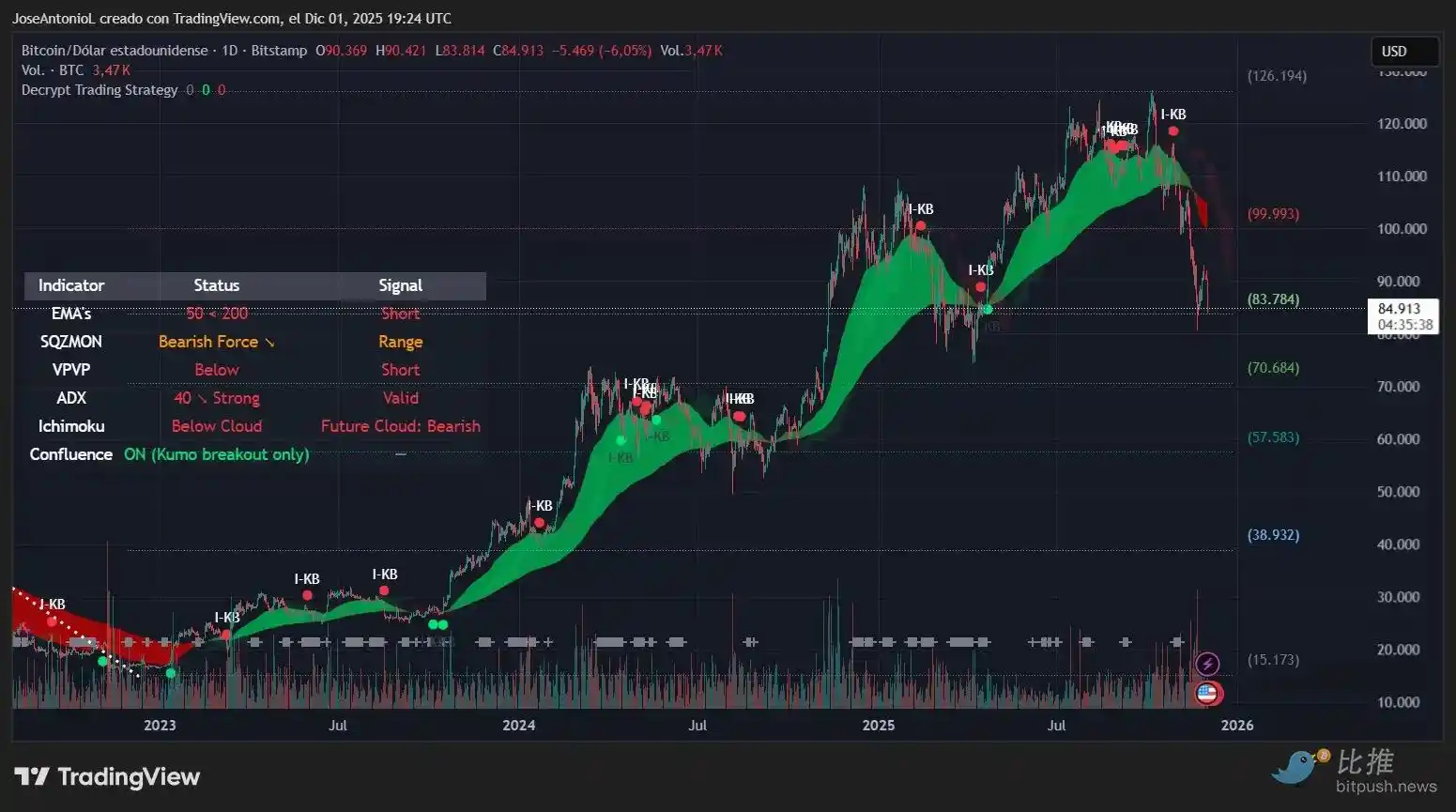
If we observe from a trading technical indicator perspective, Bitcoin's technical structure has undergone a significant change, as analyst Jose Antonio Lanz stated:
· The 50-day moving average has crossed below the 200-day moving average, forming a typical "death cross," which is a clear signal of a mid-term trend reversal;
· The ADX (an indicator of trend strength) has risen to 40, indicating that the market is entering a trend that is clear in direction and rapid in speed;
· The Squeeze Momentum indicator and other momentum indicators still show that the bearish momentum release has not ended yet;
· The current price level of around $83,000 is a key pivot point from the past few months. Once broken, the next major support level is around $70,000.
As the market continues to search for a bottom, a noteworthy development from the traditional financial world has emerged: Vanguard, a major asset management giant that has long viewed cryptocurrency as a "speculative asset," has suddenly announced that it will allow clients to trade cryptocurrency ETFs.
This shift comes amidst the backdrop of the cryptocurrency market losing over a trillion dollars in market capitalization since October. The signaling effect of this move is complex. In a trend reversal, whether the entry of a single institution is enough to reverse sentiment remains a question mark.
Because the market currently appears to be in more of a trend reversal stage rather than a simple retracement. Trending downward trends tend to last longer than emotional downturns and are more difficult to reverse through short-term bullish news.
For the average investor, the most important thing in this type of environment is not predicting "how low it will go," but understanding why the market has reached this point, how long the future volatility may continue, and whether they can withstand such volatility.
The stage of risk repricing is where mistaken killings are most likely to occur, as well as overselling; but it also eliminates all positions based on fantasies.
Bitcoin is currently undergoing such a process.
You may also like

The pricing controversy of Trade.xyz exposes the fatal weakness of Pre-IPO perpetual contracts

World Cup 2026 Coming – WEEX Celebrates with $1M Prize Pool & Michael Owen Live

Galaxy in-depth report: Is Solana still worth paying attention to?
Young people in South Korea make a "final effort" in the epic bull market

Dialogue with OmenX Founder: Why does the prediction market need an evolution from "spot" to "derivatives"?
When the P2P illicit funds from ten years ago turned into 60,000 bitcoins

Morning News | CME Group launches Nasdaq Cryptocurrency Index futures; Asset management giant Janus Henderson strategically invests in Ethena

Why did Oracle deliver the strongest financial report in history, yet its stock price fell?

Bitcoin Layer 2 Network Botanix: Why Did We Choose to Dissolve?

Morning Report | OpenAI has submitted an S-1 registration statement draft to the U.S. SEC; Morpho completes $175 million financing

Galaxy Deep Research Report: How Hyperliquid's HIP-4 Upgrade Changes the Landscape of Prediction Markets?

Latest research from 13 top universities including Cornell University: The current state, challenges, and misconceptions of the fusion of Crypto and AI
Deconstructing Anthropic: The Best AI Company, Possibly Also a Type of Organizational Invention

Every exchange is a "Universal Exchange."

The counterattack of traditional finance: Alliance chains are quietly reviving
Pantera Capital Partner: How Tokenization is Restructuring the Private Equity and Early Investment Ecosystem?

Mastercard Launches Agent Pay for AI, Plans to Record AI Agent Payment Authorizations on Polygon
Mastercard launched Agent Pay for AI, a new payment protocol designed to help AI agents make small payments such as pay-per-use access to data and APIs. The system plans to record human-granted AI agent permissions on Polygon, focusing on verifiable authorization, identity, and payment controls.

Curve Deploys Llamalend v2 on Optimism With 250,000 OP Incentives
Curve launched Llamalend v2 on Optimism with 250,000 OP incentives from the Optimism Foundation. The upgrade expands Llamalend beyond its earlier crvUSD-focused model, adding broader collateral support, LlamaRisk market reviews, and the ability to use Curve LP tokens as collateral.
The pricing controversy of Trade.xyz exposes the fatal weakness of Pre-IPO perpetual contracts
World Cup 2026 Coming – WEEX Celebrates with $1M Prize Pool & Michael Owen Live
Galaxy in-depth report: Is Solana still worth paying attention to?
Young people in South Korea make a "final effort" in the epic bull market
Dialogue with OmenX Founder: Why does the prediction market need an evolution from "spot" to "derivatives"?
When the P2P illicit funds from ten years ago turned into 60,000 bitcoins


