
- Buy Crypto
- Markets
 Futures
- Spot
- Copy Trade
- Earn
- More
「Leading Lady」 Noble Leaves the Stage, Is the Cosmos Ecosystem Now a 「Hollowed Shell」?

Original Title: "Noble Leads the Way Out, Another Solid Confirmation of 'Cosmos Is Dead'?"
Original Author: Sanqing, Foresight News
On January 20, Cosmos application chain Noble, focused on stablecoins, announced that it would migrate from the Cosmos ecosystem to an independent EVM L1 network. The Noble EVM is scheduled to launch on March 18, and the team will continue to support Cosmos-based blockchains in the short term. After the migration, Noble's own USDN stablecoin will become a core feature of the EVM L1, with the NOBLE token serving as a governance asset, closely tied to protocol decisions and the usage of stablecoins across the entire network.
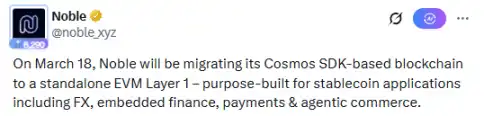
Image Source: Noble Twitter
Subsequently, the founder of Cosmos responded in a post, stating that Noble's transition is not a deviation from the vision of Cosmos, but rather an embodiment of the core concept of "sovereignty and interoperability." Noble's migration does not mean a disconnect from the Cosmos Hub. Instead, through the IBC v2 protocol, the migrated Noble EVM will become a key bridge connecting the EVM ecosystem with the Cosmos economy. He stated, "We are entering an era not defined by chains, but by liquidity."
Cosmos's Stablecoin Ace, Why Choose to Exit?
Noble is one of the most successful stablecoin infrastructure projects in the Cosmos ecosystem. It is the chain that natively issued Circle's USDC to the Cosmos ecosystem, distributing USDC securely and frictionlessly to 50+ chains through IBC, processing over $22 billion in transaction volume to date.
Noble's presence has given the Cosmos ecosystem a competitive edge with a "native stablecoin" and has avoided reliance on trust risks from external bridges.
But why did Noble choose to migrate? The reason given by the Noble team is very practical:
The EVM ecosystem is overwhelmingly dominant. Over 75% of the stablecoin market is on EVM chains. Developers, tools, wallets, dApps are all concentrated on EVM, and since Noble aims to be the "L1 stablecoin infrastructure," it naturally has to follow the money and people.
The EVM technology stack is more developer-friendly. The EVM has a mature toolset including Solidity, Remix, Hardhat, etc., making it easier to integrate protocols like Uniswap, Aave. Although the Cosmos SDK is powerful, it has a steep learning curve, and its ecosystem tools are relatively behind.
The EVM has better performance and real-world use cases. Noble EVM aims for sub-second latency, targeting scenarios such as payments, embedded finance, agentic commerce, FX, etc. While Cosmos' Tendermint consensus is reliable, the EVM stack can better align with mainstream payment chains.
Noble has its own strategic ambitions. Noble doesn't want to be just a "workhorse" within Cosmos but aims to become an independent high-performance stablecoin Layer 1, directly competing with other stablecoin public chain projects.
Therefore, Noble voted with its feet. Cosmos provided the initial groundwork, but the EVM offers it a scalable future.
Noble's Departure Took Away Cosmos's "Half-Life"
Noble is Cosmos's only "super giant." Noble's 30-day IBC transaction volume reached USD 93.84 million, which is 1.8 times that of the second-ranking Osmosis (USD 50.06 million). Within the 110 Zones linked by Cosmos IBC, Noble contributed at a ruptive level of liquidity.
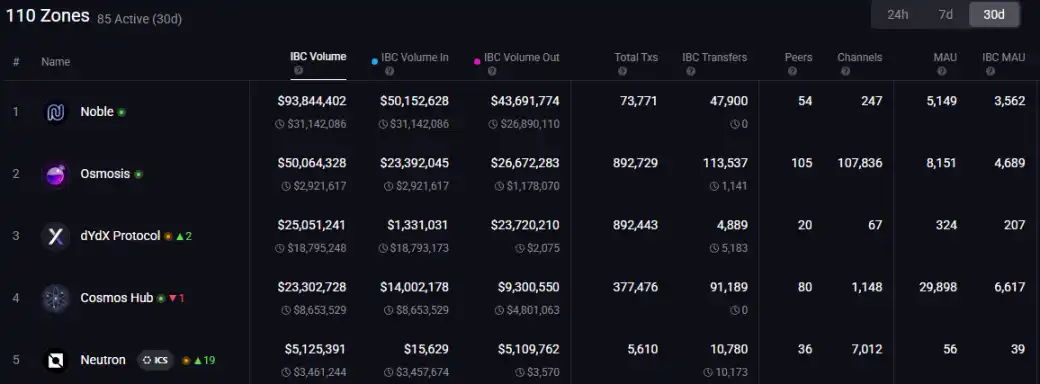
Image Source: MAP OF ZONES
Noble is the "faucet" for institutional funds. Osmosis has nearly 900,000 transactions, while Noble has only 73,000. This means that Noble's single transaction value is much higher compared to other chains. It handles institutional-level stablecoin settlements and large-scale distributions, not retail-level small exchanges.
Although there are 110 linked Zones through IBC, only 85 are active. This indicates that 23% of the chains are already in a state of death. Liquidity is highly concentrated in the top four chains, while projects outside the top ten have seen their monthly transaction volumes shrink to the million-dollar level, and the ecosystem's retail vitality is severely overdrawn.
The Cosmos Hub has approximately 30,000 monthly active users, which is six times more than Noble (around 5,000 people). However, the money actually flows to Noble. Most Cosmos users mainly stake or observe on the Hub, whereas the stablecoin activities that truly generate value are almost solely dependent on Noble.
The Soul of the Cosmos Ecosystem: How IBC Powers the "Blockchain Internet"
The core narrative of Cosmos is the "Internet of Blockchains" — an internet of blockchains, with IBC (Inter-Blockchain Communication Protocol) being the technology that makes this vision a reality.
IBC is Cosmos's most unique and successful invention. It enables independent sovereign chains to securely and trustlessly communicate and transfer assets to each other, similar to TCP/IP on the internet. Its key features include:
Minimal Trust: Verifying the state of the counterparty chain through light client validation, without the need for asset custody or multi-signature bridges.
Permissionless Interoperability: Anyone can create a channel to support token transfers, Interchain Accounts, Interchain Queries, and more.
Universality: Agnostic to consensus mechanisms, already connected to 110+ chains (Map of Zones data), and expanding to non-Cosmos chains like Ethereum and Optimism.
IBC has demonstrated high security, never experiencing a large-scale exploit, with billions of dollars transferred cumulatively. Despite any controversies in other parts of Cosmos, IBC itself remains a top-tier interoperability solution in the industry.
However, Noble's migration also exposed an awkward aspect of IBC: while it interconnected the world, it couldn't retain projects — as everyone interconnected, they all wanted to dominate as a single chain on the EVM.
Exodus Confirmation: Which Cosmos Projects Have Died or Migrated by 2025-2026?
From 2025 to early 2026, the Cosmos ecosystem experienced a significant "project exodus/closure wave."
First, let's talk about the projects that have completely closed or ceased operations, with most of them having already perished by 2025, leaving only the community's regrets and sporadic maintenance attempts.
The privacy chain Penumbra has shut down completely, with the team exiting. While the chain is being reluctantly maintained by the community, it is mostly ignored, becoming the most typical example of complete closure. Pryzm has also shut down entirely, with Comdex and Kujira falling in succession, the latter even taking down sub-projects like Fusion and Levana, causing a fracture in the entire DeFi ecosystem.
Stride has formally sunsetted, ceasing operations; Quasar and Tower have successively perished, Picasso / Composable trapped users' SOL assets after a crash, leaving users empty-handed. Drop has abandoned its TGE and sunsetted, Milkyway has shut down, Demex failed to recover after a hack, Evmos has also essentially died.
These projects covered multiple tracks such as DEX, lending, privacy, NFTs, among others, mainly due to lackluster growth, insufficient revenue, team attrition, and the long-term aftershocks of Terra's collapse.
Meanwhile, some projects chose to migrate to non-Cosmos stacks or committed the ultimate betrayal to the Cosmos narrative. Except for Noble, Sei had also previously decided to abandon its dual-stack architecture in SIP-3 upgrade, planning to retain only the EVM chain by mid-2026.
Akash is migrating to Solana, while projects like Elys, pStake, Jackal, Omniflix are migrating to Base, Stargaze is forking to an independent chain and planning to migrate to the Cosmos Hub, Shade Protocol (rebranded Feather) first migrated to Sei, with potential further EVM-ization in the future.
The core motivation behind these migrations is almost unanimous: the developer tools, liquidity, and market size of the EVM ecosystem far surpass those of Cosmos; project teams are voting with their feet, choosing to follow the money and opportunities.
There is another group of projects that, while not dead, have entered maintenance mode or resource redirection, with slow project progress.
Osmosis has entered maintenance mode, still maintaining tokenomics and other updates, but with a noticeable outward shift in team resources and a significant drop in activity; Astroport is similar, essentially stagnant; after the Axelar team was acquired by Circle, the original project's influence sharply declined. These projects were once the pillars of Cosmos DeFi but have now become a microcosm of ecosystem contraction.
Mantra has undergone restructuring (January 2026 layoffs, cost optimization) and the OM token crash (nearly 99% drop), but the project is still advancing. The ERC-20 OM migration is underway, with RWA vaults, launchpad, and other features in development, and there will continue to be operations of an IBC-compatible RWA EVM L1.
Furthermore, a large number of DEXs such as Wynd, Hopers, Junoswap, Loop, TerraSwap, among others, closed in 2024-2025. Retail DeFi is basically cooling off, with only institutions and RWAs holding the fort.
The MAP OF ZONES shows IBC connecting 110 chains, but IBC traffic is heavily concentrated in the top few (Noble, Osmosis, Cosmos Hub), and once Noble's liquidity moves away, the entire ecosystem's vitality will be further diminished.
Although the Cosmos 2026 roadmap attempts to reverse the decline through EVM compatibility and high-performance upgrades, Noble's "walkout" undoubtedly reveals a harsh reality: in the face of liquidity, the technological narrative often appears feeble and inadequate.
Original Article Link
You may also like

CoinGecko Report: Surge of 346% vs Dip of 20.8%, The Wild Rise of DEX

a16z: The Real Opportunity of Stablecoins Lies Not in Disruption but in Filling Gaps

Mining Exodus: Someone Holds $12.8 Billion AI Order

March 6 Market Key Intelligence, How Much Did You Miss?

a16z: The True Opportunity of Stablecoins is in Complementing, Not Disrupting

Predict LALIGA Matches, Shoot Daily & Win BTC, USDT and WXT on WEEX
The WEEX × LALIGA campaign brought together football excitement and crypto participation through a dynamic interactive experience. During the event, users predicted matches, completed trading tasks, and took daily shots to compete for rewards including BTC, USDT, WXT, and exclusive prizes.

Ray Dalio Dialogue: Why I'm Betting on Gold and Not Bitcoin

Who Took the Money in the AI Era? A Must-See Investment Checklist for HALO Asset Trading
Wall Street Bears Target Ethereum: Vitalik In the Know Takes Flight, Tom Lee Remains Bullish

Pump.fun Hacker Steals $2 Million, Receives 6-Year Prison Sentence, Opts for 'Self-Detonation'

6% Annual Percentage Yield as Musk Declares War on Traditional Banks
36 years, 4 wars, 1 script: How does capital price the world in conflict?

Mining Companies' Great Migration: Some Have Already Secured $12.8 Billion in AI Orders
What Is Vibe Coding? How AI Is Changing Web3 & Crypto Development
What is vibe coding? Learn how AI coding tools are lowering the barrier to Web3 development and enabling anyone to build crypto applications.
The parent company of the New York Stock Exchange strategically invests in OKX: The intentions behind the $25 billion valuation
WEEX P2P update: Country/region restrictions for ad posting
To improve ad security and matching accuracy, WEEX P2P now allows advertisers to restrict who can trade with their ads based on country or region. Advertisers can select preferred counterparty locations for a safer, smoother trading experience.
I. Overview
When publishing P2P ads, advertisers can now set the following:
Allow only counterparties from selected countries or regions to trade with your ads.
With this feature, you can:
Target specific user groups more precisely.Reduce cross-region trading risks.Improve order matching quality.
II. Applicable scenarios
The following are some common scenarios:
Restrict payment methods: Limit orders to users in your country using supported local banks or wallets.Risk control: Avoid trading with users from high-risk regions.Operational strategy: Tailor ads to specific markets.
III. How to get started
On the ad posting page, find "Trading requirements":
Select "Trade with users from selected countries or regions only".Then select the countries or regions to add to the allowlist.Use the search box to quickly find a country or region.Once your settings are complete, submit the ad to apply the restrictions.
When an advertiser enables the "Country/Region Restriction" feature, users who do not meet the criteria will be blocked when placing an order and will see the following prompt:
If you encounter this issue when placing an order as a regular user, try the following solutions.
Choose another ad: Select ads that do not restrict your country/region, or ads that allow users from your location.Show local ads only: Prioritize ads available in the same country as your identity verification.
IV. Benefits
Compared with ads without country/region restrictions, this feature provides the following improvements.
Aspect
Improvement
Trading security
Reduces abnormal orders and fraud risk
Conversion efficiency
Matches ads with more relevant users
Order completion rate
Reduces failures caused by incompatible payment methods
V. FAQ
Q1: Why are some users not able to place orders on my ad?
A1: Their country or region may not be included in your allowlist.
Q2: Can I select multiple countries or regions when setting the restriction?
A2: Yes, multiple selections are supported.
Q3: Can I edit my published ads?
A3: Yes. You can edit your ad in the "My Ads" list. Changes will take effect immediately after saving.

What are the key highlights of this year's Ethereum's most important upgrade, the Glamsterdam upgrade?

March 6 Key Market Update You Can't Miss! | Alpha Morning Report
CoinGecko Report: Surge of 346% vs Dip of 20.8%, The Wild Rise of DEX
a16z: The Real Opportunity of Stablecoins Lies Not in Disruption but in Filling Gaps
Mining Exodus: Someone Holds $12.8 Billion AI Order
March 6 Market Key Intelligence, How Much Did You Miss?
a16z: The True Opportunity of Stablecoins is in Complementing, Not Disrupting
Predict LALIGA Matches, Shoot Daily & Win BTC, USDT and WXT on WEEX
The WEEX × LALIGA campaign brought together football excitement and crypto participation through a dynamic interactive experience. During the event, users predicted matches, completed trading tasks, and took daily shots to compete for rewards including BTC, USDT, WXT, and exclusive prizes.


 App
App