
- Buy Crypto
- Markets
 Futures
- Spot
- Copy Trade
- Earn
- More
Lumoz Launches SVM as a Service, Supporting SVM L2 with Integrated ZK and TEE Hybrid Proof

Source: Lumoz
Background
In recent years, the rapid development of blockchain technology has driven innovation in multiple areas such as DeFi, NFTs, and AI. Solana, as a high-speed, low-cost blockchain, has gained widespread attention due to its unique consensus mechanism and high throughput. In large-scale application scenarios, an L2 chain or application chain based on SVM has vast market potential.
Against this backdrop, Lumoz has proposed an innovative SVM chain solution (Lumoz SVM Stack) based on the SVM execution layer, combined with unique ZK and TEE technologies, bringing a fresh perspective to the industry. Through its efficient scaling architecture and optimized algorithms, Lumoz SVM Stack not only provides high transaction throughput and processing speed for the SVM chain but also ensures security and decentralization.
Architecture
Lumoz SVM Stack is a general L2 solution based on the SVM transaction execution layer, adopting a modular architecture that separates various functions into different modules to ensure flexibility and scalability. The architecture consists of multiple core layers: supporting Ethereum and Solana as settlement layers, Celestia, Avail, among others, as data availability layers, and supporting various types of proofs such as SP1 and SGX. These designs, combined with the SVM execution environment, form an efficient and customizable modular Layer 2 solution. Ultimately, the vision of Lumoz SVM Stack is to become the world's fastest and most versatile SVM-driven Layer 2 solution.
Solana lacks a global state tree, which is crucial for ensuring that off-chain execution results can be securely settled back to Layer 1. To address this issue, Lumoz combines the fundamental function of a global state tree with a Sparse Merkle Tree (LSMT), using cryptographic techniques to verify off-chain execution results on the network extension to ensure the security and consistency of on-chain and off-chain operations. This innovative solution not only enhances Lumoz's advantages in scalability and security but also provides a more reliable cross-chain execution mechanism for the blockchain ecosystem.
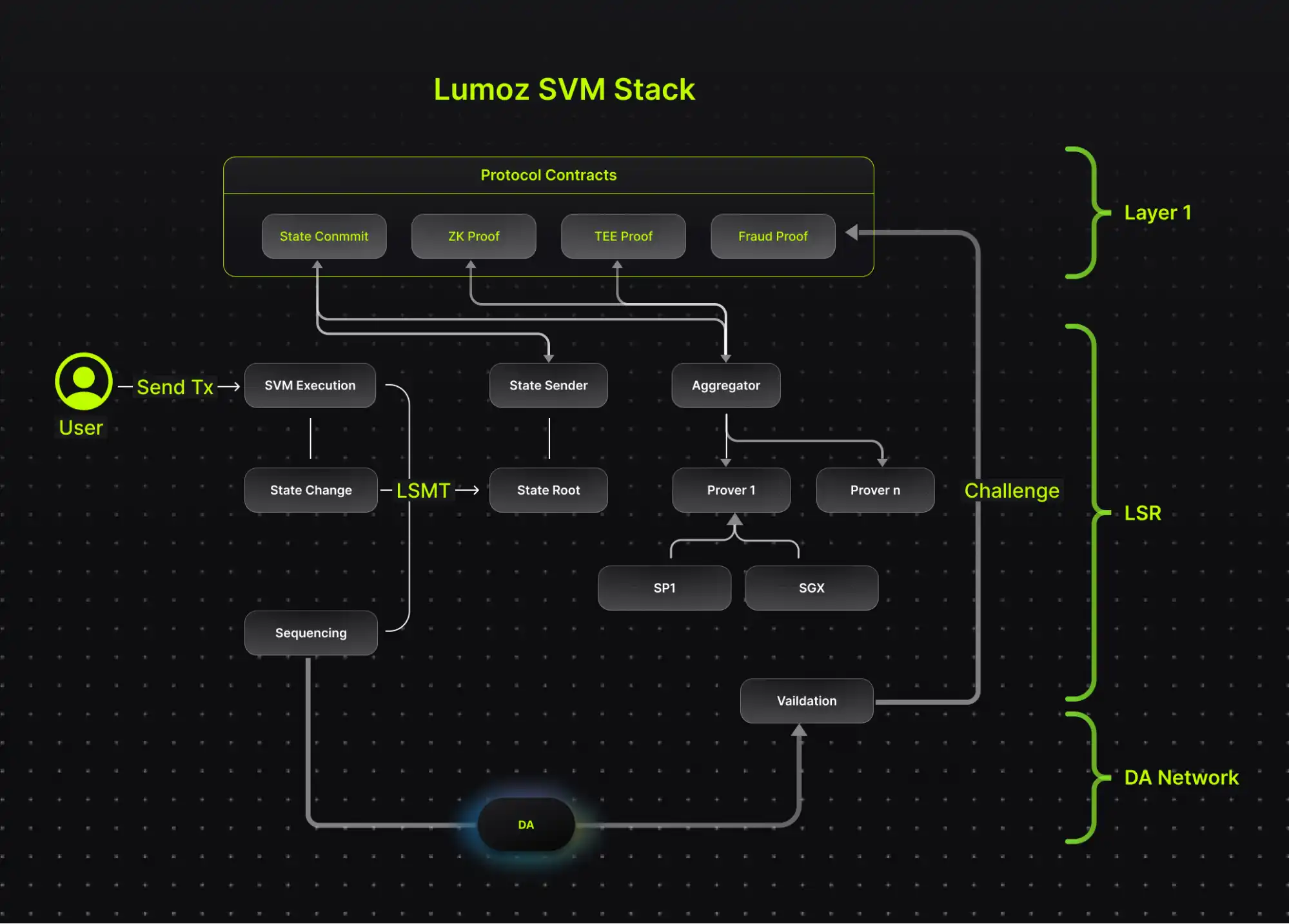
Lumoz SVM Stack is built on the Solana Agave client's code, ensuring compatibility with the Solana mainnet while leveraging Solana's parallel execution capabilities and unique transaction data structure. Through optimization of storage logic and performance parameters, Lumoz SVM Stack maximizes Solana's native performance advantages, further enhancing the system's efficiency and scalability.
The current architecture design allows existing dApps in the Solana ecosystem to seamlessly migrate to the Lumoz SVM Stack network without any modification to the program code. This solution not only reduces the required resources and costs but also maintains consistency with Solana's tools and developer stack, providing developers with lower migration costs and higher development efficiency.
Key Components of the Architecture
· Shared Sorter: The Lumoz SVM Stack adopts a decentralized and transparent transaction sorting approach, ensuring the efficiency and trustworthiness of network scalability. In terms of security, speed, and decentralization, Lumoz SVM Stack exhibits significant advantages. The shared sorter processes multiple transactions in batches, reducing the number of individual transactions the base layer needs to handle, thereby greatly increasing the system's throughput and capacity. Additionally, the Lumoz SVM Stack also provides robust support for transaction sorting, enhancing overall performance.
· Stateless Validator: The stateless validator contract of the Lumoz SVM Stack decomposes the full validation task into small chunks and distributes these tasks to the validator network. Through this design, the Lumoz SVM Stack significantly reduces the hardware requirements of participants, making it easier for nodes to join or exit the network without needing access to the full blockchain state. This not only enhances the system's flexibility but also lowers the entry barriers, promoting more participation of nodes.
· Data Availability: While Solana has strict limits on transaction size, which may pose a challenge for aggregation-based Data Availability (DA) solutions, the Lumoz SVM Stack overcomes the limitations of Solana's native DA solution by extending the DA solution. This design ensures the security and decentralization of data management while retaining the ability to conduct data audits on Solana, ensuring the blockchain's auditability and transparency.
Key Technologies
SVM Compatibility and Parallel Efficient Execution
Solana's SVM (Solana Virtual Machine) is an efficient smart contract execution environment that, with its parallel transaction processing and state-independent design, can execute multiple transactions simultaneously, significantly increasing throughput and reducing latency. SVM supports programming languages like Rust and C, allowing developers to easily build high-performance decentralized applications, driving the rapid development of the Solana ecosystem.
It is worth emphasizing that SVM's parallel execution relies on Solana's unique transaction data structure. In the Solana network, the initiator of each transaction pre-declares the account information to be read from and written to. This design allows SVM to process transactions efficiently in a parallel order based on this account information, ensuring that different transactions do not simultaneously perform read or write operations on the same account. Therefore, simply grafting SVM onto another execution framework does not bring the advantage of parallel processing.
Based on this principle, we have chosen to use the Solana Client as the underlying execution framework to fully leverage SVM's parallel execution advantage, ensuring efficient transaction processing and low-latency performance throughout the system.
Support for Multiple Proofs
Lumoz supports a powerful multi-proof pipeline that can transform assembly-level instructions from different execution clients into arithmetic of algebraic proof systems. This pipeline design enables Lumoz to not only use various backends such as SuperNova, Halo2, and eSTARK to encode arithmetic but also break free from reliance on a single protocol, providing greater flexibility and scalability.
In addition to ZK proofs, Lumoz innovatively leverages SGX to achieve a Trusted Execution Environment (TEE) that generates different types of proofs. The code executed by SGX is the same as the code executed on zkVM, acting similarly to a lightweight execution client. This ensures that all proof systems can verify the same underlying lightweight client execution, enabling potential data reuse. In the SGX environment, necessary data is signed using standard ECDSA signatures, and the signing process is completed using SGX's dedicated private key. The Trusted Execution Environment (TEE) guarantees the confidentiality and integrity of the computation and verifies it through remote attestation.
TEE: Using an Intel SGX CPU, Intel® Software Guard Extensions (SGX) are a set of security-related instructions built into certain Intel CPUs to enable TEE. By using an SGX chip, the chip owner, system operator, and observer gain strong cryptographic assurances, ensuring that no party can view what happens within the Secret memory space.
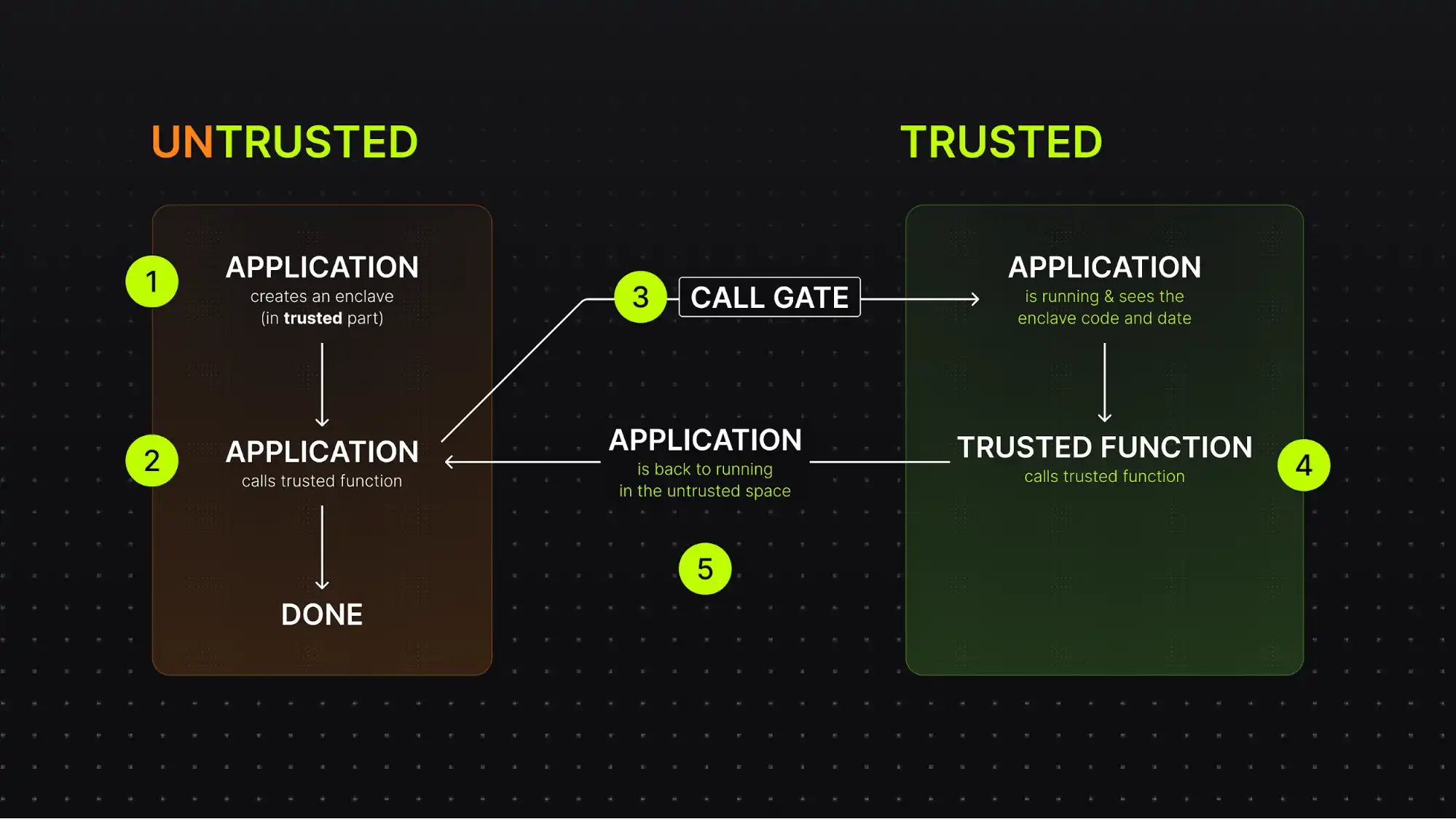
Through this multi-proof pipeline design, Lumoz provides a more efficient, secure, and flexible solution that enhances performance, improves cross-platform and cross-protocol compatibility, and drives innovation in decentralized validation and data security in blockchain technology.
Settlement Protocol Based on Sparse Merkle Tree (LSMT)
Lumoz's Sparse Merkle Tree (LSMT) is an innovative cryptographic data structure that combines the advantages of traditional Merkle trees and Patricia trees, enabling efficient storage of a large number of key-value pairs. Compared to traditional Merkle trees, LSMT only stores necessary nodes through its unique node organization, which are usually nodes containing non-null values or nodes along the path of leaf nodes with values. This design makes LSMT a "sparse" data structure, significantly reducing the storage space requirement.
A significant advantage of LSMT is its ability to provide succinct proofs (Merkle proofs) to verify whether a specific key-value pair is included in the tree without revealing its exact value. This design optimizes storage and computation efficiency, particularly suitable for scenarios requiring efficient data consistency verification.
In Layer 2 solutions, a key application of LSMT is state commitment and state verification. State commitment refers to submitting off-chain transactions (Layer 1 state) to Layer 2 solutions. By submitting this state on Layer 1, participants in Layer 2 can validate the validity of their off-chain transactions without disclosing the entire state or requiring the Layer 1 blockchain to process every off-chain transaction. In this way, LSMT provides an efficient and secure way to achieve cross-chain validation and data commitment, reducing reliance on the base layer and enhancing system scalability and privacy protection.
Conclusion
By innovatively combining various advanced blockchain solutions such as SVM, ZK, and TEE, Lumoz offers an efficient, secure, and flexible SVM general L2/application chain solution. By leveraging the parallel processing advantage of the SVM execution layer and using the Sparse Merkle Tree (LSMT) for data validation, Lumoz is able to significantly increase transaction throughput and processing speed while ensuring security and decentralization. Furthermore, Lumoz's zk and SGX multi-proof pipeline technology provides robust support for secure transaction execution, further improving the efficiency of cross-chain interaction and data processing.
With the continuous development of decentralized applications and blockchain technology, Lumoz's architecture not only provides developers with a more flexible development environment but also effectively reduces transaction costs, driving the application and popularization of blockchain technology in various fields. In the future, Lumoz is poised to become one of the most versatile and scalable Layer 2 solutions, advancing the further development of public chains like Solana and laying a solid foundation for the sustainability and innovation of the blockchain ecosystem.
This article is a submitted contribution and does not represent the views of BlockBeats
You may also like

In the next 5 years, Vitalik will expand Ethereum in this way

WBT Pulled a Quiet 15X While Everyone Was Watching Meme Coins
WBT, the native token of WhiteBIT exchange, surged from under $6 in 2023 to over $50 by 2026,…

Bank of Japan to Test Blockchain-Based Reserve Settlement Platform
Key Takeaways The Bank of Japan (BOJ) is leading the way as the first G7 member to explore…

Ethereum Price Prediction: Whales Impact 7th Red Month as RWA Sector Achieves $15B Record
Key Takeaways: Ethereum is on the brink of recording its seventh consecutive red month, indicating a potential prolonged…

VanEck’s Macro Bottom Thesis: Is the $60K–$70K Floor the Real Cycle Reset?
Key Takeaways VanEck CEO Jan van Eck asserts that Bitcoin is forming a macro market bottom around the…

WBT Did a Quiet 15X While Everyone Focused on Meme Coins
Key Takeaways WBT, WhiteBIT’s native cryptocurrency, has surged over 3,000% from its lowest point in late 2022 to…

Arthur Hayes Forecasts Bitcoin Price Surge to $750,000 by 2027 Due to Monetary Expansion
Key Takeaways Arthur Hayes, co-founder of BitMEX, forecasts Bitcoin’s price to reach $250,000 in 2026 and then surge…

Iranian Exchange Outflow Surges 700% Amid Stiffening USDT Sanctions
Key Takeaways: Iranian cryptocurrency exchange outflows surged by 700% following military strikes, signaling rapid capital flight from the…

Crypto Price Prediction Today 2 March – XRP, Bitcoin, Ethereum
Key Takeaways XRP is poised to potentially reach $5, driven by its role in stablecoin and tokenized asset…
Solana Price Outlook: Why A Billion-Dollar Loss Didn’t Deter This SOL Whale — What Insight Do They Have?
Key Takeaways A major institutional investor in Solana withstands a huge unrealized loss, maintaining confidence in the long-term…

Bitcoin Price Prediction: $1 Billion Floods Back Into Crypto ETFs — Is the Bull Run Restarting?
Key Takeaways A notable $1 billion has re-entered crypto exchange-traded products, hinting at potential upward momentum in Bitcoin…
Ethereum Price and BitMine Shares Jump 10% After Latest Treasury Buy
Key Takeaways BitMine Immersion Technologies has embarked on a bold move by purchasing a significant amount of Ethereum,…

Bitcoin Price Prediction: Fear Just Hit a Level Seen Only Twice Before — What Happens Next Could Change Everything
Key Takeaways Bitcoin’s price has dropped towards $60,000, paralleling a significant drop in market sentiment, hitting a level…

XRP Price Prediction: Are Investors Ready to Unload $650 Million XRP?
Key Takeaways A significant inflow of approximately 472 million XRP, valued at about $650 million, has been transferred…

Bitcoin and WW3: 5 Key Indicators as BTC Eyes Global Liquidity Boom
Key Takeaways Bitcoin remains resilient amidst geopolitical tensions, sustaining above key support levels. Drastic decline in Bitcoin exchange…

New ChatGPT Forecasts the Price of XRP, Solana, and Shiba Inu by the Close of 2026
Key Takeaways ChatGPT suggests a robust growth outlook for XRP, Solana, and Shiba Inu by 2026, forecasting significant…

Why Is Crypto Down Today? – February 4, 2026
Key Takeaways The crypto market declined by 2.3% over the past 24 hours, with a total market capitalization…

Magic Eden Adjusts Course: Ending EVM and Bitcoin NFT Markets as It Doubles Down on Solana
Key Takeaways Magic Eden is ending its NFT marketplaces for Ethereum, Polygon, and Bitcoin to focus on Solana…
In the next 5 years, Vitalik will expand Ethereum in this way
WBT Pulled a Quiet 15X While Everyone Was Watching Meme Coins
WBT, the native token of WhiteBIT exchange, surged from under $6 in 2023 to over $50 by 2026,…
Bank of Japan to Test Blockchain-Based Reserve Settlement Platform
Key Takeaways The Bank of Japan (BOJ) is leading the way as the first G7 member to explore…
Ethereum Price Prediction: Whales Impact 7th Red Month as RWA Sector Achieves $15B Record
Key Takeaways: Ethereum is on the brink of recording its seventh consecutive red month, indicating a potential prolonged…
VanEck’s Macro Bottom Thesis: Is the $60K–$70K Floor the Real Cycle Reset?
Key Takeaways VanEck CEO Jan van Eck asserts that Bitcoin is forming a macro market bottom around the…
WBT Did a Quiet 15X While Everyone Focused on Meme Coins
Key Takeaways WBT, WhiteBIT’s native cryptocurrency, has surged over 3,000% from its lowest point in late 2022 to…


 App
App