
Market "Discount Season": On-chain Data Reveals What Whales Are Quietly Buying?



Original Article Title: "Market 'Discount Season,' What Whales Have Been Hoarding"
Original Source: Bitpush News
Over the past month, Bitcoin has been violently fluctuating around $80,000-$90,000 most of the time, while altcoins have generally experienced a 15%-40% pullback. However, this has been the most comfortable "private accumulation" window for whales. According to real-time monitoring data from on-chain big holders tracked by Santiment and others, whales have been quietly accumulating in the following tracks, with some coins even hitting a new high in accumulation intensity since 2025.
Track One: Payment/Cross-Border Settlement Track - XRP Becomes Whale's Favorite
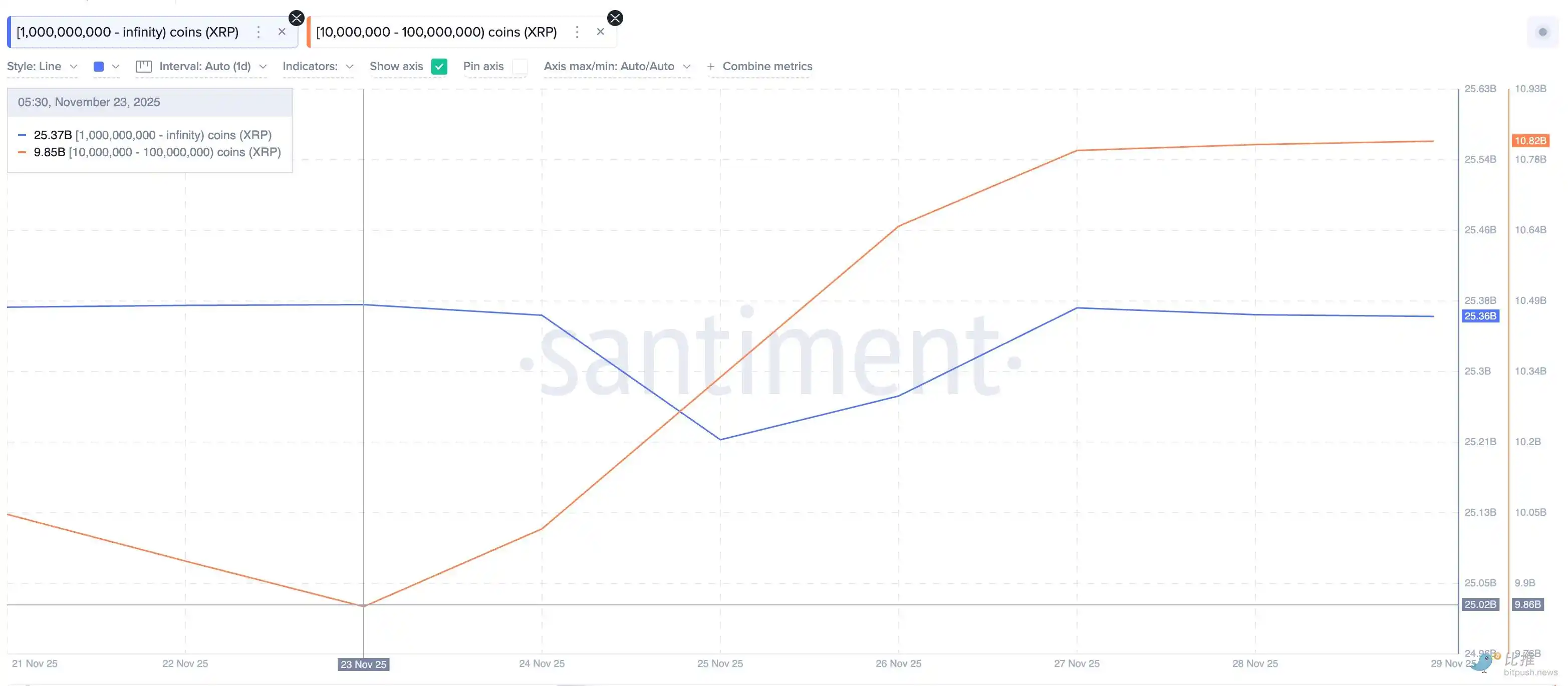
With the settlement of the SEC and Ripple lawsuit, XRP ETF has also shifted from expectation to reality, further stimulating whale accumulation behavior. In the past 30 days, XRP has been the most exaggerated species of whale net inflow among all altcoins:
- Addresses holding 1 billion to 10 billion XRP have seen a net increase of 970 million XRP
- Addresses holding over 10 billion XRP have seen a net increase of 150 million XRP
- The total inflow of the two types of addresses exceeds $2.4 billion;
- XRP balances on exchanges continue to decline, hitting a new low since 2023.
Track Two: Traditional Layer 1 - Contrarian Accumulation of ADA
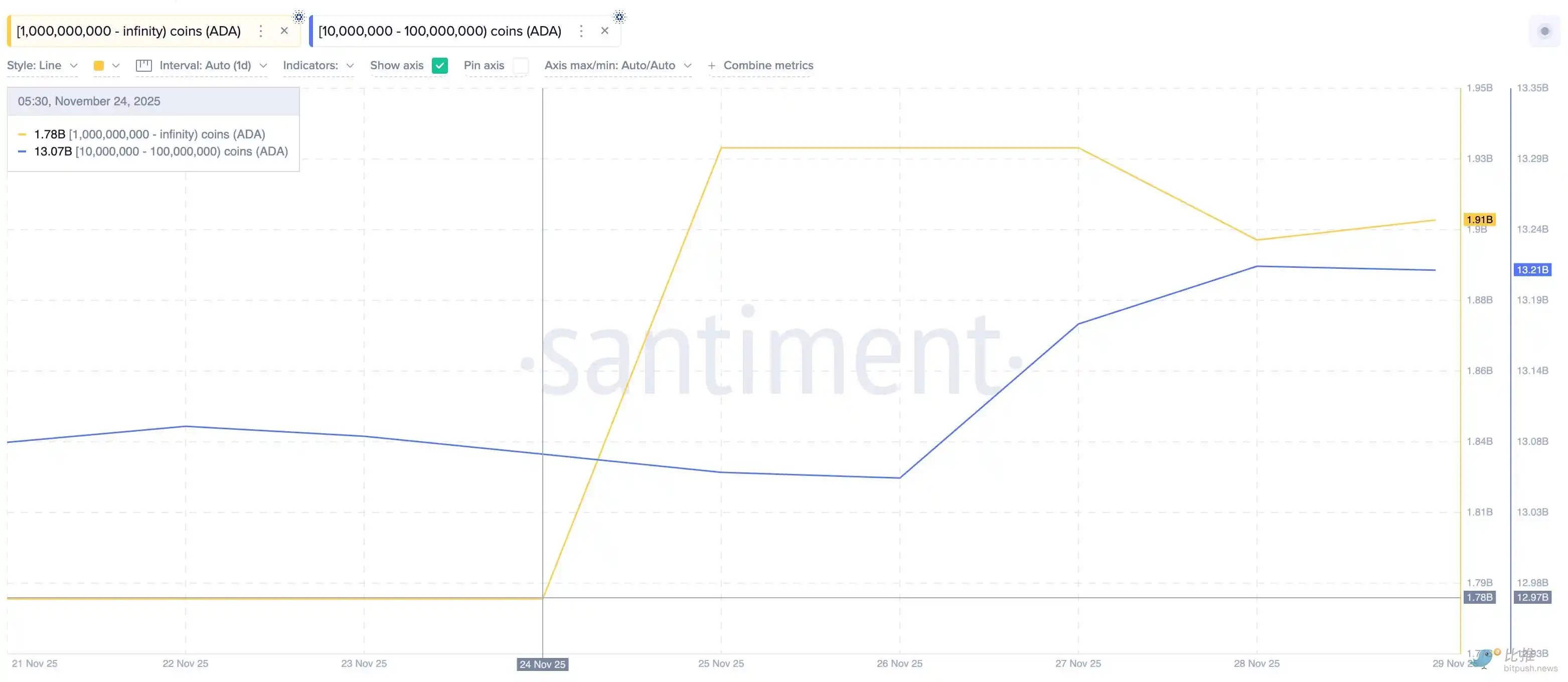
Cardano (ADA) witnessed a very rare "whale rotation buy-in" from November 24 to December 4, spanning 12 days:
- The largest wallet holder (holding over 10 billion ADA) started accumulating on November 24 and has since accumulated a total of 130 million ADA;
- Wallets holding between 10 million and 100 million ADA started accumulating on November 26, with an accumulation of 150 million ADA;
- Both groups achieved net increases in a few days, indicating that even though the ADA price is close to recent lows, large holders are relatively confident;
- Whales have a low cost basis, and if the price can break through $0.43, it may rise to $0.52. If it falls to $0.38, the bullish trend may weaken, and the reversal signal may fail.
Three, DeFi Blue Chips: UNI and AAVE Simultaneously Bought Up
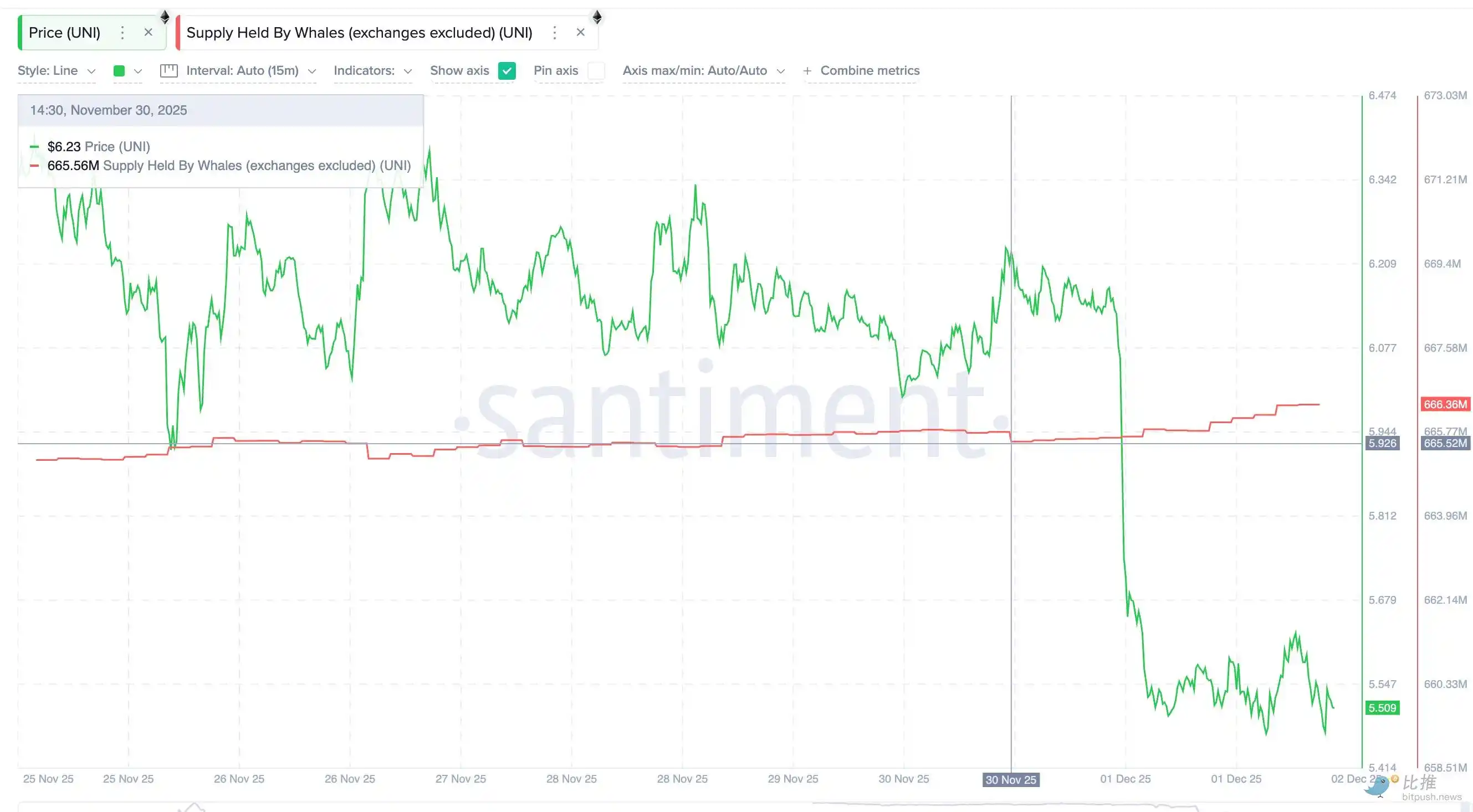
· UNI: Over the past week, a whale added approximately 800,000 tokens (worth nearly $5 million), and after the fee switch vote, the top 100 addresses hold a total of 8.98 million UNI, showing strong buying momentum, while the platform's supply continues to decrease.

· AAVE: In the past 30 days, a whale added over 50,000 tokens to their holdings, reaching a total of 3.98 million tokens ATH.
Commonalities between the two: TVL continues to rise + Real revenue (fees) begins to increase, with whales positioning themselves early.
Four, Meme Coins: Overall Pullback, Some Bought Up by Whales at "Discount"
Main battleground:


· FARTCOIN: A single address bought up 32.43 million tokens in 24 hours ($10.7 million)
· PIPPIN: Whales took away 40.45 million tokens in 24 hours ($7.28 million)
· PEPE: In the past 30 days, whale holdings increased by 1.36%, totaling over 10 million tokens. In summary, speculative and institutional capital have entered together, and a violent surge is possible at any time after liquidity dries up.
Five, AI + Data Track: ENA and TIA Most Favorable

· ENA (Ethena): Whales increased their holdings by 2.84% in the past 7 days, with the top 100 addresses adding over 50 million tokens
· TIA (Celestia): Platform supply decreased by 5%, Staking ratio and TVL both hit all-time highs
AI narrative + Modular narrative stacking has become one of the highly certain long-term tracks in this round.
6. Storage Track: FIL vs. ICP
Starting in late November, whale addresses of both FIL and ICP saw significant outflows from exchanges, while the number of active addresses and TVL rose in sync, fulfilling the demand for decentralized storage by AI large models.
· FIL: In the past 30 days, whale holdings increased by over 100,000 tokens, totaling a value of around $50 million; exchange supply decreased by 15%
· ICP: On-chain active addresses increased by 30%, whales withdrew over 50,000 tokens from exchanges; TVL rose to $1.2 billion
Summary
It can be seen that the current logic of whales is:
· Buy the dip, viewing it as a buying opportunity, buying more as the price drops, almost ignoring short-term prices;
· Prioritizing "real revenue" or "policy dividend certainty" tracks;
· Meme coins are still in the high-risk, high-return "lottery zone";
· The long-termism track (AI, modularity, storage, privacy) has been laid out by whales 2-3 quarters ahead of time.
Risk reminder: Whale accumulation does not guarantee a price increase and may also lead to subsequent sell pressure. Please make sure to DYOR, trade cautiously, and strictly manage your positions.
You may also like

Galaxy in-depth report: Is Solana still worth paying attention to?

Young people in South Korea make a "final effort" in the epic bull market

Dialogue with OmenX Founder: Why does the prediction market need an evolution from "spot" to "derivatives"?
When the P2P illicit funds from ten years ago turned into 60,000 bitcoins

Morning News | CME Group launches Nasdaq Cryptocurrency Index futures; Asset management giant Janus Henderson strategically invests in Ethena

Why did Oracle deliver the strongest financial report in history, yet its stock price fell?

Bitcoin Layer 2 Network Botanix: Why Did We Choose to Dissolve?

Morning Report | OpenAI has submitted an S-1 registration statement draft to the U.S. SEC; Morpho completes $175 million financing

Galaxy Deep Research Report: How Hyperliquid's HIP-4 Upgrade Changes the Landscape of Prediction Markets?

Latest research from 13 top universities including Cornell University: The current state, challenges, and misconceptions of the fusion of Crypto and AI
Deconstructing Anthropic: The Best AI Company, Possibly Also a Type of Organizational Invention

Every exchange is a "Universal Exchange."

The counterattack of traditional finance: Alliance chains are quietly reviving
Pantera Capital Partner: How Tokenization is Restructuring the Private Equity and Early Investment Ecosystem?

Mastercard Launches Agent Pay for AI, Plans to Record AI Agent Payment Authorizations on Polygon
Mastercard launched Agent Pay for AI, a new payment protocol designed to help AI agents make small payments such as pay-per-use access to data and APIs. The system plans to record human-granted AI agent permissions on Polygon, focusing on verifiable authorization, identity, and payment controls.

Curve Deploys Llamalend v2 on Optimism With 250,000 OP Incentives
Curve launched Llamalend v2 on Optimism with 250,000 OP incentives from the Optimism Foundation. The upgrade expands Llamalend beyond its earlier crvUSD-focused model, adding broader collateral support, LlamaRisk market reviews, and the ability to use Curve LP tokens as collateral.

Raydium Old Liquidity Pool Reportedly Exploited, With $1.34 Million Moved to Ethereum and Tornado Cash
An old Raydium liquidity pool was reportedly exploited for around $1.34 million in USDC, RAY, and wSOL, with the stolen funds bridged to Ethereum and deposited into Tornado Cash. The incident highlights the tail risks of legacy DeFi pools, old contracts, and cross-chain fund laundering paths.
Kalshi Executive Challenges “SBF Backed AI Unicorns” Narrative, Says Leopold Aschenbrenner Was Key Figure
Kalshi executive John Wang questioned the “SBF backed AI unicorns” narrative, saying Leopold Aschenbrenner was the key figure behind major AI investment decisions.
Galaxy in-depth report: Is Solana still worth paying attention to?
Young people in South Korea make a "final effort" in the epic bull market
Dialogue with OmenX Founder: Why does the prediction market need an evolution from "spot" to "derivatives"?
When the P2P illicit funds from ten years ago turned into 60,000 bitcoins
Morning News | CME Group launches Nasdaq Cryptocurrency Index futures; Asset management giant Janus Henderson strategically invests in Ethena
Why did Oracle deliver the strongest financial report in history, yet its stock price fell?


