
Messari Report Analysis: Memecoin Trading Volume Accounts for Over Half, Can Solana's Growth Myth Continue?


Original Author: MONK
Original Translation: DeepTech TechFlow
Lately, the debate over whether Memecoin is "dying" and if this will put Solana in trouble has escalated. Next, I will use data to provide you with an answer.
Since the $LIBRA event, Memecoin trading volume on Solana has dropped to the lowest level this year.
However, it is important to note that the current volume is still higher than at the beginning of 2024, indicating that Memecoin has not yet exited the stage of history.
What I really want to emphasize is the extent to which the Solana economy relies on Memecoin support.
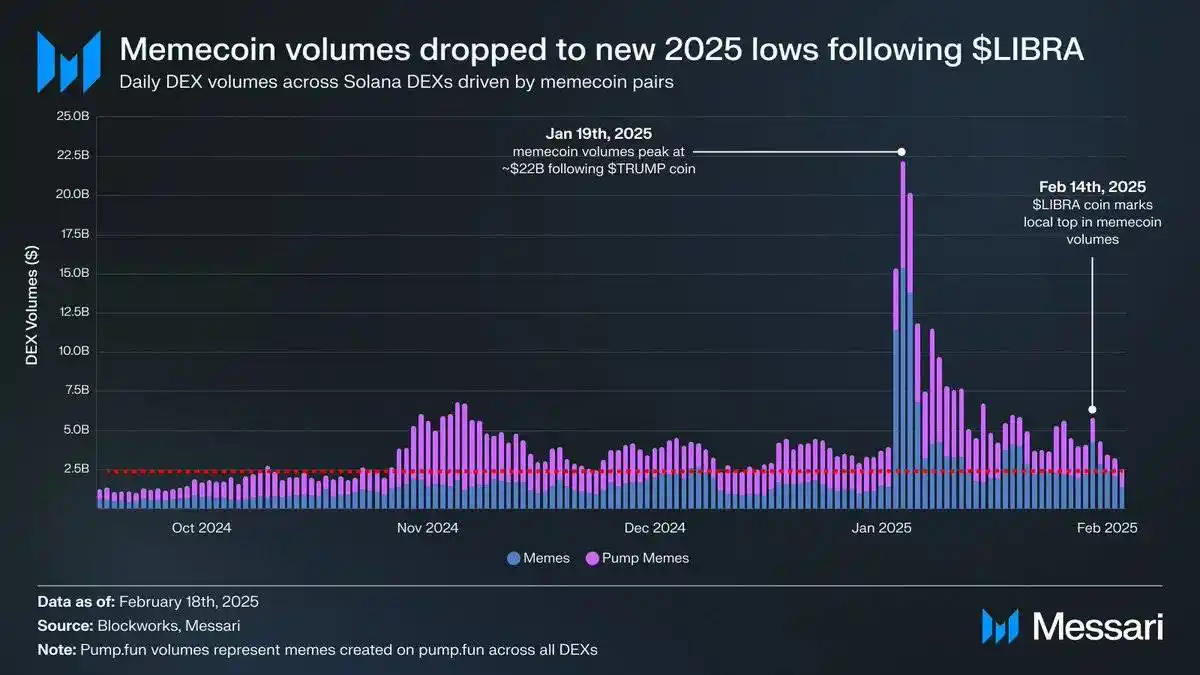
Solana's Economic Dependence on Memecoin: Risks and Current Situation
Solana's economy is fundamentally driven by transaction volume.
If we look at the leading applications ranked by revenue on Solana, we will find that these applications are almost all protocols that in some way facilitate transaction activity.
This can be validated by the strong correlation between daily DEX trading volume and application revenue.
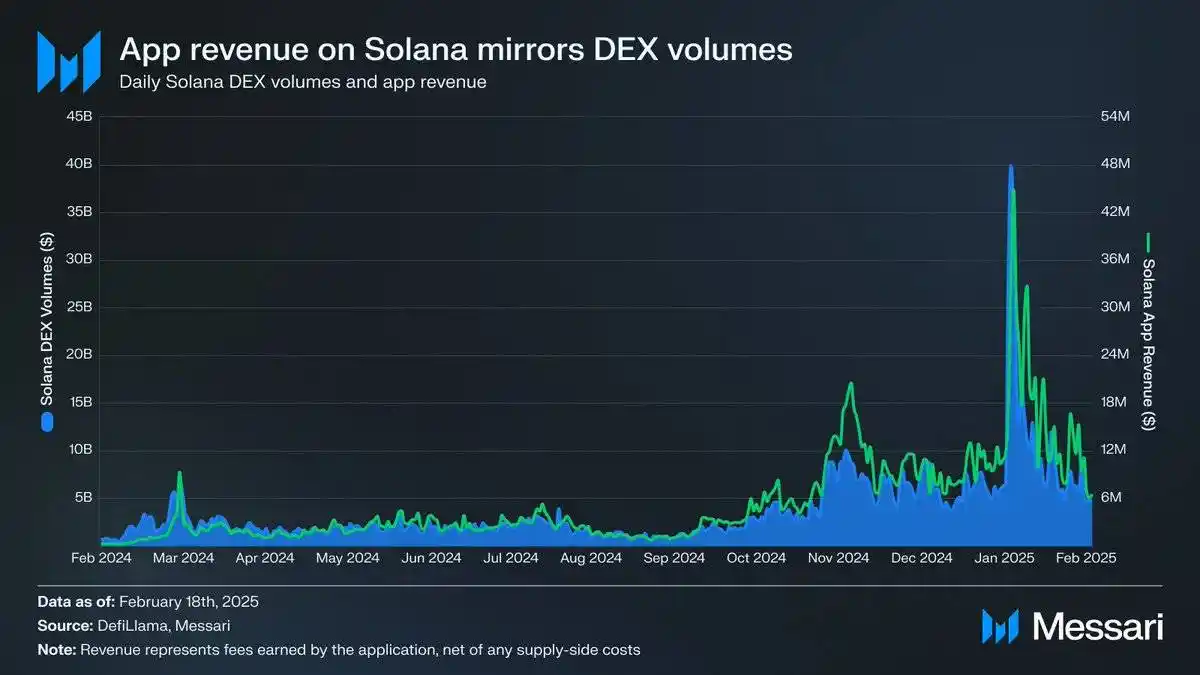
This pattern is not uncommon in today's high-throughput blockchains. For example, Base's economy also largely operates based on transaction volume.
In contrast, Ethereum's mainnet revenue comes more from applications driven by Total Value Locked (TVL), such as lending and mining rewards, mainly because transaction activity on the mainnet has significantly reduced.
However, it is important to note what drives this transaction volume.
On Solana, a significant amount of trading activity comes from Memecoin.
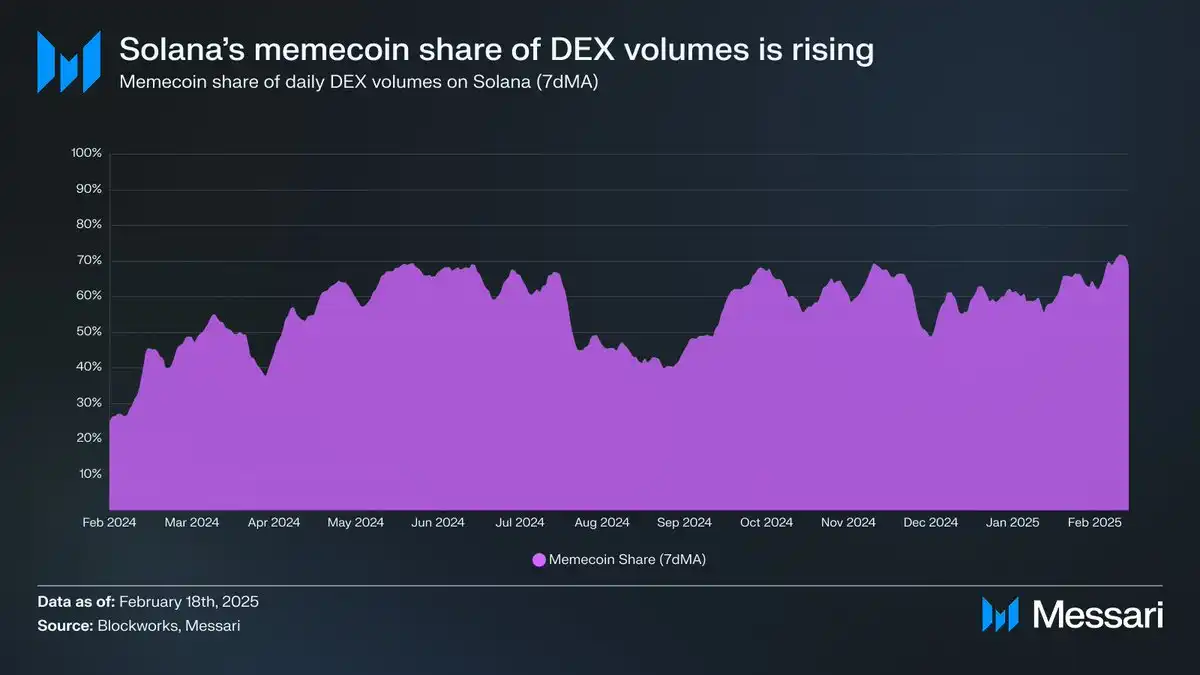
But what is concerning is that the proportion of Memecoin's trading volume has become abnormally high. For example, in February 2025, Memecoin's trading volume accounted for 70% of the total Solana DEX trading volume.
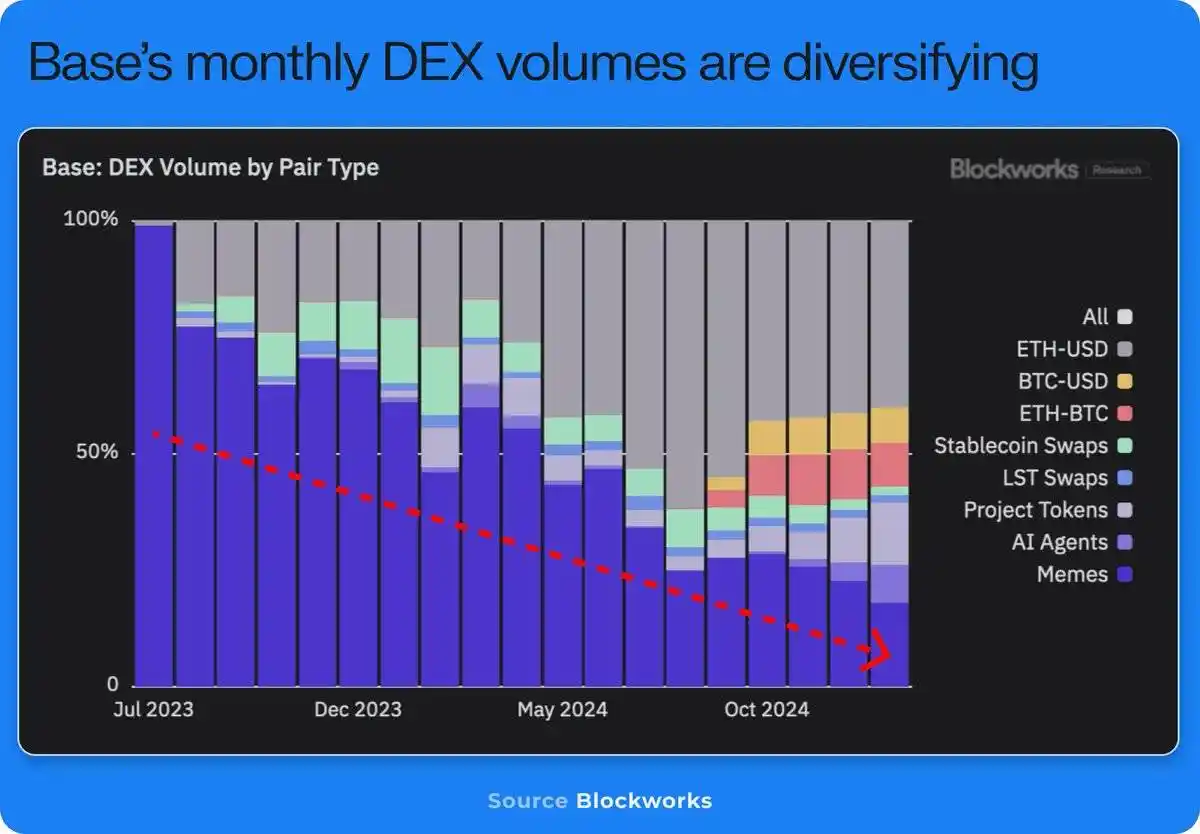
In contrast, Solana's competitor Base is gradually reducing its reliance on Memecoin trading volume and shifting towards more project tokens and trading pairs denominated in mainstream assets:
Why is this an issue?
Firstly, Solana's Memecoin volatility is extremely high, and the sustainability of these Memecoins is still in question.
More importantly, researchers, investors, and the Solana Foundation have been emphasizing the growth of application revenue and "on-chain GDP." Solana's application revenue has indeed been growing rapidly and remains one of the key metrics of user activity.
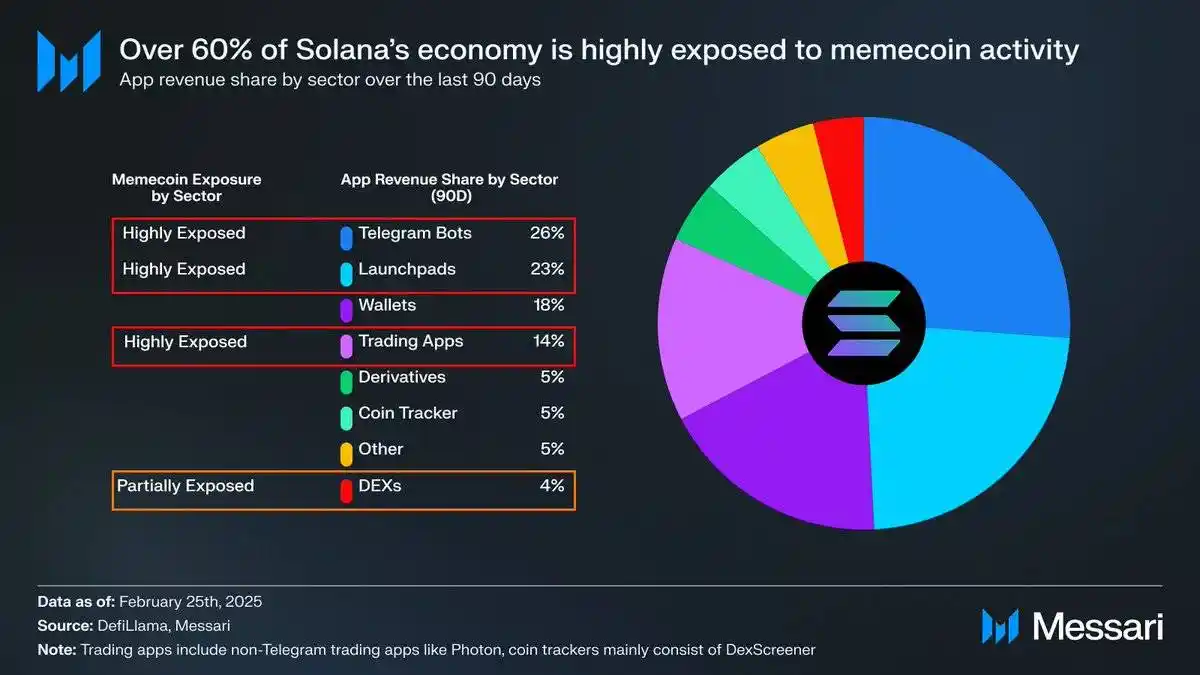
However, when we delve into the primary sources of this revenue, we find that the most profitable businesses on Solana are actually those profiting from Memecoin reliance.
For example, the two highest-earning areas on Solana are Telegram trading bots and Launchpads (such as pump.fun).
These two areas together contribute to over 60% of Solana's application revenue, with an annualized income exceeding $33 billion.
The core of these businesses is indeed Memecoin.
The interdependence in Solana's app economy further exacerbates the risk of Memecoin trading volume.
For instance, Pump relies on Raydium, Raydium relies on Jupiter, followed by Photon and Jito.
This means that a Memecoin transaction can generate revenue for five different apps simultaneously.
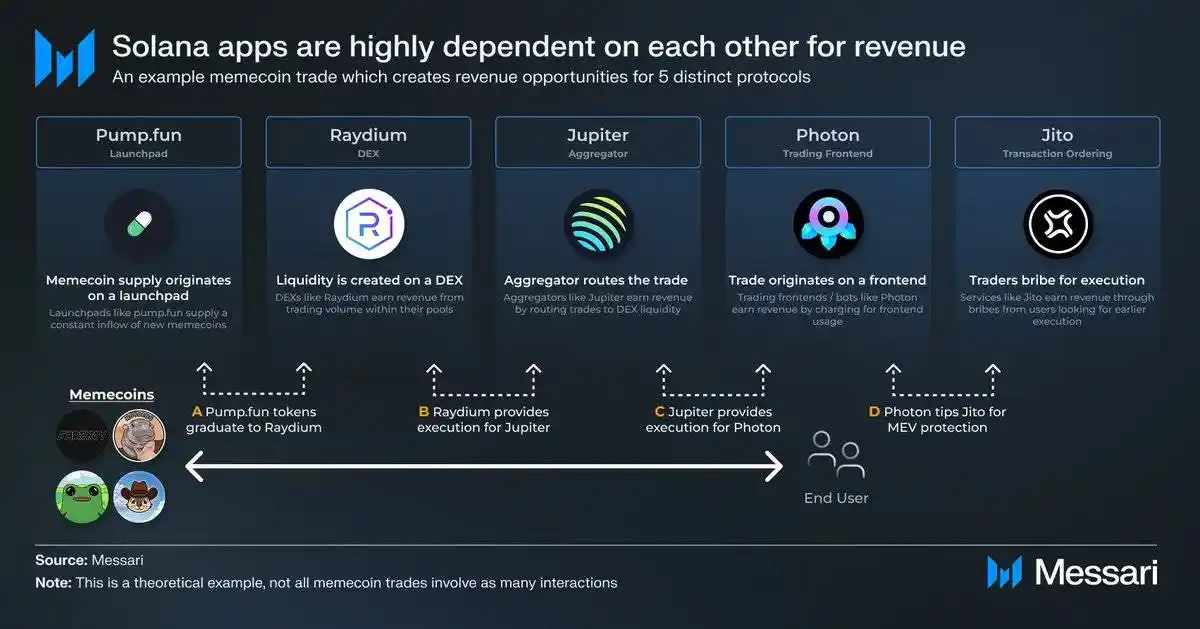
Therefore, these seemingly independent business apps are actually significantly interdependent in terms of revenue.
However, this cross-domain revenue is all built on the foundation of current 50%-70% of transaction volume originating from Memecoin activity.
From a blockchain perspective, Memecoin itself is not the issue. For Solana, this phenomenon is a natural outcome of its low-cost block space and early lead in on-chain user experience (UX).
The essence of blockchain should be to remain neutral to the type of activity.
Building an ecosystem around Memecoin is profitable, so many protocols have seized this opportunity.
In the future, other asset classes, such as Decentralized IoT Networks (DePIN), Real-World Assets (RWAs), stablecoins, and mainstream assets, may gradually replace Memecoin trading volume.
But for now, calling Solana a "Memecoin Economy" is not an exaggeration.
This also means that if Memecoin trading volume experiences a significant contraction, it could trigger a chain reaction of revenue decline.
Why is this important?
Solana's development narrative has always revolved around the growth of fundamental metrics, which have also supported the performance of the $SOL asset.
However, in reality, these metrics are highly dependent on the Memecoin space, which has a strong reflexivity (meaning changes in trading volume will amplify market fluctuations).
If we use these metrics to assess Solana's progress, then a collapse in Memecoin trading volume could turn a "growth story" into a "recovery story."
This would lead to a sharp shift in market sentiment, and restoring these economic activities could take a considerable amount of time.
Of course, it could also be that Murad's viewpoint is correct. If so, then disregard the above concerns.
In the long term, I still remain bullish on Solana's ecosystem. However, in the short to medium term, if Memecoin demand cannot be sustained, Solana's economy may face some challenges.
You may also like

Morning Report | CoinEx becomes a key hub for Iran to evade sanctions, involving over $3.8 billion in funds; Kalshi seeks a new round of financing, with a valuation potentially rising to $40 billion

From the white-haired stock god to the billionaire fund mogul, the smart people shorting Nvidia are all getting rich using the same framework

Why do cryptocurrency projects always like to change their names?

Global Launch: As predictions become the most scarce asset in the AI era, Manadia is defining the next generation of the value internet

Who is footing the bill for the $64 billion accounting frenzy?
I never expected that the first application of AI x Crypto would be in security auditing

What is your view on Binance's competitive advantages?

ETH has entered a non-consensus phase, and the turning point is approaching!
The shift in the cloud of the air: from despising stablecoins a year ago to the high-profile entry of capital today
The survival dilemma of small and medium exchanges behind the withdrawal anomalies exposed by AscendEX

Why Is Bitcoin Falling Below $60K? 5 Key Market Drivers Explained
Bitcoin has dropped sharply amid ETF outflows, Strategy stock weakness, AI stock rallies, and changing Fed expectations. Explore the key forces driving BTC’s latest correction and what traders should watch next.

Bitcoin vs. Gold in 2026: Which Asset Performs Better in Different Markets?

Morning News | The draft amendment to the People's Bank of China Law aims to clarify the legal status of digital renminbi; South Korea will transfer about 40 unregistered virtual asset service providers to law enforcement agencies
The cryptocurrency industry has entered the "Show Me" era: merely relying on vision is no longer enough

Interpreting the Ethereum Foundation's new structure: Reaffirming self-sovereignty amid institutional trends
Former SpaceX engineer reconstructs the financial execution system using first principles
Standard Chartered Bank sings a 50x rhapsody again, aiming for AAVE to reach 3500 USD

Tidal Investment: We still have a positive outlook on the AI industry chain, but the reasons have changed
Morning Report | CoinEx becomes a key hub for Iran to evade sanctions, involving over $3.8 billion in funds; Kalshi seeks a new round of financing, with a valuation potentially rising to $40 billion
From the white-haired stock god to the billionaire fund mogul, the smart people shorting Nvidia are all getting rich using the same framework
Why do cryptocurrency projects always like to change their names?
Global Launch: As predictions become the most scarce asset in the AI era, Manadia is defining the next generation of the value internet
Who is footing the bill for the $64 billion accounting frenzy?
I never expected that the first application of AI x Crypto would be in security auditing


