
Musk Denies DOGE's Relationship with the US Government, Has Dogecoin Peaked?

Original Title: "Musk Denies DOGE's Relationship with the US Government, Has Dogecoin Bottomed Out?"
Original Author: Lawrence, Mars Finance
On March 30, at a town hall meeting hosted by him in Green Bay, Wisconsin, during an American Political Action Committee event, Musk clearly distinguished the Department of Government Efficiency (DOGE) from the Dogecoin cryptocurrency.
He said: "As far as I know, the government has no plans to use Dogecoin or any other currency. While their names may sound similar, our actual goal is to increase government efficiency by 15%."
Musk further explained that the name's origin is related to internet suggestions. "I originally wanted to name it the Government Efficiency Committee, but that felt too boring," he said. "Later, the internet suggested naming it the Department of Government Efficiency, and I thought that was right."
When Musk unequivocally denied the association between the Department of Government Efficiency (DOGE) and Dogecoin at the town hall meeting, a cognitive battle sparked by the homonymous abbreviation quietly erupted. This game revolving around technological fundamentals, policy narratives, and capital leverage is now subjecting Dogecoin to the final test that could push it to a historic bottom.
Naming Paradox: The Quantum Entanglement of Political Symbols and Crypto Assets
The Cognitive Battle of Abbreviations
The Department of Government Efficiency (DOGE) sharing the DOGE abbreviation with Dogecoin is by no means coincidental. In the eve of the institution's establishment in August 2024, Musk deliberately retained a narrative interface to the crypto community in a naming poll he initiated on platform X. This political engineering colliding with meme culture is fundamentally Musk's ultimate manipulation of the attention economy—by creating semantic chaos, he reserves a public opinion buffer for policy experiments while injecting continuous topic potential into Dogecoin.
Cognitive Arbitrage of Visual Symbols
The Shiba Inu Logo flashing event on the DOGE official website in February 2025 is arguably the most ingenious case of cognitive manipulation in modern financial history. The 72-hour visual hint directly triggered a 14% instantaneous surge, with arbitrage funds harvesting a $70 million-level profit in information asymmetry. This kind of "policy memefication" operation reveals a new type of market manipulation paradigm: when political symbols become entangled with financial symbols, the traditional definition of "market manipulation" by regulators is no longer able to cover this cross-dimensional attack.
The Reflexive Trap of Narrative Economy
Within 24 hours of Musk's clarification statement, the sentiment score of DOGE-related tweets plummeted from +68 to -42, but addresses holding over 100,000 coins contrarily increased their holdings by 1.13 billion coins. This retail panic selling, juxtaposed with institutional stealth accumulation, has exposed a fatal flaw of narrative economics—short-term emotions are easily manipulated by symbols, while whales have long established cross-market hedging mechanisms.
On-Chain Stealth War: Whale's Silent Harvest and Retail's Cognitive Gap
The Binary Split of Chip Distribution
In the past 30 days, addresses holding between 10,000 and 100,000 coins have divested 2.3 billion coins, while addresses holding over 1 million coins have accumulated 4.1 billion coins. This "de-retailization" process has reached a historical peak, with the circulation ratio of the top 1% addresses rising from 58% to 67%, forming a highly concentrated control pattern. Notably, 12 of the 17 new "super whale" addresses conducted OTC trades through Coinbase Prime, indicating that traditional institutions are quietly entering the fray.
The Cipher of UTXO Age Distribution
The proportion of "zombie coins" in Dogecoin, which have been dormant for over 1 year, has surpassed 43%, reaching a historic high. These long-term holders' cost basis ranges from $0.05 to $0.08, and despite a 60% price drop, they still maintain over 200% unrealized gains. The presence of these "deep-pocketed chips" makes it difficult to complete bottom formation through regular shakeouts, and extreme events may trigger a liquidation event.
The Paradigm Shift in On-Chain Behavior
An unprecedented "hoarding - staking" composite strategy has emerged on the Dogecoin network: the net outflow from the top 20 exchanges has been positive for 9 consecutive weeks, while the locked volume in decentralized staking contracts has grown by 340% during the same period. The transition from trading assets to interest-bearing assets may reshape the valuation model. If the annual staking yield remains stable at above 8%, DOGE may become a "crypto high-yield bond," attracting inflows of conservative capital.
Fundamental Revolution: Deflationary Narrative and the Life-or-Death Race of the Payment Ecosystem
The Paradigm Shift in the Supply Mechanism
In February, Dogecoin co-founder Billy Markus revealed that DOGE may implement a deflationary mechanism through community consensus, with specific steps including: developers submitting code change proposals (GitHub Pull Request), community and miners reaching consensus, and deploying the new protocol. Currently, DOGE has a total supply of approximately 146.78 billion coins, with an annual issuance of 5 billion coins, and the inflation rate gradually decreasing as the total supply grows. Markus emphasized that DOGE's supply mechanism is more flexible than Bitcoin's and may be superior to the fiat system in the long run. If the deflation plan is implemented, it could provide long-term support for DOGE's price. However, this plan currently faces strong resistance from miners.
Lightning Strike of Payment Infrastructure
The number of merchants integrated into the Dogebox payment system has exceeded 1800, with a daily transaction volume reaching 2.4 million. If the API integration with Square and Stripe can be completed by the second quarter of 2025, Dogecoin may become the first cryptocurrency to cover 5% of all U.S. in-store merchants. However, regulatory agencies are closely reviewing its anti-money laundering compliance, with the CFPB requesting KYC data for all transactions exceeding $10,000.
Political Leverage in ETF Game
The approval process of three DOGE ETFs has become a bargaining chip in the power play between the Trump administration and the SEC. White House aides have revealed that the DOGE scheme may use "supporting financial innovation" as leverage to obtain SEC approval for spot ETFs. If this political arbitrage is successful, it will introduce institutional funds in the billions of dollars to Dogecoin, fundamentally altering the market structure.
Technical Strangulation: Bull vs. Bear Game at the $0.16 Line
Space-Time Compression of Symmetrical Triangle
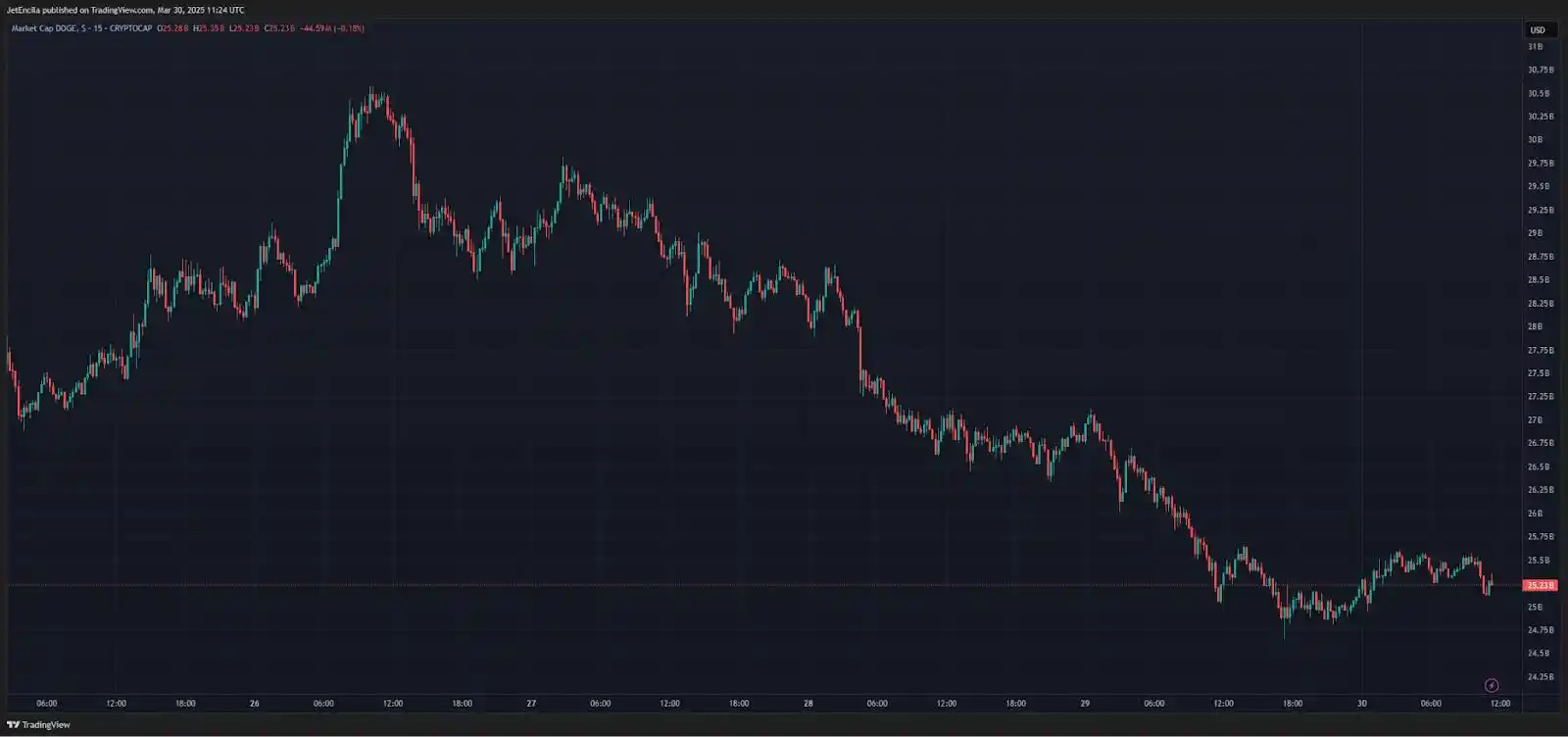
On the daily chart, Dogecoin's symmetrical triangle formation since November 2024 is about to enter its final convergence phase. The convergence point of the upper and lower bounds at $0.16-$0.18 has become the battleground for bulls and bears. This pattern historically has an 87% breakout probability, but the breakout direction depends on the catalyst.
Alignment of Weekly RSI and Candlestick Patterns
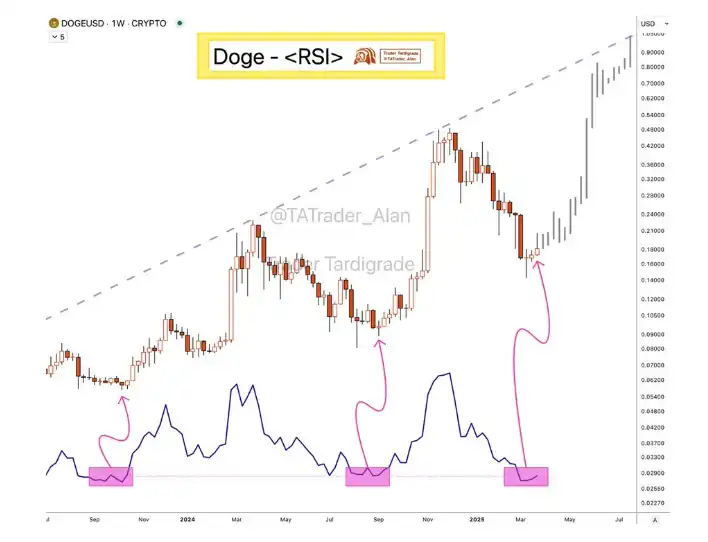
For several months, Dogecoin's relative strength index (RSI) has been consistently declining across multiple timeframes. On social media platform X, cryptocurrency analyst Trader Tardigrade noted an intriguing phenomenon in the weekly candlestick RSI indicator for Dogecoin. He believes the RSI may rebound from its current level, suggesting that Dogecoin is poised to break the $1 psychological barrier.
Miner Cost's Last Line of Defense
On-chain data shows that the current price of $0.16 is approaching the shutdown price threshold for the top three mining pools. If the price falls below this point, it will trigger the forced exit of $320 million worth of mining machines, creating a "death spiral" feedback loop. However, Glassnode has observed that the top five mining pools have established a $180 million protection in the $0.15-$0.16 range, hinting that institutional funds are staunchly defending this bottom line.
The Undercurrent of the Derivatives Market
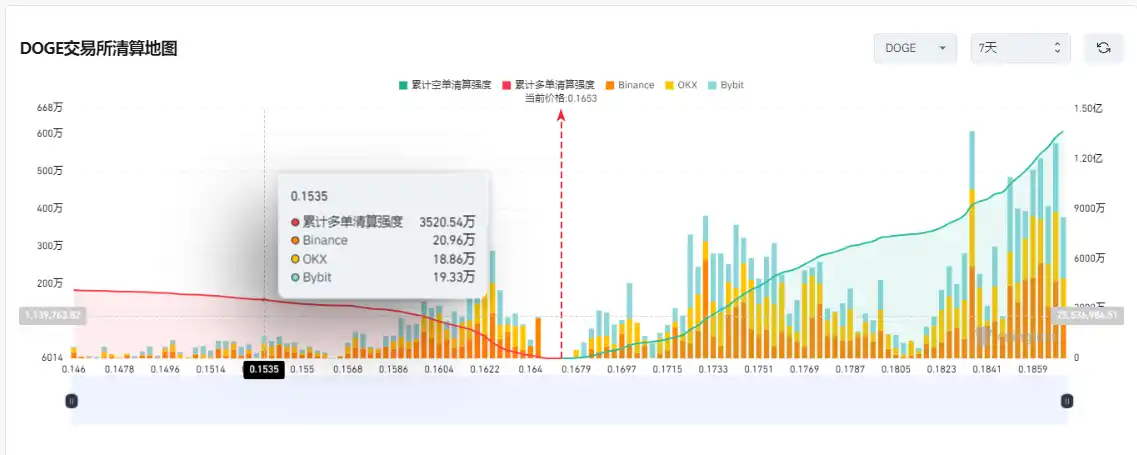
Coinglass data shows that the current Dogecoin contract holdings have dropped significantly, and the funding rate has turned negative. This extremely bearish structure, combined with a persistently negative funding rate (-0.03%), suggests that the market has already priced in the most pessimistic expectations. When considering exchange liquidation data, the Dogecoin derivatives market may trigger a short squeeze, indicating that Dogecoin may have reached a temporary bottom.
The Ultimate Revelation: Seeking Order in Chaos
When Musk insisted on using DOGE to name a government reform plan, he may have already glimpsed the wealth code of the post-truth era: in this world where consensus is scarcer than code, the bottom is not a simple technical indicator level, but a tipping point of collective cognition. Dogecoin is undergoing the most complex stress test in the history of crypto civilization—it is both the gravedigger of the old paradigm and the midwife of the new order.
You may also like

Why Tokenized Stocks Are Booming in 2026 While Crypto Is Still Struggling
From Pump.fun to Collector Crypt: Has Solana's income throne changed hands?
Looking at Stripe's ambitions and the future of stablecoins from OUSD
Do you want to buy CRCL?
Wosh: Inflation has cooled in recent weeks, AI is reshaping the economy, and forward guidance has lost its necessity
The most secretive AI winner
Former ByteDance employee's account: How I started with two Pinduoduo hard drives and made six times the profit with Seagate to achieve financial freedom?
MiCA reshuffle begins, Binance temporarily bids farewell to the EU
How does Gate redo "buying and selling stocks" from the cryptocurrency world to the stock market?
Visa and Mastercard join 140 giants to launch a new stablecoin, but the impact on the market landscape may still be limited
Circle CEO responds to OUSD's challenge: Stablecoins are a winner-takes-all business, and we will not slow down
Argentina vs Cape Verde: When a Record-Breaking Legend Meets an Unbreakable Underdog
WEEX exclusive pre-match analysis of Argentina vs Cape Verde, exploring Messi-led Argentina’s dominance and Cape Verde’s historic defensive breakout, with a breakdown of volatility, structure, and match dynamics.
WEEX Launches Depth Chart for Spot Trading
Raising interest rates to protect STRC and selling coins to maintain credit, this time the strategy has chosen the two most expensive paths
Morning Report | Samsung announces a 265.5 trillion won investment plan, focusing on semiconductor and AI computing power data centers; Vitalik publishes an article detailing the entire technology tree behind the confusion protocol (iO) mainline
In the era of AI, what is left of Bitcoin?
NeoSoul announced plans to integrate with the OKX Agentic Wallet, promoting AI agents' participation in the on-chain economy
Why Is Bitcoin Lagging Stocks in 2026? AI Stocks, ETF Outflows, and the Nasdaq Rally Explained
Why Tokenized Stocks Are Booming in 2026 While Crypto Is Still Struggling
From Pump.fun to Collector Crypt: Has Solana's income throne changed hands?
Looking at Stripe's ambitions and the future of stablecoins from OUSD
Do you want to buy CRCL?
Wosh: Inflation has cooled in recent weeks, AI is reshaping the economy, and forward guidance has lost its necessity
The most secretive AI winner