
Platform Token Valuation Revolution: Examining the Long-Term Exchange Ecosystem Battle Through the Quiet Rise of GT Market Cap

Source: Cointelegraph Chinese
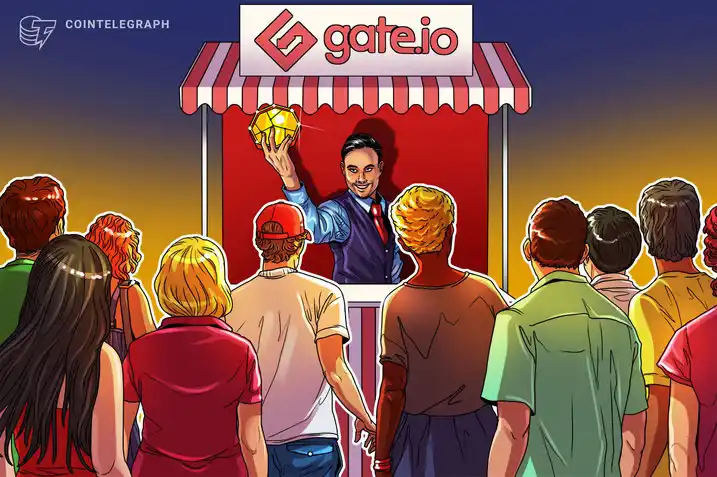
The cryptocurrency market in 2025 is showing significant "structural turbulence." Bitcoin is experiencing high volatility under institutional fund custody, while mid and small cap assets are generally under pressure, and market liquidity is concentrating towards top assets. In this context, exchange platform tokens, as the core value carriers of the exchange ecosystem, have seen further differentiation within the race track. According to the latest data from April 2025, Gate.io's platform token GT has climbed to the 32nd spot in the global cryptocurrency market cap, with its price stable above $22, becoming one of the few platform token representatives achieving "counter-cyclical growth." This phenomenon not only reflects a reassessment of the GT ecosystem value by the market but also reveals a profound transformation in the logic of exchange competition—from mere traffic competition to the efficiency of capturing ecological value.
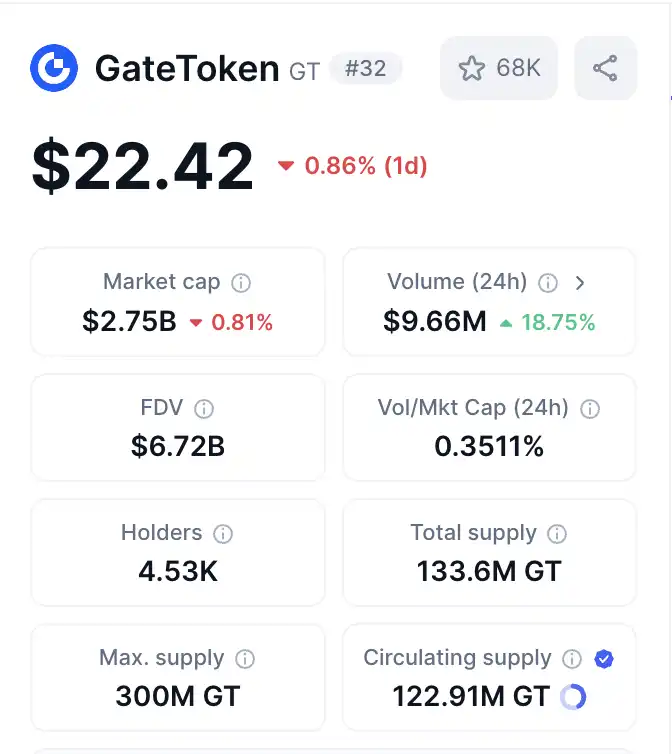
When horizontally comparing the market performance of mainstream platform tokens, GT's "low-key rise" is particularly noteworthy. As of April 2025, its circulating market cap has surpassed several traditional financial derivative tokens, and among the top 50 cryptocurrencies globally, GT is the only platform token that has achieved synchronized growth in "trading volume, number of users, and burn volume" for three consecutive quarters. Behind this "counter-trend resilience" lies deep synergy between exchange ecosystem development and tokenomics.
1. Data Mining: Where Does GT's Excess Returns Come From?
The value performance of platform tokens fundamentally reflects the overall competitiveness of exchanges. Looking at the price increase data from the past nearly 180 days, GT's 148.29% increase far exceeds BNB (3.32%) and OKB (29.17%), revealing three core trends:
1. Difference in Growth Momentum: Top platform tokens (such as BNB) have a more mature ecosystem, leading to a relatively flat growth trend, while GT, relying on Gate.io's "high-growth ecosystem," is still in an accelerated period of value release.
2. Comparison of Deflation Efficiency: As of Q1 2025, GT has burned a total of 177 million tokens (about 60% of the total supply), which is much higher than the average annual burn rate of most platform tokens (typically less than 20%). This "better-than-expected deflation" directly boosts GT's scarcity premium.
3. User Growth Dividend: Gate.io has surpassed 22 million users (a 234% increase in 2024) and a trading volume of $3.8 trillion (a 120% annual increase), with growth rates significantly above the industry average, providing continuous support for GT's demand side.
Of note is that the GT market cap/trading volume ratio is significantly lower than that of top platform coins like BNB, indicating that its valuation still has considerable room for growth — if Gate.io maintains its current growth trajectory, GT's market cap potential may be further unleashed.
II. GT's Competitive Advantages Compared to Other Platform Coins: Ecosystem Empowerment and Strategic Depth
In the platform coin arena, GT presents a starkly different development path compared to BNB and OKB. While BNB, as an industry leader, derives its value mainly from the Binance ecosystem's economies of scale, OKB relies on the technical iterations of the OKX Chain. GT's strong performance is rooted in Gate.io's constructed "trinity" value system: deflationary drive, scenario penetration, and strategic foresight.
1. Deflationary Model: From "Passive Burn" to "Active Value Management"
GT adopts a "Profit Buyback + Directed Burn" dual-track mechanism:
· Rigorous Deflation: 20% of the platform's net profit in Q1 2025 is used for GT repurchase and burn, with an expected circulation reduction of over 12 million coins within the year;
· Scenario Consumption: GT, as the native token of Gate Chain, continues to be consumed in scenarios such as DeFi, NFT cross-chain, further reducing circulation.
In comparison, the deflationary designs of most platform coins rely solely on fee offsets, lacking diverse consumption scenarios and limiting long-term deflation efficiency.
2. Strategic Deployment: Dual Drivers of Compliance and Globalization
By 2025, Gate.io's strategic focus is clearly defined:
· Compliance: Already obtained EU MiCA license, principled approval of Middle East VASPs, reserve ratio exceeding 128% (ranking third globally), significantly reducing policy risks;
· Globalization: Sponsoring the F1 Red Bull Racing Team, expanding into Latin America and Southeast Asia markets, achieving a more balanced user geographical distribution;
· Product Innovation: Targeting a contract market share of 10%, launching AI trading assistants, and MEME Innovation Zone.
3. Valuation Opportunity and Growth Certainty
· Gate.io's spot trading volume has already entered the global top three, yet its platform coin market cap is only 1/15th of BNB's. If Gate.io's contract market share increases from 5% to 10%, GT's market cap could see a 2-3 times revaluation potential.
· The deflation rate of GT (approximately 8% annually) far exceeds the industry average (2%-3%), while the use demand brought by ecosystem expansion forms continuous buying pressure. This "supply reduction and demand increase" mismatch makes it more defensive in a volatile market.
These measures not only enhance the platform's countercyclicality but also inject long-term growth expectations into GT.
III. Conclusion: The Essence of Platform Token Competition is Ecosystem Warfare
The competition in the current platform token race has shifted from "traffic scale" to "ecosystem quality." The contrarian growth of GT has confirmed the differentiated advantage constructed by Gate.io through deep deflation, scenario innovation, and compliance layout. For investors, the value of dollar-cost averaging in GT lies not only in short-term price gains but also in its positioning as an "ecosystem value aggregator" — as Gate.io transitions to a Web3 infrastructure service provider, GT may become the core link connecting trading, asset management, and on-chain applications.
In the future, platform token competition will focus more on real value capture efficiency and global compliance capabilities. Although market volatility risks always exist, GT's performance in deflation modeling, ecosystem expansion, and strategic execution has outlined a clear path of value growth.
This article is contributed content and does not represent the views of BlockBeats
You may also like
Semiconductor stocks plummet, yet Anthropic wants to create a 2nm chip
Where is Zhao Changpeng's billion-dollar investment going? YZi Labs' investment landscape fully revealed
Ethereum Foundation Report: A Basic Guide to Ethereum for Governments and Financial Institutions
A pre-announced harvesting case: After the cryptocurrency price dropped by 99%, the public chain Saga exited to transform into AI
When American giants collectively "defect" from Chinese AI models
BIS Report Compliance Observation: The Real Risks of Stablecoins, Not Just "Depegging"
Portugal 2-1 Croatia: Ronaldo's 20-Year Knockout-Stage Drought Ends With a Debt Finally Collected
Portugal beat Croatia 2-1 in the 2026 global football championship's knockout rounds as Ronaldo scored his first-ever knockout-stage goal, Gonçalo Ramos struck a stoppage-time winner, and VAR ruled out a late equalizer for offside.
Bitcoin Price Prediction July 2026: Will BTC Recover to $70K or Drop Below $55K?
A South Korean company that learned the strategy of hoarding coins, from a bull market to delisting?
WEEX API Broker Program: Turn Your Trading Platform Into a Revenue Engine
How to choose between buying discounted ETH, Bitmine, and SharpLink?
Wosh: Inflation has cooled in recent weeks, AI is reshaping the economy, and forward guidance has lost its necessity
From Pump.fun to Collector Crypt: Has Solana's income throne changed hands?
Dan Bin's latest speech: Don't miss out on a great era
Robinhood launches its own blockchain, no longer wanting to be a tenant on others' chains
Why Tokenized Stocks Are Booming in 2026 While Crypto Is Still Struggling
Looking at Stripe's ambitions and the future of stablecoins from OUSD
Do you want to buy CRCL?
Semiconductor stocks plummet, yet Anthropic wants to create a 2nm chip
Where is Zhao Changpeng's billion-dollar investment going? YZi Labs' investment landscape fully revealed
Ethereum Foundation Report: A Basic Guide to Ethereum for Governments and Financial Institutions
A pre-announced harvesting case: After the cryptocurrency price dropped by 99%, the public chain Saga exited to transform into AI
When American giants collectively "defect" from Chinese AI models
BIS Report Compliance Observation: The Real Risks of Stablecoins, Not Just "Depegging"