
 Buy Crypto
- Markets
 Futures
- Spot
- Copy Trade
- Earn
- More
Q1 Market Review: Traditional Assets Enter the Blockchain Era; Geopolitical Turbulence Puts Pressure on the Cryptocurrency Market

Original Title: Q1 2026 Review: Crypto Markets Reset as Traditional Assets Go 24/7
Original Author: Tanay Ved, Coin Metrics
Translated by: Chopper, Foresight News
TL;DR
· Amid macroeconomic and geopolitical turbulence, the crypto market remained under pressure, but ETF demand improved gradually this quarter, providing support for Bitcoin's current price.
· On-chain trading platforms and asset tokenization further facilitated the entry of traditional assets into 24/7 trading with platforms like Hyperliquid launching stock and index perpetual contracts, along with mainstream exchanges introducing stock perpetual products, driving the steady growth of open interest.
· The total stablecoin supply remained around $300 billion, with the first quarter of 2026 seeing a rise in transaction volume to around $21.5 trillion post-adjustment; regulatory policies related to stablecoin revenue and issuance have gradually become clearer, continuing to impact the industry's development.
The first quarter of 2026 has come to a close, marking a key moment to review the development dynamics and key themes of the crypto market. This quarter, amid geopolitical and macroeconomic uncertainties, the market exhibited a risk-off, high-volatility nature. Despite challenges faced by the crypto market, with the total market capitalization falling by around 22%, areas such as tokenized stocks and on-chain trading of traditional assets stood out as industry highlights, with significant progress made in industry infrastructure. This article will review the first quarter of 2026, dissecting the trends and key themes that shaped the market in that quarter.
Market Performance
In February, Bitcoin's price dropped over 30% from around $95,000, resulting in a 22% year-to-date decline. Apart from macroeconomic pressures, a general sell-off of risk assets and derivatives market liquidation exacerbated the downturn, reigniting discussions about Bitcoin's safe haven properties and store of value function.
However, since the outbreak of the Iran conflict on February 28, Bitcoin has shown more strength compared to stocks and gold, demonstrating some resilience and signs of demand recovery.
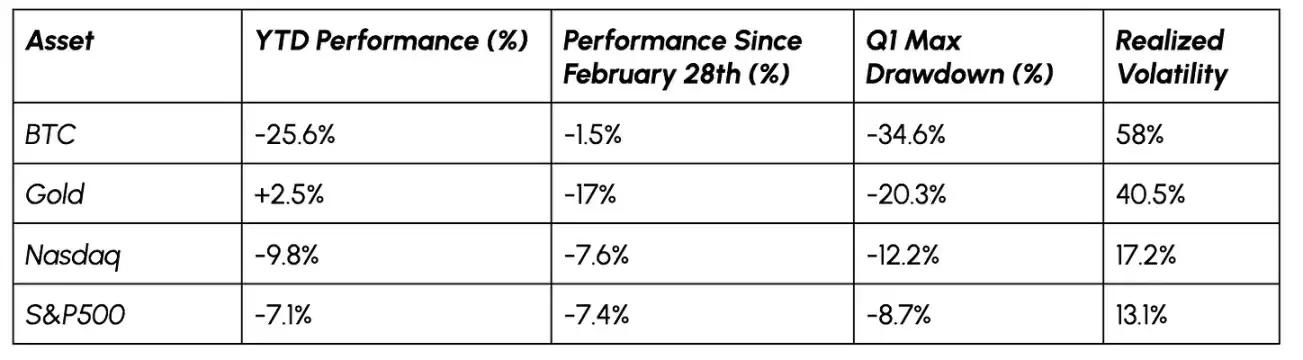
Data Source: Coin Metrics and Google Finance
The performance of crypto assets has shown significant differentiation internally, with only a few meme coins demonstrating strong narratives and real-world adoption outperforming the market.
Notable performers include Hyperliquid (HYPE), Bittensor (TAO), and Morpho (MORPHO), all seeing quarterly gains of over 30%. Hyperliquid benefited from the HIP-3 market's growth (especially in the commodities and stock index categories), expanding its business scope from crypto assets to more asset classes; Bittensor and Morpho leveraged the growth in AI infrastructure and decentralized finance credit markets, with institutional interest in decentralized AI and treasury management businesses continuing to rise.
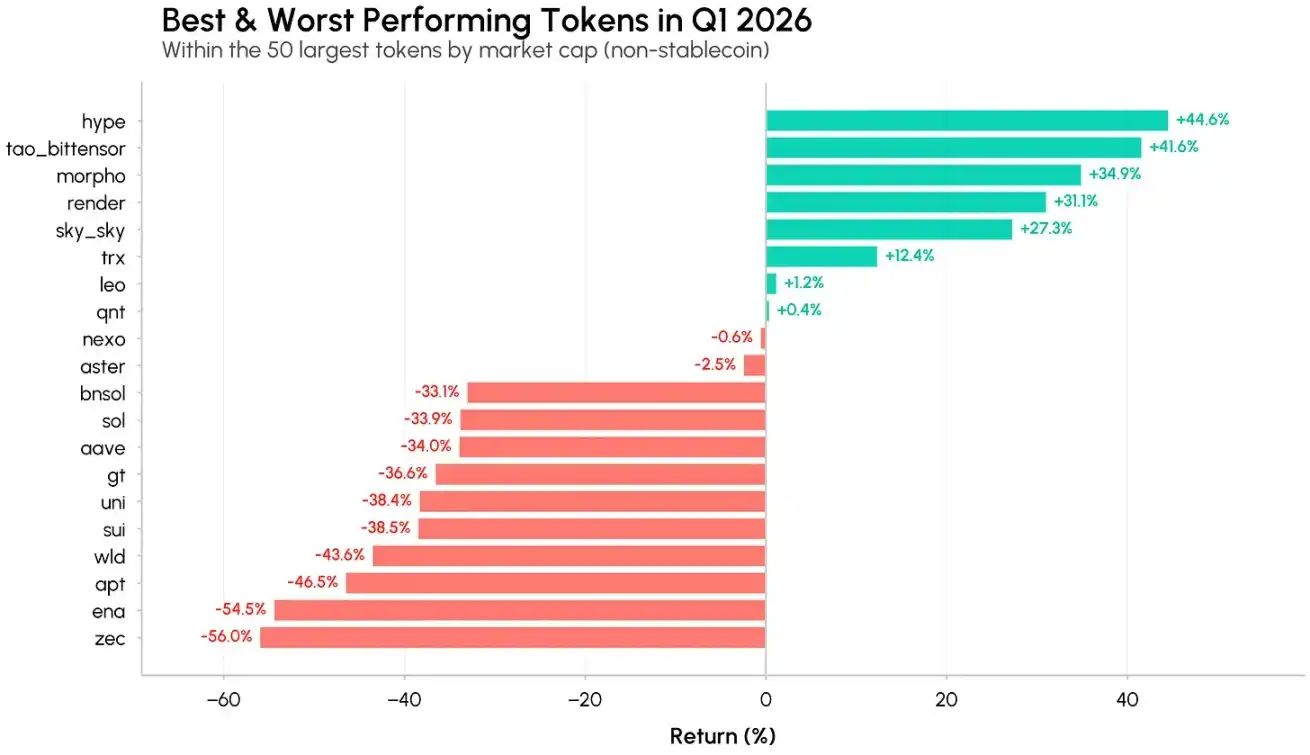
Data Source: Coin Metrics
Bitcoin Demand Slowly Stabilizing
Early in the quarter, risk-off sentiment reversed in March. Despite lingering market weakness, demand for Bitcoin spot ETFs significantly improved, reversing the trend of continuous outflows since November 2025. Rolling 30-day data shows net inflows into ETFs exceeding 30,000 BTC, supporting Bitcoin's consolidation around $70,000.
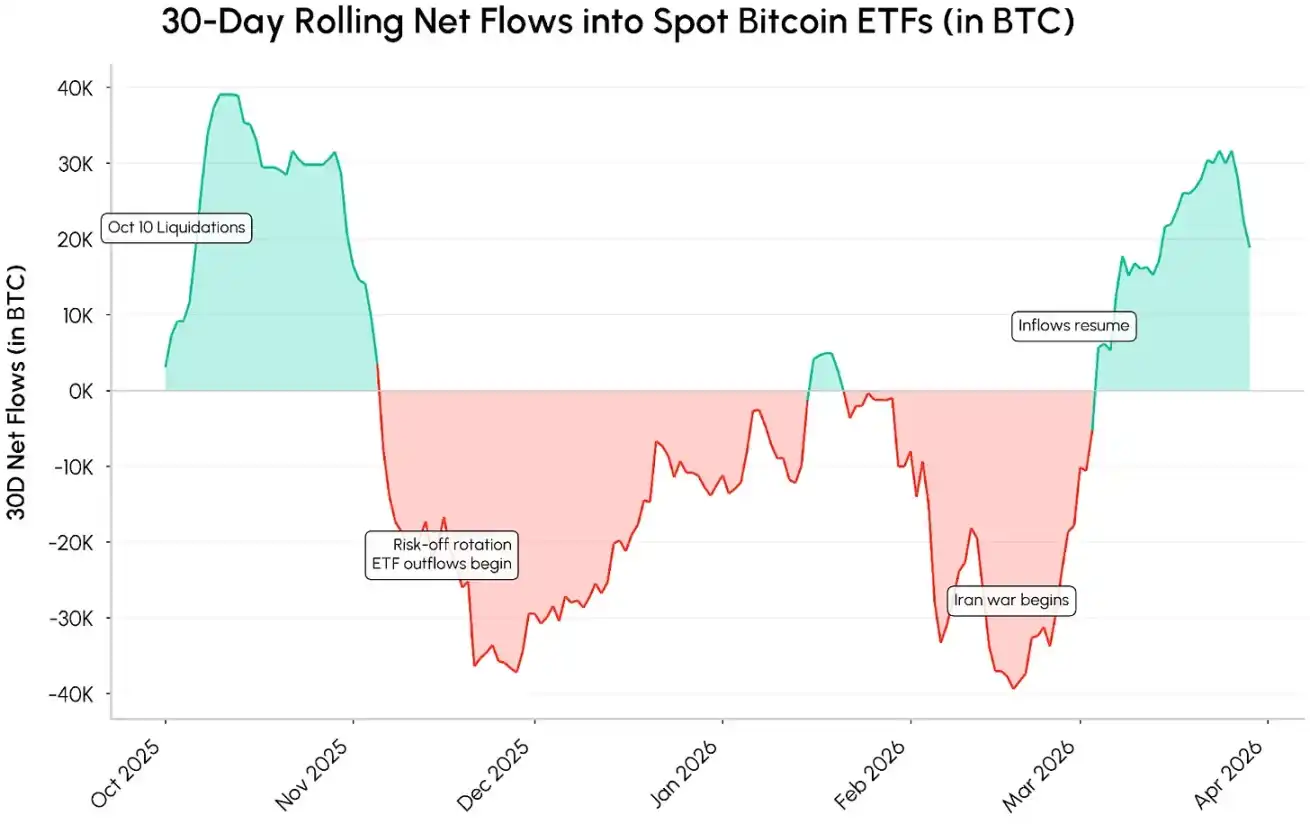
Data Source: Coin Metrics Network
The sustainability and acceleration of this demand largely depend on the macro environment and policy direction. Geopolitical risks easing, inflation slowing, rate cut expectations returning, and the continued growth in ETF and Digital Asset Treasury (DAT) allocations (including a $42 billion Bitcoin fundraising plan by institutional strategies), are all poised to further consolidate inflows.
Round-the-Clock On-Chain Markets and Tokenized Stocks
Hyperliquid and Traditional Asset Race
One of this year's core trends is the fusion of traditional financial markets with on-chain infrastructure through asset tokenization and round-the-clock trading acceleration. The growth of perpetual contracts for traditional asset classes is the most tangible manifestation of this trend.
Following the launch of the HIP-3 market covering categories such as stocks, indices, and commodities, Hyperliquid saw the non-crypto asset trading volume share increase significantly to about 45% this quarter. Amid geopolitical conflicts, traders sought round-the-clock exposure to metals, oil, and other assets, leading to significant growth in overall platform trading volume and open interest contracts; among them, traditional asset open interest contracts in HIP-3 accounted for approximately 28% of the platform's total.
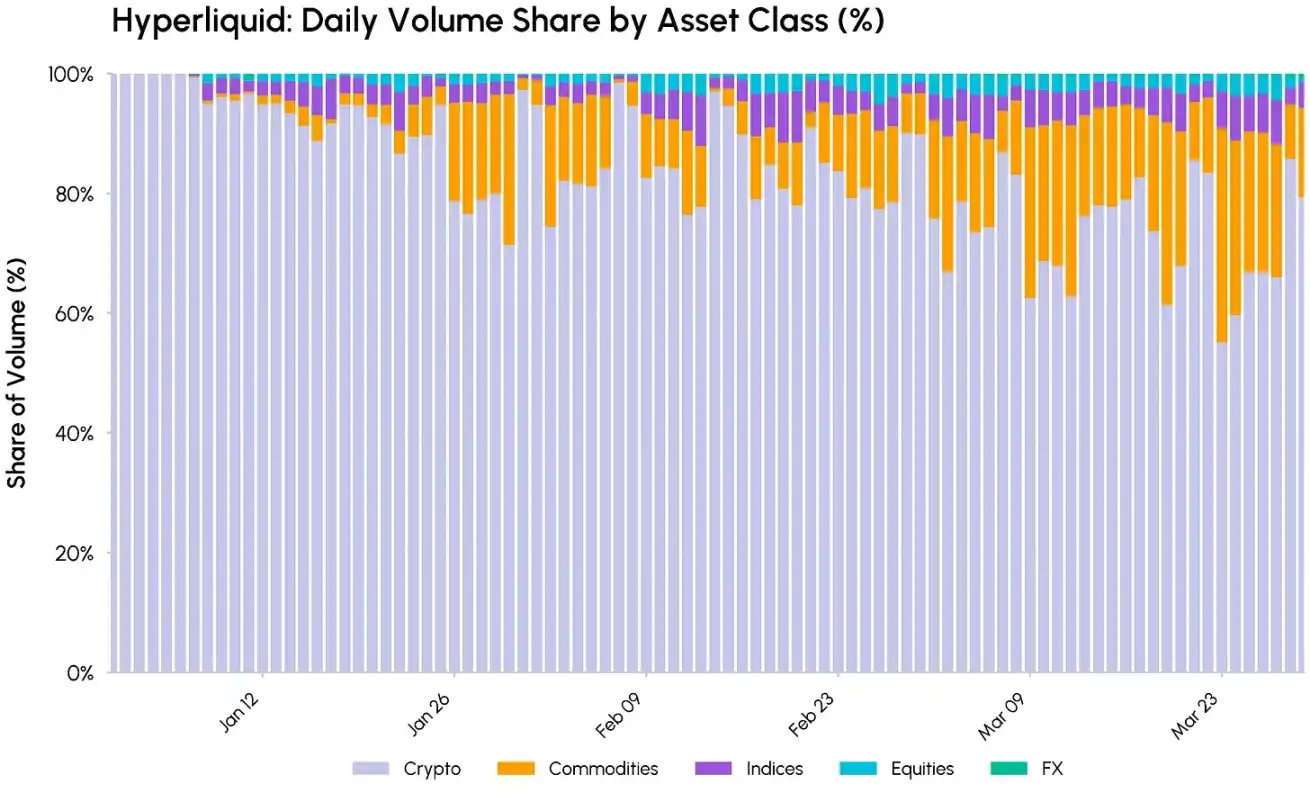
Data Source: Coin Metrics
The Rise of Stock Perpetual Contracts
In this subsector, as trading platforms continue to expand their businesses, mainstream stocks and index products have become the fastest-growing category. Kraken launched xStocks stock perpetual contracts in February, and Coinbase's international site introduced stock perpetual products, providing investors with exposure to U.S. stocks with leverage.
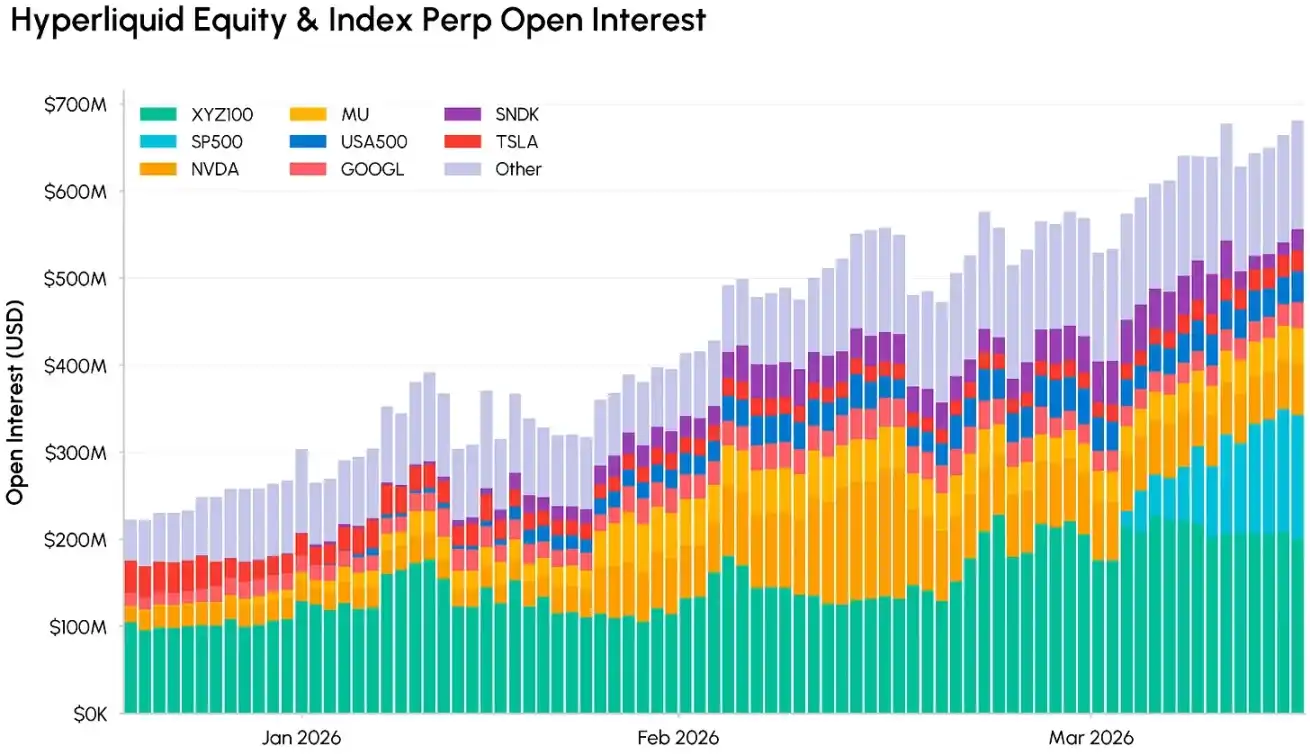
At the same time, the largest HIP-3 deployment partner of Hyperliquid [XYZ] collaborated with S&P Dow Jones Indices to launch the first official S&P 500 perpetual contract, further enriching the global stock exposure trading market.
Data Source: Coin Metrics
The open interest of stock and index perpetual contracts on Hyperliquid has been steadily increasing, with core indices such as XYZ100 (Nasdaq 100) and the S&P 500 ranking among the platform's largest open interest trading categories, and individual stocks such as Nvidia (NVDA) and Micron Technology (MU) also providing significant liquidity.
Meanwhile, tokenized stocks and fund issuance have grown in parallel, from frameworks like xStocks to institutions issuing tokenized currency market funds and stock funds on Ethereum and Solana, showing a growth trend.
The growth of tokenized stocks and Real World Asset (RWA) perpetual contracts confirms a trend: on-chain platforms are gradually becoming a round-the-clock extension of traditional markets, rather than just crypto-native trading venues.
Stablecoins: Stable Supply, Increasing Utility
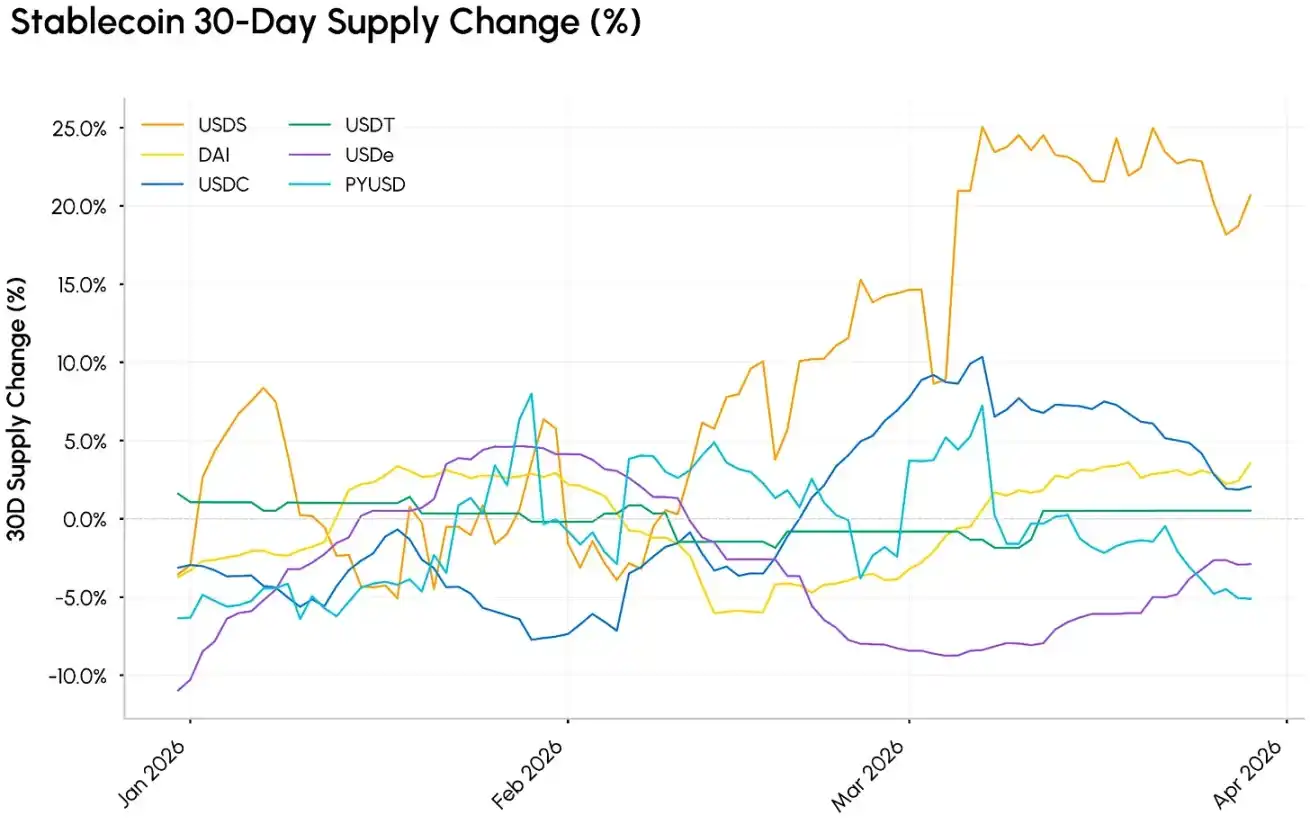
Stablecoins continue to play a role as the foundation of on-chain liquidity. Despite an overall market decline, the total supply of stablecoins remained stable around $300 billion in the first quarter of 2026, with a slight increase in supply growth on February 30.
The most prominent growth in stablecoins is seen in USDS, which is a dollar-pegged stablecoin issued by Sky Protocol (formerly MakerDAO) collateralized by crypto assets and Real World Assets, with a supply growth of 43% to around $8 billion; Circle's USDC has reached a scale of $77 billion, while USDT remains stable at around $184 billion.
Data Source: Coin Metrics
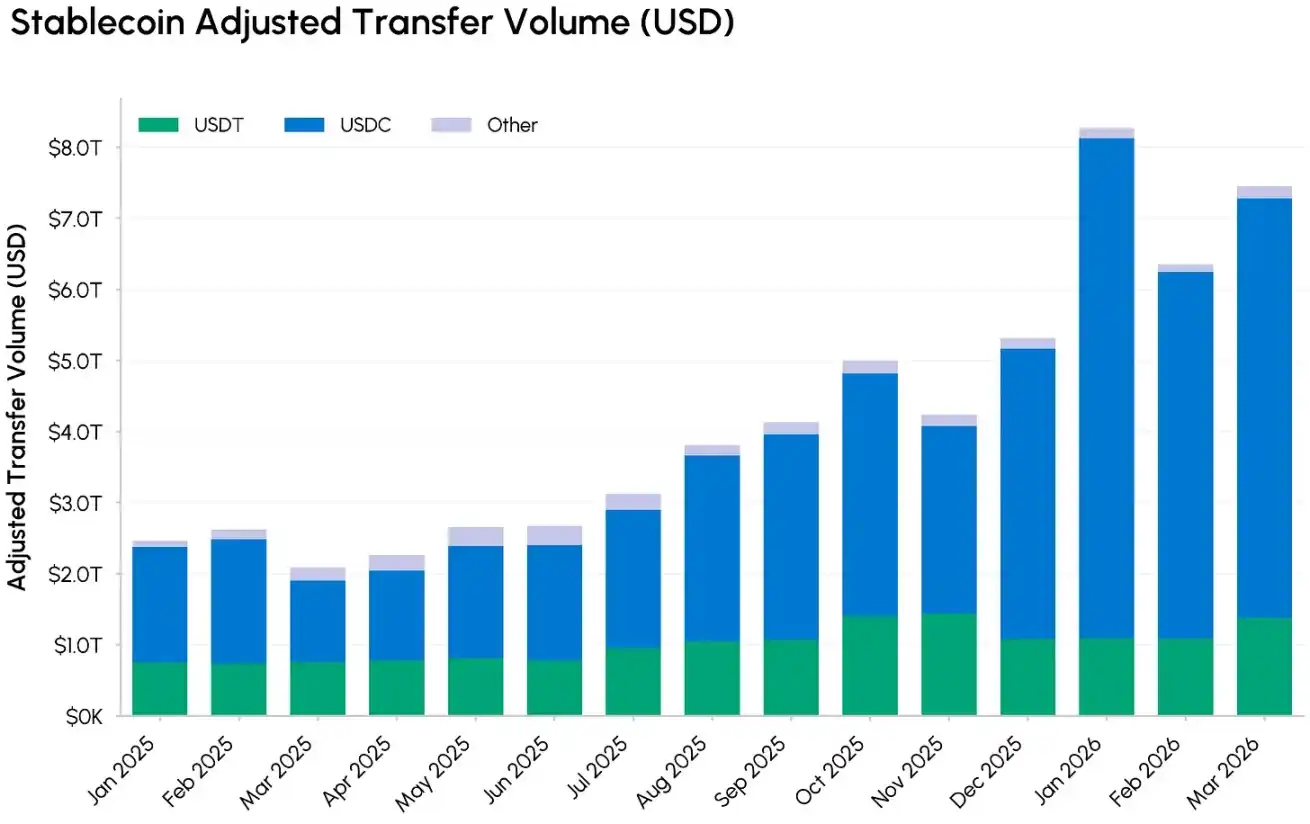
While supply remains stable, the circulation speed and usage of stablecoins have increased significantly. In the first quarter, the adjusted total transfer volume of stablecoins reached $21.5 trillion, about three times that of the same period in 2025. Over 80% of the transaction volume came from USDC, whose transaction usage share continues to expand compared to USDT. This high level of activity is mainly driven by USDC on the Base chain, with the transfer volume on that chain alone reaching $13 trillion in the first quarter.
As we analyzed in a recent report, a large part of this fund flow comes from DeFi infrastructure activities such as liquidity provider rebalancing and flash loans, rather than end-user payments or settlements, although the latter scenario is also growing concurrently.
Data Source: Coin Metrics
In the future, the direction of the stablecoin industry may depend on the revenue mechanism and issuance rules. The latest draft of the "CLARITY Act" proposes to prohibit passive income generation from stablecoin balances but allows for activity-based rewards linked to payments and platform usage. This provision may alter the business models of key stakeholders.
For Coinbase, where stablecoin revenue accounts for over 25% of total revenue, restricting USDC income could weaken its ability to attract and retain funds; Circle, on the other hand, is relatively less affected, and if the high-interest-rate environment persists and regulatory rules are clear, its payment- and transaction-related revenue may benefit. As the bill progresses, its impact on DeFi lending, yield-generating stablecoins, tokenized government bonds, and other areas is worth monitoring.
U.S. SEC Releases Digital Asset Classification Framework
This quarter saw a significant clarification on the regulatory front. The U.S. SEC and the Commodity Futures Trading Commission (CFTC) jointly released an interpretation document introducing a five-category digital asset classification framework and clarifying the positioning of each type of asset under existing securities and commodities regulations:
· Digital Commodities: Core network-native tokens whose value primarily relies on cryptographic system functionality and market supply and demand (such as mainstream public chain tokens), classified as commodities rather than securities.
· Digital Collectibles and Tools: NFTs, In-Game Assets, Gas Fee Tokens, Access Rights Tokens, generally not subject to securities rules unless fractionalized or primarily marketed as investment vehicles.
· Payment Stablecoins: Fiat-backed or real-world asset-backed payment stablecoins are considered a form of monetary tool, but variants with yield or non-compliant design still need to undergo securities identification.
· Digital Securities: Tokenized stocks, bonds, real-world asset-backed securities, and similar tools, whether on or off-chain, all fall squarely within the securities category. Staking, Mining, Wrapping: Native staking, mining, airdrops, and wrapping activities do not constitute securities transactions, but pooled staking, yield wrapping/structured tokens that offer investors return commitments could potentially be deemed investment contracts.
If you want to delve deeper into the new token classification framework, progress on the CLARITY Act negotiations, and global regulatory trends, you can refer to Talos's latest release of the Regulatory Roundup.
Conclusion
Despite cryptocurrency prices still being significantly impacted by macro and geopolitical factors, the industry's underlying infrastructure continues to evolve. Bitcoin is gradually gaining support at current price levels, and on-chain platforms are further penetrating into the all-weather trading market of stocks, commodities, and real-world assets.
Meanwhile, traditional giants like the NYSE and NASDAQ are actively entering the tokenization space, driving the modernization of the stock trading ecosystem. The progress of the CLARITY Act and regulatory policies related to stablecoin yields will become key variables for the industry; if the macro environment improves, the risk appetite for cryptocurrency assets is expected to gradually recover.
You may also like

Predicting the World Cup "Showdown": Over 150 projects are gearing up, with a total investment of nearly 6 billion dollars

RootData launches the "A-Level Transparency Project Briefing," directly reaching the cryptocurrency listing decision-making chain

What does DeFi look like that Wall Street wants?

XRP Price Prediction: Could Ripple Transform into a National Bank?
Key Takeaways: The OCC’s final rule effective from April 1 disrupts traditional banking, potentially allowing Ripple to emerge…

Ripple XRP Approaches National Bank Status: OCC Rule’s Impact
Key Takeaways: Ripple’s journey to full national trust bank status advanced significantly with the OCC’s new rule on…

Cardano Price Forecast: Is ADA Recovery a Bull Trap?
Key Takeaways: Cardano’s price recovery to $0.27 raises questions about whether this is a genuine trend change or…
BNB Price Prediction: Is Binance’s New Prediction Market a Game-Changer?
Key Takeaways: BNB holds a psychological price level at $614, with bullish momentum fueled by Binance’s prediction market.…
Fed’s Barr Advocates Stringent Stablecoin Oversight Amid Historical Lessons
Key Takeaways: Fed Governor Michael Barr stresses the necessity of rigid stablecoin oversight, referencing historical financial instabilities. The…

Solana Price Prediction: Interactive Brokers Backs SOL, Galaxy Digital Expands Support
Key Takeaways: Solana trades sluggishly at $84, despite backing from Interactive Brokers and Galaxy Digital. Institutional interest positions…
Ethereum Price Forecast: Will ETH Sustain Its Momentum?
Key Takeaways: Ethereum ended March with a 7% gain, vastly outshining Bitcoin’s modest 1% increase. Ethereum showed a…

Gold Price Prediction: Worst Month in 17 Years for Safe Haven
Key Takeaways: Gold prices plunged 12% in March, marking their largest monthly drop since October 2008. Spot gold…

Siren Crypto Crash: A 91% Plunge – Genuine Collapse or Manipulative Play?
Key Takeaways: SIREN token experienced a dramatic decline, shedding 91% from its peak of $3.61 to below $0.30…

Shiba Inu Price Prediction: Is It Time to Let Go of Millionaire Dreams?
Key Takeaways: Shiba Inu’s price rose by 0.93% over 24 hours, yet faces a 4.4% decline over the…

Agencies Must Establish Clear Prediction Market Rules to Prevent FTX-Like Catastrophes, Says CFTC Chief
Key Takeaways: CFTC Chair Michael Selig highlights the pressing need for firm policies on prediction markets to avert…

Solana Bets Surge with Franklin’s SOEZ ETF Pulling $1.53 Million Overnight
Key Takeaways: Franklin Templeton’s SOEZ Solana crypto ETF attracted $1.53 million on March 25, 2026, marking a significant…

Ripple Introduces Integrated Treasury Management System for Digital and Fiat Assets
Key Takeaways: Ripple has launched a platform integrating digital assets with traditional fiat for streamlined management. This system…
Elon Musk’s SpaceX Files for a Massive $1.75 Trillion IPO
Key Takeaways: SpaceX is targeting an IPO valuation exceeding $1.75 trillion, potentially setting a new global record. This…
Morgan Stanley Bitcoin ETF on Verge of Launch Following SEC Submission
Key Takeaways: Morgan Stanley is close to launching its Bitcoin ETF following Amendment No. 4 filed with the…
Predicting the World Cup "Showdown": Over 150 projects are gearing up, with a total investment of nearly 6 billion dollars
RootData launches the "A-Level Transparency Project Briefing," directly reaching the cryptocurrency listing decision-making chain
What does DeFi look like that Wall Street wants?
XRP Price Prediction: Could Ripple Transform into a National Bank?
Key Takeaways: The OCC’s final rule effective from April 1 disrupts traditional banking, potentially allowing Ripple to emerge…
Ripple XRP Approaches National Bank Status: OCC Rule’s Impact
Key Takeaways: Ripple’s journey to full national trust bank status advanced significantly with the OCC’s new rule on…
Cardano Price Forecast: Is ADA Recovery a Bull Trap?
Key Takeaways: Cardano’s price recovery to $0.27 raises questions about whether this is a genuine trend change or…


 App
App