
- Buy Crypto
- Markets
 Futures
- Spot
- Copy Trade
- Earn
- More
Rebuilding Long-Term Confidence in ETH and SOL: The Price-Earnings Ratio Can't Kill Blockchain

Original Title: In Defense of Exponentials
Original Author: @hosseeb
Translation: Peggy, BlockBeats
Editor's Note: Over the past two years, the mainstream narrative in the crypto market has shifted from "financial nihilism" to "financial cynicism": not denying the existence of crypto assets, but generally believing that valuations are absurd, growth is capped, and smart contract chains have long lost the possibility of exponential expansion. The pessimism around L1, collective mockery of new chains, and the "revenue logic" measuring blockchain value by Price/Earnings ratio (P/E) have gradually become the dominant direction on social media.
The author of this article attempts to ask: If we are trying to understand an inherently exponential industry through a linear framework, isn't that precisely the greatest risk?
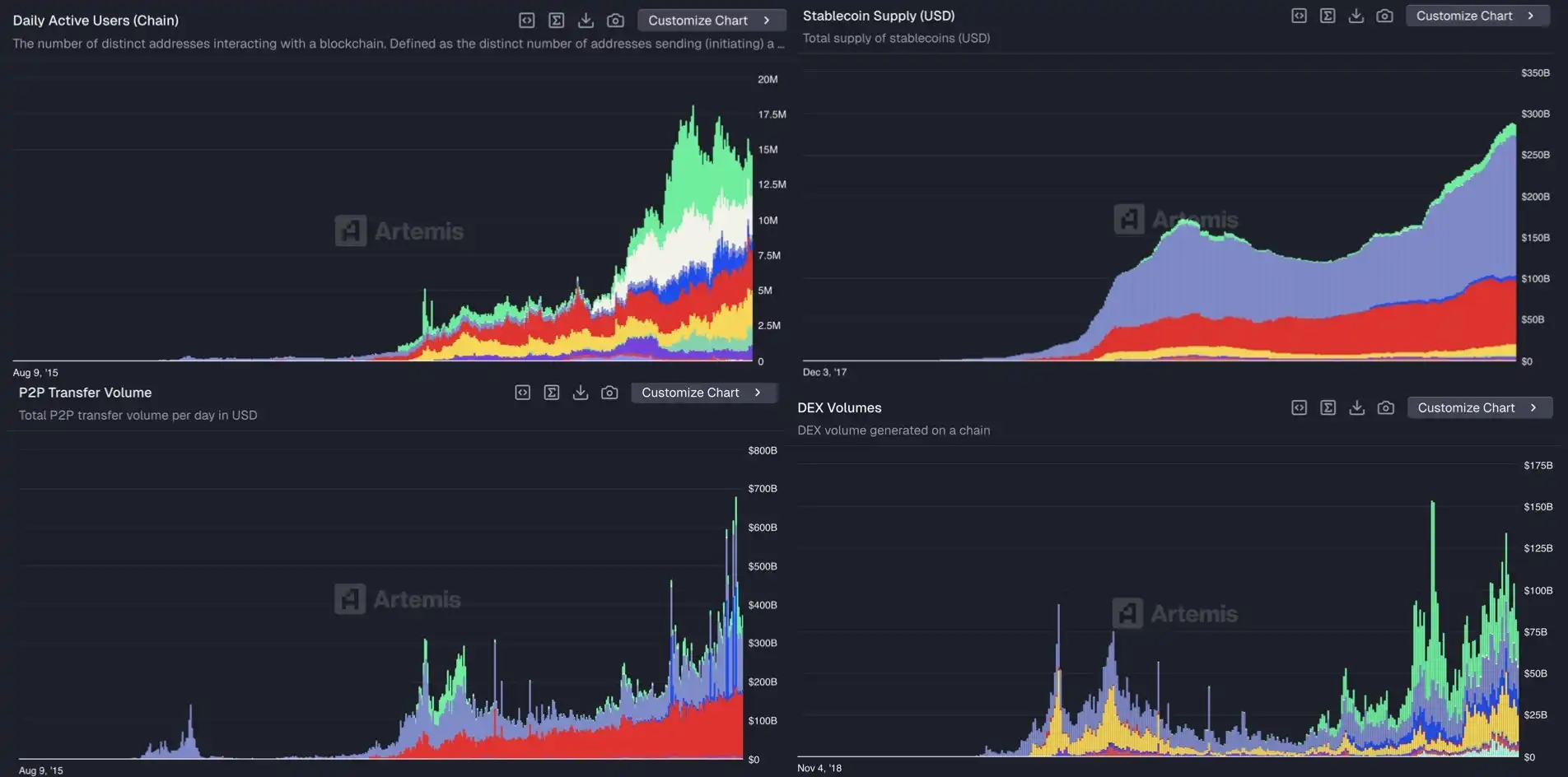
Looking back at the past decade of crypto development, from million-dollar TVL to a stablecoin scale in the hundreds of billions of dollars, from experimental DeFi to on-chain daily transaction volumes in the tens of billions of dollars, the exponential curve has not disappeared but has been overshadowed by short-term fluctuations.
The author draws on the misjudgments in the early days of e-commerce, Amazon's long period of losses, and the law of the internet's "openness wins" to try to re-establish a long-cycle perspective: when a trend is fundamentally exponential, pessimistic conclusions based on short-term revenue, P/E ratios, and early penetration rates often distort the overall picture.
In the current emotionally-driven environment, this is a rare "exponentialism manifesto" that seeks to rebuild long-term confidence.
The following is the original text:
I used to tell entrepreneurs: when you launch your new chain, the external reaction is not "hatred" but "indifference." By default, no one cares about your new chain.
But now I have to take that back. Monad just went live this week, and I have never seen a chain receive so much backlash right after launch. I have been in crypto investment for over 7 years. Until 2023, most of the chains I have seen either received a warm welcome or were ignored—rarely faced such strong hostility at launch.
Today, new chains are born surrounded by boos. Projects like Monad, Tempo, MegaETH, even before the mainnet is live, the amount of negativity I've seen is truly an unprecedented phenomenon.
I have been trying to figure out: why is this happening now? What kind of psychology does this phenomenon reflect in the market?
The Cure Is Worse Than the Disease
Forewarning: this may be the most "ambiguous" crypto valuation post you've ever read. I don't have any sophisticated metrics, nor do I have charts to pitch. What I want to express is my opposition to the current mainstream sentiment on Crypto Twitter, as for the past few years, I have almost always stood on the opposite side.
In 2024, I find myself pushing back against a form of "Financial Nihilism." Financial Nihilism believes: these assets don't matter at all; they're all ultimately memes; everything we build is fundamentally worthless.
Thankfully, that sentiment is now behind us, and we have finally emerged from that spell.
But the current mainstream sentiment, I call it "Financial Cynicism":
Well, maybe these things do have some value, maybe not all of it is a meme;
but their valuations are ridiculously high, and it's only a matter of time before Wall Street realizes this;
It's not that all chains are valueless, but their current valuations are probably only 1/5 to 1/10 of what is reasonable (have you seen those P/E ratios?)
We can only hope that Wall Street doesn't expose our facade, or else the market will be uprooted.
So, now we have many bullish analysts trying to construct more optimistic L1 valuation models to combat this sentiment by expanding P/E ratios, gross margins, DCF models, etc.
At the end of last year, Solana proudly embraced the REV metric, believing it could finally justify SOL's valuation. They proudly proclaimed:
We, and only we, are no longer pretending for Wall Street's sake!
However, unsurprisingly: as soon as REV was hyped, it plummeted (although $SOL's performance suggests it is more resilient than REV itself).
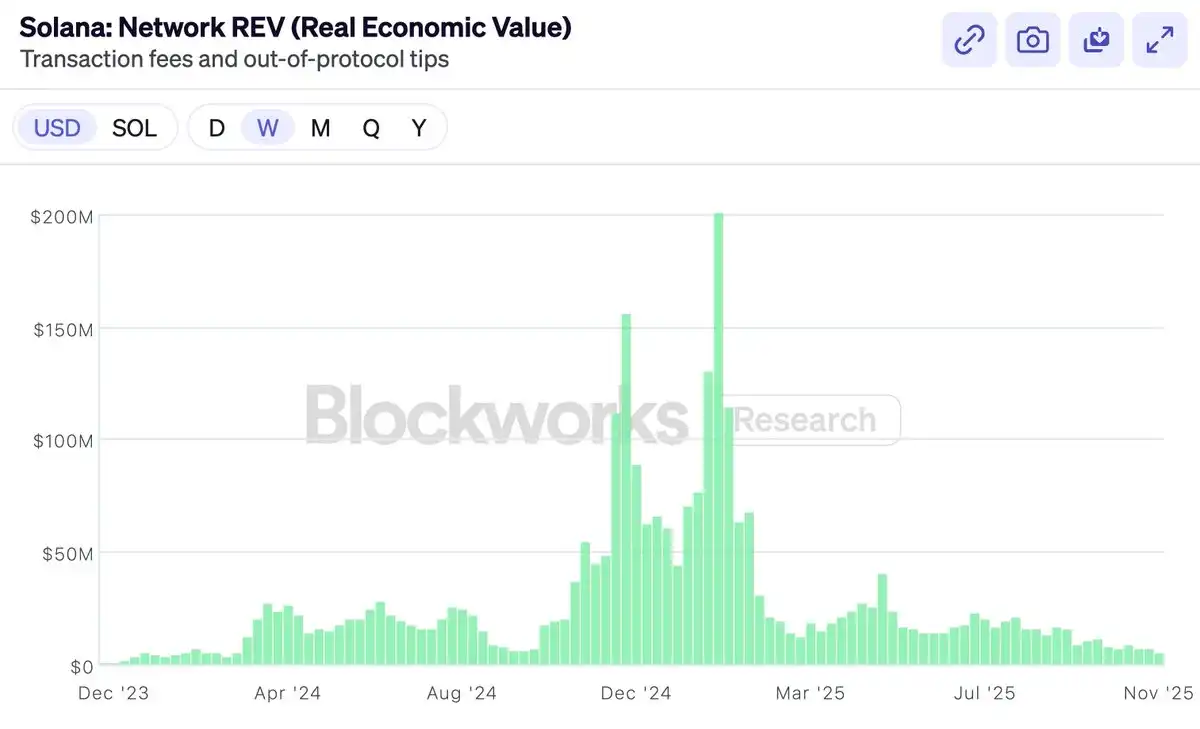
REV itself isn't the issue. REV is a very clever metric. But the point this article wants to discuss isn't "which metric to choose."
Next up is the launch of Hyperliquid. A DEX with actual revenue, buybacks, and a P/E ratio. The chorus of comments then becomes — see, I told you so! For the first time, we have a genuinely profitable token that can be measured with a proper P/E ratio. (BNB? Forget it, we don't mention it. ) Hyperliquid will swallow everything because obviously Ethereum and Solana don't make money, and we can stop pretending to value them.
Hyperliquid, Pump, Sky, these tokens with significant buybacks are great. But the market has always been able to invest in exchanges. You could always go buy Coinbase, BNB, or something else. We hold $HYPE ourselves, and I think it's a great product too.
But that wasn't the reason people originally invested in ETH and SOL. L1 doesn't have the same profit margins as exchanges, and that wasn't why everyone bought them in the first place—if they wanted those margins, they could just buy Coinbase stock.
If I'm not about to critique blockchain financial metrics, you might think I'm about to talk about the "original sin" of the token industry.
Obviously, everyone has lost money on tokens in the past year, VCs included. This year, altcoins have performed terribly overall. So the current sentiment of Crypto Twitter's other half is now discussing who to blame. Who got greedy? Are VCs greedy? Is Wintermute greedy? Is Binance greedy? Are farmers greedy? Or are founders greedy?
The answer, as always, is everyone is greedy. Everyone.
VCs, Wintermute, farmers, Binance, KOLs—everyone is greedy, including you. But that doesn't matter. Because no normally functioning market requires participants to act against their own interests. If our assessment of the crypto industry is correct, even if everyone is pursuing their self-interest, investments can still succeed. Trying to analyze a declining market by "who is greedy" is as futile as launching a witch hunt trial. I promise you, no one suddenly became greedy in 2025.
So, this is not what I'm going to write about.
Many people want me to write an article on why $MON should be worth X, $MEGA should be worth Y. But I have no interest in that, nor will I advocate for you to buy any specific asset. In fact, if you don't already believe in them, you probably shouldn't buy.
Will the new challenger chain prevail? Who knows. But if it has a non-zero and significant chance of success, its pricing will be based on that probability. If Ethereum is worth $300 billion and Solana is worth $80 billion, then a project with a 1–5% chance of becoming the next Ethereum or Solana will be priced by the market based on that probability.
Crypto Twitter is shocked by this. But this is no different from biotech stocks. A drug for Alzheimer's with a success rate of less than 10% can still be priced in the billions, even though it has a 90% chance of failing in Phase III clinical trials, ultimately going to zero. That's math—and it turns out, the market is very good at math. The pricing of binary outcomes is based on probability, not on current income or moral judgment. This is the valuation method of the "shut up and calculate" school.
I don't think this question is worth much writing about. "Win rate is 5%? No way, obviously 10%!" Such matters regarding individual tokens should be left to the market to decide, not to articles.
So what I really want to write about is: Crypto Twitter now seems to no longer believe that the chain itself has intrinsic value.
I don't think it's because they don't believe a new chain can capture market share. We witnessed Solana rapidly rise from the ashes and dominate market share in less than two years. It's not easy, but certainly possible.
More people's perspective is this: even if a new chain wins, there isn't much of a prize to win. If $ETH is just a meme, if it never earns "real income," then even if you win, you won't be worth $300 billion. The competition itself isn't worth engaging in because these valuations are all fake; the entire market would collapse before you even receive the trophy.
Remaining optimistic about a chain's valuation has become unfashionable. Not to say that no one is optimistic; obviously, there are still optimists. For every seller, there's a buyer. Despite Crypto Twitter cool kids mocking L1, people are still willing to buy SOL at $140 and ETH at $3000.
But the current market perception is: the smartest people are no longer buying smart contract chains.
The smart people know the game is almost over. If not now, then very soon. Those still buying now are fools: Uber drivers, Tom Lee, and those KOLs who will mention "trillions." Perhaps even the U.S. Treasury. But it won't be smart money.
This is nonsense. I don't believe it, and neither should you.
So, I feel I must write a "Smart People's Manifesto" to explain why general-purpose blockchains have value. This article is not a defense of Monad or MegaETH; it's a defense of ETH and SOL. Because if you believe ETH and SOL have value, everything else falls into place.
Principally speaking, advocating for the valuation of ETH and SOL is not my job as a VC. But who cares? If no one else is willing to do it, then I'll do it.
Experience the "Power Law Curve"
My partner Bo witnessed the explosion of the Chinese internet firsthand as a VC. He often hears people say, "Crypto is like the internet," which almost numbs me now. But every time I hear him tell stories from those years, I'm reminded once again of how significant the cost is when you get these types of questions wrong.
One of the stories he often tells is from the early 2000s when all early-stage e-commerce VCs (the circle was very small back then) were having coffee together. They were discussing: How big could the future market of e-commerce really be?
—Would it mainly be electronics (maybe only tech enthusiasts would use computers)?
—Would women buy (maybe they rely too much on touch)?
—Could food be sold (maybe fresh produce is just too hard to manage)?
These questions were crucial for early-stage VCs—determining what to invest in and how much they were willing to pay.
Of course, the answer was: Everyone was completely wrong.
E-commerce ended up selling everything, targeting users from all around the damn world.
But at that time, no one truly believed this. Even those who did believe thought it was so absurd that they didn't dare say it out loud.
You just had to wait long enough for the exponential curve to tell you the answer.
Even among the "believers" at that time, only a few truly believed that e-commerce would grow to such an extent. And those few, simply because they didn't sell out, almost all became billionaires in the end.
All the other VCs, as Bo put it, because he was one of them, sold out too early.
In the crypto world, "believing in the exponential curve" has become unfashionable.
But I believe in the crypto exponential curve. Because I have witnessed it with my own eyes.
When I first entered crypto, no one was using these things. It was tiny, ridiculously broken, and terrible. The total value locked (TVL) on-chain was only a few million dollars.
We invested in the first generation of DeFi, MakerDAO, Compound, 1inch, when they were still just science experiments. I remember when using EtherDelta, a DEX with daily trading volume in the millions of dollars was considered a "huge success." It was utter garbage.
Nowadays, we casually trade billions of dollars on-chain every day.
I remember the absurdity back then: Tether's total supply surpassed $1 billion, and it was reported by The New York Times as nearing a Ponzi scheme collapse.
Now stablecoins exceed $300 billion and are regulated by the Federal Reserve.
I believe in the exponential curve because I have seen it happen too many times in real life.
But you might argue: "Well, stablecoins may be experiencing exponential growth, DeFi may be experiencing exponential growth, but this growth may not flow back to ETH or SOL. The value will not be captured by the chain."
My response is: you still don't believe in exponential.
Because the exponential curve always has only one answer: it doesn't matter.
These things in the future will be much bigger than today. So big that it's absurd, big enough to overflow all debates.
When it's that big, you will recoup everything in scale.
Look at this chart.
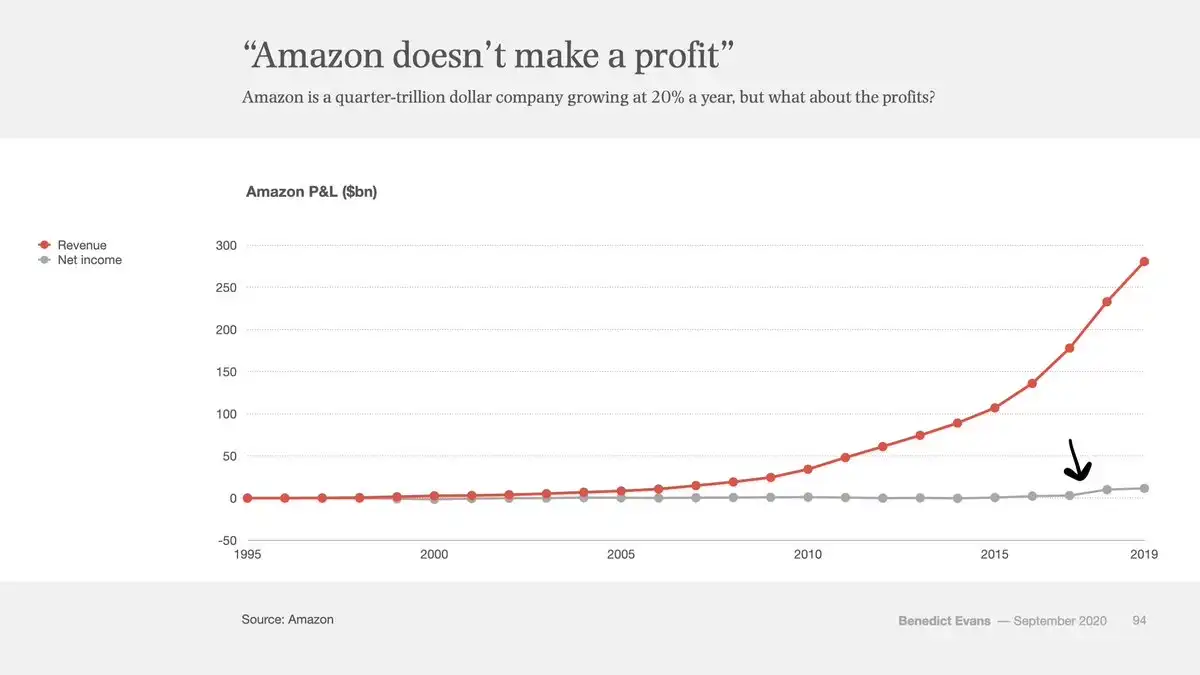
This is Amazon's profit and loss statement from 1995 to 2019, a total of 24 years. Red represents revenue, gray represents profit. Do you see that tiny bump at the end? The part where the gray line tilts upward? That is when Amazon, 22 years after its founding, truly began to be profitable.
It was in the 22nd year that Amazon's net profit line first moved above 0. In every year before that, there were editorials, critics, and short-sellers shouting: "Amazon is just a Ponzi scheme that will never make money."
Ethereum just turned 10.
And here is the stock performance of Amazon in the first 10 years after its IPO:
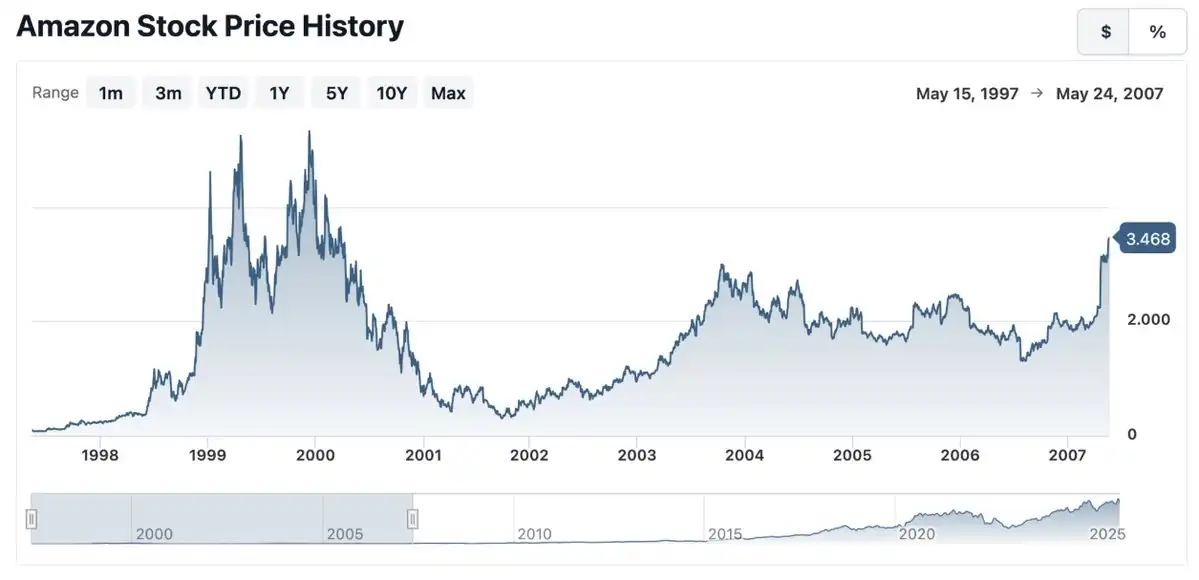
Ten years of sideways movement. During these ten years, Amazon was surrounded by doubters: Isn't e-commerce just a VC-subsidized charity?
Are they selling cheap, low-quality trinkets that only attract bargain hunters, what's the point?
When will they ever make money like Walmart or General Electric?
If you were discussing Amazon's P/E ratio at that time, you were in the wrong worldview.
The P/E ratio belongs to the world of linear growth, but e-commerce is not a linear trend.
Therefore, all those who argued about Amazon's P/E ratio for a full 22 years were completely off the mark.
No matter how much money you spent back then, and no matter when you bought in, you were not bullish enough.
Because that's the law of exponential technology.
In the face of a true exponential curve, no matter how high you think the scale will rise, it will continue to grow larger.
This, Silicon Valley has always understood more deeply than Wall Street.
Silicon Valley was raised by the exponential curve, while Wall Street grew up in linear thinking.
And in the past few years, the center of gravity of the crypto industry has gradually shifted from Silicon Valley towards Wall Street. You can clearly feel this transition.
Admittedly, the growth curve of crypto is not as smooth as e-commerce.
It is more like an explosive pulse, with surges and stagnation.
This is because the crypto world discusses "money," highly influenced by macro factors; at the same time, the regulatory tug it endures is far more intense than in e-commerce.
Crypto directly challenges a nation's core power, currency. Therefore, it is more unsettling for governments than e-commerce.
But the inevitability of exponential growth has not diminished.
This is a rough argument, but if crypto is an exponential trend, then this rough argument holds.
Zoom out.
Financial assets are inherently seeking freedom. They want to be open, interconnected, and available anytime, anywhere.
Crypto turns financial assets into a "file format," allowing you to send a dollar or a stock like sending a PDF, as easy as that.
Crypto makes "everything can interact with everything" possible, making it 24/7, global, interconnected, and open.
This model will prevail. Openness will always prevail.
If the internet taught me one of the most important lessons, it was this.
Incumbents will resist, governments will oppose, threaten, and rage—but eventually, they will all lay down their weapons in the face of the speed of technology adoption, leverage, and efficiency advantages.
The internet has done this to every industry.
Blockchain will consume the entire financial and monetary system in the same way.
Yes, given enough time, it will consume everything.
There is a saying: people overestimate what can happen in two years but underestimate what can happen in ten years.
If you believe in the exponential curve, if you zoom out far enough, then everything now is still ridiculously cheap.
And what's worth keeping humble about is this: Every day, there are holders who stay in the game longer than the sellers and the naysayers.
The time scale for big capital is much longer than what the casual contract longs and shorts players on CT imagine.
Big capital has learned throughout history: Do not bet against major tech trends.
Did you know? That grand narrative that convinced you to buy $ETH or $SOL initially? Big capital still believes in it to this day and has never stopped.
So what exactly am I arguing?
I'm arguing that putting the Price/Earnings ratio on a smart contract chain (aka the so-called "revenue logic meta") is equivalent to abandoning the exponential curve.
This means that you are fitting this industry into a framework of linear growth.
It means that you truly believe: On-chain 30 million daily active users, accounting for less than 1% of M2, is the limit.
Crypto is just a tiny thing in the world, a sideshow.
It has not won, nor is it inevitable.
Most importantly, I want to argue for a certain belief—not a short-term belief, not a shallow belief, but a long-term belief.
I'm arguing that this exponential growth will be the biggest trend you will ever participate in your lifetime.
This is your e-commerce era.
One day, when you're old and look back, you will tell your children: "I was there. Not everyone believed this was possible. Not everyone believed the entire society would be transformed, and all money and finance would be wholly reshaped by programs running on decentralized computers we all collectively own. But all of that did happen. It changed the world. And I was a part of it."
Disclosure: The above are all my personal views. Dragonfly has invested in $MON, $MEGA, $ETH, $SOL, $HYPE, $SKY, and many other tokens. Dragonfly believes in the exponential curve. This is not investment advice but a "different kind of advice."
You may also like

21Shares Enhances Crypto ETP Pricing with FTSE Partnership
Key Takeaways: 21Shares AG updates the pricing methodology for its Bitcoin and Ethereum-linked ETPs on the London Stock…

Alibaba AI Projects Crypto Value Surge for XRP, Bitcoin, and Ethereum by 2026
Key Takeaways: Alibaba’s AI predicts significant price increases for XRP, Bitcoin, and Ethereum by 2026’s end, driven by…

Ethereum USD Reclaims $2,200 Amidst Crypto Market Surge
Key Takeaways: Ethereum USD rebounds from $1,840 lows, reclaiming the $2,200 mark with a +19% recovery as of…

TRUMP Memecoin Investors Granted Exclusive Mar-a-Lago Invite
Key Takeaways: $TRUMP memecoin holders gain exclusive access to a Mar-a-Lago event featuring Donald Trump and other key…

Why Is Crypto Up: BTC USD Decoupling From Gold Amid Heated Israel-Iran Conflict
Key Takeaways: Bitcoin’s price recently hit $74,000, marking its highest close since February 2026 before slightly retracting to…

Trump Meme Coin Skyrockets 60% Post Mar-a-Lago Gala Promotion
Key Takeaways: TRUMP meme coin surged by 60% following the announcement of a gala event at Mar-a-Lago. Trading…
Large Bitcoin Wallets Resume Accumulation as BTC Holds $71K Level
Key Takeaways: Wallets holding 10 to 10,000 Bitcoin now control 68.17% of Bitcoin’s circulating supply, signaling renewed confidence…

Solana Hits Key $100 Resistance amid Institutional ETF Interest
Key Takeaways: Solana is witnessing a surge towards the psychological $100 mark, currently trading at $93 as of…

CLARITY Act Faces Diminishing Odds in 2026 Without April Committee Approval
Key Takeaways: Alex Thorn from Galaxy Digital highlights the narrowing timeframe for the CLARITY Act to progress in…

Billionaire Predicts Stablecoins’ Dominance in Global Payments Over Next 10-15 Years
Key Takeaways: Billionaire Stanley Druckenmiller foresees stablecoins as a central player in global payments within 10-15 years. Blockchain…

Hyperliquid Price Surge: A Potential 23.29% Drop Expected
Key Takeaways: Hyperliquid is anticipating a price drop to $28.81, reflecting a potential 23.29% decrease in the next…

AAVE Crypto Swap Leads to $50 Million Loss: A Costly Lesson in DeFi
Key Takeaways: A single crypto whale lost $50 million attempting to swap USDT for AAVE due to severe…

Aptos Price Trends and Predictions for March 2026
Key Takeaways: Aptos is priced at $1.01, trading 34.62% above the predicted price for March 21, 2026. Market…

DOJ and Europol Take Down SocksEscort: A Major Blow to Crypto Crime
Key Takeaways: U.S. DOJ and Europol successfully dismantled the SocksEscort proxy network, an essential tool for crypto-related cybercrime.…
Mantle Market Analysis: Current Trends and Predictions for March 2026
Key Takeaways: Mantle’s current price is 35.18% above the predicted value for March 21, 2026. The Fear &…

Bittensor Trading Above Price Prediction: Market Analysis and Forecast for March 2026
Key Takeaways: Bittensor (TAO) is trading at $279.82, significantly above the predicted $211.41 for March 20, 2026. The…
Pepe Coin Price Surges 20%: Will March Push It Higher?
Key Takeaways: Pepe coin saw a massive 20% surge, reaching near $0.00000406, reflecting renewed market interest in memecoins.…
Sui Crypto Price Prediction – SUI Estimated to Decline to $ 0.783986 by March 21, 2026
Key Takeaways: Sui Crypto, currently priced at $1.06, is predicted to fall to $0.783986 by March 21, 2026.…
21Shares Enhances Crypto ETP Pricing with FTSE Partnership
Key Takeaways: 21Shares AG updates the pricing methodology for its Bitcoin and Ethereum-linked ETPs on the London Stock…
Alibaba AI Projects Crypto Value Surge for XRP, Bitcoin, and Ethereum by 2026
Key Takeaways: Alibaba’s AI predicts significant price increases for XRP, Bitcoin, and Ethereum by 2026’s end, driven by…
Ethereum USD Reclaims $2,200 Amidst Crypto Market Surge
Key Takeaways: Ethereum USD rebounds from $1,840 lows, reclaiming the $2,200 mark with a +19% recovery as of…
TRUMP Memecoin Investors Granted Exclusive Mar-a-Lago Invite
Key Takeaways: $TRUMP memecoin holders gain exclusive access to a Mar-a-Lago event featuring Donald Trump and other key…
Why Is Crypto Up: BTC USD Decoupling From Gold Amid Heated Israel-Iran Conflict
Key Takeaways: Bitcoin’s price recently hit $74,000, marking its highest close since February 2026 before slightly retracting to…
Trump Meme Coin Skyrockets 60% Post Mar-a-Lago Gala Promotion
Key Takeaways: TRUMP meme coin surged by 60% following the announcement of a gala event at Mar-a-Lago. Trading…


 App
App