
- Buy Crypto
- Markets
 Futures
- Spot
- Copy Trade
- Earn
- More
Scaramucci Remarks on Stablecoin Yield Ban’s Impact on US Dollar

Key Takeaways:
- The CLARITY Act’s prohibition on yield-bearing stablecoins decreases the competitive edge of the US dollar against the digital yuan, argues Anthony Scaramucci.
- Brian Armstrong highlights the potential negative effects of the ban on the international competitiveness of US stablecoins.
- The People’s Bank of China permits interest payments on digital yuan deposits, enhancing their global appeal.
- Bank of America CEO Brian Moynihan warns of significant bank deposit outflows potentially triggered by stablecoins.
WEEX Crypto News, 2026-01-19 08:28:06
In an ever-evolving financial ecosystem, the competition between traditional fiat currencies and digital forms of currency continues to be a pivotal conversation. Recent amendments in the regulatory climate of the United States have reignited debates concerning the competitiveness of the US dollar against burgeoning digital currencies such as China’s digital yuan. At the center of this conversation is Anthony Scaramucci, the founder of SkyBridge Capital, who has raised significant concerns regarding the prohibition on yield-bearing stablecoins under the CLARITY Act.
A Clash of Currencies: Dollar vs. Digital Yuan
The introduction and expansion of the CLARITY Act have drawn significant attention due to its prohibition on allowing stablecoins to offer yields. This regulatory framework aims to structure the burgeoning crypto market within the United States, yet it has also raised concerns about the broader implications for the national currency’s competitiveness. In contrast, China’s digital yuan, now a yield-bearing central bank digital currency (CBDC), is poised to challenge the supremacy of conventional currencies such as the US dollar.
Scaramucci, in his critique of the current regulatory stance, underscores the disadvantage this poses to the US dollar. He questions the logic behind blocking yield opportunities on stablecoins, particularly when other global players like China actively promote their digital currencies through incentivized yields. “The whole system is broken,” he noted, critiquing the restrictions placed on yield offerings by US-based exchanges.
With China’s regulatory landscape advancing to accommodate interest payments on digital yuan deposits, the competitive disparity becomes increasingly evident. When commercial banks in China began offering these interest payments in January, it signaled a strategic shift in global economic engagement from China’s side, further widening the gap with US initiatives.
Ripple Effects on The US Market: Insights from Brian Armstrong
Brian Armstrong, CEO of Coinbase, further emphasized the detrimental impact such regulations might have on the US economy. Armstrong’s main concern points to the competitive disadvantage that US stablecoins face in the global marketplace. “I worry we are missing the forest through the trees in the US,” Armstrong warned, suggesting that the restriction might have far-reaching consequences beyond merely limiting competition.
The argument follows that restricting stablecoin yields does not necessarily impact financial lending practices within the US but constrains the ability of US-based financial products to compete with international innovations. This, as Armstrong and other industry leaders argue, could stymie the US’s position in the global financial market and inadvertently favor foreign systems like China’s which are keeping pace with innovation.
Banking Industry’s Defense Mechanism
The prohibition on yield-bearing stablecoins isn’t viewed purely as a regulatory oversight, but also as a strategic move to shield the traditional banking sector from emerging competition. With the potential influx of savings and investments into stablecoins offering yield advantages moved away, the existing banking institutions protect their historical stronghold on the US financial market.
However, this protective measure comes with significant risks as highlighted by Bank of America CEO Brian Moynihan. During a recent earnings call, Moynihan articulated concerns that the mass adoption of stablecoins could precipitate as much as a $6 trillion outflow from traditional bank deposits. Such a massive withdrawal could effectively reduce the banks’ capacity to extend credit, impacting everything from small business loans to mortgages, and altering the landscape of American finance substantially.
Industry’s Legislative Challenge: A Test in Senate
As these issues gain traction, the path to legislative reconciliation faces critical tests. Attempts to counter the provisions of the CLARITY Act are surfacing in the Senate, with legislative measures that challenge the core aspects of stablecoin yield prohibitions. Industry stakeholders argue these measures are necessary to foster innovation and maintain the US’s competitive stance on the global stage.
The debate elucidates a central tension between fostering innovation and maintaining the statu quos of economic stability. Stablecoin yield provision advocates highlight parallels in past technological disruptions across industries where initial controls were gradually lifted to accommodate innovation and resultant growth.
Contextualization of the Stablecoin Struggle
It’s vital to understand the context under which stablecoin regulations operate. The onslaught of disruptive financial technologies has continually tested regulators and policymakers tasked with balancing innovation with security. Stablecoins, pegged to traditional fiat values, offer an intriguing promise of being digital yet stable in value — an ideal amalgamation sought by traders and everyday users.
Yet, the regulatory environment in places like the US has placed considerable pressure on this modality, leading to strategic decisions that occasionally lag behind global counterparts like the European Union or China — regions which have been quicker to adopt and adapt rather than obstruct and outlaw.
The Way Forward: Bridging Innovation with Regulation
Charting a course toward future stability and competitiveness requires a nuanced understanding of the ecosystem’s needs and the banking industry’s evolving role in it. As stakeholders advocate for a reconsideration of prohibitive acts like the CLARITY Act, they find themselves at a critical juncture. There is a need to harmonize stringent financial regulations with promising technological advancements, ensuring that policies align with innovation goals rather than stifling them.
The debate strips back to fundamental economic principles: should the financial system’s future be tied down by existing protocols, or should it be propelled by new innovations? The resolution of this debate holds the potential to realign the contours of competitive global economic engagement.
Given the current trends and the debates captured by leaders like Scaramucci and Armstrong, the next years promise transformative shifts. Stakeholders must watch closely, with policymakers working to reconcile competitive participation with regulatory assurance.
Conclusion: A Crucible of Currency Competition
At this pivotal point for traditional and digital currencies, the decisions forged from these discussions will likely shape the financial landscape for decades to come. The US’s ability to adapt strategically within this competitive environment will define not only the prosperity of its currency but also the broader economic influence it commands in the global arena.
As policymakers address these complex issues, it remains imperative that they consider the broader implications of their actions. A careful balance must be struck to ensure that regulatory frameworks foster innovation and growth while providing robust safeguards for consumers and institutions alike.
Ultimately, the US’s regulatory trajectory will serve as a reference model for other nations grappling with similar issues, defining an era of global financial cooperation and competition.
FAQ
What is the CLARITY Act and why is it significant?
The CLARITY Act is an American regulatory framework aimed at establishing clear guidelines for the operation of stablecoins and other digital assets. The prohibition on yield-bearing stablecoins is part of the act and has raised concerns about its impact on the US dollar’s competitiveness against foreign currencies such as China’s digital yuan.
How does China’s digital yuan differ from US stablecoins?
China’s digital yuan has been issued by the central government and allows commercial entities to pay interest on deposits. This differentiates it from US stablecoins, which currently do not offer yield due to regulatory restrictions, making it potentially more appealing to international markets.
What concerns has Brian Armstrong raised about US stablecoins?
Brian Armstrong, CEO of Coinbase, has expressed that limiting yield on US stablecoins could diminish their competitiveness in the foreign exchange market, potentially giving an upper hand to digital currencies like China’s yuan, which offer yield benefits.
Why are traditional banks concerned about stablecoins?
Traditional banks are concerned that the popularity of stablecoins, particularly those offering yields, could lead to significant outflows of deposits from traditional banking systems. This could in turn limit their ability to provide loans and other financial services.
What steps are industry leaders taking against the yield prohibition?
Industry leaders are appealing to legislative bodies, highlighting the need for a regulatory environment that encourages innovation and competition rather than restricting yield-bearing instruments, in order to retain the US’s competitive financial standing.
You may also like

Wall Street Shorts ETH: Vitalik is aware and has front-run, while Tom Lee remains oblivious

Social Capital CEO: How Equity Tokenization is Reshaping Capital Markets from US Stocks to SpaceX?

CoinGecko Report: Surge of 346% vs Dip of 20.8%, The Wild Rise of DEX

a16z: The Real Opportunity of Stablecoins Lies Not in Disruption but in Filling Gaps

Mining Exodus: Someone Holds $12.8 Billion AI Order

March 6 Market Key Intelligence, How Much Did You Miss?

a16z: The True Opportunity of Stablecoins is in Complementing, Not Disrupting

Predict LALIGA Matches, Shoot Daily & Win BTC, USDT and WXT on WEEX
The WEEX × LALIGA campaign brought together football excitement and crypto participation through a dynamic interactive experience. During the event, users predicted matches, completed trading tasks, and took daily shots to compete for rewards including BTC, USDT, WXT, and exclusive prizes.

Ray Dalio Dialogue: Why I'm Betting on Gold and Not Bitcoin

Who Took the Money in the AI Era? A Must-See Investment Checklist for HALO Asset Trading
Wall Street Bears Target Ethereum: Vitalik In the Know Takes Flight, Tom Lee Remains Bullish
Pump.fun Hacker Steals $2 Million, Receives 6-Year Prison Sentence, Opts for 'Self-Detonation'

6% Annual Percentage Yield as Musk Declares War on Traditional Banks
36 years, 4 wars, 1 script: How does capital price the world in conflict?

Mining Companies' Great Migration: Some Have Already Secured $12.8 Billion in AI Orders
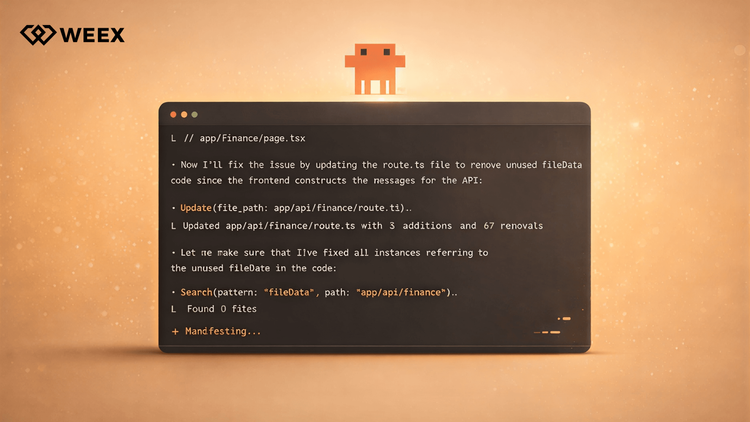
What Is Vibe Coding? How AI Is Changing Web3 & Crypto Development
What is vibe coding? Learn how AI coding tools are lowering the barrier to Web3 development and enabling anyone to build crypto applications.
The parent company of the New York Stock Exchange strategically invests in OKX: The intentions behind the $25 billion valuation

WEEX P2P update: Country/region restrictions for ad posting
To improve ad security and matching accuracy, WEEX P2P now allows advertisers to restrict who can trade with their ads based on country or region. Advertisers can select preferred counterparty locations for a safer, smoother trading experience.
I. Overview
When publishing P2P ads, advertisers can now set the following:
Allow only counterparties from selected countries or regions to trade with your ads.
With this feature, you can:
Target specific user groups more precisely.Reduce cross-region trading risks.Improve order matching quality.
II. Applicable scenarios
The following are some common scenarios:
Restrict payment methods: Limit orders to users in your country using supported local banks or wallets.Risk control: Avoid trading with users from high-risk regions.Operational strategy: Tailor ads to specific markets.
III. How to get started
On the ad posting page, find "Trading requirements":
Select "Trade with users from selected countries or regions only".Then select the countries or regions to add to the allowlist.Use the search box to quickly find a country or region.Once your settings are complete, submit the ad to apply the restrictions.
When an advertiser enables the "Country/Region Restriction" feature, users who do not meet the criteria will be blocked when placing an order and will see the following prompt:
If you encounter this issue when placing an order as a regular user, try the following solutions.
Choose another ad: Select ads that do not restrict your country/region, or ads that allow users from your location.Show local ads only: Prioritize ads available in the same country as your identity verification.
IV. Benefits
Compared with ads without country/region restrictions, this feature provides the following improvements.
Aspect
Improvement
Trading security
Reduces abnormal orders and fraud risk
Conversion efficiency
Matches ads with more relevant users
Order completion rate
Reduces failures caused by incompatible payment methods
V. FAQ
Q1: Why are some users not able to place orders on my ad?
A1: Their country or region may not be included in your allowlist.
Q2: Can I select multiple countries or regions when setting the restriction?
A2: Yes, multiple selections are supported.
Q3: Can I edit my published ads?
A3: Yes. You can edit your ad in the "My Ads" list. Changes will take effect immediately after saving.


 App
App