
Sentient Reveals Tokenomics, How Will the Market Price It?

 Prefer us on Google


Original Title: "Sentient Reveals Tokenomics, How Will the Market Price It?"
Original Author: ChandlerZ, Foresight News
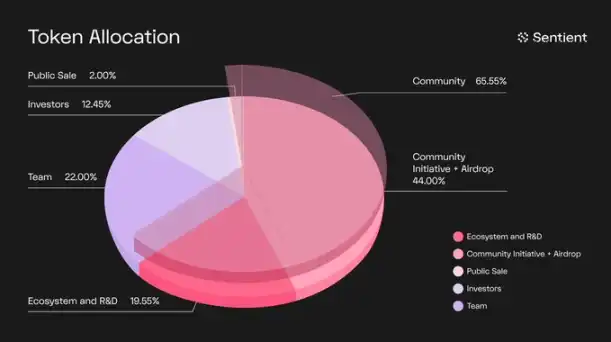
On January 16, the open-source AI platform Sentient revealed the SENT tokenomics. The total token supply of SENT is approximately 34.3 billion, with 44% allocated for community incentives and airdrops, 19.55% for the ecosystem and development, 2% for public sale, 22% for the team, and 12.45% for investors.
According to Polymarket data, the market is betting that the probability of Sentient's FDV exceeding $200 million on the day after its launch has risen to 99%, with an 87% probability of exceeding $400 million, and an 83% probability of exceeding $600 million. The current trading volume of this prediction market is approximately $330,000.
Allocation Rule Details
Within the entire ecosystem, SENT is used for agency, models, data services, and other Artifact-driven products. SENT can also be used between Artifacts for payments, enabling a composable on-chain value flow between services. The official total supply of SENT is set at 34,359,738,368, precisely 2^35. The official team mentioned that the full story of how this number was chosen will be shared in the future; however, tech-savvy readers may be able to infer the reasons behind it.
SENT allocation is divided into five main categories: community initiatives and airdrops, ecosystem and development, team, investors, and public sale.
Community Initiatives and Airdrops — 44.00%
This portion of the tokens accounts for 44% of the total supply, dedicated specifically to airdrops, community grants, bounties, and incentive programs to reward users and developers for their verifiable work on the GRID. To ensure broad ownership, 30% of this token portion will unlock at TGE (approximately 13% of the total supply), and the remaining 70% will linearly unlock over 4 years. By design, individuals contributing to building, testing, and sharing open-source intelligence and products will be eligible for the largest share of the tokens. The airdrop will fully unlock at TGE.
Ecosystem and Development — 19.55%
This portion of the token accounts for 19.55% of the total supply and will be used to promote ecosystem development, research and development, growth, infrastructure building, and Sentient Foundation's operation. To ensure a long-term stable supply, 30% of it will unlock at TGE (Token Generation Event), and the remaining 70% will unlock linearly over four years.
Team—22.00%
This part of the treasury accounts for 22% of the total supply, specifically for the Sentient Foundation and Sentient Labs' team members, including employees, founders, and key contractors. At TGE, the team treasury will be locked for one year, after which the funds will be released linearly over 6 years with a 1-year cliff.
Investors—12.45%
This portion of the token represents 12.45% of the total supply and is allocated to investors who supported Sentient in the private sale round. Investor tokens will lock for one year and unlock linearly over four years. This structure aims to reward early investors' confidence.
Public Sale—2.00%
This public sale constitutes 2% of the total supply and aims to encourage broader community participation in the project's launch. This allocation will unlock entirely at TGE. Specific details of the public sale structure will be announced soon.
By the end of November 2025, Sentient will launch an airdrop registration portal targeting four groups: community contributors, active users of Sentient Chat, top voices on social platforms, and external open-source researchers.
The second quarter activity will be based on new roles of contribution, a clearer upgrade path, and various reward mechanisms. Rewards will include SENT tokens, NFTs, and peripheral merchandise, among others. Specific details of the airdrop events are yet to be announced.
The $85 Million AI Rising Star
Sentient is an AI research organization dedicated to building an open general artificial intelligence (AGI) economy, developing a platform and protocol that allows open-source AI developers to monetize their models, data, and other innovations, enabling developers to collaborate to collectively build powerful AI alerts and become key stakeholders driving AI transformation and prosperity in the new open AGI economy.
Sentient has introduced the "OML" (Open, Monetized, Loyalty) model concept, aiming to advance the shared open AGI economy through the OML model, constructing a shared open AGI economic system involving millions of AI agents and billions of users, providing an inexhaustible driving force for the innovation and development of downstream applications.
At the product and architecture level, Sentient's core is its intelligent network called GRID (Global Research and Intelligence Directory). The official description portrays it as a collaborative system composed of specialized agents, models, data, tools, and computing power: when a user initiates a query, the task is broken down, routed to the appropriate agent/tool/data source, and then the multi-path results are aggregated into a consistent output.
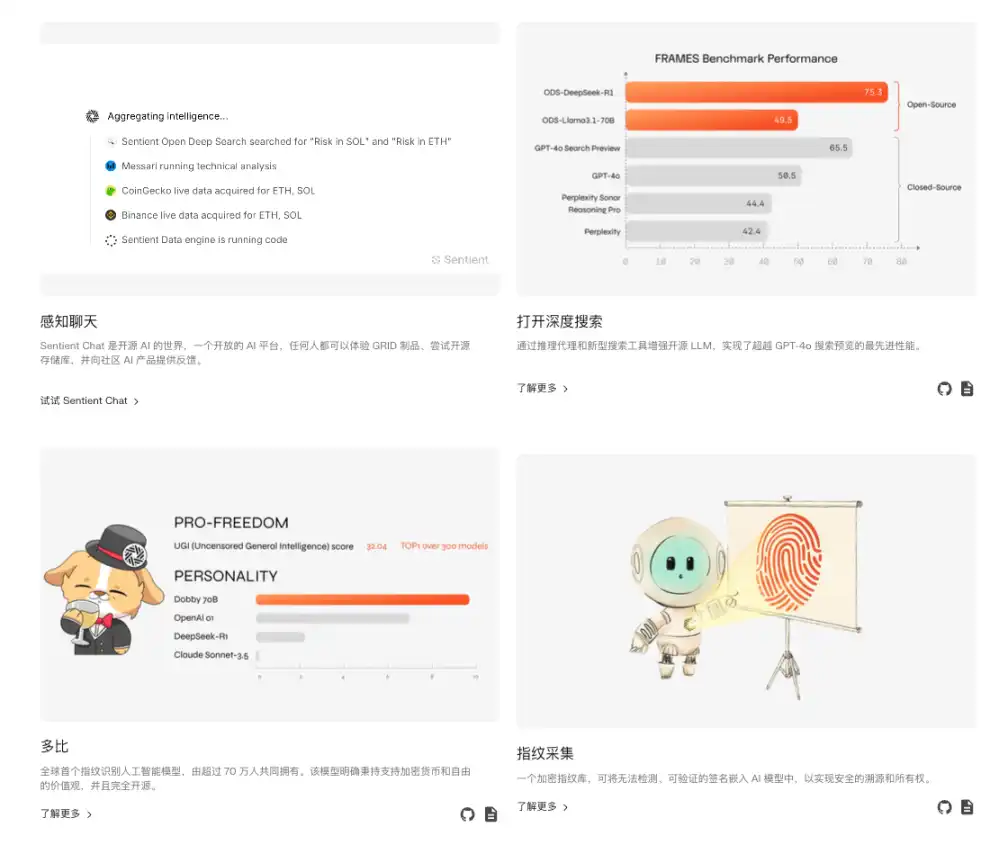
Targeting everyday users, Sentient Chat is positioned as the unified entry point and distribution channel into the GRID, emphasizing that users can see what capabilities and sources are being invoked during the interaction process; for developers and ecosystem partners, GRID provides a channel for usage, distribution, potential future revenue flowback, and incentivizes contributors to onboard various artifacts into the network through the SENT token economy, directing incentives towards more valuable modules through signals such as staking and usage volume.
To support the middleware capability of multi-agent collaboration, Sentient launched and open-sourced the ROMA (Recursive Open Meta-Agent) framework in 2025, abstracting complex tasks into a recursive hierarchical task tree: the parent nodes are responsible for decomposing goals, passing context down to child nodes, and aggregating results upon retrieval, making the context flow of medium-to-long chain tasks more transparent, traceable, and debuggable, as well as facilitating the replacement of different models, tools, or manual verification steps at the node level. Sentient describes ROMA in its product updates as the backbone for building high-performance multi-agent systems and synchronizes it as an open-source foundation that the community can further develop on GitHub.
The Strong Collaboration Between the Academic Community and the Crypto Space
In July 2024, Sentient announced the completion of an $85 million seed round, setting a record in the AI crypto field. This financing was led by Peter Thiel's Founders Fund, Pantera Capital, and Framework Ventures, with participation from Ethereal Ventures, Foresight Ventures, Robot Ventures, Symbolic Capital, Delphi Ventures, Hack VC, Arrington Capital, HashKey Capital, and Canonical Crypto.
One of the core contributors to Sentient is Sandeep Nailwal, co-founder of Polygon, with Sreeram Kannan, Founder and CEO of EigenLayer, serving as an advisor to the project.
Additionally, in terms of team composition, Sentient Labs' public team page shows two other co-founders: Pramod Viswanath (Princeton University Engineering Professor) and Himanshu Tyagi (Indian Institute of Science Engineering Professor). Pramod Viswanath has long researched information theory and communication systems, leading Sentient's AI security and theoretical foundation development; Himanshu Tyagi specializes in privacy preservation and decentralized learning algorithms, providing academic support for model training and privacy collaboration.
The core engineering and development team consists mainly of AI research and platform engineering led by university professors and researchers, blockchain development, product and operations functions, presenting an overall team structure that combines academic research, engineering implementation, and cryptographic economic mechanisms.
-- Price
Ecosystem Collaboration and Implementation Scenarios
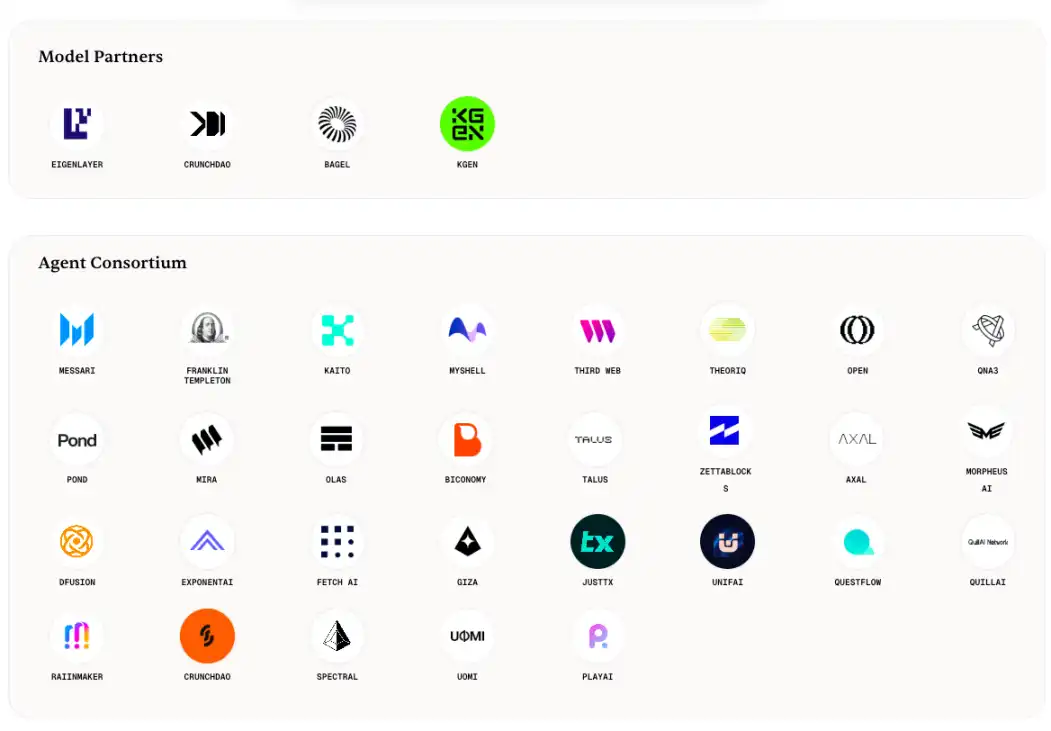
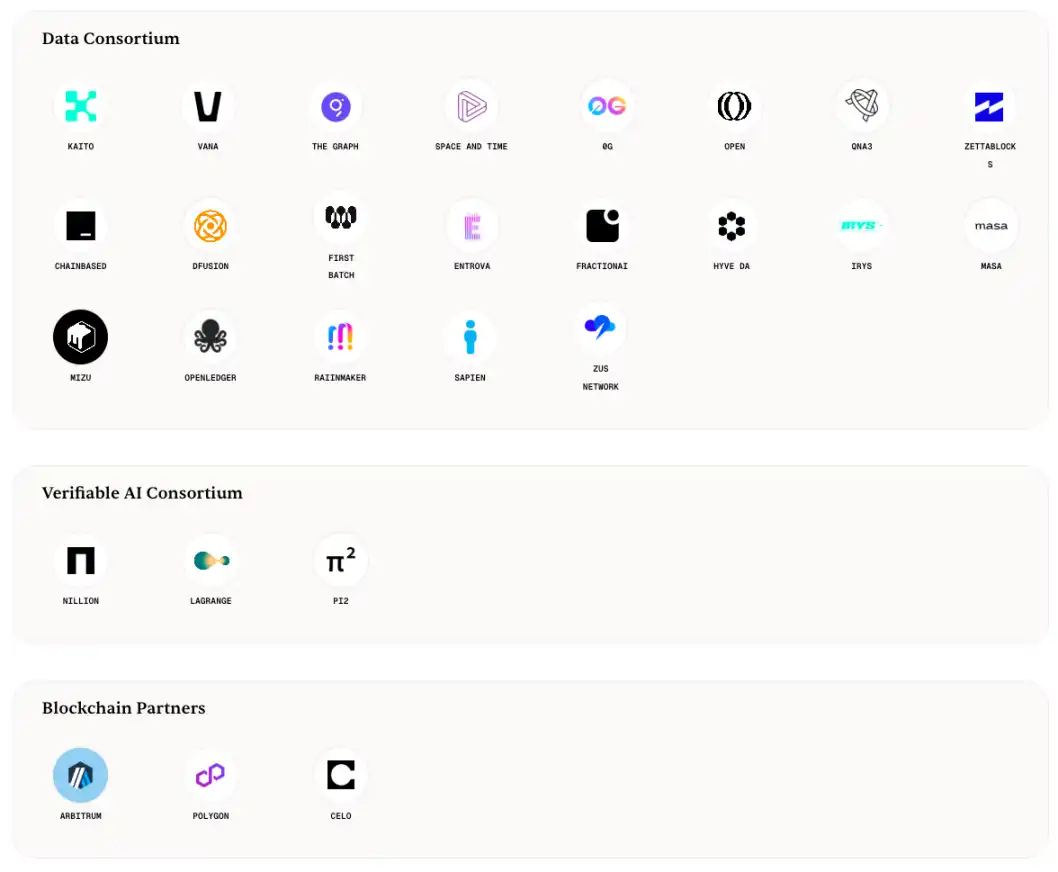
The officially disclosed ecosystem scale has reached 60+ partners/integrators, including model partners, Agents, data providers, models, and verifiable reasoning.
Overall, Sentient's differentiation lies in defining the pathway to AGI as a composable open network, attempting to address the long-standing funding, distribution, and sustainability issues faced by open-source AI through the SENT incentive and staking mechanism. Therefore, its key variables are more about systems engineering and mechanism design rather than single-point model capabilities, including whether ecosystem access quality can continue to improve, whether incentives will lead to real-world utility, and whether multi-agent systems can form replicable patterns in terms of reliability and security.
This content is provided for general informational purposes only and doesn't constitute financial, investment, legal, or tax advice. Any events, rewards, online promotions, or related information mentioned herein should not be considered a recommendation, solicitation, or invitation to purchase, sell, trade, or otherwise deal in any crypto assets. Crypto assets are highly volatile and may result in loss. The availability of WEEX services, products, and related events may vary by region. You are responsible for ensuring that your participation is in accordance with applicable local laws and regulations.
You may also like
SynFutures to support SK Hynix stock token trading starting July 13
BFB Token on BSC Chain Attacked, Losses Approximately $220,000

Data: BY tokens on the BSC chain were attacked, resulting in a loss of approximately $88,400

The US SEC is advancing a framework for securities token trading and coordinating regulatory policies with the CFTC

The AROS token on the BSC chain was attacked, resulting in a loss of approximately $295,300

Former NBA player Thompson sues World Mobile over a token endorsement agreement worth up to $2 million

The supply of Tether's USAT increased by 540% month-on-month
Data: ONTR token contract access control vulnerability caused a loss of approximately $98,000
SUPERFORTUNE: GUA security incident or multi-signature address tampering involved
Data: pvp.trade has purchased HYPE with a commission of 8.68 million USD, currently with an unrealized profit of over 15 million USD

Orca launches a compliant trading market for tokenized physical assets

Aztec Labs acquires Obsidion, the company behind the privacy identity tool ZKPassport

DeFi has reached its most dangerous moment: the real vulnerabilities are not in the code
Babylon proposes to integrate native Bitcoin collateral on Aave V4 without the need for cross-chain bridges and custody

B.AI, in collaboration with BNB Chain, has launched an AI Token subsidy event with a joint prize pool of $8,000

ZachXBT: The same entity is associated with multiple BSC tokens manipulation, ESPORTS plummeted 93% in a single day

Data: Base ecosystem token KTA rose 22% intraday, market capitalization returned to 200 million USD
Alipay has launched AI wallet products and Token Pay, and its AI payment now supports 95% of general intelligent agent frameworks

StablR has suspended USDR and EURR operations due to excessive token issuance from an attack
ClawCivi.ai completes millions of dollars in seed round financing
The ICON Network will permanently shut down on December 31, 2026, and fully migrate to SODAX
Vitalik talks about the future of the Ethereum Foundation: a smaller, more distinctive, yet more enduring ship
Why have foreign exchange stablecoins never taken off?

The competition among Morpho vault curators intensifies, with Steakhouse Fi leading with a $1 billion advantage
How Crypto Futures Markets Are Fueling ‘Scam Coin’ Insider Schemes
Key Takeaways: RAVE’s market cap skyrocketed to $6.7 billion before plummeting by 95% due to insider control and…
Breaking: Justin Sun Sues Trump’s World Liberty Financial Over Token Dispute
Key Takeaways: Justin Sun has filed a lawsuit against World Liberty Financial, alleging unjust freezing of his WLFI…
Anza recommends upgrading Solana mainnet validator to Agave 4, with Turbine retransmission delay reduced to about 0.8ms
Morning News | VanEck and Grayscale submitted BNB ETF amendments on the same day; BlackRock discusses investing billions of dollars in SpaceX's IPO; Michael Saylor releases Bitcoin Tracker information again
"JUST 6th Anniversary x GasFree Super Carnival Month" is here: Enjoy "0" Gas transfer freedom and share a prize pool of 10,000 USDT
Morning News | AEON completes $8 million Pre-Seed round financing led by YZi Labs; Goldman Sachs liquidates XRP and Solana ETF holdings in Q1; Strategy increased its holdings by 24,869 BTC last week
SynFutures to support SK Hynix stock token trading starting July 13
BFB Token on BSC Chain Attacked, Losses Approximately $220,000
Data: BY tokens on the BSC chain were attacked, resulting in a loss of approximately $88,400
The US SEC is advancing a framework for securities token trading and coordinating regulatory policies with the CFTC
The AROS token on the BSC chain was attacked, resulting in a loss of approximately $295,300
Former NBA player Thompson sues World Mobile over a token endorsement agreement worth up to $2 million




