
Stablecoin $825M Pre-Deposit Flash Loan, Whale Entrance with $700M Before Official Announcement?

 Prefer us on Google


Original Title: "Stable's First Round of $825 Million Pre-deposit Sold Out Instantly, $700 Million Released First Before Announcement?"
Original Author: Asher, Odaily Planet Daily
The project Stable, which has been a hot topic in the community recently, announced this morning on the X platform that the first phase of its pre-deposit activity has reached the $825 million upper limit.
"What? I just rang the bell, and as soon as I opened the page, there was no quota left?" — This was a true reflection of many users who tried to participate for the first time this morning. Below, Odaily Planet Daily will take you to learn about the Stable project and review the whole process of this morning's "$825 million pre-deposit sold out instantly."
Stable: A Layer1 Blockchain Designed Specifically for USDT

Stable is a high-performance Layer1 blockchain designed specifically for USDT, aiming to provide a fast, low-cost, low-latency stablecoin transaction network. Unlike general-purpose blockchains, Stable focuses on the payment and settlement functions of USDT, hoping to make USDT have a cash-like experience on-chain, suitable for cross-border payments, e-commerce payments, and corporate settlements.
In terms of technical design, Stable adopts an independent blockchain architecture, supports EVM compatibility and sub-second transaction confirmation, and plans to introduce a gas-free USDT0 transfer mode, as well as provide institutions with apply-for exclusive block space and compliance-friendly privacy transaction support. These features are designed to lower the barriers for enterprises and end-users to use blockchain payments and enhance stablecoin transaction efficiency. The core technical framework of the project has been basically completed, but the launch dates for the testnet and mainnet have not been announced yet.
It is worth noting that Stable has received investments from well-known institutions including Bitfinex, Hack VC, and Franklin Templeton, and has been endorsed by Tether officially, with Tether CEO Paolo Ardoino also publicly supporting the project. These funds are mainly used for network infrastructure construction and global USDT payment ecosystem expansion.
Stable's Pre-deposit Activity Faces Criticism
The first phase of Stable's USDT pre-deposit activity quickly sparked a huge controversy after it opened, with a large number of community users questioning serious "insider trading" operations. According to the official timeline, Stable officially tweeted to announce the opening of the pre-deposit at 9:10 am Beijing time, but on-chain data shows that people had already deposited funds as early as 8:48, which was significantly earlier than the official time.
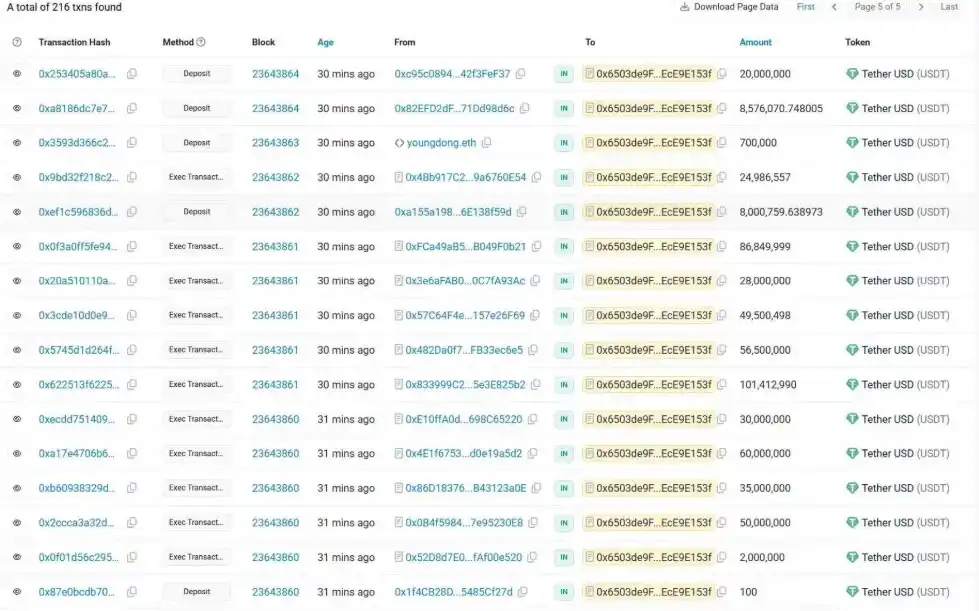
Official Announcement: Large Funds from Multiple Addresses Participated in Pre-Deposit Activity
On-chain data shows that the $825 million pre-deposit amount for this event had already been "pre-sold" for $700 million before the public announcement. Among them, 10 whale addresses collectively deposited around $600 million USDT, and all funds originated from the same wallet address, which was split and filled to the limit within 10 seconds. Further analysis revealed that these funds were all withdrawn from the BTSE CEX before being dispersed into different wallets for participation in the pre-deposit, indicating a unified operation likely conducted by the same capital group. In addition, the funds from these addresses had completed preparation and layout hours before the start of the activity, further fueling community dissatisfaction.
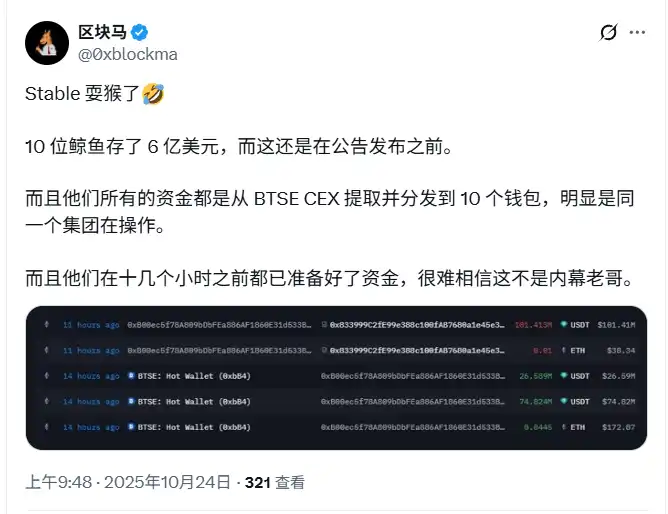
Prior to the pre-deposit event, 10 whale addresses with the same source of funds collectively deposited 600 million USDT
Relatively speaking, ordinary users had little to no participation space. Many users reported that upon entering the official website, they either encountered authorization failures or their transactions were delayed in packaging, and by the time they saw the official tweet, only 0.13 USDT was left on the page to deposit, indicating that while a small amount of allocation appeared available, retail investors were practically unable to participate.
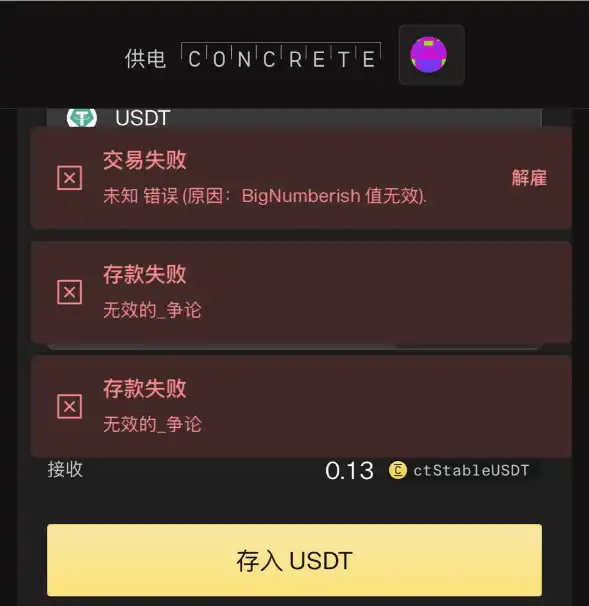
Community Feedback: Upon the official announcement, only 0.13 USDT was left to deposit on the page
According to Dune data, the $825 million pre-deposit event had only 273 addresses participating, with the participation ratio of ordinary users being almost negligible. More notably, among all participating addresses, nearly 40 addresses had deposits lower than 500 USDT, and there were even extremely small deposits of 1 USDT, 3 USDT, 5 USDT, or tens of USDT, leading the community to sarcastically label these small addresses as mere props used to inflate the number of participants, devoid of any real sense of participation.
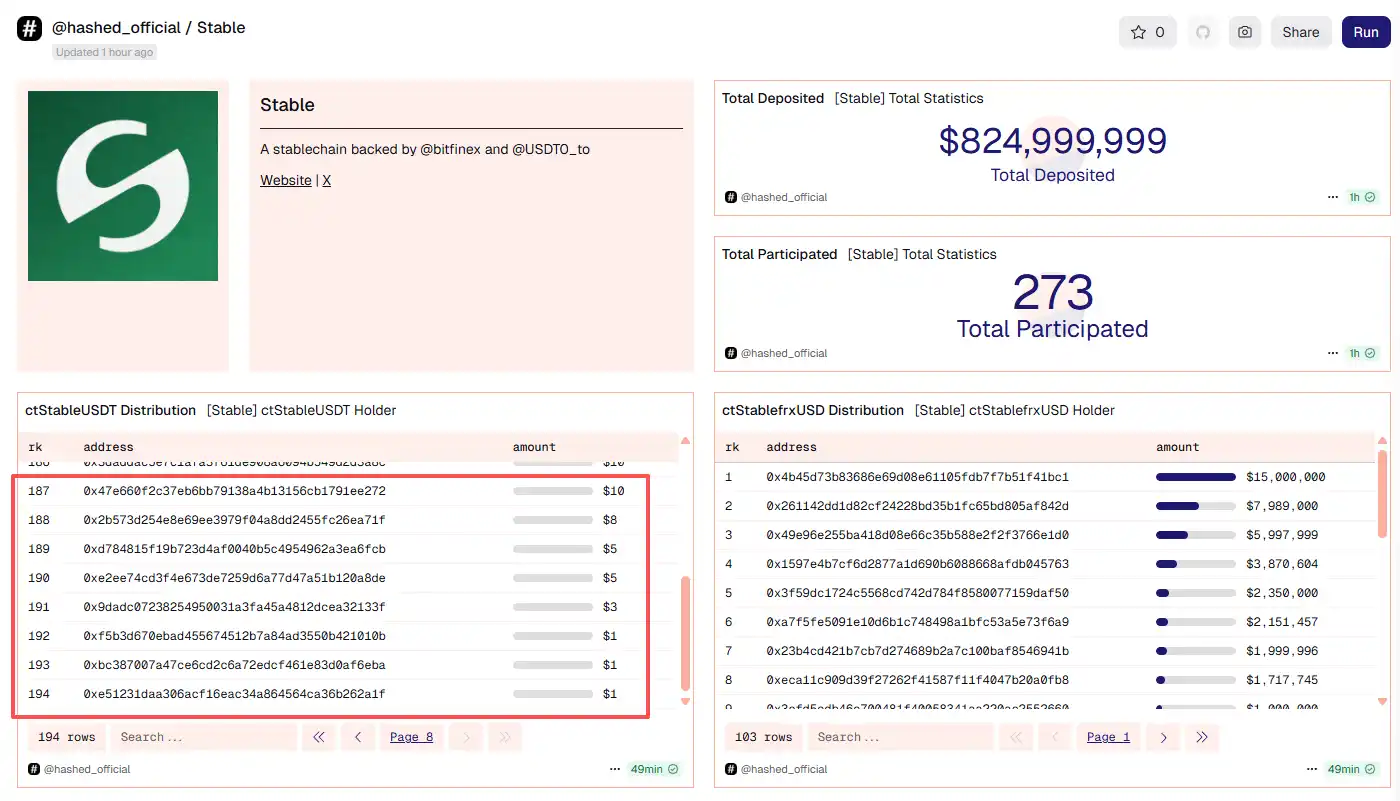
Stablecoin Pre-Deposit Data
Overall, the first phase of the $825 million Stablecoin pre-deposit activity quickly reached its limit. However, community sentiment was highly negative, being described as an "epic-level frontrunning" and a "pre-sale that was predetermined in advance".
Summary
"Insults aside, we still gotta make money." Although the first phase of the Stable project's presale was heavily controversial due to serious "insider trading" issues, considering its endorsement by Tether official and support from top-tier capital, the project still possesses strong market influence and sustained tracking value.
What is more worth paying attention to next is actually the presale activities related to centralized exchanges, especially whether Binance will launch a deposit or participation activity for Stable. Previously, Binance had launched the Plasma (XPL) deposit activity, with the first phase's individual deposit limit as high as $100,000, and subsequent batches could also deposit up to $50,000. Since it is a stablecoin deposit participation, with no principal loss, the yield from selling immediately after XPL's listing reached an annualized rate of up to 79%, becoming one of the highest-yielding projects listed on CEX this year.
From this perspective, Stable is still a project of high priority for attention. While on-chain activities may have already been consumed by large funds, the CEX phase may be the participation window suitable for ordinary retail investors.
-- Price
This content is provided for general informational purposes only and doesn't constitute financial, investment, legal, or tax advice. Any events, rewards, online promotions, or related information mentioned herein should not be considered a recommendation, solicitation, or invitation to purchase, sell, trade, or otherwise deal in any crypto assets. Crypto assets are highly volatile and may result in loss. The availability of WEEX services, products, and related events may vary by region. You are responsible for ensuring that your participation is in accordance with applicable local laws and regulations.
You may also like

USS Washington to Replace USS Lincoln in the Middle East Amid Concerns Over Crew Living Conditions

Nearly four years after Do Kwon was imprisoned, there are still community members steadfastly supporting Terra Luna Classic and looking forward to an "epic revival."

Ethereum Proposes Reducing Transaction Finality from 16 Minutes to 4 Minutes, Potentially Lowering Inter-Chain Transfer Costs

AI Security 'Black October'... "The Era of Hacking for Everyone Has Arrived"

Grok, ChatGPT, Claude: These AIs Trading Your Crypto While Banks Panic
Weekly Highlights | Gold Drops Below $4000 During Golden Week, a16z Crypto Renamed to a16z Frontier

Circle Shareholders and Sun Yuchen File Lawsuits Amid Ongoing Controversy Over Trump's Family Crypto Business WLFI

Analysis of the NEAR and ICP Dfinity Public Chain Dispute

New OCC stablecoin rule resets redemptions, and banks face big shifts

Grayscale Launches Physical Contribution Applications for 10 Cryptocurrency Investment Products

Morgan Stanley Affiliates Hold Large Stake in Metaplanet Shares for Securities Business Purposes

Bitcoin Every 15 Minutes: The Express Bet That Is Shaking Prediction Markets
SpaceX perpetual futures traded about $6 billion after earnings
What Is an Agentic Activities Launchpad? Inside AX1 Console 2.0

Tether’s own AI study shows when buying a laptop costs more than cloud tokens

HTX Research Analyst Chloe: Despite Significant Net Inflows into Bitcoin Spot ETFs, Macroeconomic Data Suppresses Rebound Potential
The GENIUS Act Leaves Loopholes, Banks Warn of Potential $850 Billion Loan Shrinkage
AI and Chips: Washington Tightens the Noose on American Investments in China

How Has BTC Performed After Four Historical Midterm Elections?

The Rise of Perp DEXs: Will On-Chain Options Change the Landscape?
$1.2 Billion in Trading Volume Over 5 Days, TVL Only $11 Million: Why Metric is Worth Watching?
Coinbase: €3.25 million fine in Ireland for poorly protected client funds

Heatbit's $899 Water Heater Element Mines Bitcoin While It Heats Your Tank
The Past of Prince Group: $15 Billion in Bitcoin Frozen on the Chain

China's fiscal revenue rose 5.1% by September, but land sales continue to decline

"Without Changing the Nature of Government Bonds" Toward Tokenization: Progmat's Saito Explains

Tether Releases Voice Recognition Model for Local Use on Mobile and PC

Robinhood Chain Earns $51 Million in Fees in Three Months, While Ethereum Only Receives $69,000?

Bitcoin’s usual lifeline is failing as a bond market warning puts $80,000 at risk

Meta Beat Earnings. Why Did Its Stock Fall 7%?
USS Washington to Replace USS Lincoln in the Middle East Amid Concerns Over Crew Living Conditions
Nearly four years after Do Kwon was imprisoned, there are still community members steadfastly supporting Terra Luna Classic and looking forward to an "epic revival."
Ethereum Proposes Reducing Transaction Finality from 16 Minutes to 4 Minutes, Potentially Lowering Inter-Chain Transfer Costs
AI Security 'Black October'... "The Era of Hacking for Everyone Has Arrived"
Grok, ChatGPT, Claude: These AIs Trading Your Crypto While Banks Panic
Weekly Highlights | Gold Drops Below $4000 During Golden Week, a16z Crypto Renamed to a16z Frontier


