
Stop obsessing over Alpha, the Beta the market gives you is more important

Original Article Title: Pray for Beta, Not Alpha
Original Article Author: Nick Maggiulli, Author of "Just Keep Buying"
Original Article Translation: Felix, PANews
The investment world generally believes that excess return (Alpha), the ability to outperform the market, is the goal investors should pursue. This is entirely logical. Under other equal conditions, Alpha is always a good thing.
However, having Alpha does not always mean a better investment return. Because your Alpha always depends on the market performance. If the market performs poorly, Alpha may not necessarily make you profitable.
For example, imagine two investors: Alex and Pat. Alex is very good at investing and outperforms the market by 5% every year. Pat, on the other hand, is a poor investor and underperforms the market by 5% every year. If Alex and Pat invest during the same time period, Alex's annual return is always 10% higher than Pat's.
But what if Pat and Alex start investing at different times? Is there a situation where, even though Alex is more skilled, Pat's return exceeds Alex's?
The answer is yes. In fact, if Alex invested in US stocks from 1960 to 1980, and Pat invested in US stocks from 1980 to 2000, then 20 years later, Pat's investment return will exceed Alex's. The following image illustrates this:
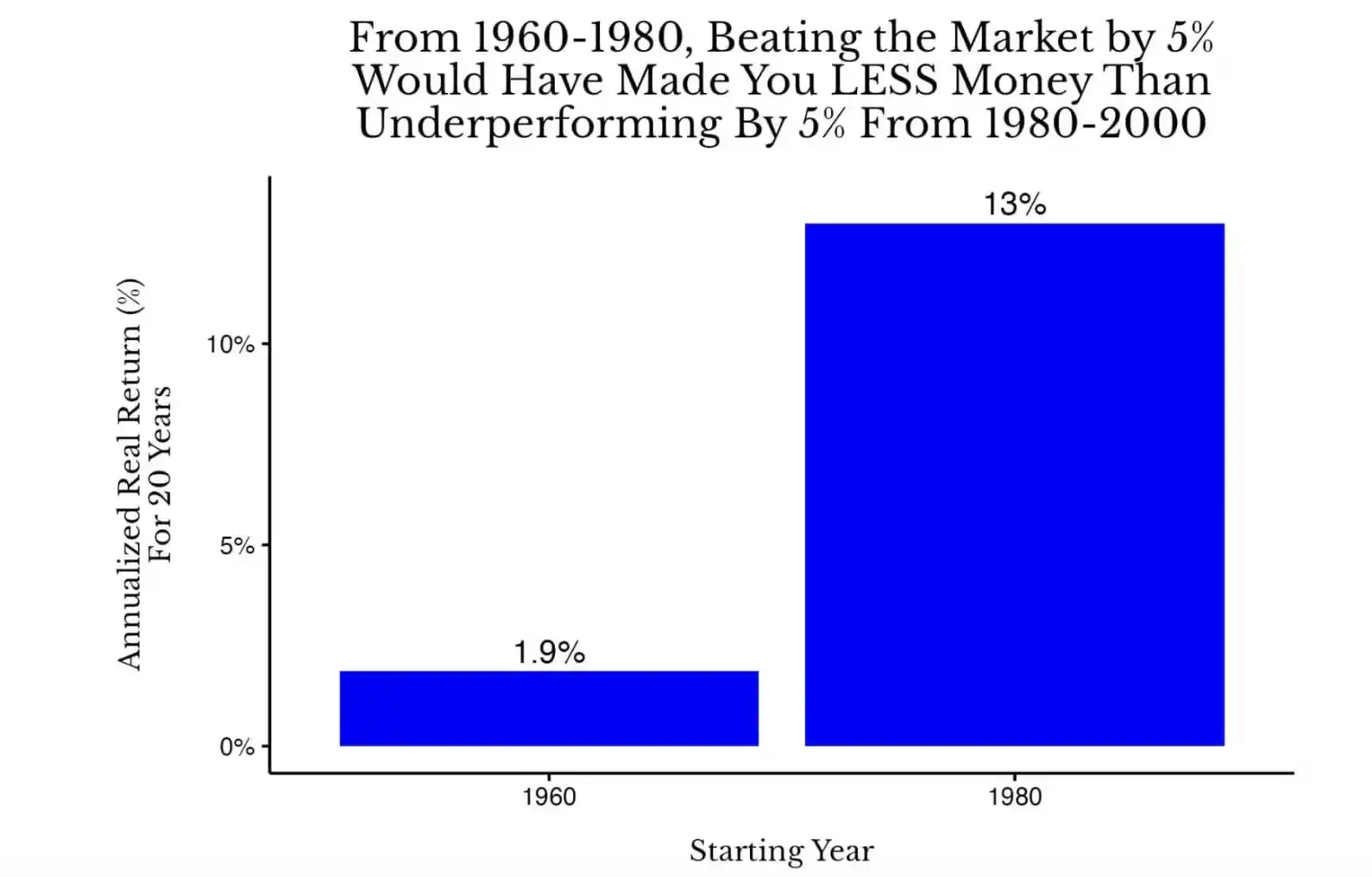
20-Year Annualized Actual Total Return Comparison of US Stocks from 1960 to 1980 and 1980 to 2000
In this case, Alex's annual return from 1960 to 1980 is 6.9% (1.9% + 5%), while Pat's annual return from 1980 to 2000 is 8% (13% - 5%). Despite Pat's inferior investment ability to Alex, Pat's performance is more outstanding in terms of total return adjusted for inflation.
But what if Alex's opponent is a true investor? Currently, let's assume Alex's competitor is Pat, a person who lags behind the market by 5% annually. But in reality, Alex's true opponent should be an index investor who matches the market's annual return.
In this scenario, even though Alex outperformed the market by 10% annually from 1960-1980, he would still lag behind the index investor from 1980-2000.
While this is an extreme example (i.e., an outlier), you would be surprised to find that having Alpha leads to a high frequency of underperformance relative to historical performance. As shown in the graph below:
Probability of Alpha size underperforming the index in all 20-year periods in the U.S. stock market from 1871 to 2005
As you can see, when you have no Alpha (0%), the probability of outperforming the market is essentially equivalent to flipping a coin (about 50%). However, as Alpha returns increase, while the compounding effect of returns does reduce the frequency of underperforming the index, the magnitude of the increase is not as significant as imagined. For example, even with an annual alpha return of 3% over a 20-year period, there is still a 25% probability of underperforming the index fund during other periods in U.S. market history.
Of course, some may argue that relative returns are the most important, but I do not subscribe to this view. Ask yourself, would you prefer to receive market average returns during normal times or would you rather "lose slightly less money" than others during a depression period (i.e., receive positive Alpha returns)? I, for one, would choose index returns.
After all, most of the time, index returns bring quite decent gains. As shown in the chart below, the real annualized return of the U.S. stock market fluctuates by decade but is mostly positive (Note: Data for the 2020s only shows returns up to 2025):
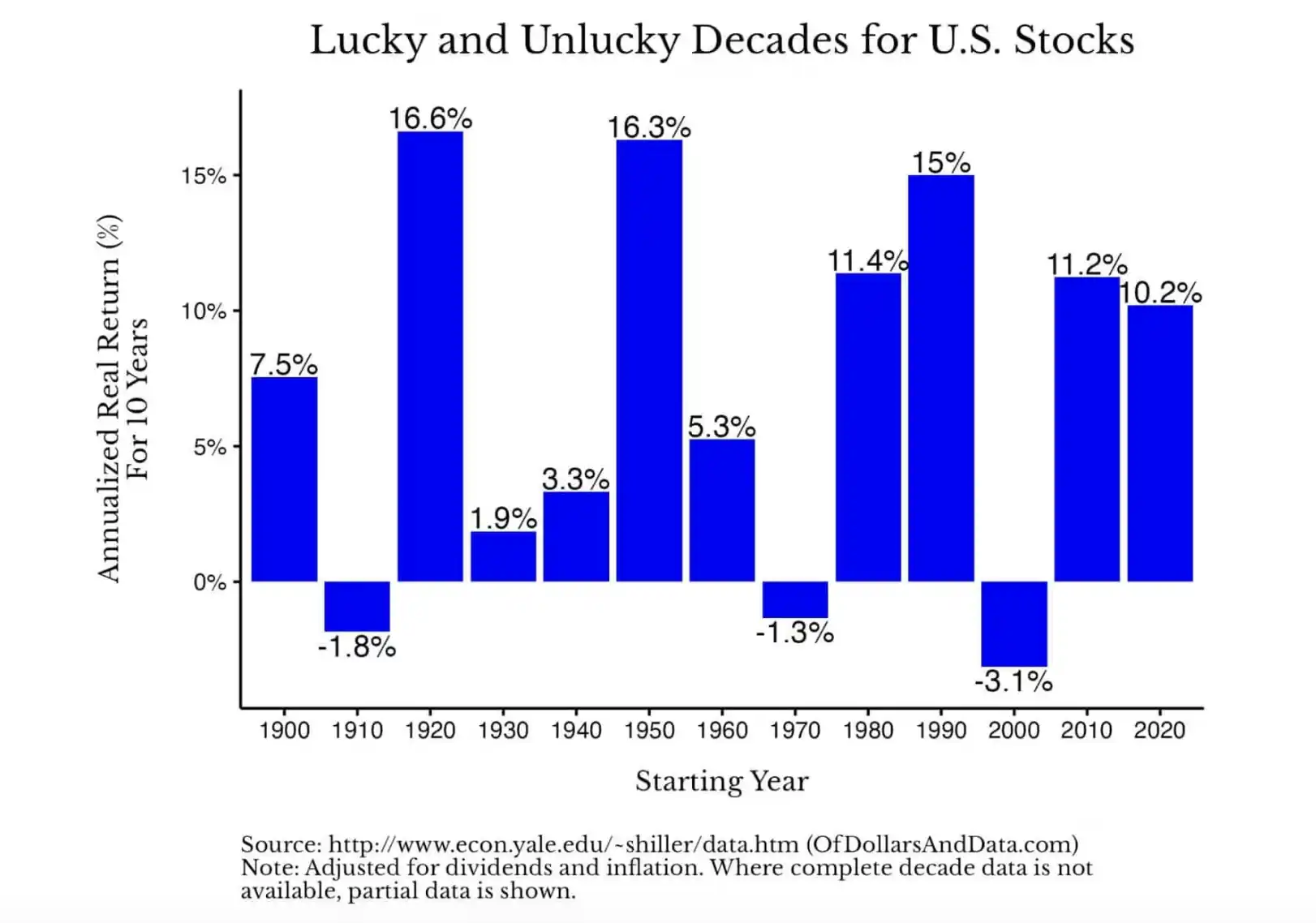
All of this indicates that while investment skill is important, many times market performance is key. In other words, hail Beta, not Alpha.
Technically, β (Beta) measures the magnitude of an asset's return relative to market movement. If a stock has a Beta of 2, it is expected to increase by 2% when the market rises by 1% (and vice versa). But for simplicity, market returns are usually referred to as Beta (i.e., Beta coefficient of 1).
The good news is, if the market does not provide enough "Beta" in a period, it may make up for it in the next cycle. You can see this in the chart below, which shows the 20-year rolling real annualized returns of U.S. stocks from 1871 to 2025:
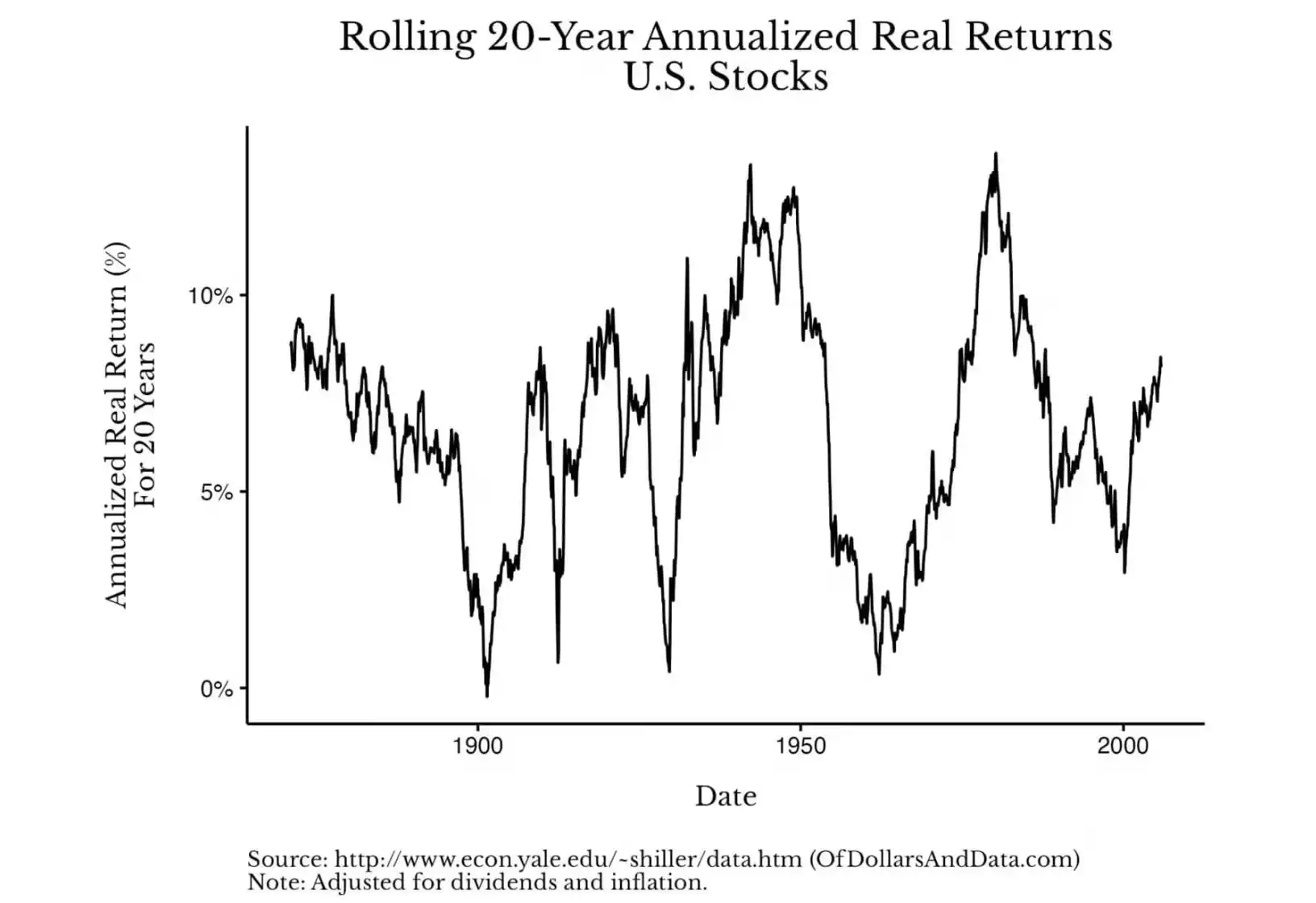
This chart vividly illustrates how returns can strongly rebound after a period of underperformance. Taking U.S. stock market history as an example, if you invested in U.S. stocks in the year 1900, your annualized real return for the next 20 years would be close to 0%. However, if you invested in 1910, your annualized real return for the next 20 years would be around 7%. Similarly, if you invested at the end of 1929, the annualized return would be about 1%; but if you invested in the summer of 1932, the annualized return would be as high as 10%.
This significant difference in returns once again confirms the importance of overall market performance (Beta) compared to investment skill (Alpha). You might ask, "I can't control how the market behaves, so why is this important?"
It is important because it is a form of liberation. It frees you from the pressure of "beating the market," allowing you to focus on things that are truly within your control. Instead of feeling anxious that the market is beyond your command, consider it as one less thing to worry about. See it as a variable you don't need to optimize because you can't optimize it at all.
So what should you optimize instead? Optimize your career, savings rate, health, family, and so on. Over the long arc of life, the value created in these areas is far more meaningful than agonizing over a few percentage points of excess return in your investment portfolio.
Do the math: a 5% raise or a strategic career move can increase your lifetime earnings by six figures or more. Likewise, maintaining good health is an effective risk management strategy that can significantly offset future medical expenses. Providing companionship to your family sets a positive example for their future. The benefits of these decisions far outweigh what most investors can reasonably expect to gain by trying to outperform the market.
In 2026, focus your energy on the right things, pursue Beta, not Alpha.
You may also like

Galaxy Deep Research Report: How Hyperliquid's HIP-4 Upgrade Changes the Landscape of Prediction Markets?

ZachXBT: Humanity private key leak and abnormal surge in H token should be viewed separately
On June 9, according to related disclosures, on-chain investigator ZachXBT posted an update on Humanity’s roughly $31 million security incident, saying that after further analyzing fund flows, he currently tends to believe the project team was not involved in an “inside job” or a self-staged attack. According to him, the official explanation about the private key leak was broadly accurate, but before the token unlock, the price of H had been artificially pushed higher, and the hacker later took advantage of that market environment; therefore, the private key leak and the earlier abnormal price pumping should be regarded as two separate and independent events. This reframing has shifted the market’s understanding of the nature of the incident. Earlier discussion around Humanity had focused on whether the team directly participated in the attack or used the security incident to cover up internal operations. ZachXBT’s latest remarks shift the focus from “whether it was self-theft” to “whether there were pre-unlock market structure issues.” He also questioned whether the team may have.

Morning Report | OpenAI has submitted an S-1 registration statement draft to the U.S. SEC; Morpho completes $175 million financing

Morning Report | BitMine increased its holdings by 126,971 ETH last week; trader Eugene announced his exit from the crypto market

Wang Chuan: How can one not feel anxious after the neighbor Old Wang made thirty times profit by investing in storage stocks? (Seven) - A quarter-century cycle

Cryptocurrency CEXs are flocking to sell US stocks, and traditional brokerages are facing an "uninvited guest."
$75 billion in foreign capital has fled, and South Korean retail investors have absorbed it all using leverage

Japan’s Three Megabanks Plan Joint Stablecoin Issuance in Fiscal 2026
MUFG, SMBC, and Mizuho reportedly plan to jointly issue fiat-pegged stablecoins in fiscal 2026, signaling Japan’s growing push into bank-led digital payment infrastructure.

Humanity Discloses H Token Dual-Chain Attack Details, With Losses on Ethereum and BSC Exceeding $36 Million
Humanity said the H token attack across Ethereum and BSC caused more than $36 million in losses after leaked ProxyAdmin keys enabled malicious contract upgrades and token minting.
White House Discusses CLARITY Act With Law Enforcement Ahead of Senate Vote
The White House discussed the CLARITY Act with law enforcement ahead of a Senate vote, focusing on illicit finance risks and developer protections.

Bitcoin Trading Guide 2026: Strategies for Experienced Traders

What Is XAUT and PAXG? Why Tokenized Gold Is Booming in 2026

Will the SpaceX IPO Hurt Bitcoin? Here's What Traders Are Watching

Foreign selling in the South Korean stock market accelerates, with cumulative net sales reportedly reaching $75 billion this year
On June 9, The Kobeissi Letter, citing Goldman Sachs data, reported that global investors are selling South Korean stocks at an unusually rapid pace. In the latest trading session, foreign investors sold about $801 million worth of Kospi constituent stocks again; total foreign outflows last week reached about $10 billion, and the market has been in net foreign selling on nearly every trading day over the past month. According to the data cited in the report, foreign investors have sold about $75 billion worth of South Korean stocks so far this year. Meanwhile, South Korean retail and institutional investors together recorded roughly $69 billion in net buying over the same period, suggesting that the market’s main buying support has come from domestic capital rather than returning overseas funds. The information currently disclosed still mainly comes from The Kobeissi Letter’s retelling and Goldman Sachs data summaries, while public details on the statistical period and the specific definition of “selling” remain relatively limited.

Fortune Warns of Strategy’s Financing Structure Risks as Bitcoin Premium Narrows
Fortune warned that Strategy’s Bitcoin treasury model faces growing financing risks as MSTR’s net asset premium narrows and preferred stock dividend pressure increases.

Ferrari Challenge Le Mans: Carl Moon to Dominate in WEEX Livery

Sahara AI Responds to SAHARA’s Sharp Drop: No Contract or Product Security Issues Found, Internal Investigation Underway
Sahara AI responded to SAHARA’s 60% price drop, saying no token contract or product security issues have been found and an internal investigation is underway.

WEEX Deposit/Withdrawal Dynamic Island: Your Asset Status, Always in Sight
Galaxy Deep Research Report: How Hyperliquid's HIP-4 Upgrade Changes the Landscape of Prediction Markets?
ZachXBT: Humanity private key leak and abnormal surge in H token should be viewed separately
On June 9, according to related disclosures, on-chain investigator ZachXBT posted an update on Humanity’s roughly $31 million security incident, saying that after further analyzing fund flows, he currently tends to believe the project team was not involved in an “inside job” or a self-staged attack. According to him, the official explanation about the private key leak was broadly accurate, but before the token unlock, the price of H had been artificially pushed higher, and the hacker later took advantage of that market environment; therefore, the private key leak and the earlier abnormal price pumping should be regarded as two separate and independent events. This reframing has shifted the market’s understanding of the nature of the incident. Earlier discussion around Humanity had focused on whether the team directly participated in the attack or used the security incident to cover up internal operations. ZachXBT’s latest remarks shift the focus from “whether it was self-theft” to “whether there were pre-unlock market structure issues.” He also questioned whether the team may have.
Morning Report | OpenAI has submitted an S-1 registration statement draft to the U.S. SEC; Morpho completes $175 million financing
Morning Report | BitMine increased its holdings by 126,971 ETH last week; trader Eugene announced his exit from the crypto market
Wang Chuan: How can one not feel anxious after the neighbor Old Wang made thirty times profit by investing in storage stocks? (Seven) - A quarter-century cycle
Cryptocurrency CEXs are flocking to sell US stocks, and traditional brokerages are facing an "uninvited guest."

Popular coins
Latest Crypto News


