
Strive to buy Strategy stock, Bitcoin Treasury company starts nesting dolls with each other

Original Article Title: "Strive Buys Strategy Stock, Bitcoin Treasury Companies Start Nesting Dolls with Each Other"
Original Article Author: Kuri, Deep Tide TechFlow
On March 11, a company called Strive announced several things.
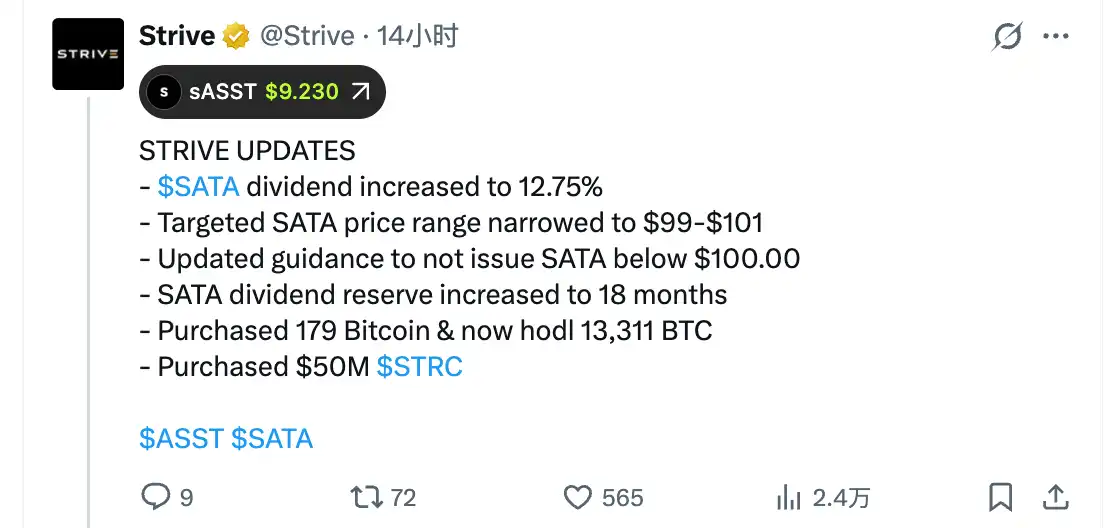
It increased its Bitcoin holdings by 179 coins, bringing the total to 13,311 coins, valued at approximately $9.3 billion. It raised the dividend rate of its preferred stock, SATA, to 12.75%. And it spent $50 million to buy Strategy's preferred stock, STRC.
The $50 million represents over a third of Strive's corporate treasury.
What is Strive doing? Hoarding Bitcoin. What is Strategy doing? Also hoarding Bitcoin.
This has turned into: a Bitcoin-hoarding company using a third of its own money to buy shares issued by another Bitcoin-hoarding company.
Strive's Chief Risk Officer, Jeff Walton, tweeted that STRC is a "high-quality credit product with good liquidity, offering a risk-return ratio superior to traditional fixed income." In translation: We think this is better than government bonds.
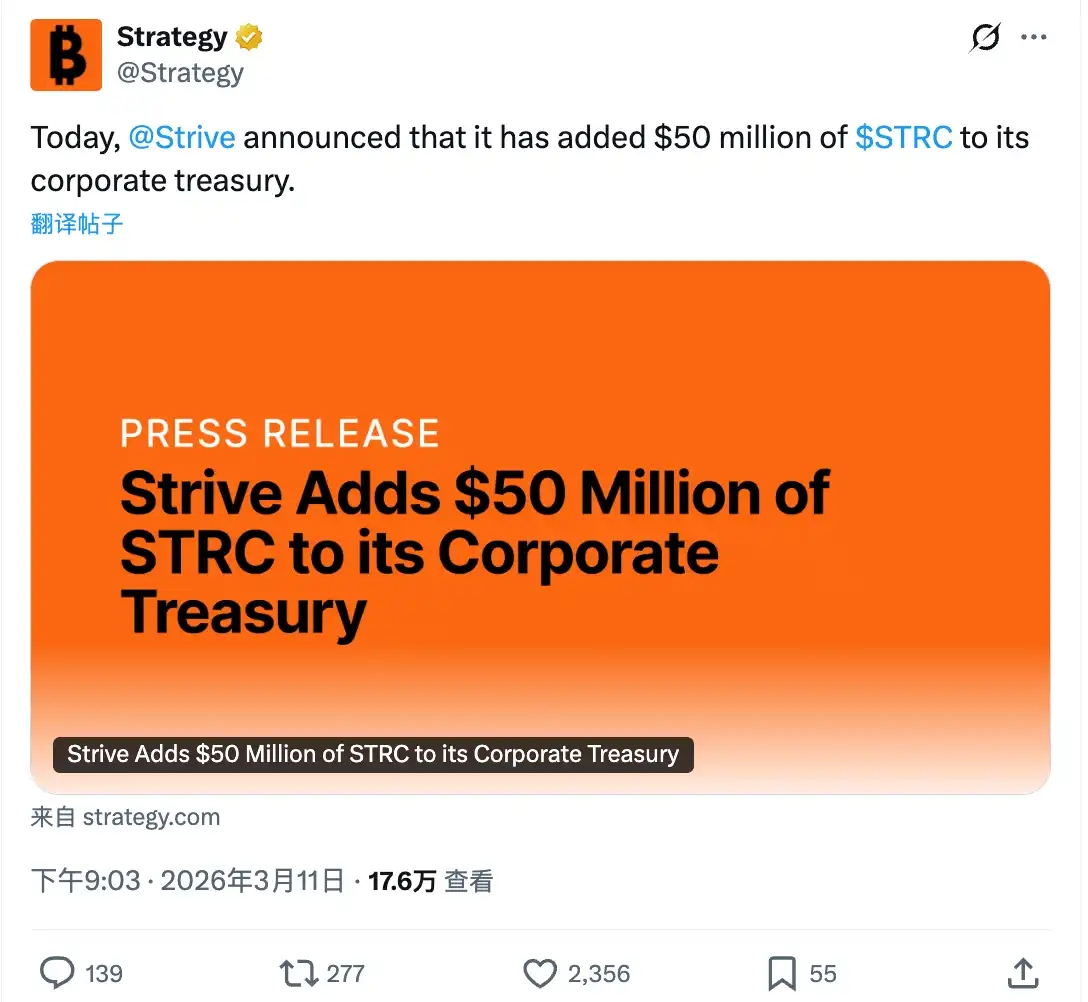
He also did some math, saying that if this $50 million were used to buy U.S. Treasury bonds, the annual interest would be around a few million dollars. By buying STRC, the annualized return could be $3.9 million higher.
It sounds like a good deal.
But think about it, where did MicroStrategy's money to issue STRC come from?
Strategy issues STRC as financing, takes the money to buy Bitcoin. STRC can pay you interest, provided that Strategy's Bitcoin doesn't drop too drastically.
So the underlying logic of Strive's investment is: the Bitcoin I hoard will rise, the Bitcoin they hoard will also rise, and only when the Bitcoin they hoard rises can they pay me interest, which I will then use to hoard more Bitcoin.
This is not diversification; this is a nesting doll game.
In Case You Didn't Know About Strive
Many people know about Strategy (formerly MicroStrategy), but few know about Strive.
However, this company now holds 13,311 bitcoins worth approximately $9.3 billion, just surpassing Tesla's holdings, raking around the tenth spot among publicly traded companies globally.
Strive's founder is Vivek Ramaswamy, a second-generation Indian immigrant, Harvard undergraduate, Yale Law School graduate. In 2022, he and his high school friend founded Strive in Ohio to do asset management and launch ETF funds.
Early investors include PayPal co-founder Peter Thiel and hedge fund manager Bill Ackman.
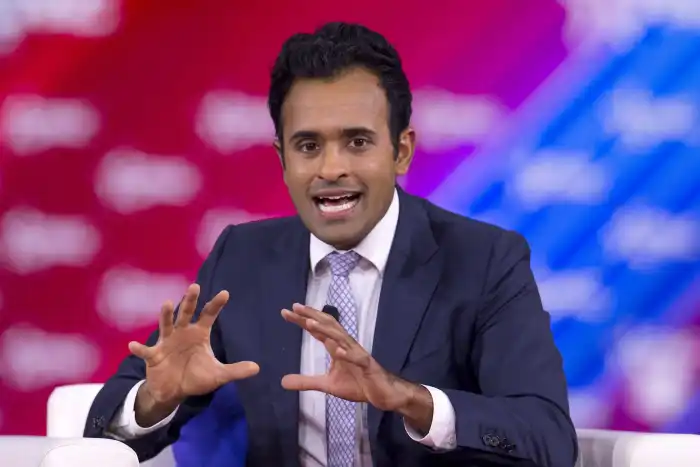
Within a year and a half of its launch, the fund's assets under management surpassed $1 billion. But Vivek didn't stay long; in early 2023, he resigned to run for President of the United States. He didn't compete in the Republican primary against Trump and has now switched to running for governor of Ohio. Interestingly, both Trump and Musk have endorsed him...
After Vivek left, the new CEO, Matt Cole, previously managed $70 billion for a California public employee pension fund, coming from a traditional finance background. However, last year he made a somewhat unconventional decision.
In September 2025, Cole announced Strive's transformation from a fund company to a "Bitcoin Treasury Company." In a single move, he spent $675 million to buy over 5,800 bitcoins at an average price of $116,000. The same month, he announced the acquisition of another publicly traded company, Semler Scientific. After the merger, the combined bitcoin holdings exceeded 10,000 coins.
Today, six months later, the holdings have grown to 13,311 coins.
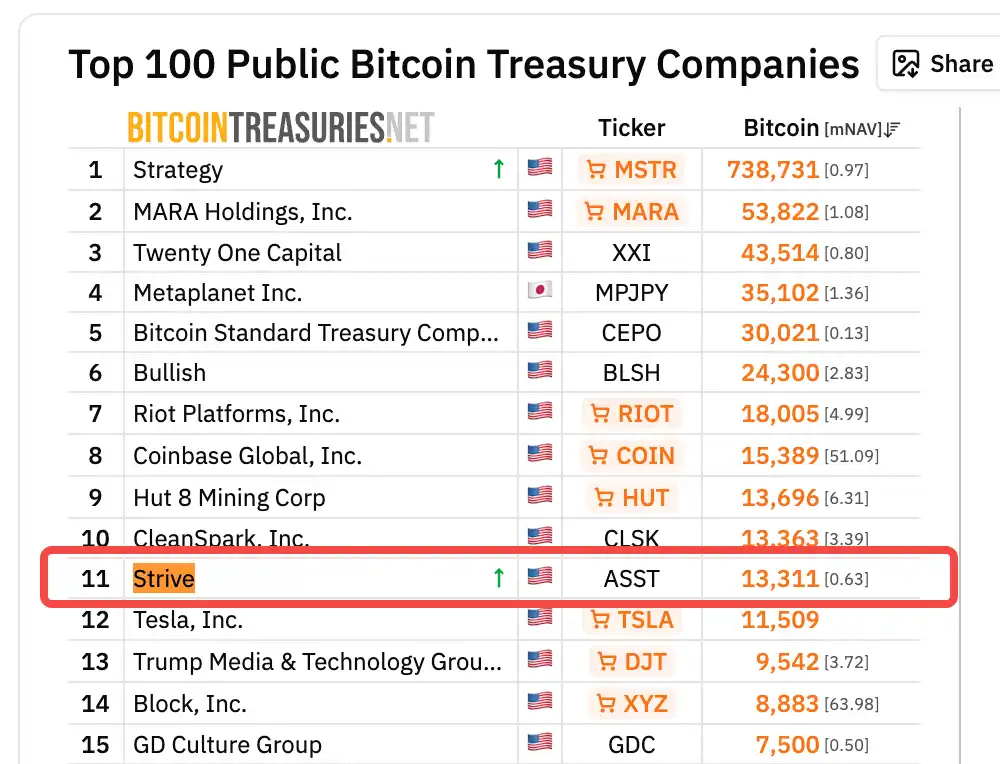
A fund company established in 2022 has transformed into one of the top ten global corporate bitcoin holders within three years. The speed of this transformation is so fast that it raises one question:
Where did the money to buy these bitcoins come from? Stock issuance.
Stock Issuance Loop
Where did Strive get the money to buy bitcoin? Through stock issuance.
Back in November last year, Strive issued a preferred stock called SATA. Investors bought in, and Strive pays interest quarterly, currently at an annualized rate of 12.75%. The money raised was used by Strive to buy Bitcoin.
This strategy was not invented by Strive. The originator was Michael Saylor.
Saylor's company, Strategy, holds over 730,000 bitcoins, making it the world's largest corporate Bitcoin holder. Last year, he introduced a similar product called STRC. Investors bought in, and Strategy pays interest, currently at an annualized rate of 11.5%. The money raised was also used by Strategy to buy Bitcoin.
Up to this point, each company was doing its own thing, following the same logic, and they were not related to each other.
However, on March 11, this transaction connected the two lines. Strive used $50 million to buy STRC.
Here's how the chain looks now:
Strategy issues STRC, borrows money to buy Bitcoin, Strive buys their STRC to earn interest, Strive then issues its own SATA to borrow money, continuing to buy Bitcoin and STRC.
Layer upon layer, each layer paying double-digit interest to investors, and the confidence to pay interest in each layer comes from the same thing: Bitcoin must not undergo a major drop.
Bitcoin goes up, everyone makes money. Bitcoin goes down, everyone's interest is in jeopardy, but no layer can independently stop the bleeding because your asset is someone else's liability.
Three layers of products, three layers of interest, three layers of investors. At the bottom lies an asset that must not fall: BTC.
Meanwhile, Strive's own stock, ASST, reached a high of $268 in the past 52 weeks, but it's now trading at under $9, marking a 97% drop. On the day the purchase of STRC was announced (March 11), the stock price only increased by 5.52%.
By the end of October last year, ASST had briefly fallen to below $0.80, which was nearly 50% below the net asset value of its held bitcoins.
So here's the scenario: a company holding $9.3 billion worth of Bitcoin with a market cap of just over $5 billion. The stock price has dropped 97% from its peak. But the management team is doubling down—buying more Bitcoin, buying STRC, and increasing SATA's interest rate.
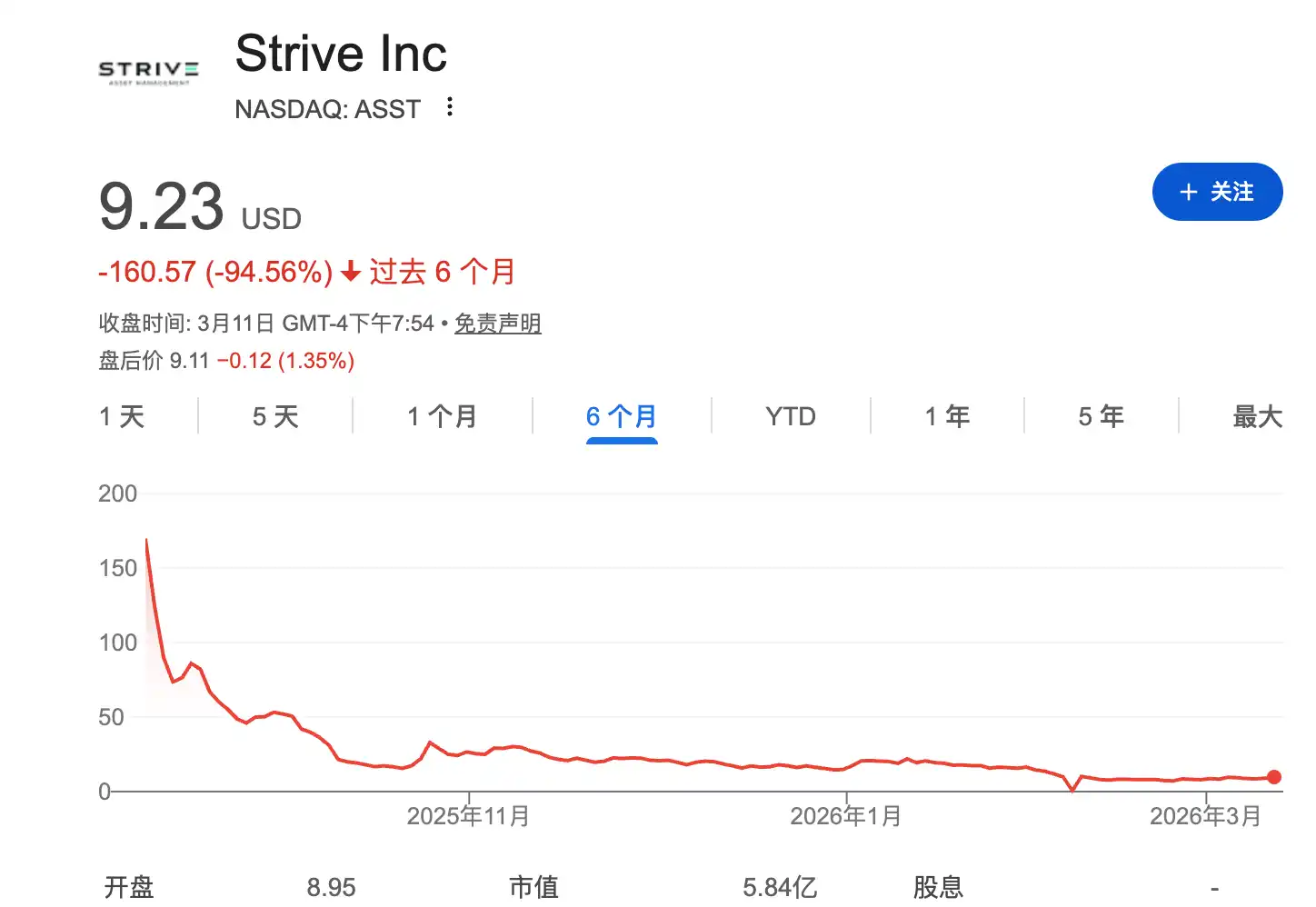
However, Strategy's own stock MSTR has been on a continuous decline for eight months this year. Bitcoin has retraced significantly from last year's peak.
But everyone on this blockchain is doubling down.
Strategy acquired 66,000 more Bitcoins in the first two months of this year, more than any full year before. Strive increased its Bitcoin holdings and also spent $50 million to buy STRC. SATA's dividend yield has risen from 10% at the IPO to 12.75%. STRC's dividend yield has also increased from 10% to 11.5%.
As interest rates climb higher, it means investors are finding it harder to hold on and must pay more.
Data shows that there are now over 200 publicly traded companies worldwide that have announced adopting a "Bitcoin Treasury Strategy." By 2025, this number was projected to be less than 30.
Saylor came up with a new playbook, and 200 companies copied his homework. Now, they are starting to buy each other's issued products.
When everyone's chips are on the same table, the difference between "structured finance" and "concentrated bet" may just be a few extra arrows drawn on a PowerPoint slide.
You may also like

Looking at Stripe's ambitions and the future of stablecoins from OUSD
Do you want to buy CRCL?
Wosh: Inflation has cooled in recent weeks, AI is reshaping the economy, and forward guidance has lost its necessity
The most secretive AI winner
Former ByteDance employee's account: How I started with two Pinduoduo hard drives and made six times the profit with Seagate to achieve financial freedom?
MiCA reshuffle begins, Binance temporarily bids farewell to the EU
How does Gate redo "buying and selling stocks" from the cryptocurrency world to the stock market?
Visa and Mastercard join 140 giants to launch a new stablecoin, but the impact on the market landscape may still be limited
Circle CEO responds to OUSD's challenge: Stablecoins are a winner-takes-all business, and we will not slow down
Argentina vs Cape Verde: When a Record-Breaking Legend Meets an Unbreakable Underdog
WEEX exclusive pre-match analysis of Argentina vs Cape Verde, exploring Messi-led Argentina’s dominance and Cape Verde’s historic defensive breakout, with a breakdown of volatility, structure, and match dynamics.
WEEX Launches Depth Chart for Spot Trading
Raising interest rates to protect STRC and selling coins to maintain credit, this time the strategy has chosen the two most expensive paths
Morning Report | Samsung announces a 265.5 trillion won investment plan, focusing on semiconductor and AI computing power data centers; Vitalik publishes an article detailing the entire technology tree behind the confusion protocol (iO) mainline
In the era of AI, what is left of Bitcoin?
NeoSoul announced plans to integrate with the OKX Agentic Wallet, promoting AI agents' participation in the on-chain economy
Why Is Bitcoin Lagging Stocks in 2026? AI Stocks, ETF Outflows, and the Nasdaq Rally Explained
What you bought on CEX is really not US stocks: Analyzing the 94% liquidation monopoly and the evaporation of equity under a five-layer pipeline
In such a crowded cross-border payment arena, where is the next stop for the future?
Looking at Stripe's ambitions and the future of stablecoins from OUSD
Do you want to buy CRCL?
Wosh: Inflation has cooled in recent weeks, AI is reshaping the economy, and forward guidance has lost its necessity
The most secretive AI winner
Former ByteDance employee's account: How I started with two Pinduoduo hard drives and made six times the profit with Seagate to achieve financial freedom?
MiCA reshuffle begins, Binance temporarily bids farewell to the EU