
Sui Ecosystem's Core Project Walrus Goes Live: Secures $140 Million in Funding, Can It Reshape the Decentralized Storage Landscape?


Original Article Title: "Sui's Brainchild Walrus Goes Live — Backed by $140 Million, Is the New Web3 Storage King Born?"
Original Article Author: Luke, Mars Finance
In the blockchain wave, Sui has emerged as a dark horse in the Web3 space due to its high performance and innovative ecosystem layout. And today, on March 27, 2025, the Sui ecosystem welcomed a heavyweight new member — the decentralized storage protocol Walrus (WAL). With a $140 million funding scale and a fully diluted valuation (FDV) of $20 billion, Walrus made a strong debut, officially launching at 6 p.m. on top exchanges like Upbit, Bybit, and Kraken.
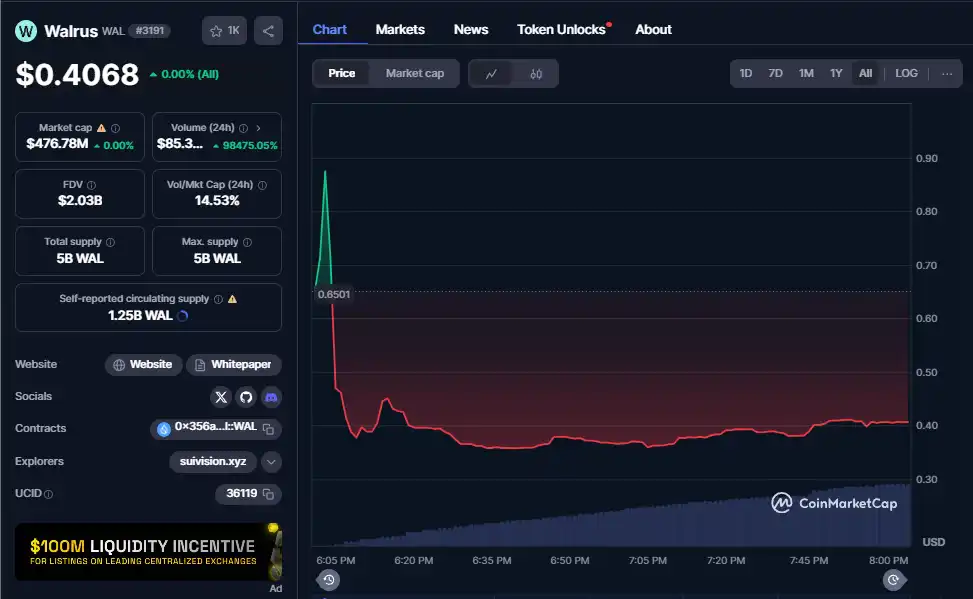
On its first day of listing, WAL briefly surged to $0.87 before falling back to $0.39, showcasing the market's keen interest. As an important part of the Sui ecosystem, Walrus has not only injected new vitality into the decentralized storage field but has also raised expectations for the future of the Sui ecosystem. So, what sets Walrus apart? How does it, with Sui's support, attempt to reshape the landscape of decentralized storage? Let's dive in.
Sui Ecosystem's Rising Star: Walrus Background and Potential
Walrus is developed by Mysten Labs, the creators of Sui. Most of the team members come from the blockchain project Diem, previously known as Meta, with unquestionable technical prowess. Sui is renowned for its efficient parallel processing capability and low-cost transactions, while Walrus is another masterpiece of the Sui ecosystem, focusing on solving the challenges of decentralized storage. The name "Walrus" symbolizes resilience and adaptability in the storage field. The official slogan "As reliable as a walrus, as adaptable as a walrus" conveys its core value: to provide efficient, reliable, and flexible storage solutions for Web3 applications.
While Walrus operates on the Sui blockchain, it is an independent protocol with its governance token, WAL. This independence allows Walrus to not only serve the Sui ecosystem but also provide storage support for other blockchain ecosystems, demonstrating broader potential. Sui's high-performance blockchain serves as the control plane for Walrus, responsible for storage node lifecycle management, data lifecycle management, and economic incentive coordination. This division of labor enables Walrus to focus on storage optimization without developing a separate blockchain protocol. More importantly, the combination of Sui and Walrus lays the groundwork for building Layer 2 (L2) solutions, leveraging Sui's high-performance computing power and Walrus's decentralized storage capabilities, theoretically possessing all the requirements to create L2. The future potential of more L2 chains within the Sui ecosystem is something to look forward to.
The Walrus has shown remarkable performance in the testnet phase. The data indicates that the testnet has attracted 14 million accounts, processed 5 million Blobs, totaling 27.85TB of active usage, with an average Blob size of 5.57MB. Blobs are large binary files stored in the Walrus protocol (such as images, AI datasets), sharded across decentralized nodes, and accessed and paid for using the Sui blockchain. This demonstrates that Walrus has the capability to handle high-frequency data requirements, whether it is storing massive AI training data or backing up blockchain transaction history. Walrus excels in these tasks, showcasing its strong potential in the Web3 storage arena.
Decentralized Storage Race: Why Walrus is Indispensable and Its Use Cases
Decentralized storage is a crucial part of Web3 infrastructure, but current solutions still have many shortcomings. Traditional cloud storage giants like AWS and Google Cloud, while dominating the trillion-dollar market, suffer from high costs, single points of failure, and concerns regarding data privacy and censorship. Decentralized storage protocols aim to address these issues, but existing solutions each have their limitations.
Filecoin ($FIL) with a market cap of $2 billion and $206 million in funding, focuses on static storage, ensuring data persistence but lacks the ability to make data "live," such as supporting real-time updates or dynamic interactions. Arweave ($AR) with a market cap of $4.9 billion and $23.57 million in funding, aims for permanent storage, making it challenging to modify data, hence not suitable for scenarios requiring frequent updates. Celestia ($TIA) with a market cap of $20.3 billion and $156.5 million in funding, primarily focuses on the Data Availability Layer (DA Layer), acting more like a data "transit station" than a complete storage solution.
The emergence of Walrus is precisely to fill these gaps. It can securely store data and give data "vitality" – through integration with smart contracts, data can be dynamically called, real-time updated, and even support version control. Leveraging the high-performance network of Sui, Walrus also excels in data retrieval speed and cost control. Importantly, Walrus's storage cost is only 1/5 of traditional cloud storage, simultaneously ensuring high data availability. This efficient, cost-effective feature sets Walrus apart in the Web3 storage field, poised to become a strong competitor challenging traditional cloud storage giants.
Walrus was designed to provide a solution for storing large binary files (Blobs), which are the lifeblood of many decentralized applications. It can offer decentralized storage for NFTs, ensuring metadata integrity and availability, mitigating the risk of centralized server downtime or tampering; in the AI field, Walrus can support model training by ensuring data set integrity, dynamic updates, and version control; for DApps, Walrus can store and distribute frontend and client-side code, avoiding the single point of failure in traditional web hosting;
In addition, Walrus can also provide a Data Availability Layer (DA Layer) for Rollup, reducing storage costs while ensuring data recoverability. In decentralized social and collaborative platforms, Walrus supports storing rich media content such as images and videos, providing efficient solutions for these platforms. These use cases demonstrate Walrus's wide applicability in the Web3 domain.
Walrus Technical Architecture: How to Achieve Efficient Storage?
Walrus's technical architecture can be described as "smart yet simple." Its core lies in a novel encoding scheme called RedStuff, along with deep collaboration with the Sui blockchain. Below, we will explain Walrus's technical implementation in plain language.
1. "Slice Magic" for Data Storage: RedStuff Encoding
Imagine you have a large image (such as a 1GB video file) that you want to store on a group of friends' computers, but you don't want each friend to keep a full copy of the file as it would take up too much space. Walrus's RedStuff encoding is like a "slice magician" that slices this image into many small pieces (called "slices") and then "shuffles" these pieces in a special way to distribute them among different friends.
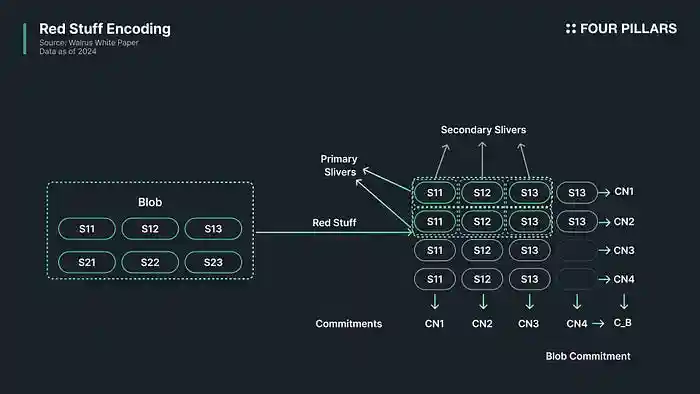
What sets RedStuff apart is its "two-dimensional slicing" approach. In simple terms, it first divides the image into "main slices" and "sub-slices," similar to cutting the image along rows and columns. The main slices handle storage and retrieval, while the sub-slices handle backup and recovery. The benefit of this two-dimensional design is that even if a friend's computer fails (node goes offline), you only need to retrieve a small portion of the slices from other friends to reconstruct the full image, without having to redownload the entire file. This approach significantly reduces both storage and recovery costs—Walrus's replication factor (data backup multiplier) is kept between 4 to 5 times, much lower than the traditional approach's 25 times.
2. Efficient Computation: Using "Addition and Subtraction" Instead of Complex Calculations
Traditional decentralized storage solutions, such as Storj and Sia, often use Reed-Solomon (RS) encoding. While this encoding can save space, it requires complex mathematical operations (such as polynomial calculations), akin to solving a grade school math problem using advanced math, time-consuming and labor-intensive.
Walrus's RedStuff encoding is more down-to-earth, primarily using a simple operation called XOR (equivalent to "addition and subtraction") to perform data encoding and decoding. This method is like solving problems with logic such as 1+1=2, fast and efficient. It is precisely because of this simple and efficient operation that Walrus can handle larger files, involve more storage nodes, and truly achieve decentralized scalability.
3. Proof of Storage: From "Proof-of-Individual-Check" to "Proof-of-Bulk-Check"
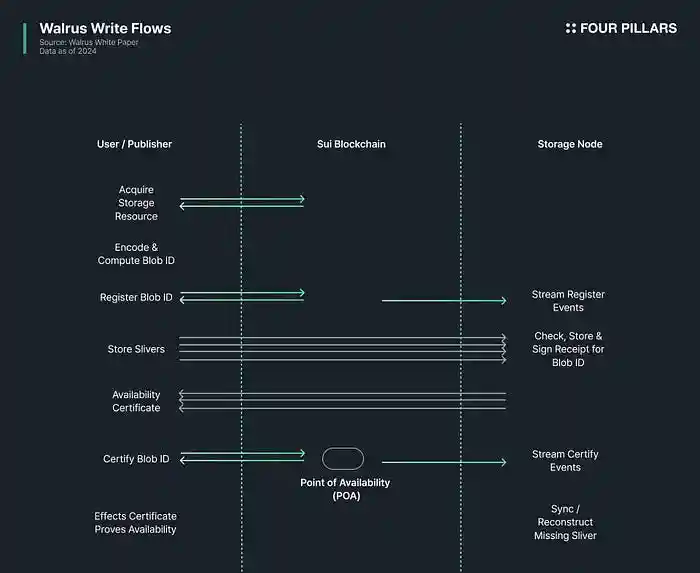
In decentralized storage, there is a challenge: How can you ensure that your friend (storage node) is indeed helping you store files and not secretly deleting them? Traditional solutions would individually check each file, similar to a teacher checking each student's homework one by one, which is time-consuming and laborious. Walrus, however, is smarter; it has designed a "Proof-of-Bulk-Check" mechanism—by challenging the storage nodes as a whole instead of checking each file individually to confirm if the data is still there. This approach reduces the verification cost from "linear growth" (more files, more effort) to "logarithmic growth" (even more files, still easy), significantly improving the system's efficiency.
4. Collaboration with Sui: Clear Division of Labor, Doubled Efficiency
Walrus's technical architecture also relies on Sui's support. Sui acts as a "commander," responsible for coordinating and managing all storage nodes, such as deciding who stores which slices, how to allocate rewards, etc. Meanwhile, Walrus focuses on the actual work of data slicing, storage, and recovery. Sui's high-performance blockchain can rapidly handle these coordination tasks, ensuring the smooth operation of the entire system. This division of labor allows Walrus to concentrate on optimizing storage functions, doubling efficiency.
Tokenomics: WAL Distribution and Use Cases
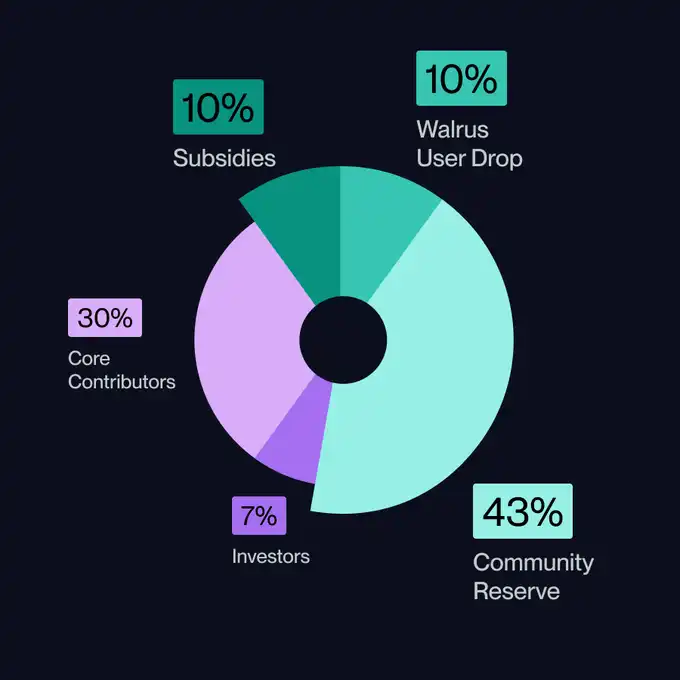
Walrus's tokenomics are designed to incentivize community participation and ecosystem development. The distribution of the WAL token is as follows: over 60% allocated to the community, with 10% for user airdrops (distributed to early adopters and reserved for future distribution), 43% for community reserves (used to fund developers, incentive programs, etc.), and 10% for storage subsidies (supporting storage nodes); 30% allocated to core contributors as rewards for early developers; 7% allocated to investors. This community-oriented distribution model ensures the long-term sustainable development of the ecosystem.
The WAL token plays multiple roles in the Walrus ecosystem. Firstly, it is the primary tool for paying storage fees, as users need to use WAL to pay for storing and retrieving data; secondly, WAL is used to incentivize storage nodes, as nodes earn WAL rewards by storing data and responding to read requests; additionally, WAL is also a governance token, allowing holders to participate in adjusting protocol parameters, such as determining the pricing model for storage fees or reward mechanisms. Through these use cases, WAL not only drives the operation of the Walrus ecosystem but also empowers the community with greater participation rights.
Epilogue: Can Walrus Become the Leader in Web3 Storage?
From technological innovation to ecosystem empowerment, Walrus is undoubtedly a rising star in the Sui ecosystem. Through RedStuff encoding and programmability, it has addressed the pain points of decentralized storage, opening up new possibilities for Web3 applications. The testnet data and the performance on its listing day further prove its potential. However, the decentralized storage race is intense, with established players like Filecoin and Arweave still holding significant positions.
Walrus needs to continue to focus on technological implementation, ecosystem expansion, and community development to stand out in the Web3 storage field. By 2025, can Walrus become the leader in decentralized storage? Let's wait and see!
You may also like
Looking at Stripe's ambitions and the future of stablecoins from OUSD
Do you want to buy CRCL?
Wosh: Inflation has cooled in recent weeks, AI is reshaping the economy, and forward guidance has lost its necessity
The most secretive AI winner
Former ByteDance employee's account: How I started with two Pinduoduo hard drives and made six times the profit with Seagate to achieve financial freedom?
MiCA reshuffle begins, Binance temporarily bids farewell to the EU
How does Gate redo "buying and selling stocks" from the cryptocurrency world to the stock market?
Visa and Mastercard join 140 giants to launch a new stablecoin, but the impact on the market landscape may still be limited
Circle CEO responds to OUSD's challenge: Stablecoins are a winner-takes-all business, and we will not slow down
Argentina vs Cape Verde: When a Record-Breaking Legend Meets an Unbreakable Underdog
WEEX exclusive pre-match analysis of Argentina vs Cape Verde, exploring Messi-led Argentina’s dominance and Cape Verde’s historic defensive breakout, with a breakdown of volatility, structure, and match dynamics.
WEEX Launches Depth Chart for Spot Trading
Raising interest rates to protect STRC and selling coins to maintain credit, this time the strategy has chosen the two most expensive paths
Morning Report | Samsung announces a 265.5 trillion won investment plan, focusing on semiconductor and AI computing power data centers; Vitalik publishes an article detailing the entire technology tree behind the confusion protocol (iO) mainline
In the era of AI, what is left of Bitcoin?
NeoSoul announced plans to integrate with the OKX Agentic Wallet, promoting AI agents' participation in the on-chain economy
Why Is Bitcoin Lagging Stocks in 2026? AI Stocks, ETF Outflows, and the Nasdaq Rally Explained
What you bought on CEX is really not US stocks: Analyzing the 94% liquidation monopoly and the evaporation of equity under a five-layer pipeline
In such a crowded cross-border payment arena, where is the next stop for the future?
Looking at Stripe's ambitions and the future of stablecoins from OUSD
Do you want to buy CRCL?
Wosh: Inflation has cooled in recent weeks, AI is reshaping the economy, and forward guidance has lost its necessity
The most secretive AI winner
Former ByteDance employee's account: How I started with two Pinduoduo hard drives and made six times the profit with Seagate to achieve financial freedom?
MiCA reshuffle begins, Binance temporarily bids farewell to the EU