
The 2000% Surge of RFC Token: The Crypto Capital Game Amid Whale Manipulation and Musk Narrative


Original Article Title: "Behind the 2000% Surge of RFC Token: Whale Manipulators and the Crypto Capital Game Amid the Musk Narrative"
Original Article Author: Alvis, Mars Finance
1. Phenomenal Surge: From Edge Meme to Hundredfold Myth
On the night of April 13, 2025, a Solana on-chain monitoring alert suddenly sounded—an Meme token named RFC (Retard Finder Coin) saw its price skyrocket by 200% in just 15 minutes, surpassing a $1 billion market cap, with the price spiking to a peak of $0.199. The climax of this frenzy was ignited by a massive $1.2 million buy order. While the market was still speculating whether this was a collective frenzy of retail investors, on-chain data revealed a more intricate capital game: at least 3 clusters of associated addresses, 5 liquidity providers, and a sophisticated network of $180 million in liquidity were weaving a web of this "community frenzy" towards an unpredictable abyss.
1.1 Capital Riot: Achieving Hundredfold Leap in Two Weeks
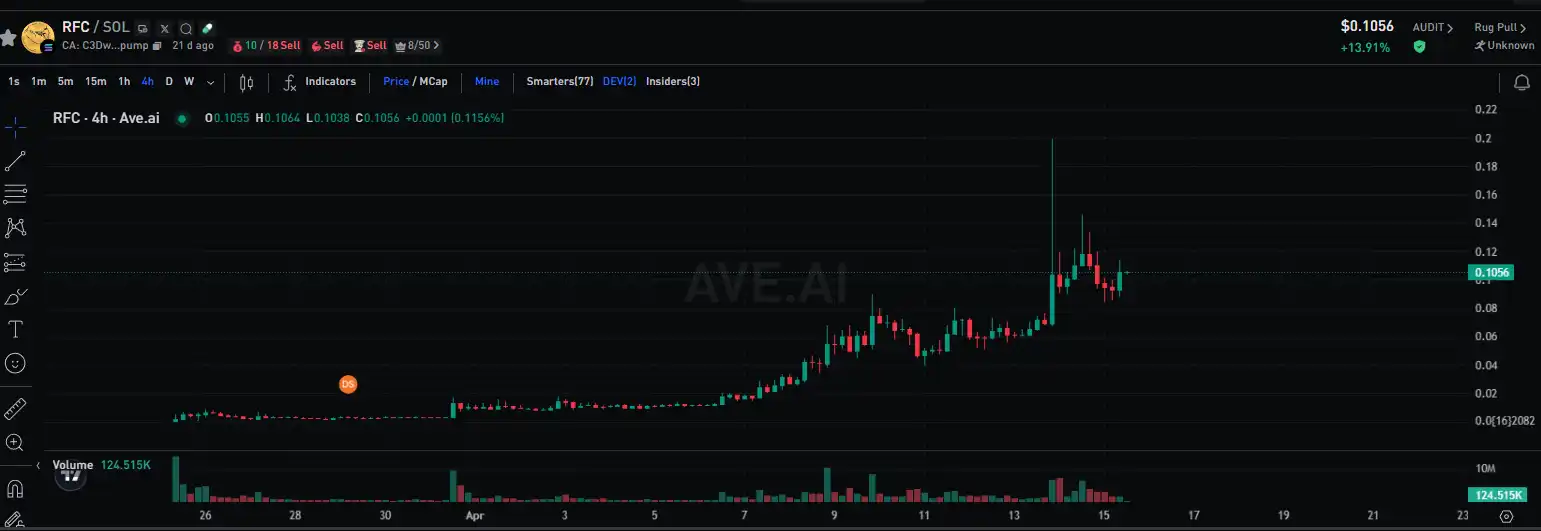
Since Elon Musk's first endorsement of the "Retard Finder" social account on March 29, RFC entered a frenzied uptrend. From $0.003 on April 1 to a historic high of $0.2 on April 13, its price curve exhibited a typical "step-wise accumulation" pattern: with massive buy orders stacking up at each integer threshold breakthrough, the pullback remained consistently within 15%. This abnormal stability is extremely rare in the world of meme coins known for their high volatility.
1.2 Whale Appearance: The Mystery of $1.2 Billion Liquidity
In the early hours of April 14, on-chain detective @CaNoe disclosed crucial evidence: a whale address starting with 0x3d... made four transactions to buy $1.2 million worth of RFC, driving the market cap beyond $1 billion.
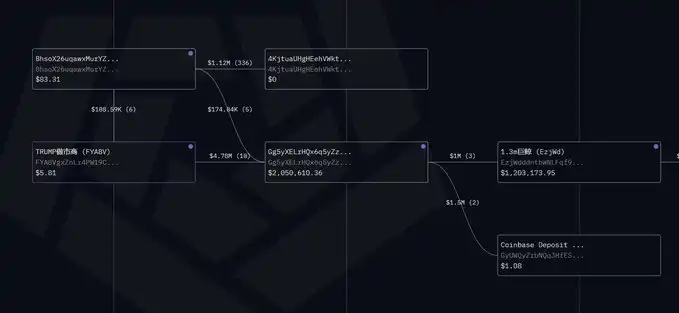
However, this was just the tip of the iceberg—the address, in a span of 3 days, orchestrated fund split among 14 associated wallets, with an actual buying scale of over $8 million, comprising 23% of the total trading volume.
What was even more shocking was the fund circulation path:
1. Upstream Liquidity Pool: $100 million USDC originated from a certain TRUMP liquidity provider address, routed through Gg5yX...
2. Relay Network: Address group 8hsoX... completed 10 cross-chain transfers, involving the ETH, SOL, and BASE blockchains
3. Terminal Operation: Ultimately, 5 newly created addresses on the SOL chain completed an RFC cleanout
This three-step fund flow reveals the adept skill of the operator in evading regulation. As crypto analyst Yu Jin said, "This is not a spur-of-the-moment speculation, but a capital layout planned for months."
II. Dissecting the Whale: Capital Landscape of Cross-Ecosystem Operators
2.1 TRUMP Market Maker's Reinforced Stand

By tracing the historical behavior of the 0x3d address, we found a deep connection between it and the 2024 election concept coin TRUMP.
This address has only interacted with three coins, namely $TRUMP, $VIRTUAL, $LIBRA, with a particular emphasis on $TRUMP, engaging in nearly 50 frequent interactions, with a total buy of $7.3m and a total sell of $11.2m. This interaction pattern can be essentially confirmed as an address of a market maker.
It has also been active in $LIBRA and $VIRTUAL, both of which are acknowledged as super-strong coin projects, not to mention that $LIBRA was deeply involved in the manipulation scandal behind the foundation (although not many people mention it now).
This typical market maker behavior pattern was perfectly replicated in the RFC campaign. It is worth noting that this address group suddenly liquidated all TRUMP holdings on March 15, coinciding perfectly with the start of the RFC surge.
2.2 Surging Undercurrents of the Associated Network
Delving further into the fund flow, we mapped out a larger network of associations:
(Data Source: GMGN On-Chain Analytics Platform)
These projects collectively outline the strategy preference of the operator: choosing tokens with strong narratives, low circulation, and celebrity endorsements, creating a liquidity illusion through high-frequency trading. And RFC meets all the conditions—Elon Musk interaction, Solana ecosystem support, fixed supply, and other features—making it an ideal manipulation target.
3. Musk Effect: The Fatal Temptation of Decentralized Narrative
3.1 From Twitter Interaction to Code Revelation
The eruption of RFC was by no means coincidental. On March 7, when Musk replied to a "Retard Finder" account on Twitter regarding the need for "more rebellious spirit in cryptocurrency," keen capital had already sniffed out the opportunity. On-chain data shows:
· March 8-10: 6 new addresses aggressively bought $800,000 worth of RFC
· March 15: Project's official website updated the codebase, revealing the "XCorp" key (a company under Musk)
· April 1: Eric Trump retweeted RFC-related tweets, triggering enthusiasm in the right-wing community
This "celebrity interaction - code hint - community dissemination" three-step marketing hit the narrative-thirsty crypto market precisely. Even though Musk never publicly admitted any relationship with RFC, enough "coincidences" have driven speculators into collective frenzy.
3.2 The Sword of Damocles of Chip Concentration
M7 Research's on-chain report reveals an even more dangerous reality: the top 500 addresses control 36.46% of RFC's token supply, with the Green Cluster single address group accounting for 29.61%.
This concentration even exceeds SHIB in 2021 (where the top 10 addresses held 27%), giving whales absolute market control.
We simulated price impacts under different sell-off scenarios:
(data model based on historical Meme coin liquidity data)
This means that out of the current $120 million daily trading volume, at least $40 million belongs to "fake liquidity" — once a whale initiates a sell-off, price collapse could be calculated in hours.
4. Eco Resonance: Solana's Wealth Generation Engine and Risk Incubator
4.1 The Foundation's Mysterious Mover
The deep involvement of the Solana ecosystem injected additional momentum into RFC's surge. On-chain data shows:
· March 25: SOL Foundation address transferred 5000 SOL to RFC development team
· April 5th: A RFC/SOL Liquidity Pool appeared on the Serum DEX, with an initial $2 million USD valuation
· April 12th: A Solana Ventures affiliated address participated in RFC community governance proposal 7
This intertwined support has elevated RFC beyond the realm of a typical meme coin, transforming it into a "reference project" showcasing the capabilities of the Solana ecosystem. However, the question remains—when the interests of the project team and ecosystem builders are deeply intertwined, has the so-called "decentralization" devolved into a mere marketing slogan?
4.2 Liquidity Siphon Effect
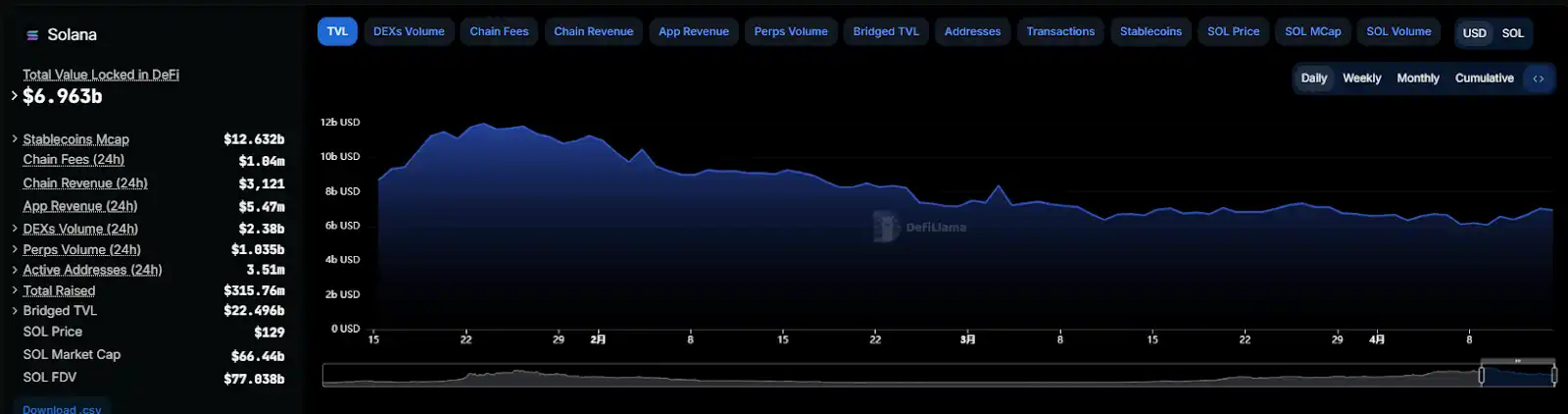
Since April, SOL's on-chain TVL has grown by 16%, with 63% of it coming from meme coin-related protocols. The Sol token price has surged from a bottom of $95 to its current $130, marking a 35% increase. RFC's rise comes at a crucial time for Solana ecosystem recovery.
Future Speculation: Direction of the Capital Game
Based on historical data modeling, we anticipate that RFC may face two possible paths:
· Optimistic Scenario: Liquidity providers continue to maintain the price fluctuating between $0.08-$0.12, hedge profits through the derivatives market, extending the lifecycle to 6-8 weeks
· Pessimistic Scenario: A new hotspot emerges in the Solana ecosystem, causing liquidity migration, whales initiate distribution above $0.15, triggering a over 60% retracement
The current market may lean towards the second possibility—April 14th witnessed OM Coin's flash crash (a 90% single-day drop), sparking a chain reaction of panic, rapidly contracting investors' risk appetite.
You may also like

Semiconductor stocks plummet, yet Anthropic wants to create a 2nm chip
Where is Zhao Changpeng's billion-dollar investment going? YZi Labs' investment landscape fully revealed
Ethereum Foundation Report: A Basic Guide to Ethereum for Governments and Financial Institutions
A pre-announced harvesting case: After the cryptocurrency price dropped by 99%, the public chain Saga exited to transform into AI
When American giants collectively "defect" from Chinese AI models
BIS Report Compliance Observation: The Real Risks of Stablecoins, Not Just "Depegging"
Portugal 2-1 Croatia: Ronaldo's 20-Year Knockout-Stage Drought Ends With a Debt Finally Collected
Portugal beat Croatia 2-1 in the 2026 global football championship's knockout rounds as Ronaldo scored his first-ever knockout-stage goal, Gonçalo Ramos struck a stoppage-time winner, and VAR ruled out a late equalizer for offside.
Bitcoin Price Prediction July 2026: Will BTC Recover to $70K or Drop Below $55K?
A South Korean company that learned the strategy of hoarding coins, from a bull market to delisting?
WEEX API Broker Program: Turn Your Trading Platform Into a Revenue Engine
How to choose between buying discounted ETH, Bitmine, and SharpLink?
Wosh: Inflation has cooled in recent weeks, AI is reshaping the economy, and forward guidance has lost its necessity
From Pump.fun to Collector Crypt: Has Solana's income throne changed hands?
Dan Bin's latest speech: Don't miss out on a great era
Robinhood launches its own blockchain, no longer wanting to be a tenant on others' chains
Why Tokenized Stocks Are Booming in 2026 While Crypto Is Still Struggling
Looking at Stripe's ambitions and the future of stablecoins from OUSD
Do you want to buy CRCL?
Semiconductor stocks plummet, yet Anthropic wants to create a 2nm chip
Where is Zhao Changpeng's billion-dollar investment going? YZi Labs' investment landscape fully revealed
Ethereum Foundation Report: A Basic Guide to Ethereum for Governments and Financial Institutions
A pre-announced harvesting case: After the cryptocurrency price dropped by 99%, the public chain Saga exited to transform into AI
When American giants collectively "defect" from Chinese AI models
BIS Report Compliance Observation: The Real Risks of Stablecoins, Not Just "Depegging"