The Next Catalyst for Crypto AI? Exploring the "New Darling of the AI World" MCP Protocol


Original Article Title: Model Context Protocol (MCP): The Next Crypto AI Catalyst
Original Article Author: @S4mmyEth, AI Agent Analyst
Original Article Translation: zhouzhou, BlockBeats
Editor's Note: This article introduces the Model Context Protocol (MCP), a standardized framework designed to connect AI agents with external data sources, enabling the autonomy and intelligence of AI systems. MCP addresses the bottleneck of AI systems interacting with the real world, allowing for automated operations in fields such as DeFi. The article discusses the importance of MCP to the crypto and AI ecosystem, and how it drives the development of agent-based AI, despite facing challenges such as widespread adoption and interoperability.
The following is the original content (reformatted for ease of understanding):
If you are like me, you may have been wondering: "What on earth is MCP?!" ... Why are so many people discussing it? Currently, there is little information about MCP, which is not surprising—it has only been around for four months. So I decided to dig into it and compile my findings.
In short: This could be a significant breakthrough for cryptocurrency and open-source AI, worthy of your attention. It may drive a new wave of AI agent-centric cryptographic product development.
Table of Contents
· Introduction
· What is the Model Context Protocol (MCP)?
· How does MCP empower AI agents?
· The Future of the Agent Era: The Importance of MCP
· Other Projects Similar to MCP
· Key Differences from Traditional AI Integration Methods
· Conclusion
Introduction
As AI agents become increasingly autonomous and deeply integrated into real-world applications, the Model Context Protocol (MCP) is fundamentally changing how they interact with external data and tools. Introduced by Anthropic in late 2024, MCP aims to be a standardized framework that allows AI agents to seamlessly connect to various data sources for more efficient interactions.
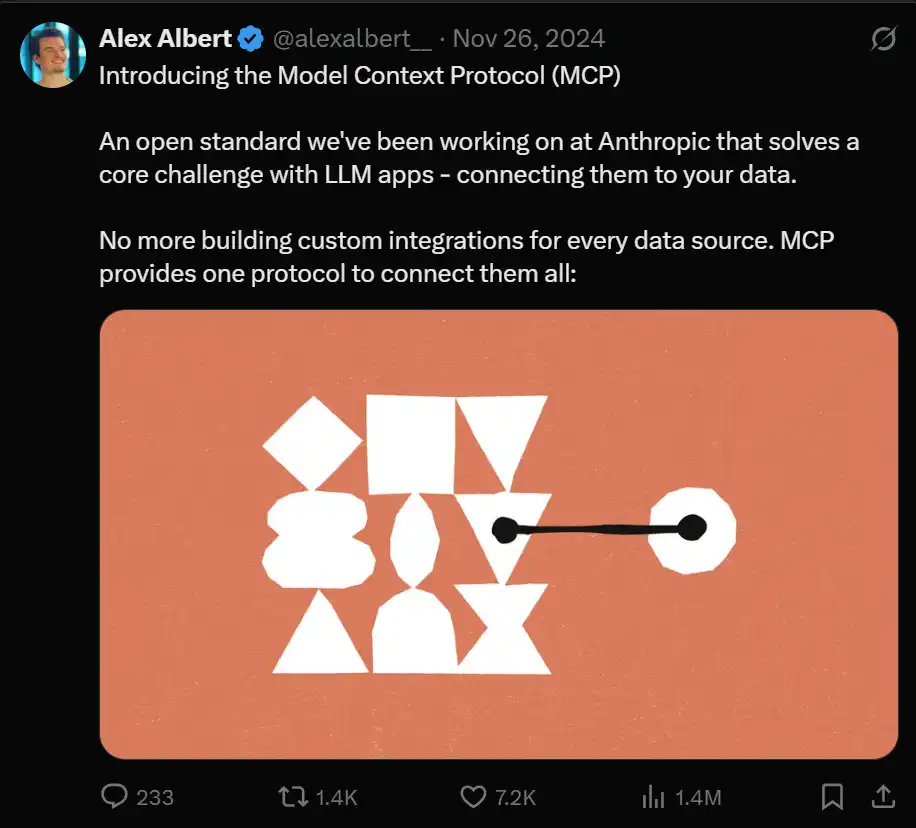
But since @anthropicai introduced this communication standard, more and more AI solutions have started to adopt it as the default way. Simply put, it is the "way AI interacts in real time with software".

With the advent of the Agent Epoch — a future where an AI system can autonomously perform complex tasks, will MCP be the key to driving the next wave of AI innovation? Perhaps it can even ignite a new bull run in the Crypto x AI race?
From chatbots to automation systems driving various industries, AI agents increasingly need to make real-time decisions and access the latest information from multiple data sources. However, a core bottleneck has always existed: AI models lack a standardized way to connect to external systems such as databases, file repositories, or enterprise tools. This is where MCP comes into play.
Introducing the Model Context Protocol (MCP)
MCP is an open standard designed to bridge this gap, enabling AI agents to dynamically access and interact with external data sources. It empowers large language models with agent capabilities, allowing them to execute smart contracts and participate in DeFi operations — a significant breakthrough indeed! If you are part of the crypto community, you should resonate with this — ChatGPT struggles to provide real-time insights and analysis in the crypto market, with even missing accurate spot prices of some top 100 cryptocurrencies.
Meanwhile, MCP can enhance AI's ability to empower DeFi, for example: "Find the highest USDC APY and allocate $1,000," automatically adjusting the investment portfolio based on market fluctuations.
This indicates that AI agents are moving towards a more autonomous and efficient future, a change distinct from traditional AI systems, aligning better with the permissionless nature of the crypto ecosystem.
What is the Model Context Protocol (MCP)?
The Model Context Protocol (MCP), introduced by Anthropic in late 2024, is an open-source standard aimed at connecting AI assistants, especially AI agents powered by large language models, enabling them to access and leverage real-time data.
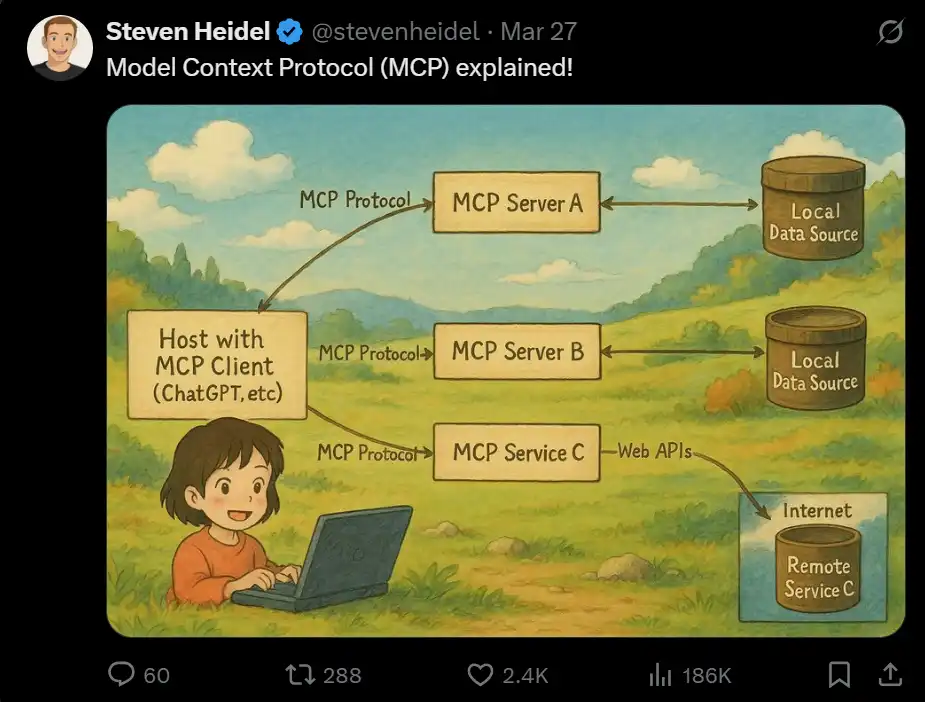
MCP can be seen as a universal adapter that allows AI agents to securely and standardly access:
Content repositories, enterprise tools, development environments, and more!
Why is this important?
Traditional AI integration often relies on scattered, customized solutions, while MCP provides a unified framework that supports bidirectional communication. This means that AI agents can not only retrieve information from external data sources but also push updates or operations back to the system, enabling a more dynamic and autonomous behavior.
Imagine your AI agent being able to automatically update enterprise systems or even autonomously manage your personal affairs! Anthropic's introduction of MCP aims to simplify AI integration, making it easier for developers to build autonomously operating AI workflows, allowing AI agents to perform tasks independently and intelligently.
How Does MCP Empower AI Agents?
MCP serves as the integration layer, allowing AI agents to connect to external services on-demand. Here are its core mechanics:
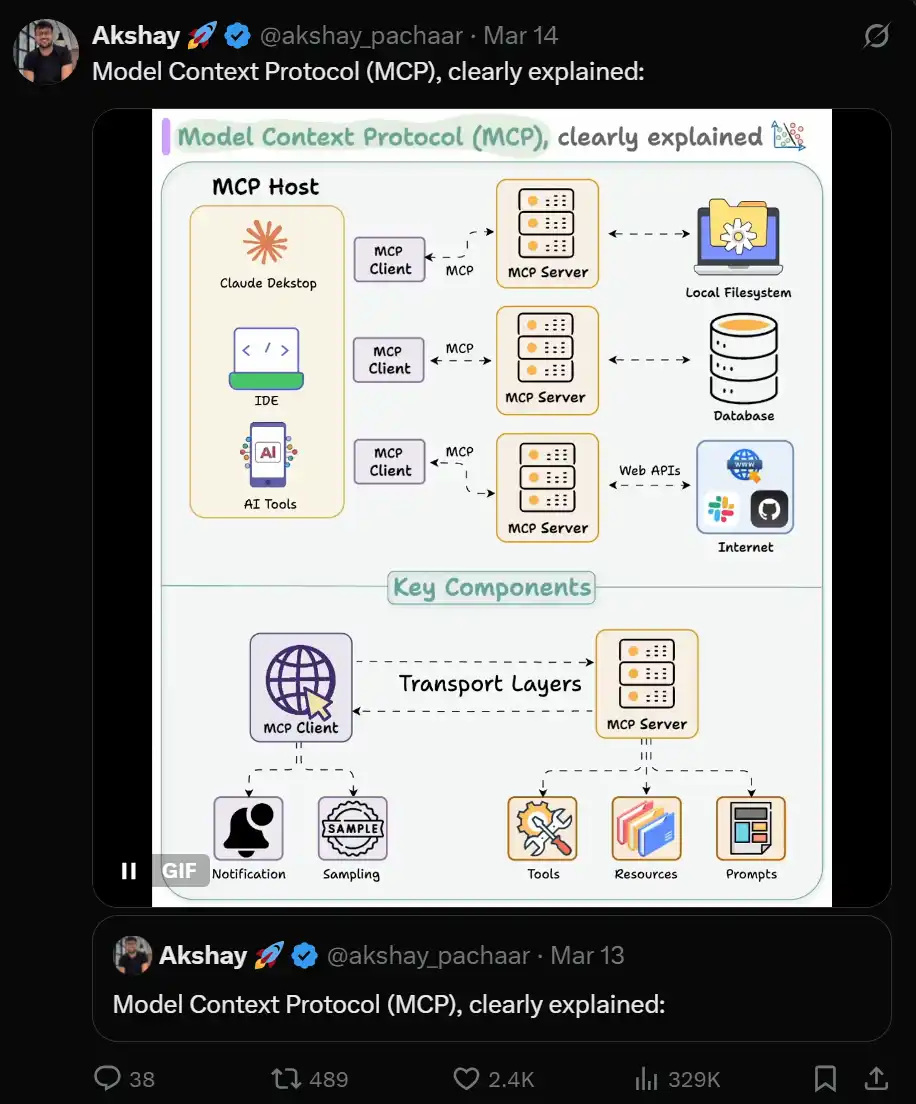
Dynamic Data Access
Unlike traditional AI that relies solely on pre-trained data, AI agents using MCP can access real-time or on-demand contextually relevant data, such as relational databases, file systems, and code repositories.
In other words, even the prices of those obscure cryptocurrencies can be fetched in real-time! Even @0rxbt is using MCP to optimize our favorite Purple Frog, a.k.a. SkyNet, alias @aixbt_agent!

Bidirectional Communication
MCP supports bidirectional interaction, meaning that AI agents can not only retrieve data but also take actions based on analysis, such as updating databases or triggering workflows.
Standardized Framework
MCP provides a generic protocol, eliminating the need for customized integration, reducing development complexity, and ensuring application consistency. Perhaps this is the answer to addressing multi-chain fragmentation and compatibility with different programming languages? Maybe in the future, AI agents will become the aggregation layer of Web3?!
Heading Towards the Era of AI Agents: Why Is MCP Important?
AI agents are no longer just passive responsive systems but are becoming more proactive, goal-oriented, and can even make autonomous decisions. However, to make AI agents truly useful, they must overcome the limitations of training data and interact seamlessly with the real world. This is where MCP comes into play.
Real-World Use Cases of MCP (from Anthropic Documentation)
Imagine an AI agent is tasked with managing the software development process.
With MCP, it can:
· Pull the latest code
· Analyze code errors
· Push reports to the team's project management tool — all in real time!
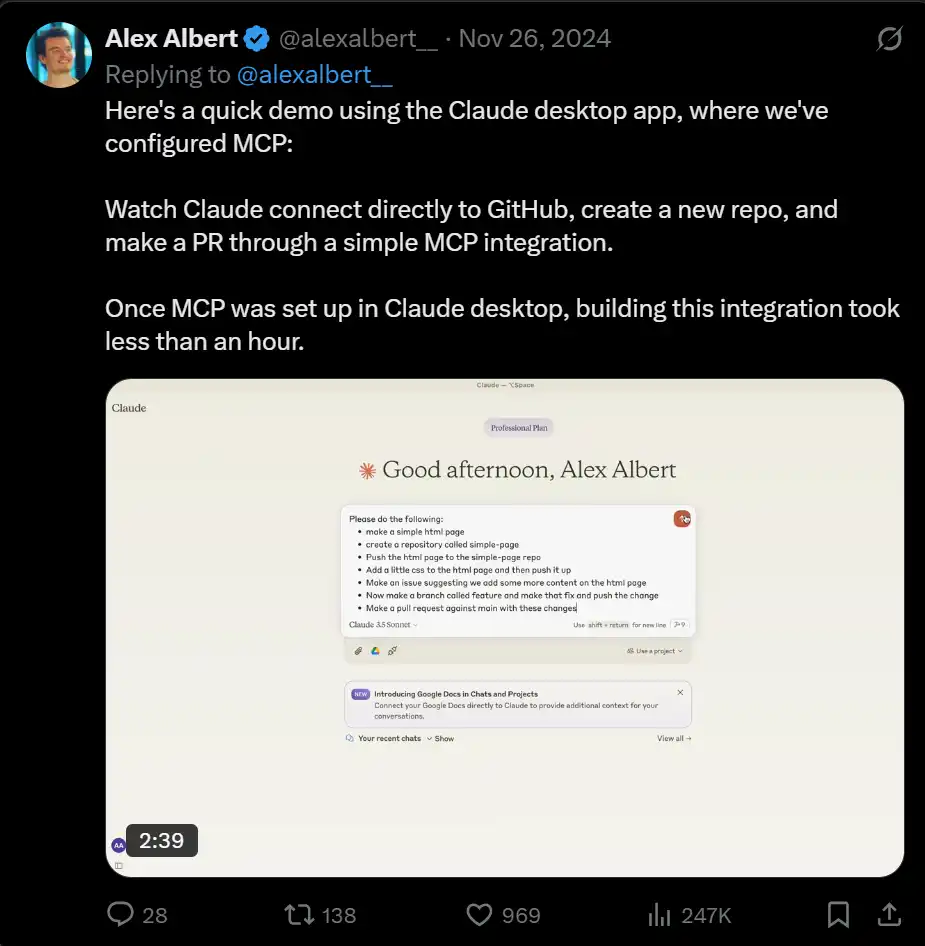
In the example below (thanks to @alexalbert__), you can see Anthropic's Claude directly connecting to GitHub, creating a new code repository, and using MCP to automate PRs (pull requests)!
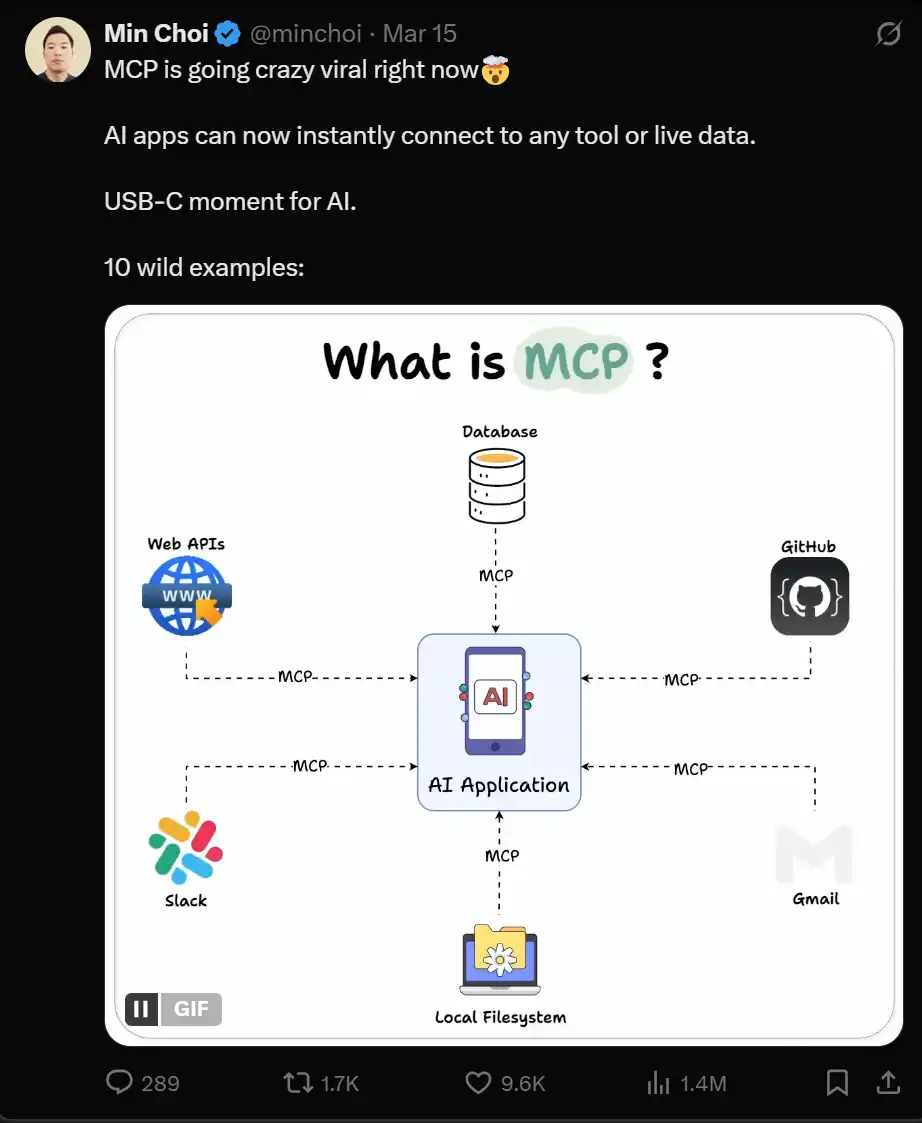
MCP enables AI agents to access real-time data, allowing them to adapt to a constantly changing environment, making them smarter and more efficient. The example below demonstrates how MCP integrates with systems like GitHub, Web APIs, Slack, email, and communicates in action!
MCP provides a viable solution for the concept of the "ultimate AI agent" proposed by @davidsacks:

Perhaps the true secret sauce is not the AI agent itself but the connection of agents to real-world infrastructures! With standardized protocols, developers can build AI agent workflows more quickly without reinventing the wheel for each new integration.
The essence of the agent era is to enable AI to act independently and tackle complex tasks. Whether it's automating business processes, managing the supply chain, or assisting in scientific research, MCP is becoming a key step in realizing this vision, providing AI agents with the infrastructure to interact with the real world!
Other Projects Similar to MCP
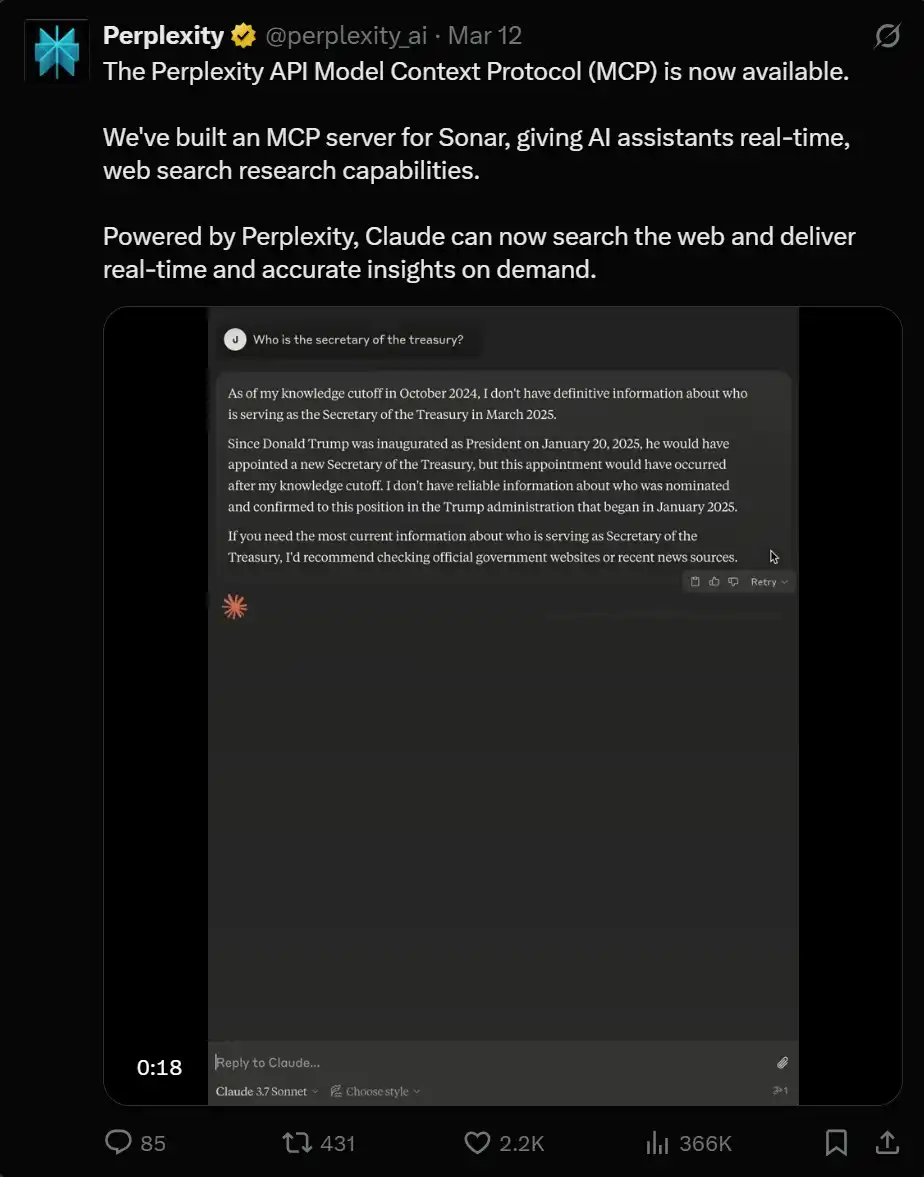
Anthropic is not the only player to recognize the importance of standardizing AI integration protocols. Recently, several well-known protocols and companies have introduced or supported frameworks similar to MCP to drive the development of the AI agent ecosystem:
Perplexity MCP
OpenAI Agents SDK MCP
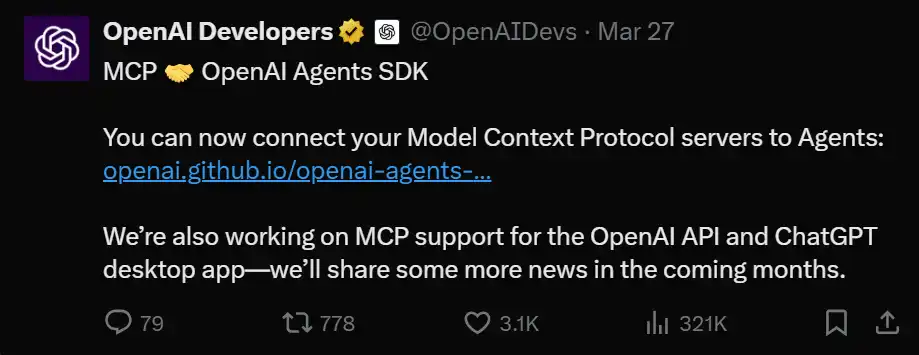
Recently (in fact, just yesterday), OpenAI released its proprietary MCP plugin, integrated into its Agents SDK:
Stripe MCP Integration:
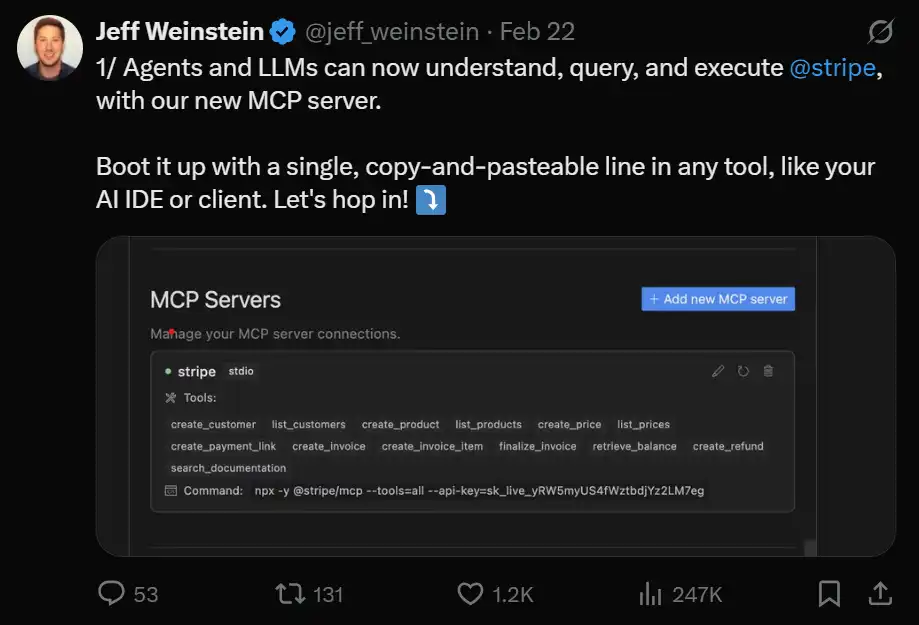
...and more MCP servers are in development, aimed at making communication between AIs even more seamless:
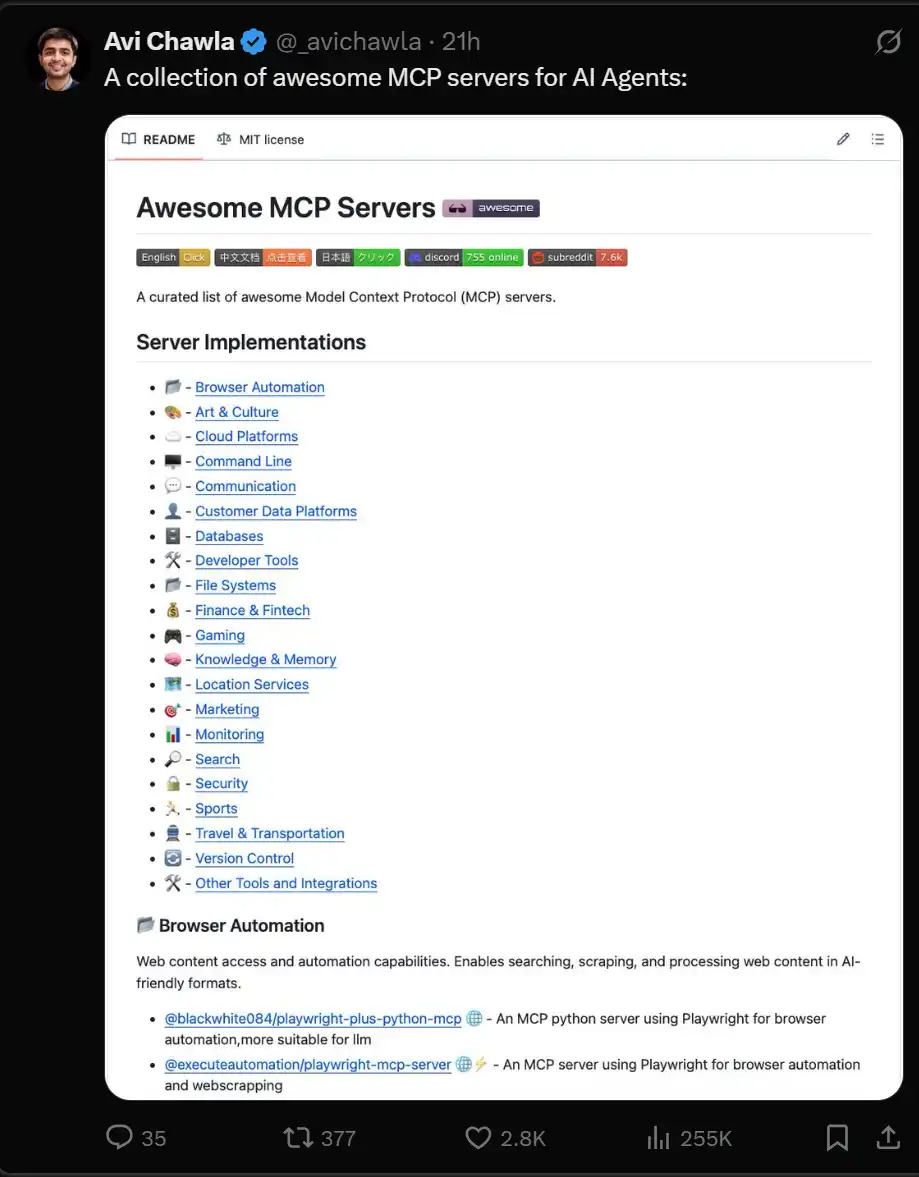
CEOs from outside Anthropic are also recognizing the importance of MCP in driving the future development of AI agents:
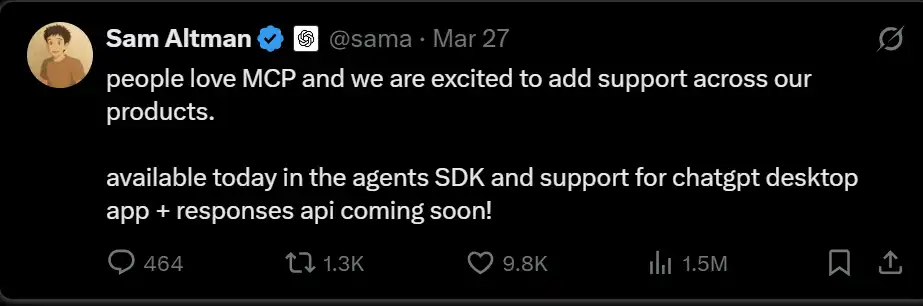
These initiatives highlight a growing trend: the recognition that agent AI requires a standardized, scalable data integration solution. While MCP remains a leader due to its open-source nature and wide applicability, the involvement of major players like xAI, Google, and Meta further underscores the importance of this field.
Key Differences in Integration with Traditional AI
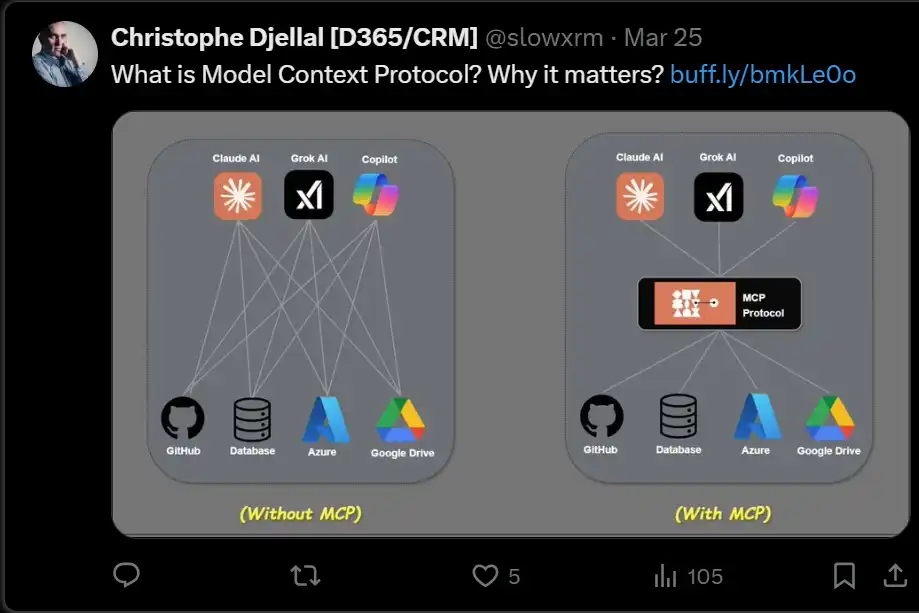
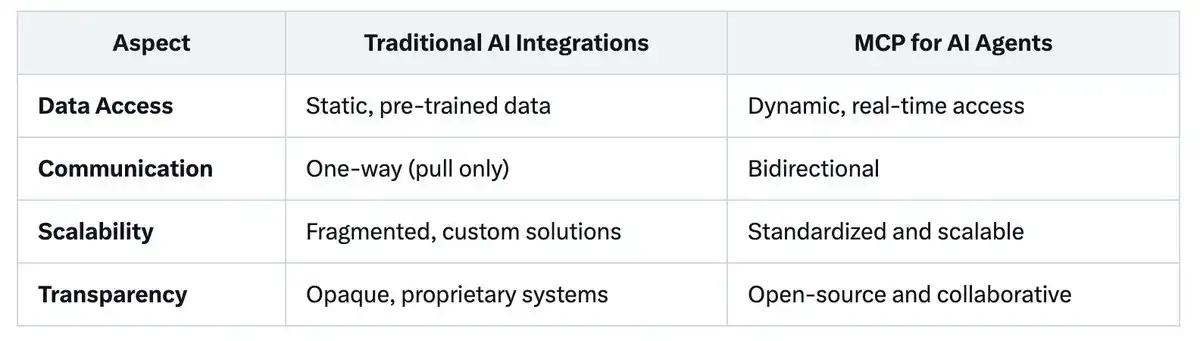
Why does MCP (and similar frameworks) stand out when compared to integration with traditional AI? Traditional integration typically involves custom APIs or middleware, leading to fragmented solutions that are difficult to scale. MCP, on the other hand, provides a common standard that reduces complexity and ensures consistency.
The following comparison graphic clearly illustrates the difference between the two:
Open Source Collaboration:
The open-source nature of MCP promotes collaboration across the industry, contrasting sharply with the isolated approach of centralized AI companies. This is a key value proposition in the crypto space.
Here is a concise comparison:
Here are some examples of high-level cryptographic applications:
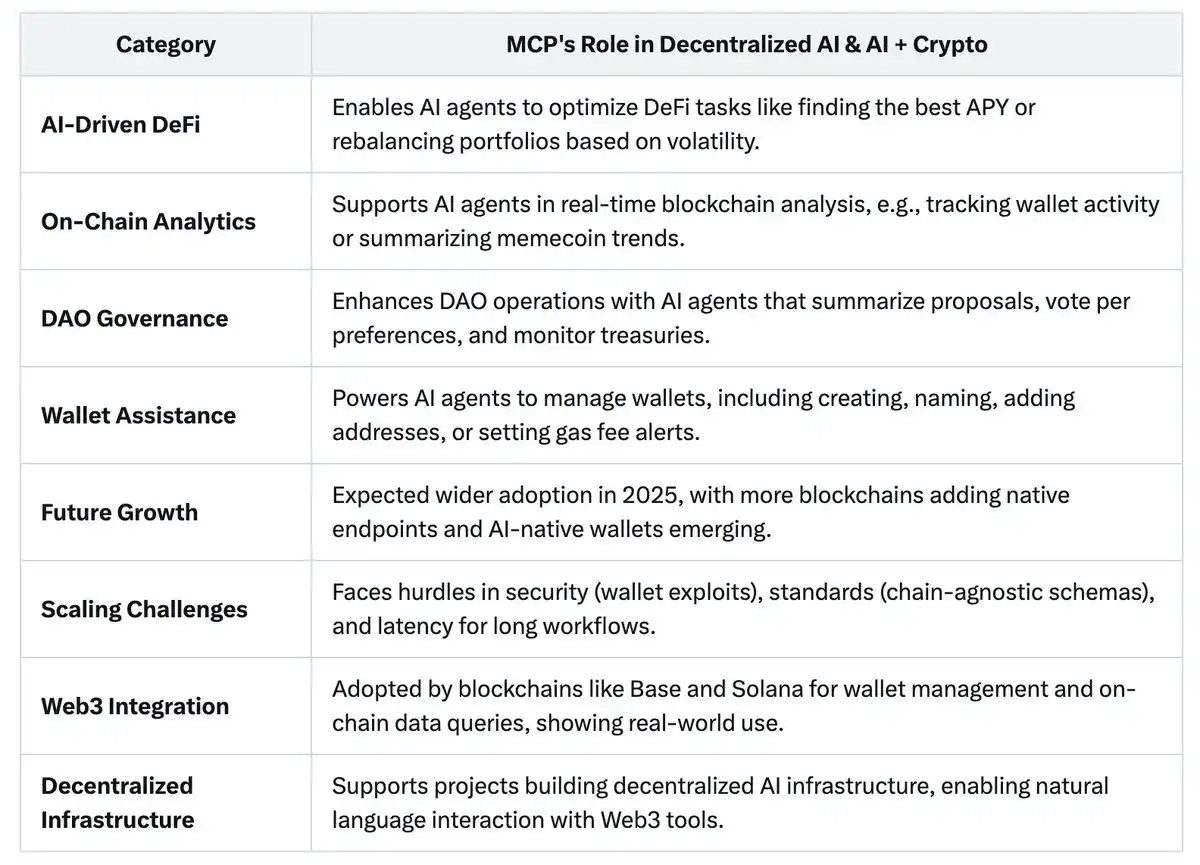
We are already seeing a push in DeFAI solutions, such as @danielesesta's @heyanonai, @LimitusIntel, or @gizatechxyz, and through custom tools like @aixbt_agent to address on-chain analytics issues. As MCP further integrates into the broader crypto and AI ecosystem, we expect to see more such innovations!
MCP represents a significant step towards an agent-based AI future, where autonomous systems can seamlessly interact with the world around them. By providing a standardized framework for AI agents to connect to external data sources, MCP addresses a key bottleneck in AI development, enabling more intelligent, adaptive, and scalable solutions.
The industry-wide embrace of MCP-like protocols signals a collective push towards the agent-based vision. However, challenges remain. The success of MCP and similar protocols will depend on widespread adoption, interoperability between protocols, and the ability to keep pace with the rapidly evolving field of AI.
As we move towards a future where AI agents play an increasingly prominent role in our lives, frameworks like MCP will serve as the bridge between AI and real-world applications. Whether MCP becomes a de facto standard or merely a catalyst for further innovation, it has sparked crucial discussions about the infrastructure needed for agent-based AI and cryptographic products.
You may also like

From Pump.fun to Collector Crypt: Has Solana's income throne changed hands?
Looking at Stripe's ambitions and the future of stablecoins from OUSD
Do you want to buy CRCL?
Wosh: Inflation has cooled in recent weeks, AI is reshaping the economy, and forward guidance has lost its necessity
The most secretive AI winner
Former ByteDance employee's account: How I started with two Pinduoduo hard drives and made six times the profit with Seagate to achieve financial freedom?
MiCA reshuffle begins, Binance temporarily bids farewell to the EU
How does Gate redo "buying and selling stocks" from the cryptocurrency world to the stock market?
Visa and Mastercard join 140 giants to launch a new stablecoin, but the impact on the market landscape may still be limited
Circle CEO responds to OUSD's challenge: Stablecoins are a winner-takes-all business, and we will not slow down
Argentina vs Cape Verde: When a Record-Breaking Legend Meets an Unbreakable Underdog
WEEX exclusive pre-match analysis of Argentina vs Cape Verde, exploring Messi-led Argentina’s dominance and Cape Verde’s historic defensive breakout, with a breakdown of volatility, structure, and match dynamics.
WEEX Launches Depth Chart for Spot Trading
Raising interest rates to protect STRC and selling coins to maintain credit, this time the strategy has chosen the two most expensive paths
Morning Report | Samsung announces a 265.5 trillion won investment plan, focusing on semiconductor and AI computing power data centers; Vitalik publishes an article detailing the entire technology tree behind the confusion protocol (iO) mainline
In the era of AI, what is left of Bitcoin?
NeoSoul announced plans to integrate with the OKX Agentic Wallet, promoting AI agents' participation in the on-chain economy
Why Is Bitcoin Lagging Stocks in 2026? AI Stocks, ETF Outflows, and the Nasdaq Rally Explained
What you bought on CEX is really not US stocks: Analyzing the 94% liquidation monopoly and the evaporation of equity under a five-layer pipeline
From Pump.fun to Collector Crypt: Has Solana's income throne changed hands?
Looking at Stripe's ambitions and the future of stablecoins from OUSD
Do you want to buy CRCL?
Wosh: Inflation has cooled in recent weeks, AI is reshaping the economy, and forward guidance has lost its necessity
The most secretive AI winner
Former ByteDance employee's account: How I started with two Pinduoduo hard drives and made six times the profit with Seagate to achieve financial freedom?