
- Buy Crypto
- Markets
 Futures
- Spot
- Copy Trade
- Earn
- More
There's a kind of "turnover" called getting Arthur Hayes to call you a cab

Original Article Title: "Arthur Hayes's 2025 Trading Ledger: Dreaming with Left Hand, On-Chain Liquidation with Right Hand"
Original Article Author: angelilu, Foresight News
Looking back at the year 2025, Arthur Hayes was still the beloved and hated big winner.
As the founder of BitMEX and the crypto industry's most skilled "tweetstorm" writer, he was able to rally retail traders' trading enthusiasm with every "call." However, looking back at the year 2025, you would suddenly realize that if you boarded the train at each of his calls, the result was that he made money while you lost.
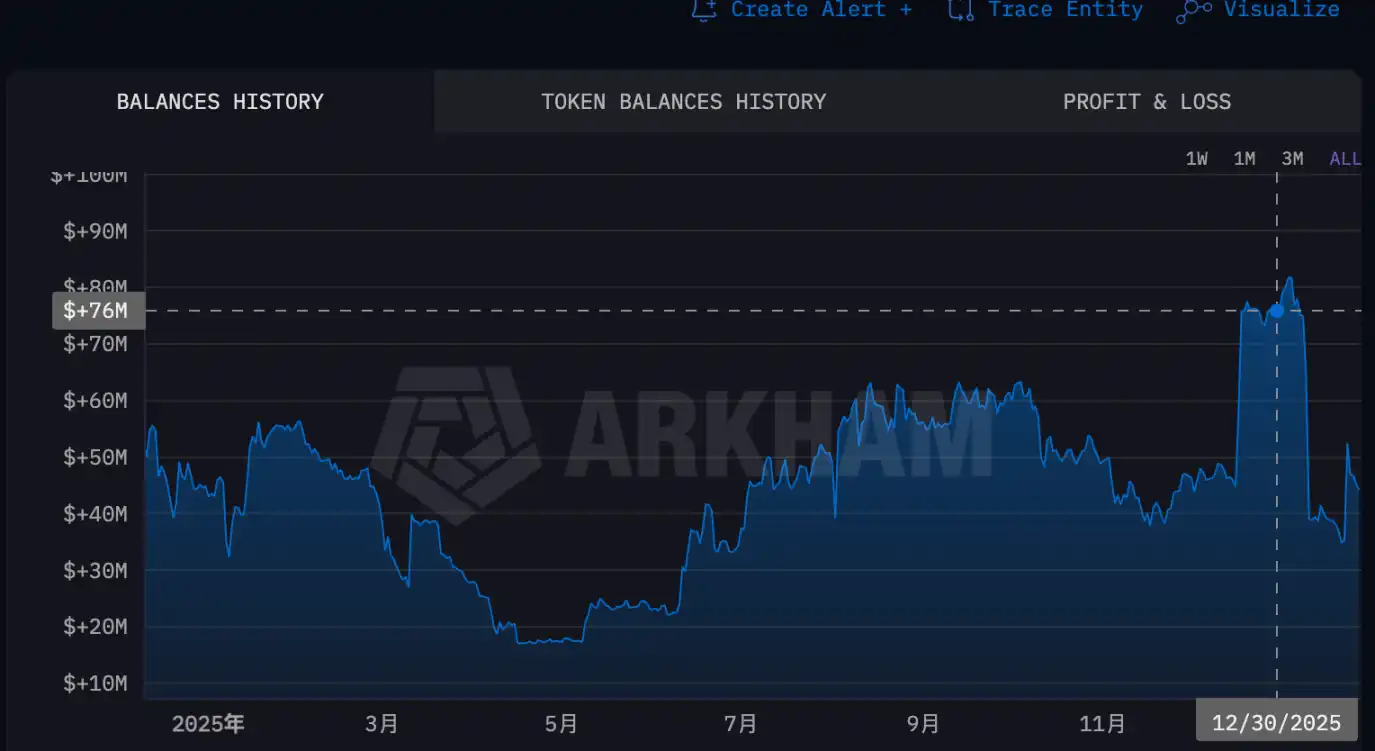
He loudly proclaimed "Bitcoin to one million dollars" and "ETH heading to $10,000" on Twitter, but on-chain, Arthur Hayes would always inadvertently sell assets he once believed in. If we were to lay out all his actions from last year, you would discover the trading record of a top-tier trader who was extremely calm, even ruthless.
We can break down his actions into three categories.
VC Coins of "Public Calls, Private Dumps"
Hayes's most controversial actions usually occurred with projects where he held early chips. This was actually a completely asymmetric game: perhaps he had already earned 10x by selling at $50, while your losses were just beginning when you bought in at $60.
The most typical scenario occurred with Hyperliquid (HYPE). As an early investor holding very low-cost chips, his operating logic was very straightforward:
First, he used his influence to make public calls at high prices, constructing a grand narrative (such as "HYPE a hundredfold in three years");
Second, when the tokens unlocked or liquidity became sufficient, he promptly liquidated his position.
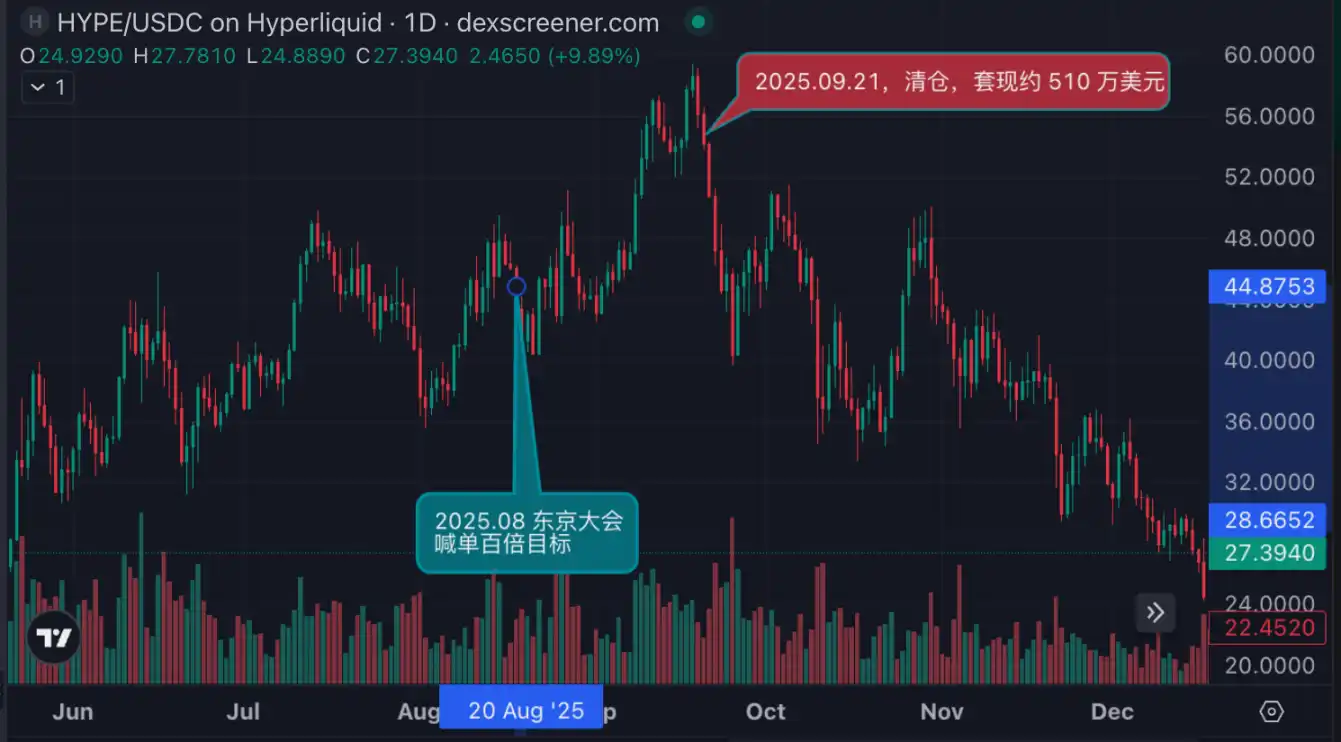
For example, in August of last year, Hayes prophesied at a conference in Tokyo that HYPE would grow a hundredfold and made high-profile purchases. Just one month later, before the drop in HYPE, he liquidated his position and made profits of millions of dollars, citing "avoiding unlock risk" as the reason.
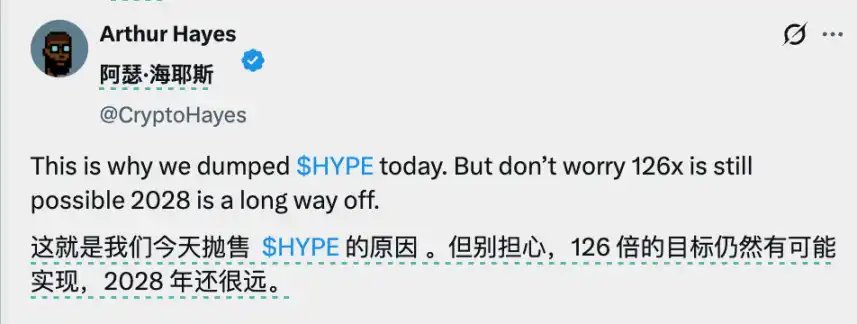
However, he did not completely abandon HYPE. In mid-January 2026, three months later, Hayes repurchased approximately $499,000 worth of HYPE.
The same story keeps repeating itself, including ETHFI, ATH, etc., all going through a similar script.
But imagine, what if you were Arthur Hayes? How would you act? To achieve profits on a large scale, this seems to be the most standard playbook: first put forward market analysis that is convincing enough, use logic to win over the audience; when believers flock in, the market will naturally confirm his prophecy.
For a whale, the only window to quietly exit is when there is a buzz of voices and the highest liquidity.
The Unshakable "Old Narrative"
After watching Hayes successfully calling the shots, we found that Hayes also made mistakes. Especially when he tried to "resurrect" some old or niche tracks.
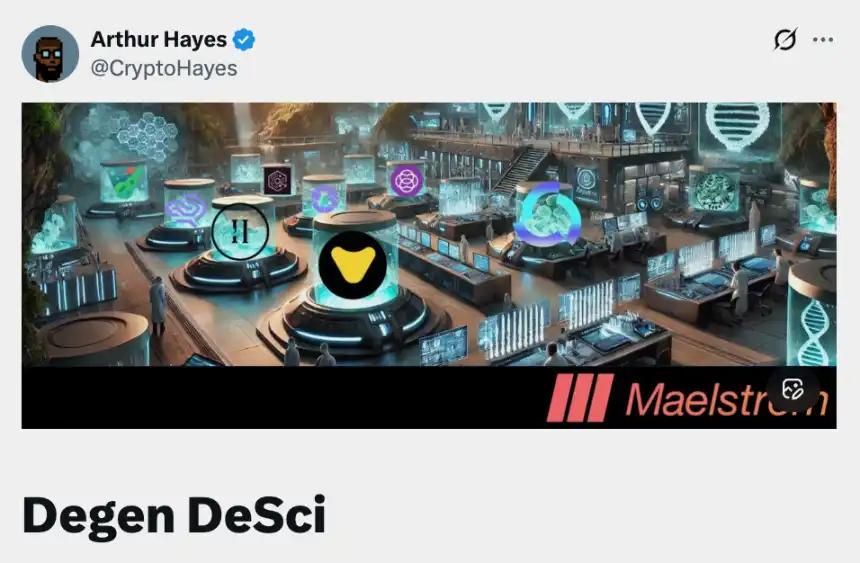
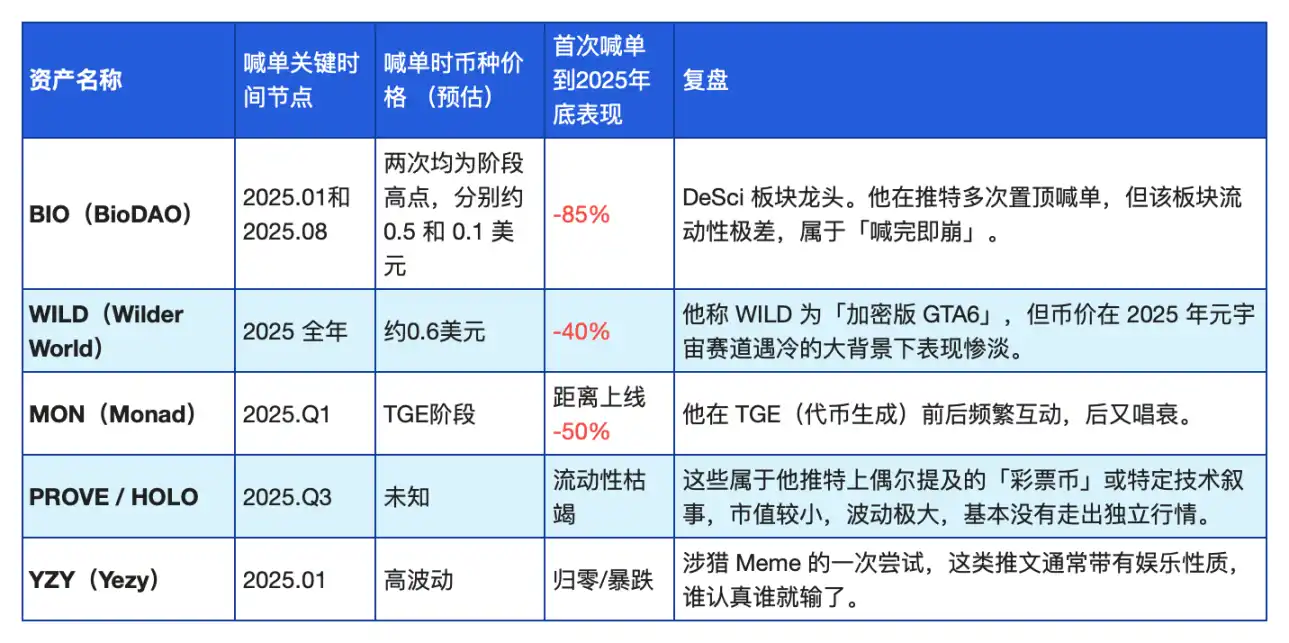
In early 2025, his family fund Maelstrom wrote a long and profound article "Degen DeSci," strongly bullish on the DeSci (Decentralized Science) track. He made a list, both BIO and GROW ······
As a result, everyone saw that the DeSci sector was almost completely wiped out, with many coins dropping more than 85% from their highs. In August, Hayes again built up $1.1 million worth of BIO and eventually deposited 7.66 million BIO into Binance in late November, resulting in a loss of up to $640,000 (-58%).
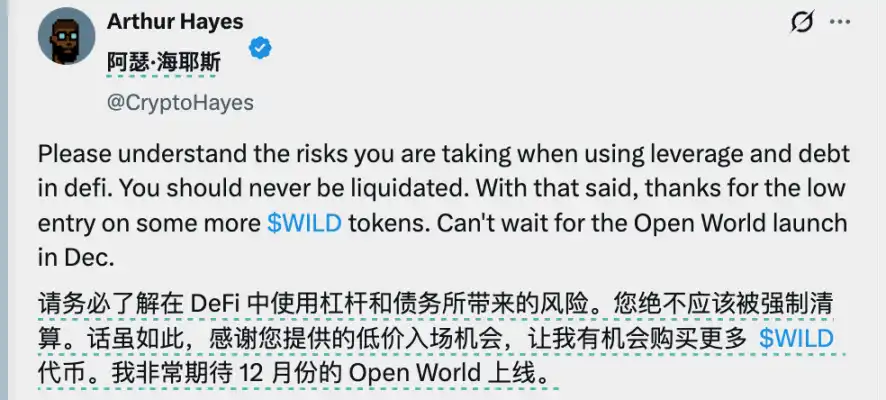
Then there was the one he called "the crypto version of GTA6," Wilder World (WILD), which was hyped for a whole year, only for the coin price to sink along with the Metaverse concept.
Most of Hayes's calls were for tokens that were hot at a specific stage, summarized in the chart below:
ZEC's "Smoke Bomb"
This may have been Hayes's most exciting and intriguing operation in 2025.
On the surface, Hayes made a frenzy of calls for Zcash (ZEC), stating that he initially bought in for millions after receiving advice from Silicon Valley giant Naval at a private dinner at Token 2049. He shouted out the slogan "target $10,000" in November last year.

Hayes even initiated a withdrawal movement, urging everyone to withdraw their coins and lock up liquidity on-chain.
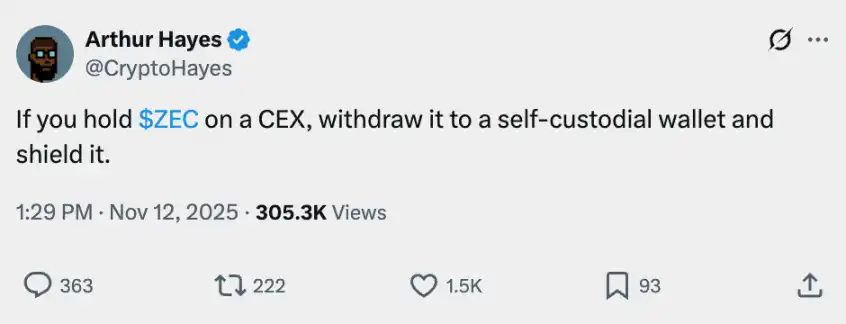
Many people kept an eye on his wallet, wanting to see if he was secretly selling ZEC. The result: he didn't sell, and he was even accumulating more.
Perhaps Hayes engineered this ZEC frenzy, and his true goal may have been to sell ETH and swap it for whatever was pumping at the time.
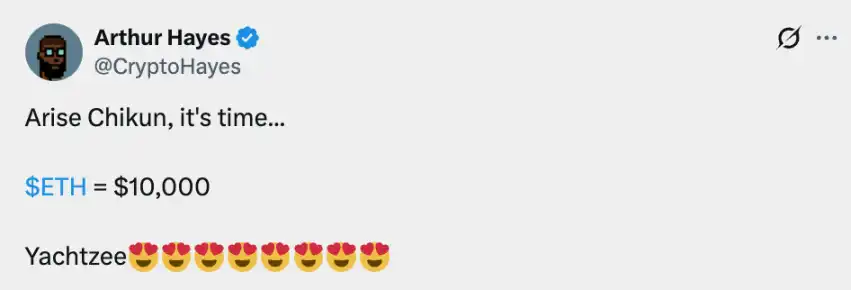
Prior to this, Hayes had actually "knifed" ETH several times. Although he had loudly proclaimed that ETH would rise to $10,000 by 2025, he went through several rounds of "flip-flopping." On August 2, he sold about $13.34 million worth of ETH and other tokens, but by August 9, he expressed regret for taking profits and had to buy back in.
By November 15, 2025, precisely when he was aggressively shilling ZEC, LookIntoBitcoin detected that he had transferred millions of dollars' worth of ETH and ENA to Binance on the same day. Hayes publicly announced on Twitter that he had "aped more" into ZEC. Blockchain analyst EmberCN also pointed out that this selling pressure was most likely intended to provide "ammunition" for accumulating ZEC.
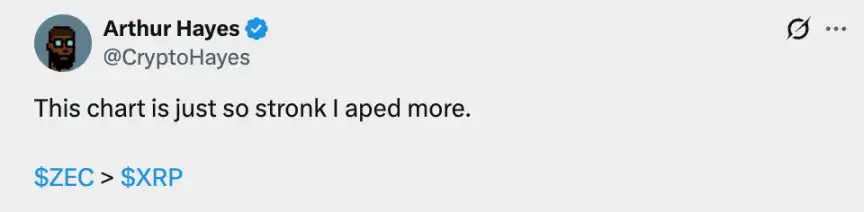
Due to ZEC's privacy features, his transparent ETH was sold off in exchange for opaque assets. On-chain, we could only see his "exit" (selling ETH) but couldn't quantify the scale of his "entry" (buying ZEC).
However, in the last two weeks of 2025, Hayes once again sold 1,871 ETH (approximately $5.53 million) and proceeded to buy back a DeFi asset he had dumped a month earlier.
This was a very stark signal: in his rationale, Ethereum was the "reserve fund" in his portfolio. When he needed money to buy into a new narrative (ZEC), he would sell it; when he needed funds to bottom fish in an old track (DeFi), he would still sell it.
Ultimately, you would discover that he used ZEC's price surge to attract the market's attention, then, while everyone was discussing the "privacy renaissance," quietly executed a portfolio rotation. It wasn't until early 2026 when ZEC plummeted due to internal team conflicts that people realized that although Hayes had reduced his holdings, he had successfully exited the underperforming ETH.
How to Understand Arthur Hayes?
Looking back on this year, you will find that Hayes, as he wrote in his Twitter background, is not a "faithful" HODLer, but an extremely savvy businessman.
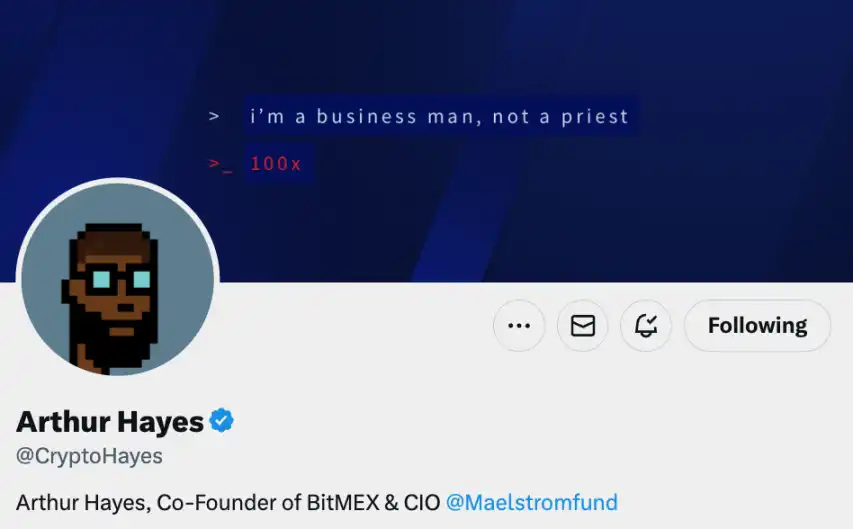
He used words to build a vision, to attract liquidity; he used on-chain operations to harvest profits, to mitigate risks; he dared to admit mistakes quickly when he got it wrong (such as giving up on ETH), to preserve his capital.
Therefore, his articles are still worth reading because his macro judgments have been validated. But before you are ready to hit the "buy" button, take one more step: don't just listen to what he says, go see what his on-chain wallet is doing.
After all, in this brutal market, his loyalty to "volatility" is far higher than his belief in any single project. And volatility is precisely the part of money that is transferred from retail pockets to traders' pockets.
You may also like

Morning News | NYSE parent company invests in OKX; Morgan Stanley provides $500 million loan to Core Scientific; Western Union partners with Crossmint to launch stablecoin USDPT

These former crypto builders have transitioned to the hottest AI projects globally

Ethereum Overhaul 2026 Blueprint, this time to abandon "gradualism"
What Is OpenClaw? How AI Agents Could Change Crypto Exchange Trading
OpenClaw is a rapidly growing open-source AI agent that can autonomously execute tasks and interact with software, including connecting to crypto exchanges through APIs to analyze markets and automate trading strategies. While this creates new opportunities for smarter trading, it also introduces security and operational risks. Through this article, WEEX aims to help users better understand the potential and risks of AI trading agents so they can explore new technologies while trading more safely and responsibly.
Ethereum 2029 Strawmap Guide: Ultra-Fast Consensus, Native Privacy, and the "Acceleration Variables" Brought by AI

Altcoin ETF Surge: SOL and XRP Inflows Total $23 Million as Institutions Diversify
Key Takeaways Institutional interest in altcoin ETFs is expanding, with SOL and XRP showing significant inflows on March…
Vitalik Drops Ethereum Endgame Bombshell: ETH USD to $3,000?
Key Takeaways Vitalik Buterin introduces the “Sanctuary Tech” manifesto to address Ethereum’s non-financial limitations. A current lack of…
Exclusive: Yuliya Barabash Predicts the Most Regulated Could Be the Biggest Crypto Winners
Key Takeaways The aftermath of FTX and Celsius collapses has ushered a new regulatory era, reshaping the crypto…

iPhone Crypto Wallets Under Threat from State-Grade Malware
Key Takeaways: The Coruna exploit kit exploits 23 iOS vulnerabilities, threatening iPhone users’ crypto wallets. Initially state-level surveillance,…

Bitcoin Nears Two-Year ‘Make-or-Break’ Resistance: Future Implications
Key Takeaways Bitcoin’s price is approaching key resistance levels around $73,000, observed for the first time since early…
Bitcoin Price Prediction: Analyst Says $220,000 BTC Is Coming — But Only After This Happens
Key Takeaways: Bitcoin may experience a significant drop before the next major rally begins, potentially revisiting the $50,000…

Solana Price Outlook: All Eyes Focused on $95 — Could This Trigger New SOL Highs?
Key Takeaways Solana’s price is approaching a pivotal $95 mark, which may indicate potential support or resistance for…

Advanced AI Predicts Future Prices for XRP, Solana, and Cardano by 2026
Key Takeaways: Claude AI predicts significant price increases for XRP, Solana, and Cardano by the end of 2026.…

Bitcoin Price Prediction: Fed Rate Cut Hints Propel Bitcoin Beyond $72K — Is a Mega Rally Starting?
Key Takeaways Bitcoin surged past the $72,000 mark, ignited by potential Federal Reserve interest rate cuts. The rally…

XRP Price Prediction: Ripple Just Turned to AI to Protect the XRP Ledger — Is This a Security Game-Changer?
Key Takeaways: Ripple is leveraging AI to enhance the security of the XRP Ledger after identifying vulnerabilities. AI…

Institutional Accumulation: US Bitcoin ETFs and MicroStrategy Drive $1.2B in Demand Surge
Key Takeaways: Institutional investments in Bitcoin have surged with US Bitcoin ETFs and MicroStrategy leading the charge, absorbing…

South Korea Tax Service Leaks Seed Phrases, Loses $4.8 Million in Seized Crypto
Key Takeaways The National Tax Service of South Korea inadvertently leaked private keys in a press release, resulting…
Current Crypto Predictions: XRP, Bitcoin, and Ethereum on the Rise
Key Takeaways Despite geopolitical tensions, Bitcoin hits a remarkable $71,500, reflecting market adaptability. Passage of the U.S. CLARITY…
Morning News | NYSE parent company invests in OKX; Morgan Stanley provides $500 million loan to Core Scientific; Western Union partners with Crossmint to launch stablecoin USDPT
These former crypto builders have transitioned to the hottest AI projects globally
Ethereum Overhaul 2026 Blueprint, this time to abandon "gradualism"
What Is OpenClaw? How AI Agents Could Change Crypto Exchange Trading
OpenClaw is a rapidly growing open-source AI agent that can autonomously execute tasks and interact with software, including connecting to crypto exchanges through APIs to analyze markets and automate trading strategies. While this creates new opportunities for smarter trading, it also introduces security and operational risks. Through this article, WEEX aims to help users better understand the potential and risks of AI trading agents so they can explore new technologies while trading more safely and responsibly.
Ethereum 2029 Strawmap Guide: Ultra-Fast Consensus, Native Privacy, and the "Acceleration Variables" Brought by AI
Altcoin ETF Surge: SOL and XRP Inflows Total $23 Million as Institutions Diversify
Key Takeaways Institutional interest in altcoin ETFs is expanding, with SOL and XRP showing significant inflows on March…


 App
App