
Treasuries at 5.30% and Nasdaq at Record High: What Explains the Divergence

 Prefer us on Google


Wall Street opened the week with a picture that encapsulates the market dilemma in 2025: on one side, U.S. Treasury yields have climbed back towards historical highs. On the other, the Nasdaq has renewed its intraday nominal record, surpassing 27,399 points. The explanation for this apparent contradiction lies in a market split between fiscal concern and euphoria concentrated in artificial intelligence.
The yield on the 10-year Treasury rose to 5.30%, while the 30-year reached 5.663%. These levels have not been seen since before the 2008 financial crisis and carry profound implications for the cost of capital in the world's largest economy.
Why Treasuries Continue to Rise
The movement in long-term U.S. bonds is not an isolated event. It reflects a combination of structural factors that have been accumulating over the past few quarters: high fiscal deficit, record public debt issuance, and a growing perception that the Federal Reserve will have less room to cut rates than the market would like.
With the 10-year yield at 5.30%, the cost of financing for companies, mortgages, and local governments rises significantly. For comparison, this same bond paid about 3.8% twelve months ago. A rise of 150 basis points in this timeframe is historically one of the sharpest moves outside of recession periods.
The economic activity data released this Monday reinforces the scenario of an economy that continues to operate above potential. The ISM services PMI slightly declined to 54.9, down from 55.4 the previous month, but remained comfortably above the 50 mark that separates expansion from contraction. The services sector accounts for more than two-thirds of U.S. GDP, complicating the thesis of a slowdown that would justify rate cuts in the short term. As we analyzed in our financial market coverage, this environment of high rates for a longer period has become the baseline scenario for most global managers.
Nasdaq at Record: The Exception That Confirms the Rule
If high rates are theoretically poison for growth stocks, how do we explain the Nasdaq reaching historical highs? The answer has a name: Nvidia.
The chipmaker for artificial intelligence surpassed $5.7 trillion in market value for the first time, establishing itself as the most valuable company on the planet. Nvidia's rise is not just a story of strong quarterly results. It reflects the perception that the AI infrastructure investment cycle is just beginning, with hyperscalers like Microsoft, Amazon, and Google committing hundreds of billions of dollars to data centers in the coming years.
The problem is that this narrative masks the health of the market as a whole. When looking at the equally weighted S&P 500, which gives the same weight to all 500 stocks, the performance is significantly inferior to that of the traditional market-cap weighted index. In other words, the rise is concentrated in a handful of companies linked to the AI thesis, while the rest of the market feels the weight of long rates.
This dynamic is similar to what happened at the end of 1999 when the Nasdaq also led amid rising rates, driven by a dominant tech theme. The comparison does not imply that the outcome will be the same, but serves as a warning: narrow markets tend to be more fragile.
What the Divergence Means for Investors
The coexistence of Treasuries at highs and the Nasdaq at record levels creates a particularly challenging environment for portfolio allocation. U.S. bonds offer high real yields, which historically compete with risk assets. An investor can lock in 5.30% per year in dollars for ten years, virtually without credit risk. This changes the calculation of any investment decision.
For emerging markets, including Brazil, the impact is direct. Higher U.S. rates strengthen the dollar and reduce risk appetite in peripheral economies. The Brazilian exchange rate is already feeling this pressure, and the domestic interest rate curve responds to every movement of the Treasuries. Those who follow the dynamics between global rates and local assets know that tightening cycles in the U.S. tend to limit the maneuvering space of the Brazilian Central Bank.
In the U.S. stock market, the central issue is sustainability. If Nvidia and a handful of AI companies are the only ones supporting the indices, any disappointment in results or regulatory change could trigger a disproportionate correction. The stable services PMI suggests that the U.S. economy is not slowing down enough to force the Fed to act, which keeps pressure on Treasuries.
-- Price
The Market is Pricing Two Scenarios at Once
Ultimately, what Wall Street is doing is pricing two worlds simultaneously. The fixed income market bets on persistent inflation, rising deficits, and fewer rate cuts. The Nasdaq bets on a technological revolution capable of generating profit growth that offsets any cost of capital. Both cannot be completely right at the same time.
Historically, divergences of this type resolve sharply. Either rates yield because the economy slows (which would hurt profits), or the stock market recognizes that the cost of money matters (which would force a repricing). In both scenarios, volatility tends to increase.
For Brazilian investors, the practical lesson is to be cautious with excessive exposure to either end. Diversification across asset classes and geographies remains the most rational strategy in an environment where even Wall Street cannot agree with itself.
This content is informational and educational and does not constitute investment advice. Past performance is not a guarantee of future results.
This content is provided for general informational purposes only and doesn't constitute financial, investment, legal, or tax advice. Any events, rewards, online promotions, or related information mentioned herein should not be considered a recommendation, solicitation, or invitation to purchase, sell, trade, or otherwise deal in any crypto assets. Crypto assets are highly volatile and may result in loss. The availability of WEEX services, products, and related events may vary by region. You are responsible for ensuring that your participation is in accordance with applicable local laws and regulations.
You may also like

NYSE’s owner is backing 24/7 stock tokens without Wall Street’s usual price rules

JPMorgan Now Offers Two Tokenized Money Market Funds on Solana

Follow the Money: $630 Million for Strive, Tether Activity and Attention to CeFi

HTX Research Analyst Chloe: Despite Significant Net Inflows into Bitcoin Spot ETFs, Macroeconomic Data Suppresses Rebound Potential

Killa: Frequent Short-term Trading Risks Missing Major Market Movements, Patience in Holding Positions is Important
China's fiscal revenue rose 5.1% by September, but land sales continue to decline

90% of Revenue from Meme Coins, Yet Valuation Rivals Pump: What Should Meteora Be Worth?

Former FTX Executive Slams Netflix's New Series: Turning Financial Fraud into a 'Romantic Film' is Absurd

Ripple teams up with $10B payments firm Arf to expand RLUSD use on XRPL

One billion dollars in three days is not enough. Bitcoin faces a significant challenge
WEEX Exclusive:Major Indexes Close Higher; Focus on TSLA, META Stock Earnings | WEEX TradFi Daily(October 22, 2026)

Major Indexes Close Higher; Focus on TSLA, META Stock Earnings | WEEX TradFi Daily(October 22, 2026)
The three major indexes closed higher on October 21, led by the Nasdaq. SpaceX beat earnings expectations and disclosed AI-business revenue; merger discussions with Tesla also helped lift AI and crypto-related stocks. Bitcoin traded near $84,000 and Ethereum near $2,470. LIT led majors on compliance-license expectations. On October 22, investors will watch Procter & Gamble, Southern Copper and Union Pacific before the open, followed by Western Digital and Newmont after the close.

Irish drug lord’s lost Bitcoin fortune comes back to life as $41 million moves to Coinbase

ZachXBT Reports on Cryptocurrency Laundering via FreedomXMR on Hyperliquid

Willy Woo: Good Time to Accumulate Bitcoin

Tech and AI: Hedge Funds Reduce Exposure at Unprecedented Rate in Ten Years

The Qubic network is back in operation after the hacking of users

Crypto rallies point to slower USDC growth and faster USDT growth, study finds
North Korea-linked SquidSquad suspected in $2.84M BNB Chain theft

Putting Childhood on the Trading Table: TCG May Be the Closest Moment for Young People to Get Rich

Kraken’s $80 stablecoin fee gap exposes hidden costs

Justin Sun Sells 80-90% of His ETH: Bitcoin Warning
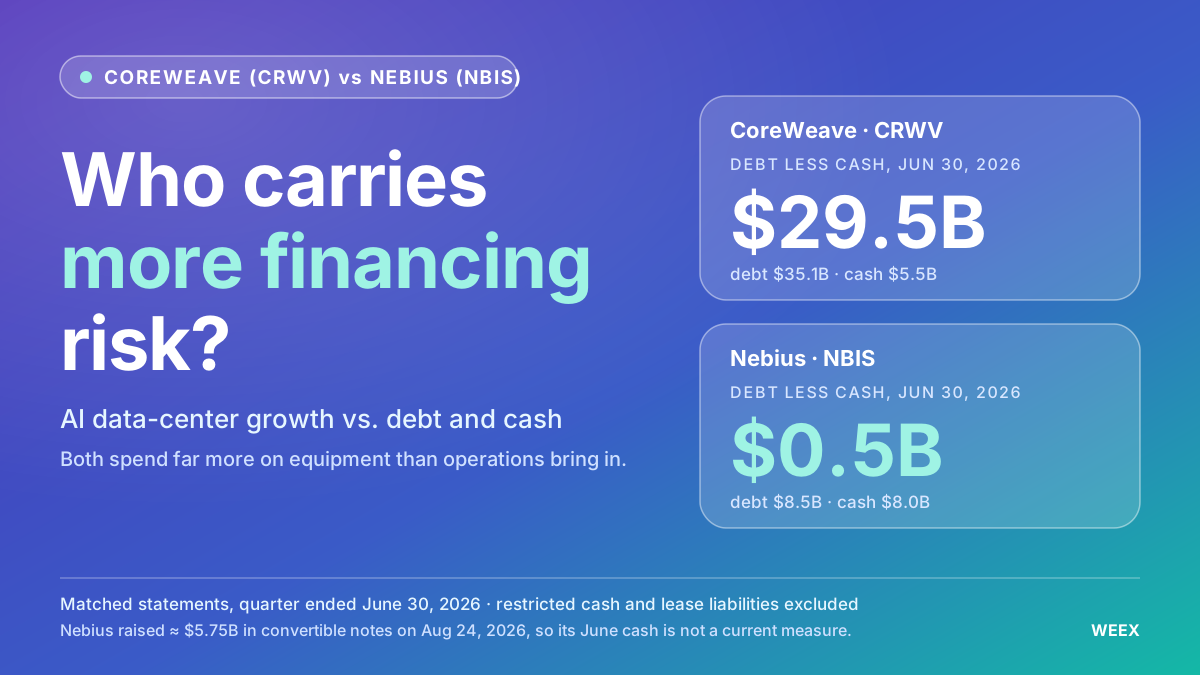
CoreWeave vs. Nebius Stock: Which AI Cloud Business Faces Greater Financing Risk?
Compare CoreWeave and Nebius stock through debt, cash flow, customer prepayments and dilution to assess which AI cloud business faces greater financing risk.

Cryptocurrency Exchange Bitget Suddenly Exits Russia. What Happened
EU bans cash payments over €10,000 starting July next year
Country risk near 680 points: why Argentine bonds fall despite international relief

Bitcoin at $100,000 in 2026: Bitwise Remains Optimistic Despite Inflation

Bitcoin Wallet Moves 411.45 BTC Worth 33400000 Dollars Amid Lawsuit

Bank of America predicts a hit of up to 10% on European stocks due to risks in the AI cycle

Fake Demand, Real Losses: How Popular Crypto Schemes Work
NYSE’s owner is backing 24/7 stock tokens without Wall Street’s usual price rules
JPMorgan Now Offers Two Tokenized Money Market Funds on Solana
Follow the Money: $630 Million for Strive, Tether Activity and Attention to CeFi
HTX Research Analyst Chloe: Despite Significant Net Inflows into Bitcoin Spot ETFs, Macroeconomic Data Suppresses Rebound Potential
Killa: Frequent Short-term Trading Risks Missing Major Market Movements, Patience in Holding Positions is Important
China's fiscal revenue rose 5.1% by September, but land sales continue to decline
Contents
Latest articles


Latest coin listings on WEEX


