
- Buy Crypto
- Markets
 Futures
- Spot
- Copy Trade
- Earn
- More
Trump Family Enters the Stablecoin Race? A Deep Dive into the Binance Smart Chain's "USD1 President Stablecoin"

The ever-evolving BSC ecosystem witnessed another surge in popularity early this morning. The DeFi project World Liberty Financial (WLFI), supported by the Trump family, launched the USD-pegged stablecoin USD1 on BSC. After CZ shared this news, a community-created token with the same name instantly entered a "gold rush mode."
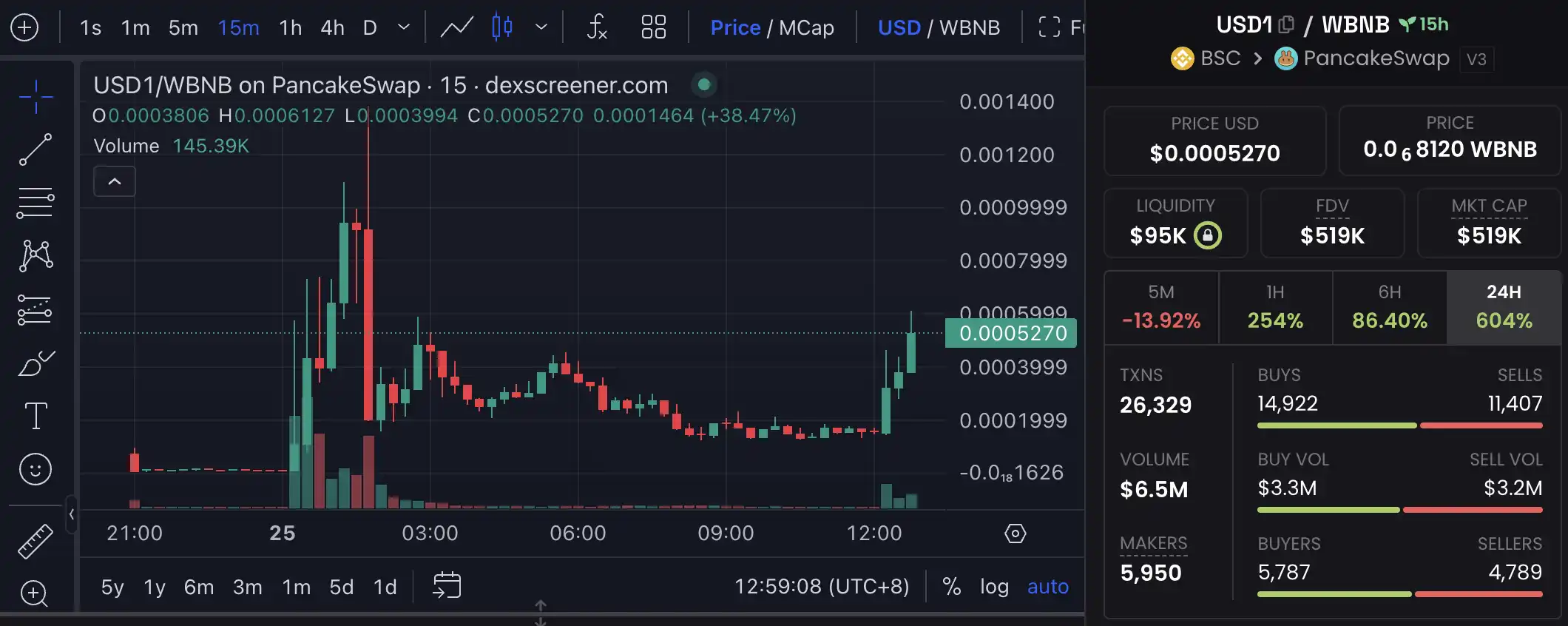
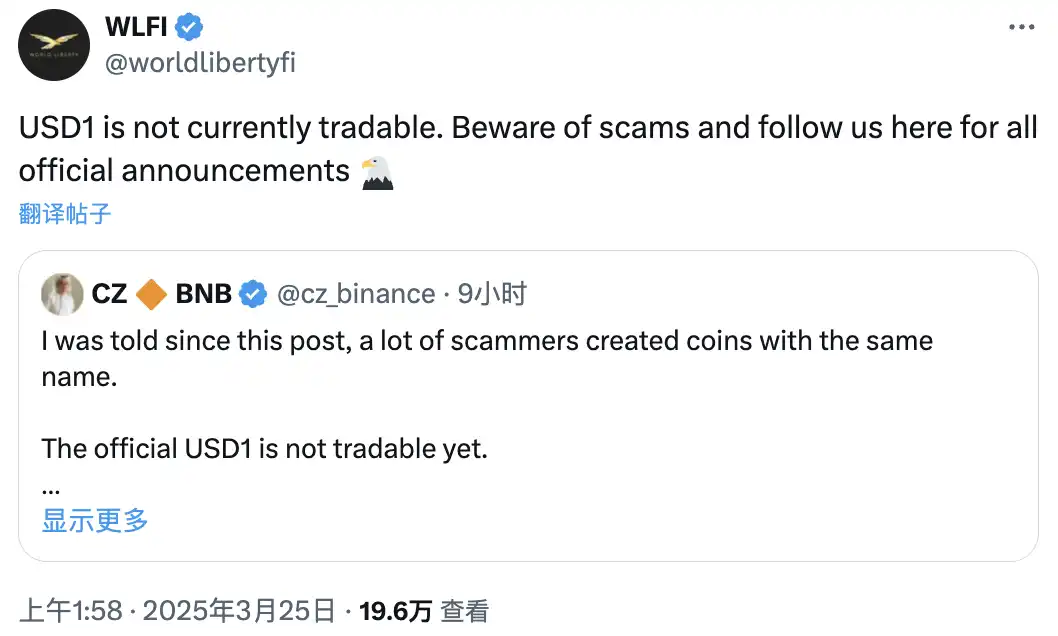
Due to numerous scam tokens with the same name, both CZ and the WLFI official accounts posted warnings to users to beware of scams. Subsequently, the price of USD1 quickly retraced, dropping over 50% from its peak at the time of writing.
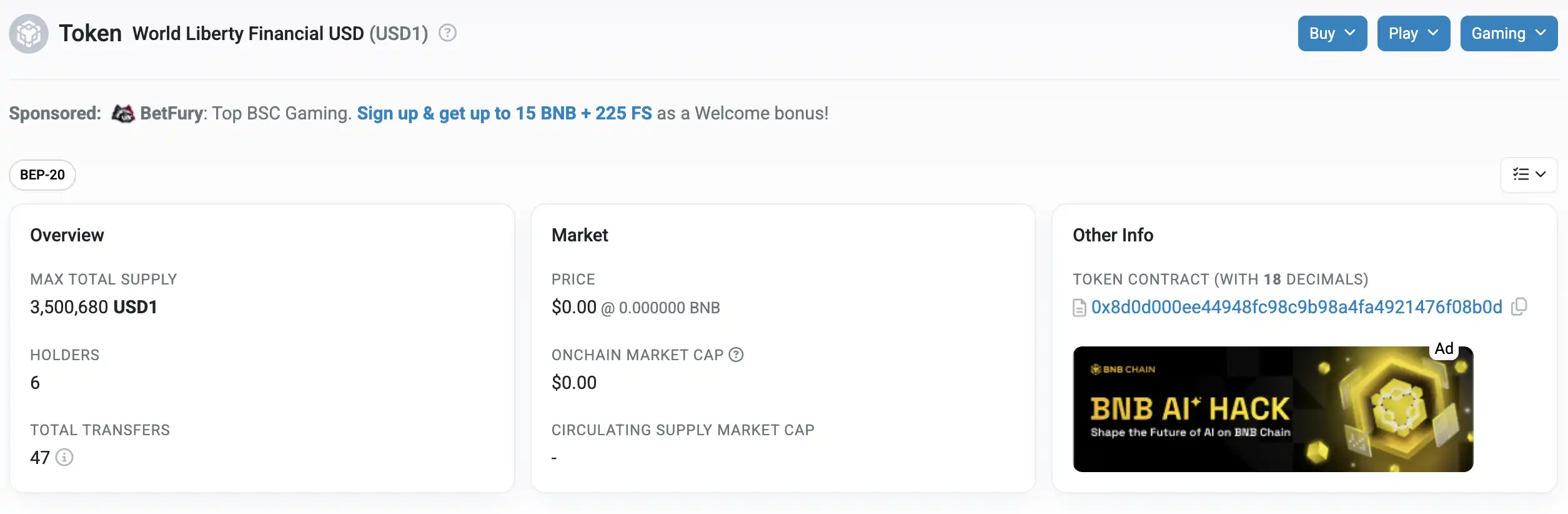
The total supply of USD1 exceeds $3.5 million. According to on-chain data from Etherscan and BscScan, this project issued the World Liberty Financial USD (USD1) token in early March. CZ confirmed that the stablecoin contract has been deployed on the BNB chain and Ethereum, currently open for testing to a limited number of addresses.
Why Did WLFI Target a Stablecoin?
The reason WLFI targeted a stablecoin may lie in its developmental trajectory. Since initiating its first token sale in October last year, WLFI has aimed to become the "decentralized finance benchmark," promoting to investors in the US and globally. With Trump himself serving as the "Chief Crypto Advocate" and his three sons as "Ambassadors" and "DeFi Visionaries," the family's aura has been their biggest selling point. However, difficulties in the initial fundraising round and the market perception as a "meme project" led to significant doubts.
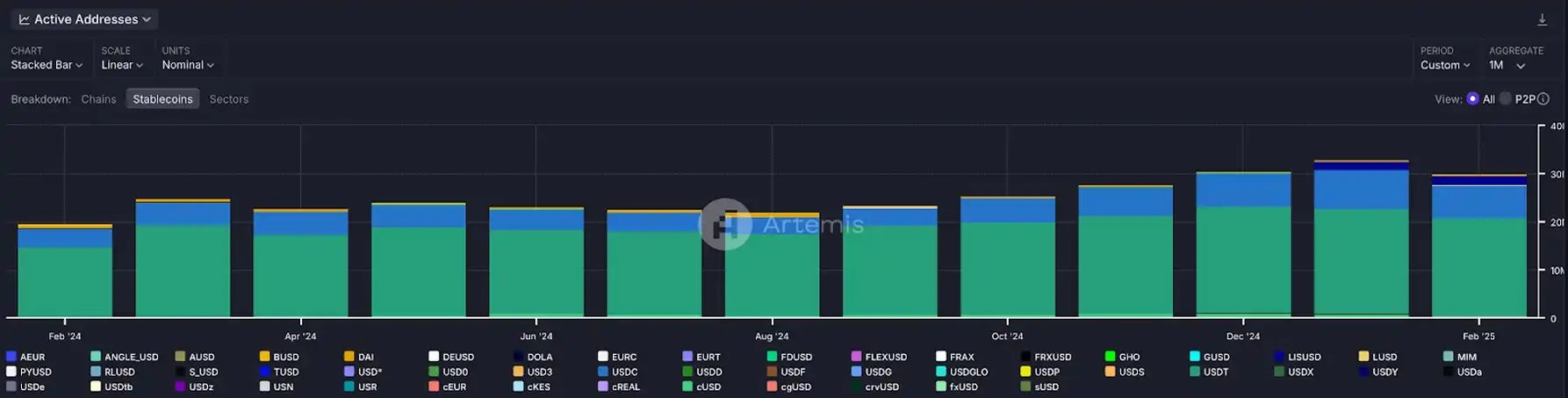
A stablecoin project thriving in a bear market can not only provide WLFI with trading, lending, and liquidity services but also generate substantial long-term returns. Following the launch of USD1, it might attract a significant amount of institutional and retail funds, potentially helping WLFI shed its "meme project" label and transform into a genuine DeFi player. According to WLFIArtemis and Dune platform data, the active stablecoin wallet count grew by over 50% between February 2024 and February 2025. In March of this year, the total stablecoin market value surpassed $230 billion, with USDT and USDC still dominant. WLFI's entry at this time might leverage favorable policies to compete for market share.
Since Trump's election, he has publicly supported cryptocurrency development multiple times, promising to make the US the "global crypto center" and emphasizing the US Dollar's dominant position in the digital economy. Given that stablecoins serve as a vital vehicle for digitizing the Dollar, they have naturally become a policy focal point.
Related Reading: "Why Did $900 Billion Evaporate from the Crypto Market While Stablecoin Market Cap Hit an All-Time High?"
The launch of USD1 comes at a critical time as the U.S. Congress is deliberating on the "Guidance and Effective Supervision of Stablecoin Innovation Act” (GENIUS Act). The bill was approved by the Senate Banking Committee on March 13 with 18 votes in favor and 6 against, poised to proceed to a full Senate vote. This marks a significant step towards the bill becoming law, signaling the first approval of stablecoin regulation at the Senate committee level.
Bo Hines, Executive Director of the Presidential Advisory Council on Digital Assets, expects the bill to be submitted for Trump's signature before June. Kristin Smith, CEO of the Blockchain Association, suggests that the U.S. Congress may pass stablecoin-related legislation by August 2025, with the GENIUS Act seen as a key driving force. If WLFI can refine USD1 early, it not only has the potential to quickly comply with the law after its enactment but may also seek a regulatory “green channel” leveraging Trump's influence.
Following the Trend or Seizing the Opportunity?
Since Trump returned to the White House as the "Crypto President," his and the WLFI family's actions have gradually become a barometer of the crypto market. Following CZ's return to the BSC ecosystem, the heat has surged, trading volumes have picked up, and various "power couple shill" meme coins have made the market exceptionally lively. Meanwhile, stablecoins continue to attract attention with their positioning as a "bear market haven." The launch of USD1 by WLFI this time can be said to have gathered the three major "BUFFs" of Trump's traffic, BSC ecosystem, and stablecoin concept, naturally generating high interest.
Although the timing is auspicious, in fact, WLFI's layout for stablecoins was not a spur-of-the-moment decision but rather a well-thought-out plan. Back on October 14 last year, Rich Teo, former CEO of Paxos, joined WLFI as the head of stablecoin and payment business, with this personnel change already sparking speculation in the market about its foray into stablecoin projects.
Then on October 29, Decrypt reported, citing sources, that WLFI planned to develop its own stablecoin. At that time, the project had already raised $14 million through an initial token sale, but the product still needed time to enhance security.
On March 13 this year, Bloomberg revealed that WLFI had held secret discussions with Binance, with four sources disclosing discussions on the possibility of collaborating to develop a U.S. dollar-pegged stablecoin. Although negotiation details were not made public, this clue aligns well with the current launch of USD1 on BSC.
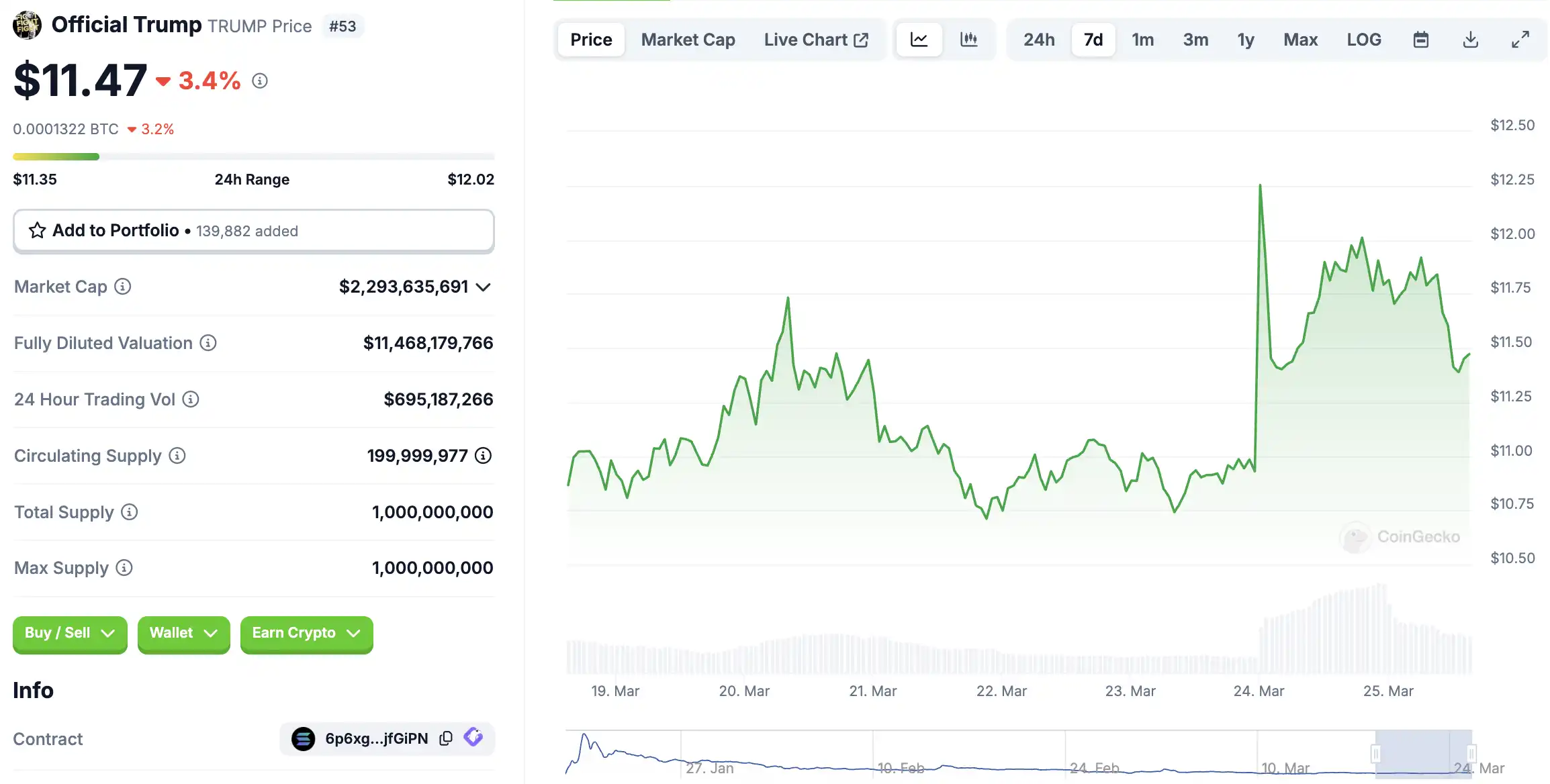
While it is currently not possible to trade USD1, the market is full of speculation as to whether this is another question mark over Trump's new "harvesting" strategy. After all, this year's crypto market has been spun around by this president's tariff threats, meme pumping, and post-liquidation shilling. Just the day before yesterday, he was still passionately shouting "I LOVE $TRUMP—SO COOL!!! The Greatest of them all!!!!!!!!!!!!!!!!" for his $TRUMP, but obviously the market is no longer buying it. This time, the shilling only caused $TRUMP to briefly rise by about 12% before quickly falling back.
Related Read: "Is Trump Still Good News for the Crypto Community?"
As for USD1 itself, is its collateral mechanism transparent? When will the audit report be released? These key pieces of information have not been disclosed. Moreover, the outside world has been in constant controversy over WLFI and related conflicts of interest issues. Since the launch of the WLFI platform in September 2024, many operational details have never been made public. Its official website shows that Trump and some of his family members hold 60% of the company's shares. As of March 14, the project has completed two rounds of public token sales, raising a total of $550 million. According to the issuance document of the initial token sale of World Liberty, Trump and his related company, DT Marks DEFI LLC, will receive 75% of the net revenue as fees—meaning a profit of $390 million.
But perhaps the bigger question lies in Trump's true motives. Is his pro-crypto stance a genuine effort to drive industry development, or is it a case of "fishing in troubled waters" for his family's benefit? Can WLFI break free from the skepticism of "harvesting" and the stereotypical image of a "meme project" to truly become a builder in the DeFi space? The answer may only be judged by time.
You may also like

Mining Companies' Great Migration: Some Have Already Secured $12.8 Billion in AI Orders
What Is Vibe Coding? How AI Is Changing Web3 & Crypto Development
What is vibe coding? Learn how AI coding tools are lowering the barrier to Web3 development and enabling anyone to build crypto applications.

The parent company of the New York Stock Exchange strategically invests in OKX: The intentions behind the $25 billion valuation
WEEX P2P update: Country/region restrictions for ad posting
To improve ad security and matching accuracy, WEEX P2P now allows advertisers to restrict who can trade with their ads based on country or region. Advertisers can select preferred counterparty locations for a safer, smoother trading experience.
I. Overview
When publishing P2P ads, advertisers can now set the following:
Allow only counterparties from selected countries or regions to trade with your ads.
With this feature, you can:
Target specific user groups more precisely.Reduce cross-region trading risks.Improve order matching quality.
II. Applicable scenarios
The following are some common scenarios:
Restrict payment methods: Limit orders to users in your country using supported local banks or wallets.Risk control: Avoid trading with users from high-risk regions.Operational strategy: Tailor ads to specific markets.
III. How to get started
On the ad posting page, find "Trading requirements":
Select "Trade with users from selected countries or regions only".Then select the countries or regions to add to the allowlist.Use the search box to quickly find a country or region.Once your settings are complete, submit the ad to apply the restrictions.
When an advertiser enables the "Country/Region Restriction" feature, users who do not meet the criteria will be blocked when placing an order and will see the following prompt:
If you encounter this issue when placing an order as a regular user, try the following solutions.
Choose another ad: Select ads that do not restrict your country/region, or ads that allow users from your location.Show local ads only: Prioritize ads available in the same country as your identity verification.
IV. Benefits
Compared with ads without country/region restrictions, this feature provides the following improvements.
Aspect
Improvement
Trading security
Reduces abnormal orders and fraud risk
Conversion efficiency
Matches ads with more relevant users
Order completion rate
Reduces failures caused by incompatible payment methods
V. FAQ
Q1: Why are some users not able to place orders on my ad?
A1: Their country or region may not be included in your allowlist.
Q2: Can I select multiple countries or regions when setting the restriction?
A2: Yes, multiple selections are supported.
Q3: Can I edit my published ads?
A3: Yes. You can edit your ad in the "My Ads" list. Changes will take effect immediately after saving.

What are the key highlights of this year's Ethereum's most important upgrade, the Glamsterdam upgrade?

March 6 Key Market Update You Can't Miss! | Alpha Morning Report

Sell Nvidia, Buy Power Plant: 27-Year-Old AI Investor Earns $5 Billion in One Year
The $24 Million Heist Behind It: The Most Dangerous Vulnerability in the Crypto World is Actually Human

Justin Sun Lawsuit Dismissed, BlackRock Bullish on Tokenization, What Is the English-Speaking Community Paying Attention To?

Morning News | NYSE parent company invests in OKX; Morgan Stanley provides $500 million loan to Core Scientific; Western Union partners with Crossmint to launch stablecoin USDPT

These former crypto builders have transitioned to the hottest AI projects globally

Ethereum Overhaul 2026 Blueprint, this time to abandon "gradualism"
What Is OpenClaw? How AI Agents Could Change Crypto Exchange Trading
OpenClaw is a rapidly growing open-source AI agent that can autonomously execute tasks and interact with software, including connecting to crypto exchanges through APIs to analyze markets and automate trading strategies. While this creates new opportunities for smarter trading, it also introduces security and operational risks. Through this article, WEEX aims to help users better understand the potential and risks of AI trading agents so they can explore new technologies while trading more safely and responsibly.
Ethereum 2029 Strawmap Guide: Ultra-Fast Consensus, Native Privacy, and the "Acceleration Variables" Brought by AI

Altcoin ETF Surge: SOL and XRP Inflows Total $23 Million as Institutions Diversify
Key Takeaways Institutional interest in altcoin ETFs is expanding, with SOL and XRP showing significant inflows on March…
Vitalik Drops Ethereum Endgame Bombshell: ETH USD to $3,000?
Key Takeaways Vitalik Buterin introduces the “Sanctuary Tech” manifesto to address Ethereum’s non-financial limitations. A current lack of…
Exclusive: Yuliya Barabash Predicts the Most Regulated Could Be the Biggest Crypto Winners
Key Takeaways The aftermath of FTX and Celsius collapses has ushered a new regulatory era, reshaping the crypto…

iPhone Crypto Wallets Under Threat from State-Grade Malware
Key Takeaways: The Coruna exploit kit exploits 23 iOS vulnerabilities, threatening iPhone users’ crypto wallets. Initially state-level surveillance,…
Mining Companies' Great Migration: Some Have Already Secured $12.8 Billion in AI Orders
What Is Vibe Coding? How AI Is Changing Web3 & Crypto Development
What is vibe coding? Learn how AI coding tools are lowering the barrier to Web3 development and enabling anyone to build crypto applications.
The parent company of the New York Stock Exchange strategically invests in OKX: The intentions behind the $25 billion valuation
WEEX P2P update: Country/region restrictions for ad posting
To improve ad security and matching accuracy, WEEX P2P now allows advertisers to restrict who can trade with their ads based on country or region. Advertisers can select preferred counterparty locations for a safer, smoother trading experience.
I. Overview
When publishing P2P ads, advertisers can now set the following:
Allow only counterparties from selected countries or regions to trade with your ads.
With this feature, you can:
Target specific user groups more precisely.Reduce cross-region trading risks.Improve order matching quality.
II. Applicable scenarios
The following are some common scenarios:
Restrict payment methods: Limit orders to users in your country using supported local banks or wallets.Risk control: Avoid trading with users from high-risk regions.Operational strategy: Tailor ads to specific markets.
III. How to get started
On the ad posting page, find "Trading requirements":
Select "Trade with users from selected countries or regions only".Then select the countries or regions to add to the allowlist.Use the search box to quickly find a country or region.Once your settings are complete, submit the ad to apply the restrictions.
When an advertiser enables the "Country/Region Restriction" feature, users who do not meet the criteria will be blocked when placing an order and will see the following prompt:
If you encounter this issue when placing an order as a regular user, try the following solutions.
Choose another ad: Select ads that do not restrict your country/region, or ads that allow users from your location.Show local ads only: Prioritize ads available in the same country as your identity verification.
IV. Benefits
Compared with ads without country/region restrictions, this feature provides the following improvements.
Aspect
Improvement
Trading security
Reduces abnormal orders and fraud risk
Conversion efficiency
Matches ads with more relevant users
Order completion rate
Reduces failures caused by incompatible payment methods
V. FAQ
Q1: Why are some users not able to place orders on my ad?
A1: Their country or region may not be included in your allowlist.
Q2: Can I select multiple countries or regions when setting the restriction?
A2: Yes, multiple selections are supported.
Q3: Can I edit my published ads?
A3: Yes. You can edit your ad in the "My Ads" list. Changes will take effect immediately after saving.


 App
App