
- Buy Crypto
- Markets
 Futures
- Spot
- Copy Trade
- Earn
- More
U.S. Tariff Truce Fiasco: BTC Flash Crashes Below $81K, May Rate Cut Expectation Soars

Original Article Title: "Trump Halts Tariff Roller Coaster Event - Bitcoin Surges to $81K, US Stocks on Wild Ride, Fed Rate Cut Expectation Soars in May"
Original Article Author: Joe, BlockTempo
After a "Black Monday" in Asian stock and cryptocurrency markets yesterday, news broke last night that the Trump administration might pause matching tariffs for 90 days, sparking a strong market rebound and pushing Bitcoin above $80,000.
However, the White House quickly denied this as fake news, causing an instant market confidence collapse and a sharp decline in stocks and Bitcoin. Subsequently, US President Trump issued a tough threat to China once again, stating that if China does not withdraw retaliatory tariffs (China announced a 34% retaliatory tariff last night), the US will raise the existing tariff rate to 50% on the 9th, causing another market shock.
The Dow Jones Index plunged more than 1,700 points intraday, although the closing losses narrowed, and the S&P 500 Index also recorded its worst three-day performance since the 2020 pandemic outbreak. Meanwhile, the EU is waving the flag of negotiation priority but is also prepared to counter with tariffs, casting a shadow over the global trade war.
Bitcoin Surges Above $81K Before Retracing
The cryptocurrency market also experienced volatility last night due to the Trump tariff suspension fake news, with Bitcoin reaching a high of $81,213 but quickly falling back after the White House clarification. As of 9:30 am Taipei time on April 8th, the Bitcoin price is around $79,670, and the Ethereum price is around $1,574. Whether the rebound can continue remains to be seen.
Overall, the current market trend highlights the high uncertainty of the current global economic environment, bringing tremendous pressure to the risk market. Investors must be more cautious when assessing risks and opportunities, closely monitoring subsequent policy directions and economic data changes.

US Stocks See Saw Movement, Nvidia Rebounds
As for US stocks, Apple (AAPL-US) closed at $181.46, plummeting 3.67%. The company's stock price has accumulated a 19% decline over the past three trading days, evaporating nearly $640 billion in market value. There are market rumors that, in order to replenish stock ahead of a potential tariff effective date on the 9th, Apple has initiated emergency logistics plans and is using cargo planes to transport a large number of iPhones and other products from India and China to the US.
Nvidia (NVDA) closed at $97.64, up 3.53%. A Bernstein analyst is bullish on Nvidia, reiterating an "outperform" rating with a target price of $185, expecting its AI server products to potentially be exempt from the latest tariffs under the "USMCA" agreement.
The Dow Industrial Average intraday plunged 1703 points, eventually closing down 349.26 points, a decrease of 0.91%, at 37,965.6 points
The S&P 500 Index fell 11.83 points, or 0.23%, to 5,062.25 points, marking a cumulative decline of over 10% in the past three days, the most severe downturn since the market crash triggered by the early 2020 pandemic
Tech stocks showed resilience as bargain hunters stepped in, with the Nasdaq Composite Index rising 15.48 points, or 0.1%, to 15,603.26 points
Benefiting from a strong rebound in semiconductor stocks, the Philadelphia Semiconductor Index surged against the trend by 97.29 points, or 2.70%, to close at 3,694.95 points
Fed's Closed-Door Meeting Adds Suspense, Rate Cut Expectations Soar
Amid market jitters over tariff news, the Federal Reserve unexpectedly held a previously unannounced closed-door board meeting last night. While the specific discussion topics of the meeting have not been disclosed, this rare move at such a sensitive time has intensified market tension and speculation.
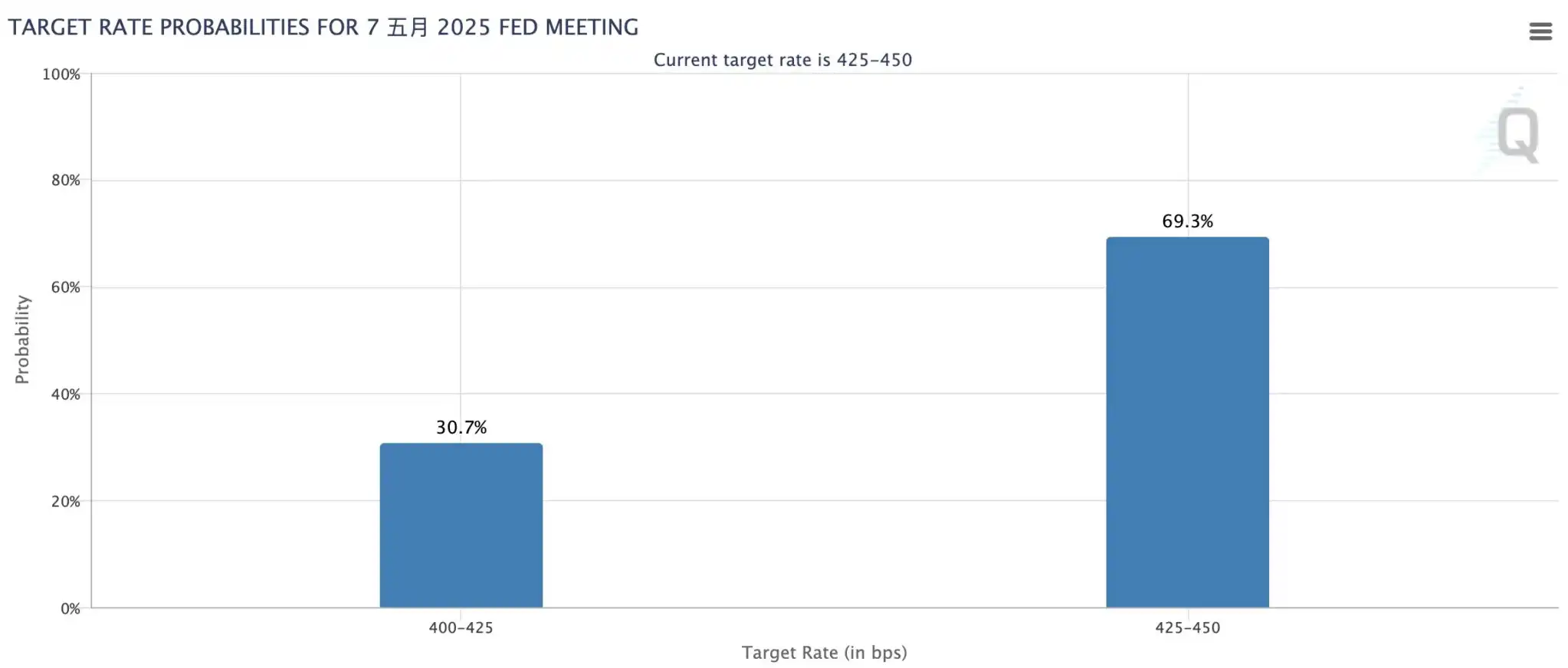
According to the Chicago Mercantile Exchange's (CME) FedWatch tool, market traders currently expect the Fed to cut rates as early as May, with the likelihood increasing from 14% a week ago to 30.7%. This reflects a strong market expectation that, amidst trade war fears and concerns of a potential economic slowdown, the Fed will take a more dovish stance to support the economy.
EU Adopts "Fight-and-Talk" Strategy, Proposes Zero-for-Zero Tariffs
Facing U.S. tariff pressures, the EU reached a consensus at a trade ministers' meeting of the 27 member states held in Luxembourg to prioritize resolving trade disputes through negotiation. EU Trade Commissioner Maros Sefcovic stated that the EU has proposed industrial product "zero-for-zero" tariff negotiations to the U.S., meaning both sides would completely exempt each other from industrial goods tariffs.
However, the EU also made it clear that it would not wait indefinitely. Sefcovic outlined the EU's three key positions:
1. Recognizing the importance of cooperation with the U.S. in strategic areas (such as addressing overcapacity from non-market economies, semiconductor competition, critical raw material supply, etc.)
2. Acknowledging that negotiations with the U.S. will be protracted, currently only in the preliminary stage, as the U.S. sees tariffs as "corrective measures" rather than negotiation chips
3. Pursuing open-ended negotiations while adopting a "three-track approach": defending interests through retaliatory measures, diversifying the market through new trade agreements, and preventing harmful trade diversion effects
In terms of specific actions, regarding the U.S.'s previous tariffs on steel and aluminum products, the European Union is expected to implement the first wave of retaliatory tariffs on April 15, with the related list already submitted to member states and set for a vote on the 9th. The second wave of counterbalancing tariffs is expected to be introduced on May 15.
Currently, the EU's strategy clearly prioritizes "negotiation first, while engaging in talks alongside actions," actively seeking to diversify its trading partners. Dombrovskis specifically mentioned India, Indonesia, Thailand, the Philippines, and Gulf countries, urging to expedite ongoing free trade agreement negotiations. The President of the European Commission vividly expressed that the EU would "focus like a laser beam on 83% of global trade, excluding the United States."
At the same time, the EU is also highly alert to trade diversion risks, especially the potential influx of Chinese products into the EU market due to U.S. tariffs. Dombrovskis recently visited China, with one of the key focuses being on addressing trade imbalances with China, overcapacity, market access, and issues related to Chinese investments in Europe.
You may also like

Social Capital CEO: How Equity Tokenization is Reshaping Capital Markets from US Stocks to SpaceX?

CoinGecko Report: Surge of 346% vs Dip of 20.8%, The Wild Rise of DEX

a16z: The Real Opportunity of Stablecoins Lies Not in Disruption but in Filling Gaps

Mining Exodus: Someone Holds $12.8 Billion AI Order

March 6 Market Key Intelligence, How Much Did You Miss?

a16z: The True Opportunity of Stablecoins is in Complementing, Not Disrupting

Predict LALIGA Matches, Shoot Daily & Win BTC, USDT and WXT on WEEX
The WEEX × LALIGA campaign brought together football excitement and crypto participation through a dynamic interactive experience. During the event, users predicted matches, completed trading tasks, and took daily shots to compete for rewards including BTC, USDT, WXT, and exclusive prizes.

Ray Dalio Dialogue: Why I'm Betting on Gold and Not Bitcoin

Who Took the Money in the AI Era? A Must-See Investment Checklist for HALO Asset Trading
Wall Street Bears Target Ethereum: Vitalik In the Know Takes Flight, Tom Lee Remains Bullish
Pump.fun Hacker Steals $2 Million, Receives 6-Year Prison Sentence, Opts for 'Self-Detonation'

6% Annual Percentage Yield as Musk Declares War on Traditional Banks
36 years, 4 wars, 1 script: How does capital price the world in conflict?

Mining Companies' Great Migration: Some Have Already Secured $12.8 Billion in AI Orders
What Is Vibe Coding? How AI Is Changing Web3 & Crypto Development
What is vibe coding? Learn how AI coding tools are lowering the barrier to Web3 development and enabling anyone to build crypto applications.
The parent company of the New York Stock Exchange strategically invests in OKX: The intentions behind the $25 billion valuation

WEEX P2P update: Country/region restrictions for ad posting
To improve ad security and matching accuracy, WEEX P2P now allows advertisers to restrict who can trade with their ads based on country or region. Advertisers can select preferred counterparty locations for a safer, smoother trading experience.
I. Overview
When publishing P2P ads, advertisers can now set the following:
Allow only counterparties from selected countries or regions to trade with your ads.
With this feature, you can:
Target specific user groups more precisely.Reduce cross-region trading risks.Improve order matching quality.
II. Applicable scenarios
The following are some common scenarios:
Restrict payment methods: Limit orders to users in your country using supported local banks or wallets.Risk control: Avoid trading with users from high-risk regions.Operational strategy: Tailor ads to specific markets.
III. How to get started
On the ad posting page, find "Trading requirements":
Select "Trade with users from selected countries or regions only".Then select the countries or regions to add to the allowlist.Use the search box to quickly find a country or region.Once your settings are complete, submit the ad to apply the restrictions.
When an advertiser enables the "Country/Region Restriction" feature, users who do not meet the criteria will be blocked when placing an order and will see the following prompt:
If you encounter this issue when placing an order as a regular user, try the following solutions.
Choose another ad: Select ads that do not restrict your country/region, or ads that allow users from your location.Show local ads only: Prioritize ads available in the same country as your identity verification.
IV. Benefits
Compared with ads without country/region restrictions, this feature provides the following improvements.
Aspect
Improvement
Trading security
Reduces abnormal orders and fraud risk
Conversion efficiency
Matches ads with more relevant users
Order completion rate
Reduces failures caused by incompatible payment methods
V. FAQ
Q1: Why are some users not able to place orders on my ad?
A1: Their country or region may not be included in your allowlist.
Q2: Can I select multiple countries or regions when setting the restriction?
A2: Yes, multiple selections are supported.
Q3: Can I edit my published ads?
A3: Yes. You can edit your ad in the "My Ads" list. Changes will take effect immediately after saving.



 App
App