
- Buy Crypto
- Markets
 Futures
- Spot
- Copy Trade
- Earn
- More
Vitalik's Latest Speech: Ethereum L1 Scalability Essential, Serving Key Functions

Original Title: "Vitalik's Latest Speech Overview: Building Ethereum L1 as the Core of the 'World Computer'"
Original Author: KarenZ, Foresight News
On April 9, at the "2025 Hong Kong Web3 Carnival" ETHAsia 2025 event, Ethereum co-founder Vitalik Buterin delivered a keynote speech titled "The Future of Ethereum L1." The speech revolved around key topics such as scalability improvements to Ethereum L1, future plans and technical upgrades, the collaborative development of L1 and L2, and the impact of account abstraction on user experience.
Vitalik first analyzed the current state of Ethereum. Currently, L1's throughput is 15 transactions per second (15 TPS). The gas limit has recently been increased to 36 million, representing about a 6x increase over the past 10 years. Meanwhile, L2's throughput has reached around 250 TPS, showcasing significant scalability progress.
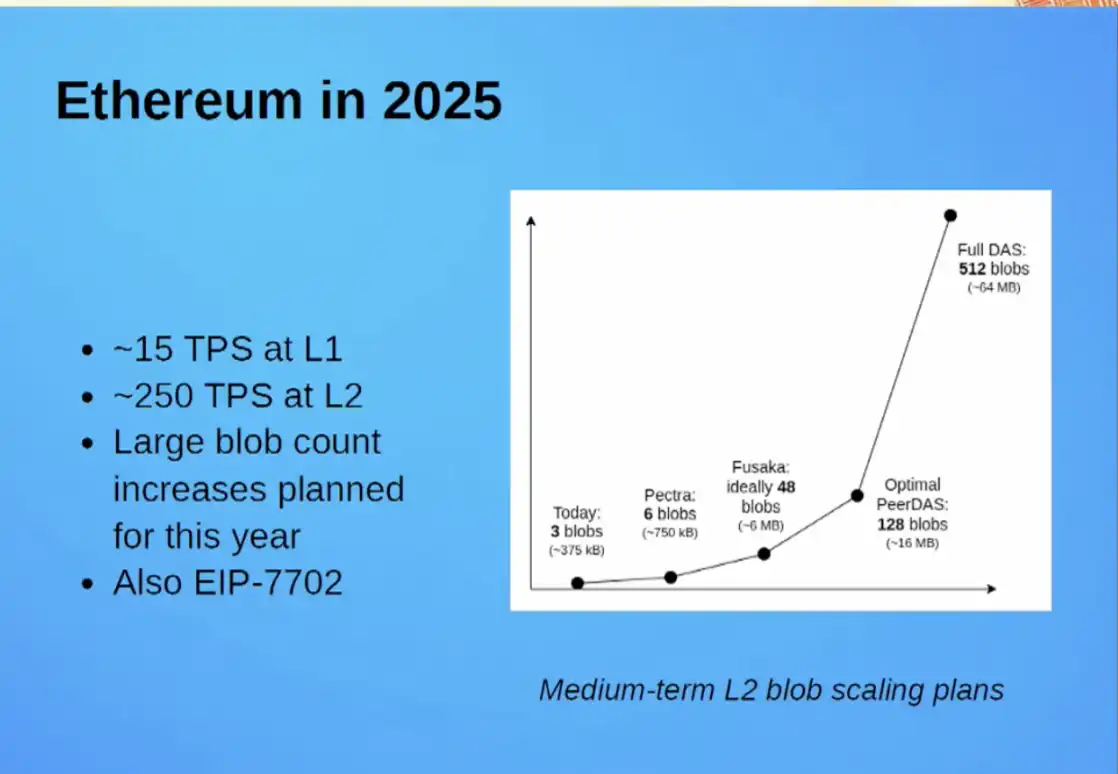
The upcoming Pectra upgrade will increase the Blob count from 3 to 6. Currently, 3 Blobs are approximately 375kb, generating 375kb of data every 12 seconds, roughly 20kb per second, corresponding to TPS of about 250; if the Blob count is increased to 6, TPS is expected to rise to 500. However, the expansion of Blob capacity largely depends on the Fusaka upgrade scheduled for the third or fourth quarter of this year. In an ideal scenario, the Fusaka upgrade could raise the Blob capacity to 48; if DAS is fully implemented, Blob capacity could reach 512, potentially allowing Ethereum L2's TPS to increase to tens of thousands.
Additionally, EIP-7702 has made significant progress, which is essentially the first step in abstracting accounts, giving accounts higher intelligence and security.
Of course, the extension of Ethereum L1 is equally crucial. Even if users widely adopt L2 in the future, L1 will still need to fulfill many key functions. Particularly when L2 experiences failures, L1 needs to provide corresponding remedies or support users in large-scale exit operations.
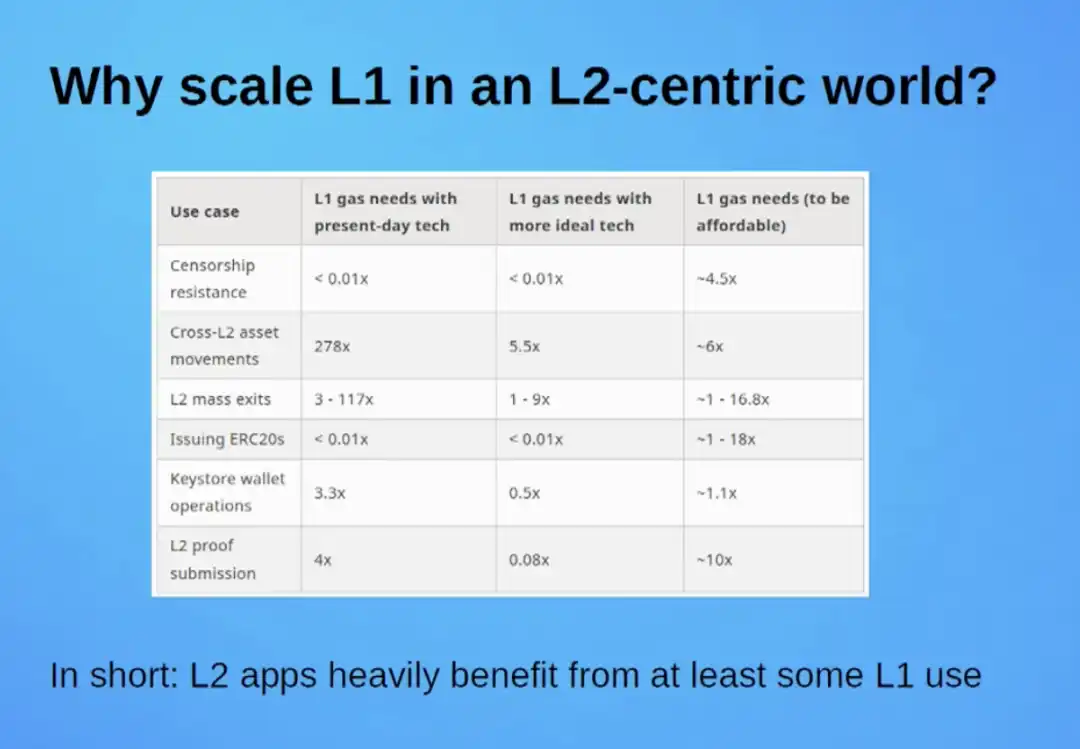
This means that despite the rapid development of L2, enhancing L1's scalability remains crucial to achieve censorship resistance and cross-L2 asset transfers. So, what changes will expanding L1 further bring?
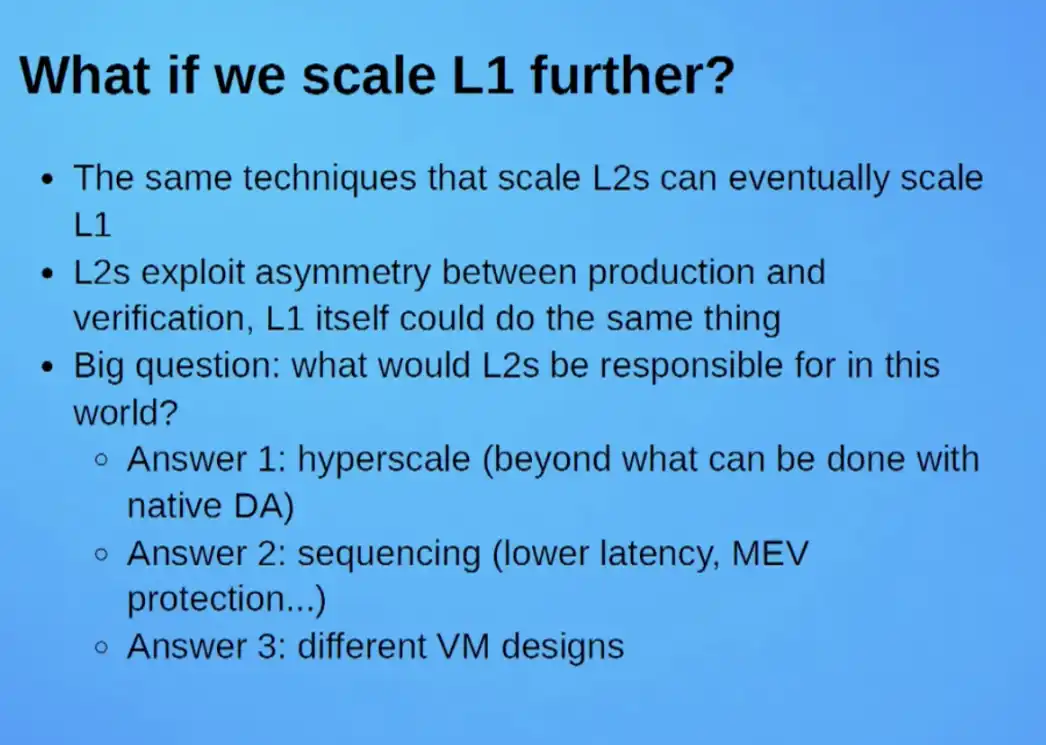
Extension technologies applied to L2 can also be used for L1 scalability in the future; L2 leverages the asymmetry between production and verification, a concept that L1 can also benefit from; in such a world, what responsibilities will L2 take on? 1. Hyperscale (beyond the level achievable by native DA); 2. Orderliness (lower latency, MEV protection, etc.); 3. Different virtual machine (VM) designs.
In other words, L1 can learn from L2's scaling solutions, while L2 continues to focus on processing transactions at hyperscale and experimenting with new technologies.
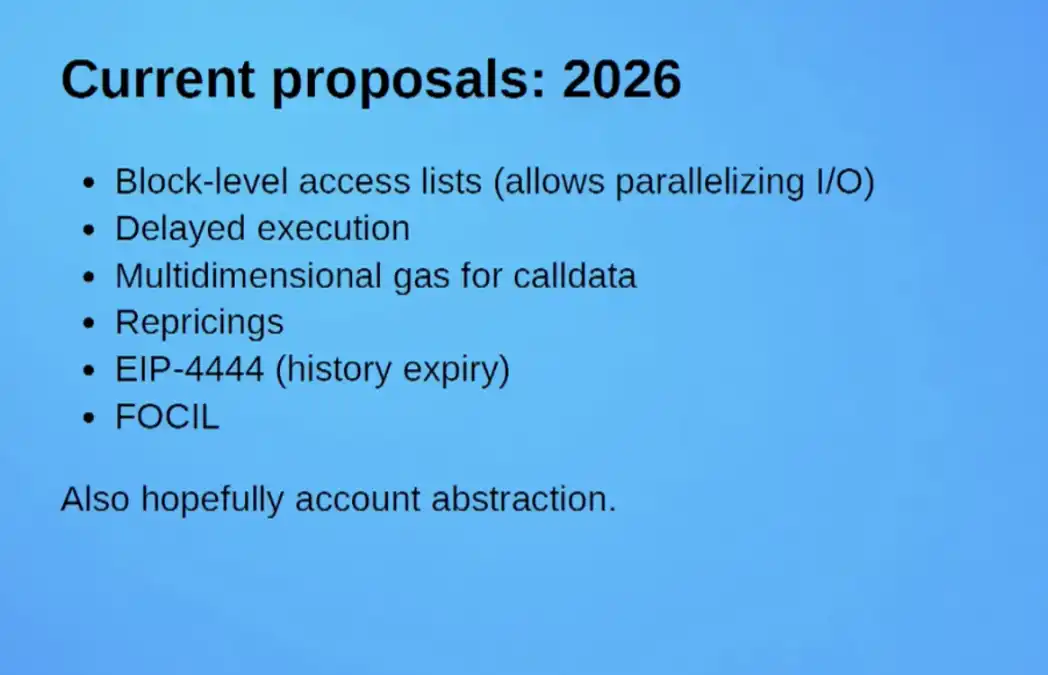
Vitalik expressed that in the short-term roadmap, a series of proposals are expected to be gradually implemented by 2026. Through these proposals, Ethereum is poised to significantly increase the Gas limit and achieve this goal securely while ensuring that node decentralization is not compromised.
Regarding the 2026 plan, some of the proposed initiatives include:
Block-level access lists (allowing I/O parallelization); delayed execution; multi-dimensional calldata Gas; repricing; EIP-4444 (historical data expiry): no longer requiring every Ethereum node to store Ethereum historical records, instead using a peer-to-peer network and distributing historical data in a more decentralized manner; FOCIL.
Vitalik also outlined numerous benefits that account abstraction can bring, including enhanced security and user experience; quantum attack resistance; Paymaster: allowing others to pay Gas fees for you or pay Gas fees with tokens other than ETH; support for smart contract wallets' native use; L1 lead, L1 follow.
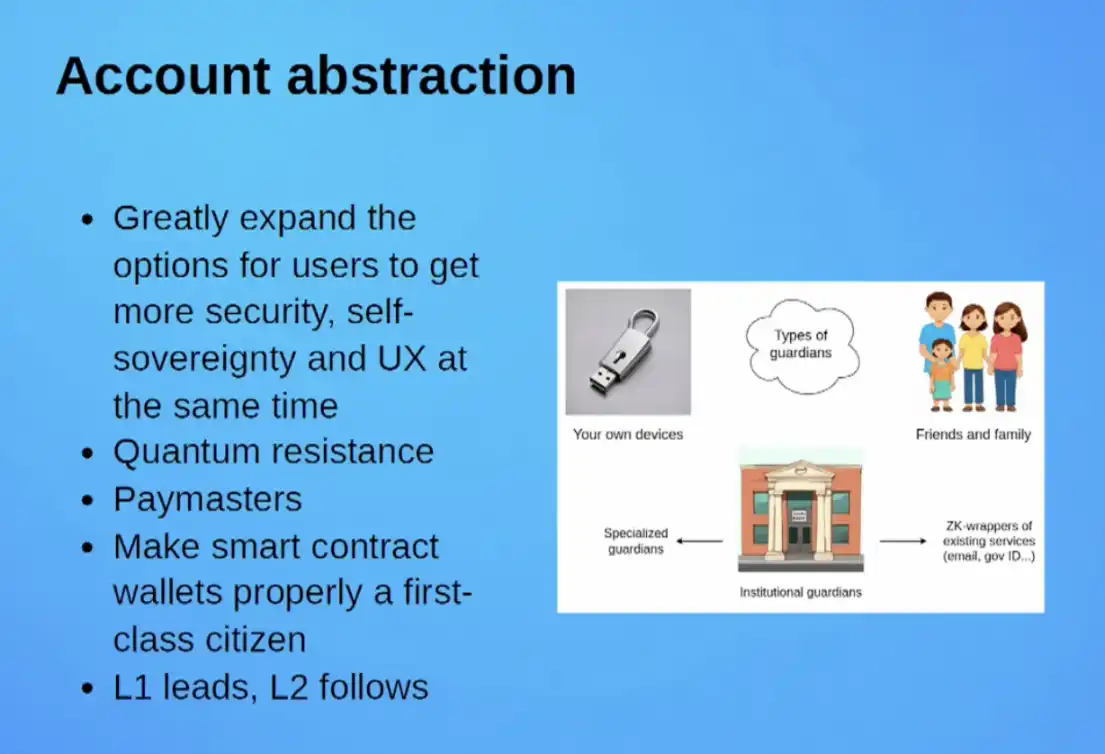
Furthermore, through technologies like Social Recovery and Guardians, Ethereum will provide more decentralized identity verification and asset control solutions.
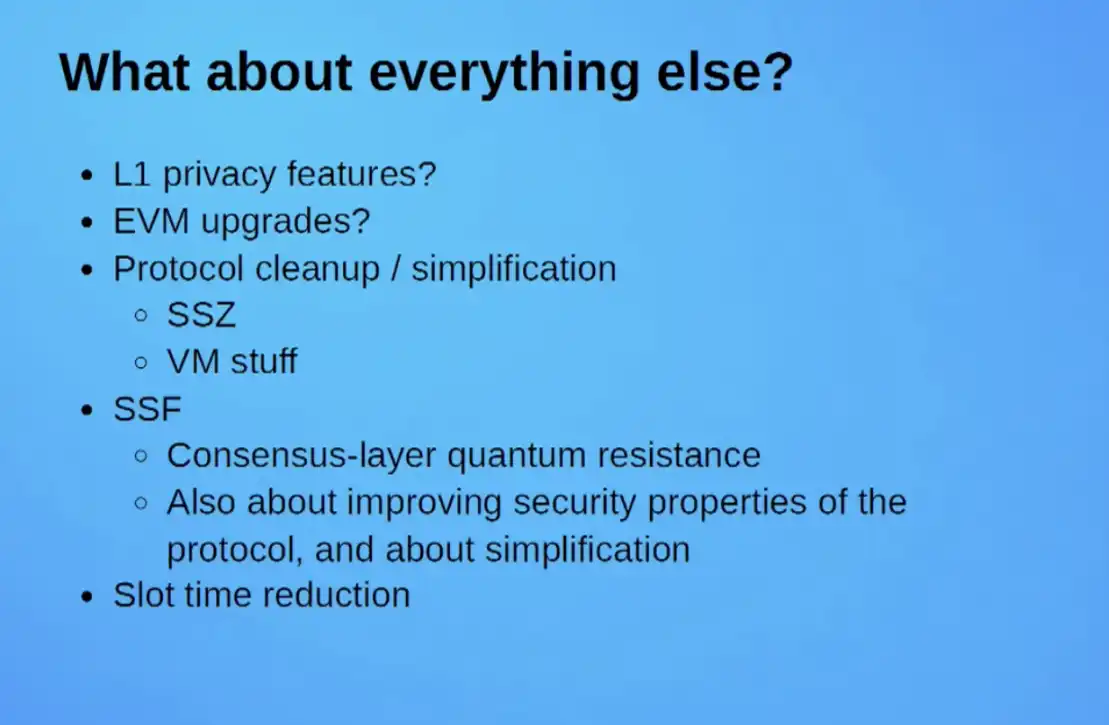
In other aspects, Ethereum is actively exploring L1 privacy enhancement, EVM upgrades, protocol cleanup/simplification, consensus layer quantum resistance improvement, protocol security properties and simplification optimizations, as well as Slot time reduction.
Overall, we need to improve L1, enhance L2, consider Ethereum's diversified development path, including AI-based approaches, improve the application layer, to truly drive the development of the Ethereum ecosystem. Ethereum is striving to be well-prepared for mainstream large-scale applications, with the ultimate goal of making Ethereum L1 the core of the "world computer," supporting a diverse range of applications with high security and efficiency.
You may also like

Social Capital CEO: How Equity Tokenization is Reshaping Capital Markets from US Stocks to SpaceX?

CoinGecko Report: Surge of 346% vs Dip of 20.8%, The Wild Rise of DEX

a16z: The Real Opportunity of Stablecoins Lies Not in Disruption but in Filling Gaps

Mining Exodus: Someone Holds $12.8 Billion AI Order

March 6 Market Key Intelligence, How Much Did You Miss?

a16z: The True Opportunity of Stablecoins is in Complementing, Not Disrupting

Predict LALIGA Matches, Shoot Daily & Win BTC, USDT and WXT on WEEX
The WEEX × LALIGA campaign brought together football excitement and crypto participation through a dynamic interactive experience. During the event, users predicted matches, completed trading tasks, and took daily shots to compete for rewards including BTC, USDT, WXT, and exclusive prizes.

Ray Dalio Dialogue: Why I'm Betting on Gold and Not Bitcoin

Who Took the Money in the AI Era? A Must-See Investment Checklist for HALO Asset Trading
Wall Street Bears Target Ethereum: Vitalik In the Know Takes Flight, Tom Lee Remains Bullish
Pump.fun Hacker Steals $2 Million, Receives 6-Year Prison Sentence, Opts for 'Self-Detonation'

6% Annual Percentage Yield as Musk Declares War on Traditional Banks
36 years, 4 wars, 1 script: How does capital price the world in conflict?

Mining Companies' Great Migration: Some Have Already Secured $12.8 Billion in AI Orders
What Is Vibe Coding? How AI Is Changing Web3 & Crypto Development
What is vibe coding? Learn how AI coding tools are lowering the barrier to Web3 development and enabling anyone to build crypto applications.
The parent company of the New York Stock Exchange strategically invests in OKX: The intentions behind the $25 billion valuation

WEEX P2P update: Country/region restrictions for ad posting
To improve ad security and matching accuracy, WEEX P2P now allows advertisers to restrict who can trade with their ads based on country or region. Advertisers can select preferred counterparty locations for a safer, smoother trading experience.
I. Overview
When publishing P2P ads, advertisers can now set the following:
Allow only counterparties from selected countries or regions to trade with your ads.
With this feature, you can:
Target specific user groups more precisely.Reduce cross-region trading risks.Improve order matching quality.
II. Applicable scenarios
The following are some common scenarios:
Restrict payment methods: Limit orders to users in your country using supported local banks or wallets.Risk control: Avoid trading with users from high-risk regions.Operational strategy: Tailor ads to specific markets.
III. How to get started
On the ad posting page, find "Trading requirements":
Select "Trade with users from selected countries or regions only".Then select the countries or regions to add to the allowlist.Use the search box to quickly find a country or region.Once your settings are complete, submit the ad to apply the restrictions.
When an advertiser enables the "Country/Region Restriction" feature, users who do not meet the criteria will be blocked when placing an order and will see the following prompt:
If you encounter this issue when placing an order as a regular user, try the following solutions.
Choose another ad: Select ads that do not restrict your country/region, or ads that allow users from your location.Show local ads only: Prioritize ads available in the same country as your identity verification.
IV. Benefits
Compared with ads without country/region restrictions, this feature provides the following improvements.
Aspect
Improvement
Trading security
Reduces abnormal orders and fraud risk
Conversion efficiency
Matches ads with more relevant users
Order completion rate
Reduces failures caused by incompatible payment methods
V. FAQ
Q1: Why are some users not able to place orders on my ad?
A1: Their country or region may not be included in your allowlist.
Q2: Can I select multiple countries or regions when setting the restriction?
A2: Yes, multiple selections are supported.
Q3: Can I edit my published ads?
A3: Yes. You can edit your ad in the "My Ads" list. Changes will take effect immediately after saving.



 App
App