
- Buy Crypto
- Markets
 Futures
- Spot
- Copy Trade
- Earn
- More
Wintermute Outlook: Funding Stagnation, Market Enters Zero-Sum Game Phase

Original Title: Liquidity, the lifeblood of crypto
Original Source: Wintermute
Original Translation: Azuma, Odaily Planet Daily
Key Takeaways
1. Liquidity drives the market cycles of the crypto sector, with inflows from stablecoins, ETFs, and DATs (Digital Asset Treasuries) slowing down.
2. Global liquidity remains ample, but higher SOFR rates are keeping funds parked in short-term treasuries (T-bills) rather than flowing into the crypto market.
3. The crypto market is in a phase of "self-circulation" — funds are circulating internally until new external funds re-enter.
The Dominant Role of Liquidity
Liquidity often dictates the cyclical nature of each cryptocurrency market cycle. While adoption in the long run may shape the narrative of the cryptocurrency industry, what truly drives price changes is the direction of fund flows.
Over the past few months, the momentum of this fund flow has notably slowed down. Capital entering the ecosystem through the three main channels — stablecoins, ETFs, and Digital Asset Treasuries (DAT) — has seen its velocity synchronized weakening, shifting the crypto market from an expansion phase to a stock fund-supported phase.
While technological adoption is crucial, liquidity is the key driver behind the market's cyclical shifts. It is not just a matter of market depth but also of fund availability. When global monetary supply expands or real interest rates decline, excess liquidity will inevitably seek risk assets, with crypto assets historically (especially during the 2021 cycle) being among the largest beneficiaries.
In previous cycles, liquidity primarily entered digital assets through stablecoin issuance, which is the most fundamental fiat on-ramp. As the market matures, three major liquidity funnels have gradually emerged, determining the path for new capital to enter the crypto market:
· Digital Asset Treasuries (DATs): Tokenized funds with yield structures, used to bridge traditional assets with on-chain liquidity.
· Stablecoins: On-chain forms of fiat liquidity, serving as the base collateral for leverage and trading activity.
· ETF: Provides a BTC and ETH exposure channel for traditional financial institutions and passive funds.
Combining the ETF's Assets Under Management (AUM), the DAT's Net Asset Value (NAV), and the circulating supply of stablecoins can serve as a reasonable metric to gauge the inflow of total digital asset capital.
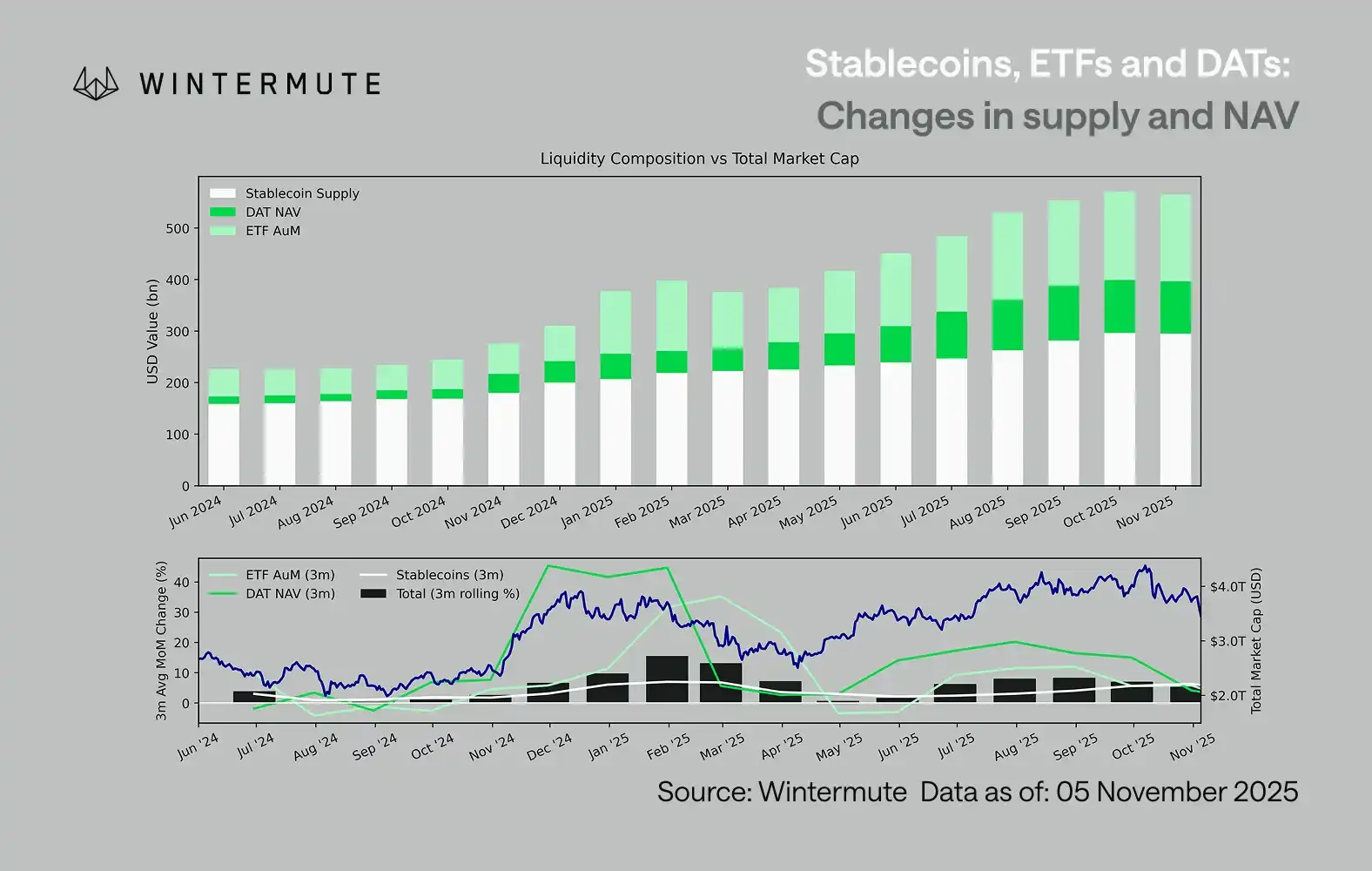
The chart below illustrates the changes in these components over the past 18 months. The bottom chart demonstrates that the variation in this total amount is highly correlated with the overall digital asset market capitalization—when inflows accelerate, prices also rise.
Which inflow path has slowed down?
An important insight reflected in the chart is that the momentum of inflows into DAT and ETF has significantly weakened. These two paths showed strong performance in the fourth quarter of 2024 and the first quarter of 2025, experienced a brief recovery in early summer, but the momentum has gradually dissipated since. Liquidity (M2) is no longer naturally flowing into the crypto ecosystem as it did at the beginning of the year. Since early 2024, the combined size of DAT and ETF has increased from around $400 billion to $2.7 trillion, while stablecoin supply has doubled from about $1.4 trillion to $2.9 trillion. This demonstrates structural growth but also indicates a clear "plateau."
Observing the deceleration pace of different paths is crucial as each path reflects distinct sources of liquidity: Stablecoins reflect the native risk appetite of the crypto market; DAT embodies institutional demand for yield assets; and ETFs map the allocation trend of traditional financial funds; with all three slowing down simultaneously, it suggests that new capital deployment is universally decelerating, not just rotating between products.
Stockpile Game Market
Liquidity has not vanished; it is merely circulating within the system, rather than expanding continuously.
From a broader macro perspective, overall economic liquidity (M2) outside the crypto market has not stalled. While higher SOFR rates may temporarily constrain liquidity—making cash returns more attractive, keeping funds in the treasury market—the world is still in an accommodative phase, and the U.S. quantitative tightening (QT) has officially ended. The structural backdrop remains supportive; it's just that liquidity is currently flowing more toward other risk expression forms, such as the stock market.
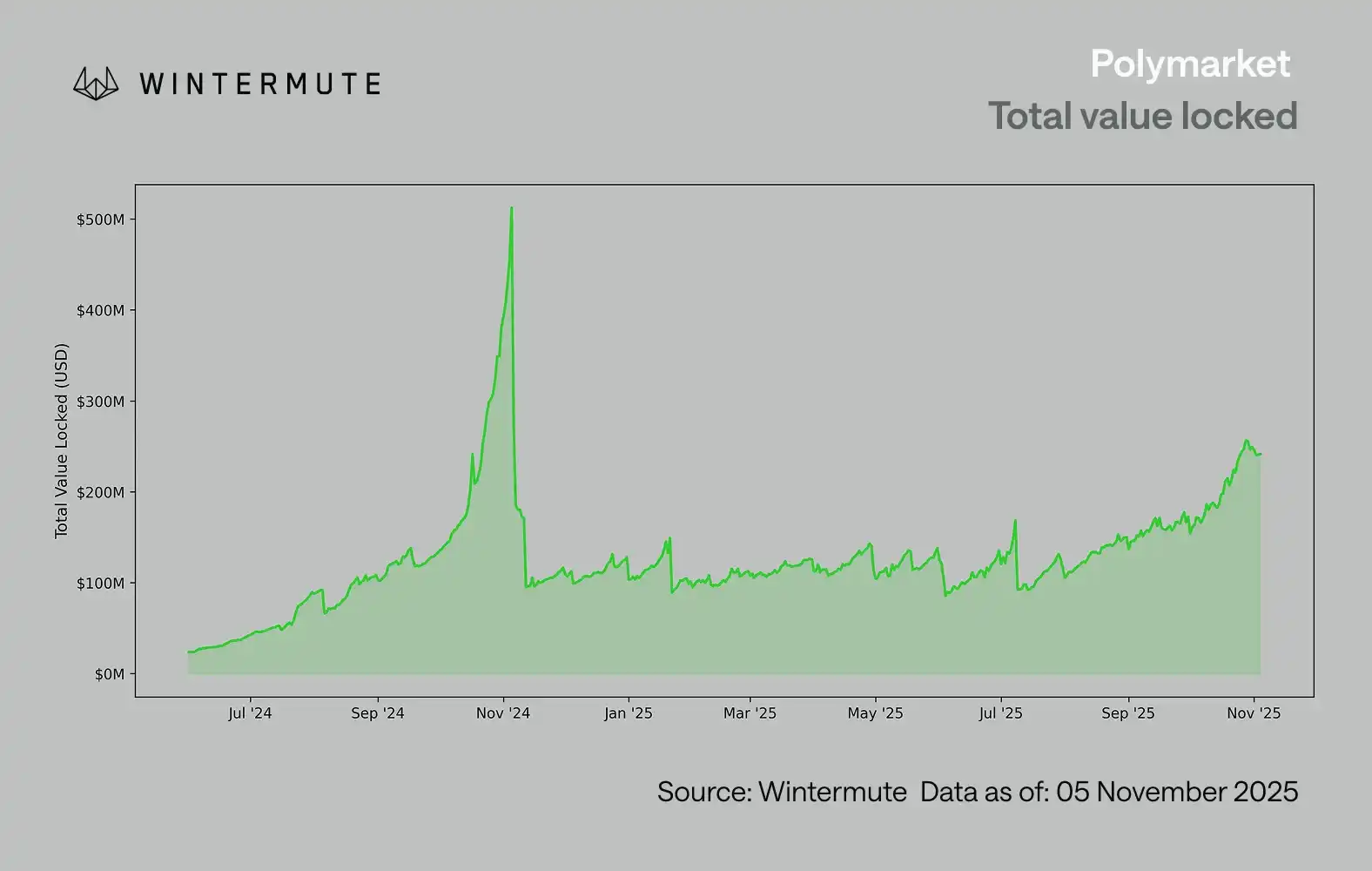
Due to a decrease in external funding inflows, the market dynamics have become more closed-off. Funds mostly rotate between large-cap coins and altcoins, creating an environment of internal PvP (player versus player). This explains why bull market rallies are always short-lived and why market breadth continues to narrow even when the total asset under management remains stable. Currently, the surge in market volatility is primarily driven by a cascade of liquidations rather than sustained trend-following.
Looking ahead, if any of the liquidity pathways see a substantial recovery — whether it's a resurgence in stablecoin minting, a renewed interest in ETFs, or a rebound in DeFi Activity Token (DAT) volume — it would signify that macro liquidity is flowing back into the digital asset space.
Until then, the crypto market will remain in a "self-sustaining" phase where funds circulate internally rather than compounding growth.
You may also like

How a Structured AI Crypto Trading Bot Won at the WEEX Hackathon
Ritmex demonstrates how disciplined risk control and structured signals can make an AI crypto trading bot more stable and reliable on WEEX, highlighting the importance of combining execution discipline with scalable AI trading systems.

Old Indicator Fails, Three Major New Signals Emerge: BTC True Bottom May Still Be Below $60K

Meeting OpenClaw Founder at a Hackathon: What Else Can Lobsters Do?

Huang Renxun's Latest Podcast Transcript: NVIDIA's Future, Embodied Intelligence and Agent Development, Soaring Demand for Inferencing, and AI's PR Crisis
How a Structured AI Crypto Trading Bot Won at the WEEX Hackathon
Crypto_Trade shows how structured inputs and controlled adaptability can build a more stable and reliable AI crypto trading bot within the WEEX AI Trading Hackathon, highlighting a practical path toward scalable AI trading systems.

AI Starts to Devour the Manufacturing Industry | Rewire News Morning Edition

When Scaling Meets Speed, Ethereum Foundation Introduces "Hardness" to Safeguard the Base Layer
Google, Circle, Stripe Flock Together to Let AI Spend Money: Payment Giants' Joys and Worries in 2026 Q1

$100 Billion Factory Purchase: Bezos and Middle Eastern Capital Shift AI Money from Cloud to Shop Floor

Xiaomi and MiniMax both unleash their ultimate moves, signaling the start of the Agent Pricing War.

Predicting markets has taken the spotlight, but the Perp DEX has been quietly waging war on traditional exchanges.

Is the Market Slump Still Making Millions a Day? Is pump.fun's Revenue Real?

Understanding x402 and MPP in One Article: The Two Paths of Agent Payments

Quick Look at the Latest 18 Graduation Projects from Alliance: Who's the Next Pump.fun?

It's not just the prediction market that profits from the Iraq War

The "bank card" of AI has caught the attention of the giants
Morning News | U.S. SEC approves tokenized trading on Nasdaq; Animoca Brands announces investment in AVAX tokens; Algorand Foundation completes strategic integration

$70 trillion wealth transfer, the financial gateway is being rewritten | Interview with Robinhood CEO Vlad Tenev
How a Structured AI Crypto Trading Bot Won at the WEEX Hackathon
Ritmex demonstrates how disciplined risk control and structured signals can make an AI crypto trading bot more stable and reliable on WEEX, highlighting the importance of combining execution discipline with scalable AI trading systems.
Old Indicator Fails, Three Major New Signals Emerge: BTC True Bottom May Still Be Below $60K
Meeting OpenClaw Founder at a Hackathon: What Else Can Lobsters Do?
Huang Renxun's Latest Podcast Transcript: NVIDIA's Future, Embodied Intelligence and Agent Development, Soaring Demand for Inferencing, and AI's PR Crisis
How a Structured AI Crypto Trading Bot Won at the WEEX Hackathon
Crypto_Trade shows how structured inputs and controlled adaptability can build a more stable and reliable AI crypto trading bot within the WEEX AI Trading Hackathon, highlighting a practical path toward scalable AI trading systems.


 App
App