
- Buy Crypto
- Markets
 Futures
- Spot
- Copy Trade
- Earn
- More
Yen Weakness Nears Inflation Red Line: Bank of Japan May Be Forced to Hike Early

Original Title: "Yen's Sharp Drop Forces Central Bank to Consider Early Rate Hike? Report: Officials More Concerned About Weak Exchange Rate's Impact on Inflation"
Original Author: Yeh Huiwen, Wall Street News
Bank of Japan officials are increasingly focused on the potential impact of the weak yen on inflation, a trend that could substantially disrupt the future rate hike path. According to sources familiar with the matter speaking to Bloomberg, while the Bank of Japan may keep rates unchanged at the upcoming policy meeting, exchange rate considerations may prompt a reevaluation of the timing of the rate hike, potentially even forcing an earlier action.
According to Bloomberg, Bank of Japan officials believe that the influence of the weak yen on prices is strengthening, especially as companies are increasingly inclined to pass on rising input costs to consumers, leading to further inflationary pressures. Despite the Bank of Japan having just raised its benchmark rate last month and not set a predetermined rate path, if the yen continues to weaken, policymakers may consider bringing forward the previously anticipated rate hike.
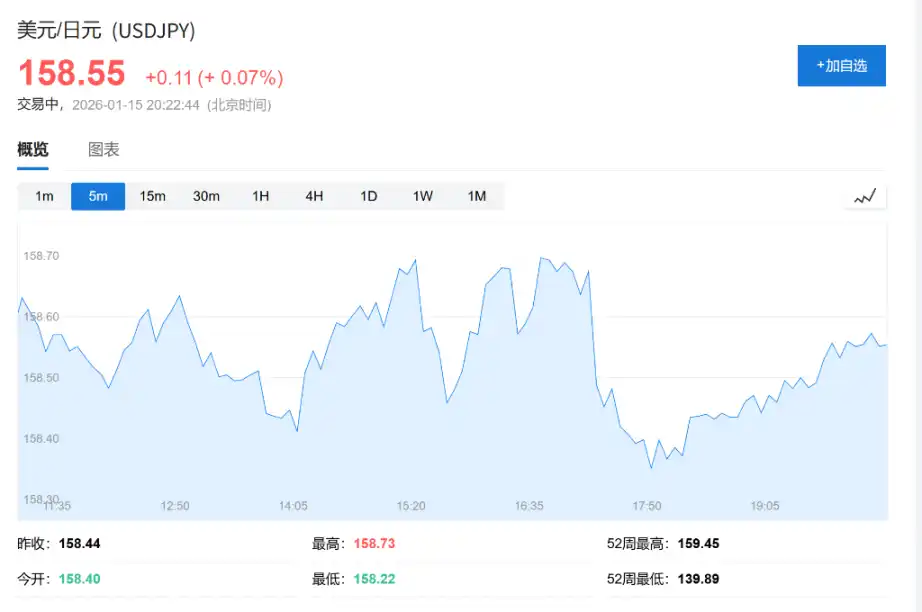
Currently, the general expectation among private economists is that the Bank of Japan will raise rates at a pace of approximately once every six months, implying that the next action could take place in the summer of this year. However, sources speaking to Bloomberg indicated that officials are inclined to act promptly on policy adjustments rather than being overly cautious, indicating variability in the market's previously expected rate hike pace. In response to this news, the yen to dollar exchange rate briefly dropped to around 158.68 before rebounding to 158.33. As of the time of writing, the yen against the dollar had fallen to 158.55.
January Meeting Expectation: Maintain Rates
The Bank of Japan is set to announce its latest policy decision on January 23. Sources familiar with the matter told the media that officials' current view is that keeping the rate at 0.75% is appropriate, a level that has reached a three-decade high. While the overall inclination is to hold steady, the committee will continue to monitor economic data and changes in the financial markets until the last moment to make the final decision.
The focus of this meeting will be on how the central bank assesses the yen's impact on potential inflation. Sources told Bloomberg that given the inflation trend is nearing the central bank's 2% target, officials will closely watch how exchange rate fluctuations alter household and business price expectations.
Exchange Rate Transmission Mechanism in Focus
A yen devaluation typically increases inflationary pressure by raising import costs and also boosts exporters' profits. However, some officials pointed out that as the yen continues to weaken, its negative impact on the economy may be growing. Officials believe that the Bank of Japan still has room to continue raising rates, with the key being to seize the timing of policy adjustments.
The voice of the Japanese business community on the exchange rate issue is also becoming increasingly frequent. Yoshinobu Tsutsui, President of Keidanren, Japan's largest business lobbying group, made rare comments this week, calling on the government to conduct currency intervention to prevent excessive depreciation of the yen, describing the recent yen trend as "a bit overdone."
Market Background and Political Factors
Despite the Bank of Japan raising interest rates on December 19, the yen continues to maintain a weak position against the US dollar. Influenced by the news that Prime Minister Takaichi Sanae will hold a snap election next month, the yen slid further this week to a new 18-month low.
Bloomberg data shows that the 10-year average exchange rate of the yen against the US dollar is 123.20, while over the past two years, the yen's exchange rate has fluctuated between approximately 140 and 161.95. Although it touched an 18-month low earlier this week and saw a slight rebound with intensified warnings from monetary authorities, the overall depreciation trend continues to exert sustained pressure on the central bank's decisions.
You may also like

Wall Street Shorts ETH: Vitalik is aware and has front-run, while Tom Lee remains oblivious

Social Capital CEO: How Equity Tokenization is Reshaping Capital Markets from US Stocks to SpaceX?

CoinGecko Report: Surge of 346% vs Dip of 20.8%, The Wild Rise of DEX

a16z: The Real Opportunity of Stablecoins Lies Not in Disruption but in Filling Gaps

Mining Exodus: Someone Holds $12.8 Billion AI Order

March 6 Market Key Intelligence, How Much Did You Miss?

a16z: The True Opportunity of Stablecoins is in Complementing, Not Disrupting

Predict LALIGA Matches, Shoot Daily & Win BTC, USDT and WXT on WEEX
The WEEX × LALIGA campaign brought together football excitement and crypto participation through a dynamic interactive experience. During the event, users predicted matches, completed trading tasks, and took daily shots to compete for rewards including BTC, USDT, WXT, and exclusive prizes.

Ray Dalio Dialogue: Why I'm Betting on Gold and Not Bitcoin

Who Took the Money in the AI Era? A Must-See Investment Checklist for HALO Asset Trading
Wall Street Bears Target Ethereum: Vitalik In the Know Takes Flight, Tom Lee Remains Bullish
Pump.fun Hacker Steals $2 Million, Receives 6-Year Prison Sentence, Opts for 'Self-Detonation'

6% Annual Percentage Yield as Musk Declares War on Traditional Banks
36 years, 4 wars, 1 script: How does capital price the world in conflict?

Mining Companies' Great Migration: Some Have Already Secured $12.8 Billion in AI Orders
What Is Vibe Coding? How AI Is Changing Web3 & Crypto Development
What is vibe coding? Learn how AI coding tools are lowering the barrier to Web3 development and enabling anyone to build crypto applications.
The parent company of the New York Stock Exchange strategically invests in OKX: The intentions behind the $25 billion valuation

WEEX P2P update: Country/region restrictions for ad posting
To improve ad security and matching accuracy, WEEX P2P now allows advertisers to restrict who can trade with their ads based on country or region. Advertisers can select preferred counterparty locations for a safer, smoother trading experience.
I. Overview
When publishing P2P ads, advertisers can now set the following:
Allow only counterparties from selected countries or regions to trade with your ads.
With this feature, you can:
Target specific user groups more precisely.Reduce cross-region trading risks.Improve order matching quality.
II. Applicable scenarios
The following are some common scenarios:
Restrict payment methods: Limit orders to users in your country using supported local banks or wallets.Risk control: Avoid trading with users from high-risk regions.Operational strategy: Tailor ads to specific markets.
III. How to get started
On the ad posting page, find "Trading requirements":
Select "Trade with users from selected countries or regions only".Then select the countries or regions to add to the allowlist.Use the search box to quickly find a country or region.Once your settings are complete, submit the ad to apply the restrictions.
When an advertiser enables the "Country/Region Restriction" feature, users who do not meet the criteria will be blocked when placing an order and will see the following prompt:
If you encounter this issue when placing an order as a regular user, try the following solutions.
Choose another ad: Select ads that do not restrict your country/region, or ads that allow users from your location.Show local ads only: Prioritize ads available in the same country as your identity verification.
IV. Benefits
Compared with ads without country/region restrictions, this feature provides the following improvements.
Aspect
Improvement
Trading security
Reduces abnormal orders and fraud risk
Conversion efficiency
Matches ads with more relevant users
Order completion rate
Reduces failures caused by incompatible payment methods
V. FAQ
Q1: Why are some users not able to place orders on my ad?
A1: Their country or region may not be included in your allowlist.
Q2: Can I select multiple countries or regions when setting the restriction?
A2: Yes, multiple selections are supported.
Q3: Can I edit my published ads?
A3: Yes. You can edit your ad in the "My Ads" list. Changes will take effect immediately after saving.


 App
App