
What Is Tokenized USO/USOS and How Do Commodity-Backed RWAs Function in DeFi Trading in 2026

 Prefer us on Google


Executive Market & Narrative Summary
Tokenized commodities crossed roughly $7.37 billion in total market capitalization by early April 2026, but that headline number obscures a lopsided reality: gold alone, through Tether Gold and Paxos Gold, accounts for close to 74% of it, leaving oil-linked products like USOon as small, structurally immature experiments by comparison. Ondo Finance's USOon, a tokenized wrapper on the United States Oil Fund ETF, traded around $108 with a market cap near $2 million and daily volume under $500,000 as of late June 2026, per MetaMask's own pricing data. Our structural view here breaks from the retail narrative that treats oil tokenization as simply "gold's next category." Gold has a century of vaulting, assay, and redemption infrastructure that transferred cleanly on-chain. Oil has none of that at the retail token level, it's a paper claim on an ETF share, not a barrel in a tank, and that distinction changes the entire risk conversation. This piece also untangles a naming trap retail traders keep falling into: USOR, a Solana-native RWA-branded token, borrows oil imagery without any custodial link to the actual USO ETF at all.
What Does Tokenized USO Actually Represent as an On-Chain Asset
Tokenized USO, most prominently issued as USOon by Ondo Finance, is a blockchain token that provides fractional economic exposure to shares of the United States Oil Fund ETF rather than direct ownership of physical crude oil reserves. This distinction is the single most important thing a beginner trader needs to internalize before touching this product category.
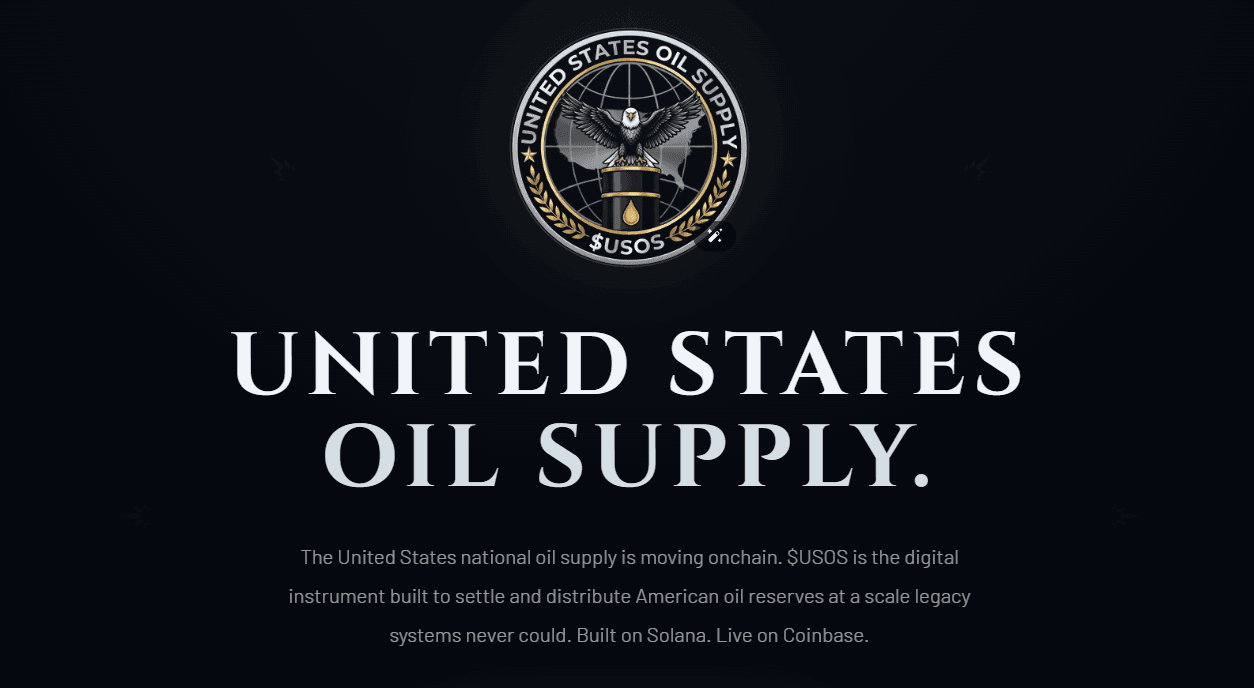
USOS Official Contact Address:Eer3tVuejo9QPm9SGjJC5brn7bMzEEzymMrAeo7tZ3Y2
How the Ondo Global Markets Wrapper Structure Works
USOon operates through Ondo Global Markets, minting a token backed 1:1 by actual USO ETF shares, with real-time price tracking delivered through Chainlink oracle data feeds rather than a synthetic algorithmic peg. Per Ondo's own product documentation, the token settles economic exposure identically across two access windows, standard trading availability runs 24 hours a day, five days a week matching conventional market sessions, from Sunday evening through Friday evening New York time, while peer-to-peer wallet-to-wallet transfers remain available continuously across weekends and holidays. That distinction matters practically. You can move your USOon position to another wallet at 3 a.m. on a Saturday, but you cannot execute a new buy or sell order against the underlying price feed until the standard window reopens, which is a meaningfully different liquidity profile than crypto-native assets that trade with zero interruption.
Why This Is Fundamentally a Claim on a Fund Share, Not a Barrel of Oil
The critical mechanical point retail marketing frequently blurs is that USOon derives its value from USO the ETF, which itself holds oil futures contracts, not from a custodian physically storing crude oil in a tank somewhere. This makes tokenized USO a second-order derivative wrapper, a token tracking a fund that tracks a futures curve, layering blockchain settlement on top of an already-indirect commodity exposure vehicle. Our take is that this layering is precisely why oil tokenization has stalled so far behind gold. Gold tokens like PAXG and XAUT settle against a physical, assayable, vaultable unit, one fine troy ounce, sitting in Brink's or comparable secure storage with monthly attestations. Oil tokenization at the retail level has never solved that same physical redemption problem, because storing and insuring actual barrels of crude at scale for token holders is a logistics and cost problem gold's small physical footprint simply doesn't share.
How Do Commodity-Backed RWAs Actually Differ From Tokenized Equities and Treasuries
Commodity-backed RWAs occupy a structurally distinct risk category from tokenized equities or Treasuries because the underlying asset itself, not just the custody wrapper, introduces additional physical storage, insurance, and redemption complexity that paper financial instruments never face. Understanding this distinction is what separates an informed RWA trader from someone chasing yield without reading the fine print.
Why Gold Dominates While Oil, Silver, and Softs Remain Small Experiments
Gold tokens function through a genuinely mature vaulting and redemption infrastructure that decades of institutional gold-backed financial products already built, while tokenized oil, silver, and agricultural commodities exist as comparatively small experiments that still lack equivalent redemption plumbing. Paxos's PAXG, regulated under a New York Department of Financial Services trust charter with monthly reserve attestations, and Tether Gold's XAUT, vaulted in Switzerland, both settle against one troy ounce per token with redemption processes that institutional custodians have already stress-tested across market cycles. Oil's underlying complexity, futures contract rolls, storage-cost variability, geographic delivery specifications, means no issuer has yet built comparable retail-grade physical redemption infrastructure, which is exactly why every current oil tokenization product routes through an ETF wrapper instead of attempting direct physical-barrel backing.
| RWA Commodity Category | Approximate Market Cap (2026) | Backing Mechanism | Redemption Maturity |
|---|---|---|---|
| Gold (XAUT, PAXG combined) | ~$5.1 billion (74% of category) | Physical ounce in vault, monthly attestation | Mature, institutional-grade |
| Oil (USOon and similar) | ~$2 million (single-product scale) | ETF share wrapper, not physical crude | Early-stage, ETF-dependent |
| Silver, agricultural softs | Small, experimental scale | Varies, generally thin infrastructure | Minimal, largely unproven |
| Tokenized Treasuries (comparison) | $2.1-2.8 billion per major issuer | Money-market fund or T-bill portfolio shares | Mature, daily yield distribution |
How DeFi Composability Changes What You Can Do With a Commodity Token Versus the Real Asset
The genuine structural reward of commodity tokenization is composability, meaning a token like USOon can be used as loan collateral, deposited into liquidity pools, or integrated into automated yield strategies in ways the underlying ETF share never could be inside a traditional brokerage account. This is the actual value proposition beyond simple price speculation. A traditional USO ETF share sits inert in a brokerage account generating zero additional utility beyond its price exposure. A tokenized equivalent can theoretically be pledged as collateral for a stablecoin loan, paired in an automated market maker pool, or layered into a broader on-chain portfolio strategy, all without leaving the wallet or triggering a separate brokerage transaction. Our structural read, though, is that this composability reward is currently more theoretical than realized for oil specifically, given that a $2 million market cap token with under $500,000 in daily volume simply doesn't have the liquidity depth to support meaningful DeFi integration without significant slippage, a limitation that gold-backed tokens with billions in circulation don't face nearly as acutely.
Why Does the USOR Naming Collision Create a Genuine Trap for Retail Traders
USOR, sometimes marketed as referencing the "United States Oil Reserve," is a Solana-based token that borrows oil-related branding and RWA terminology without any actual custodial claim on the real United States Oil Fund ETF or physical petroleum reserves. This is a textbook case of narrative-borrowing that every trader researching tokenized oil exposure needs to check before allocating capital.
How to Verify Which Product You're Actually Looking At
Confirming whether a specific "oil token" is a custodied RWA wrapper like USOon or a narrative-driven token like USOR requires checking three things: the issuing platform's regulatory registration, whether the token discloses a specific custodian or ETF-share backing mechanism by name, and whether independent price trackers classify it as an RWA product tied to a real fund versus a standalone crypto-native asset. Per available market coverage, USOR's own promotional materials acknowledge it operates independently of any formal link to the actual USO ETF, using the imagery and terminology of oil reserves while functioning as a speculative Solana ecosystem token whose price trajectory depends far more on general RWA-narrative sentiment and trading volume sustainability than on any crude oil futures curve.
Why This Distinction Matters More for Commodities Than It Does for Equities
The naming-collision risk is arguably more dangerous in commodity RWAs than in tokenized equities, because commodity tickers are less standardized and more prone to narrative branding than widely recognized stock tickers that retail traders already associate with a specific public company. A trader searching "GME crypto" at least has a well-known equity ticker as a reference anchor. A trader searching "tokenized oil" or "USO crypto" has far less standardized terminology to filter against, which is precisely the ambiguity that narrative-driven tokens like USOR are positioned to exploit, whether or not that exploitation is the deliberate intent of any specific project.
What Structural Risks Should a Trader Actually Weigh Before Holding a Commodity RWA
Commodity-backed RWAs carry a distinct risk stack layering custody risk, oracle risk, and liquidity risk on top of whatever price volatility the underlying commodity itself already carries, and each layer deserves separate evaluation rather than being treated as a single generic "crypto risk."
How Oracle Dependency Creates a Failure Point Separate From Custody
Every tokenized commodity depends on a price oracle, commonly Chainlink in Ondo's implementation, correctly relaying the underlying ETF or spot price on-chain in real time, and any lag or malfunction in that feed creates a temporary but real gap between the token's on-chain price and the actual reference asset's value. This is a distinct risk from whether the custodian is solvent and actually holding what it claims. A perfectly custodied token can still trade at a meaningful premium or discount during a volatile session if its oracle update lags the underlying market, and that mispricing window is exactly when uninformed traders transacting at the stale price absorb losses that have nothing to do with the commodity's actual fundamentals.
Why Liquidity Depth Determines Whether Composability Is a Real Feature or a Marketing Claim
A commodity RWA's advertised DeFi composability, collateral use, liquidity pool integration, yield strategies, only functions in practice if the token carries sufficient trading volume and pool depth to support those use cases without severe slippage. USOon's roughly $2 million market cap and sub-$500,000 daily volume as of mid-2026 illustrate why oil tokenization composability claims should be read skeptically relative to gold tokens carrying billions in circulating supply and correspondingly deeper integration across lending protocols and liquidity venues. Traders evaluating whether a specific commodity RWA can genuinely support the leveraged or collateralized strategies its marketing describes should check actual on-chain pool depth directly rather than assuming composability claims apply uniformly across the entire commodity-tokenization category, and reviewing live market depth data through the WEEX TradFi market is a reasonable step before committing capital to a thinly traded RWA wrapper.
What Regulatory Classification Risk Applies Specifically to Commodity Wrappers
Commodity-backed RWA tokens generally fall within securities or commodities-adjacent regulatory classifications precisely because they represent claims on an underlying regulated fund or physical asset, exposing issuers and by extension holders to the same evolving SEC and CFTC jurisdictional questions affecting tokenized equities more broadly. The same regulatory bifurcation separating issuer-sponsored, custodial, and synthetic models in equity tokenization applies conceptually to commodities as well, meaning a trader's actual legal standing depends heavily on which specific issuer and jurisdiction backs the particular token, not on the commodity category itself.
Evaluating tokenized commodities responsibly means separating genuine physical-backing infrastructure maturity, which gold has built and oil has not, from marketing narratives that borrow commodity imagery without equivalent custodial substance, and sizing any position according to the actual liquidity depth and oracle reliability of the specific product rather than the broader RWA category's headline growth numbers. As institutional tokenization infrastructure continues maturing through 2026, building the habit of verifying custody chains, checking oracle providers, and confirming actual redemption mechanisms before allocating capital remains the most defensible framework for navigating this still-early corner of on-chain finance.
Frequently Asked Questions About Tokenized USO and Commodity RWAs
1. Does owning tokenized USO mean I own physical crude oil
No, tokenized USO products like USOon represent economic exposure to shares of the United States Oil Fund ETF, which itself holds oil futures contracts, meaning you own a blockchain-based claim on fund shares rather than any physical barrel of crude oil in storage.
2. What is the difference between USOon and USOR
USOon is an Ondo Finance product backed 1:1 by actual United States Oil Fund ETF shares with real-time Chainlink oracle price tracking, while USOR is a separate Solana-based token that uses oil reserve branding and terminology without any formal custodial link to the real USO ETF or physical oil reserves.
3. Why does gold dominate the tokenized commodity market compared to oil
Gold benefits from decades of mature vaulting, assay, and redemption infrastructure that transferred cleanly into blockchain custody models, while oil's underlying complexity around storage costs and futures contract mechanics has prevented issuers from building comparable retail-grade physical redemption systems, leaving oil tokenization dependent on ETF wrappers instead.
4. Can I use tokenized commodities like USOon in DeFi lending or liquidity pools
Technically yes, since the underlying architecture supports collateral use and liquidity pool integration, but practical usability depends heavily on the specific token's trading volume and market depth, and USOon's roughly $2 million market cap as of mid-2026 limits how much meaningful DeFi composability the product can currently support without significant slippage.
5. What are the main risks of holding a commodity-backed RWA token
The primary risks include custodian solvency and redemption reliability, oracle price feed lag or malfunction creating temporary mispricing, thin liquidity limiting both exit options and genuine DeFi utility, and evolving regulatory classification questions that determine what legal claim, if any, a token holder actually has against the underlying asset or issuer.
Disclaimer: This content is provided for general branding and informational purposes only and doesn't constitute financial, investment, legal, or tax advice. Any events, rewards, online events, or related information mentioned herein should not be considered a recommendation, solicitation, or invitation to purchase, sell, trade, or otherwise deal in any crypto assets or to use any services. Crypto assets are highly volatile and may result in loss. WEEX services and online events may not be available in all regions and are subject to applicable laws, regulations, and eligibility requirements. You are responsible for ensuring that your use of WEEX services complies with local laws and for carefully assessing the risks before participating in any crypto-related activities.
You may also like
What Is a Broker? The Complete Guide to Understanding Financial and Crypto Brokers
How to Compare Crypto Brokers: What the Rankings Don't Tell You and What Actually Matters
Oracle Stock Price Prediction 2026-2027: Can ORCL Reach $250 After the Pentagon Deal?
Is Oracle Stock a Buy After the $7 Billion Pentagon Deal? What the Defense Contract Changes
SPCX Stock Price Is Down $1 Trillion From Its Peak: Is Now the Time to Buy?
Is Tesla Stock a Buy at $320 After the Q2 Earnings Crash?

SPCX Stock Price and Starship Flight 13: What Tonight's Launch Needs to Deliver
Why Tesla Stock Crashed 14% on Record Revenue: What the 1.4% Operating Margin Actually Means
Tesla Stock Is Betting Everything on Robotaxi and Optimus: What Investors Are Actually Paying For
Intel Stock vs AMD Stock: Which Chip Giant Is the Better Buy After Q2?
Intel Stock Price Prediction 2026-2027: Can INTC Reach $150 After the Foundry Turnaround?
What Are the Risks and Rewards of Trading Tokenized Equities Like GME On-Chain in 2026
Is Intel Stock a Buy After Q2 Earnings? What 163% Year to Date Gain and Raised Guidance Tell Investors
How Does Tokenized GameStop (GMEx) Differ From the GME Meme Coin on Blockchains in 2026
Goldman Sachs CEO Backs Senate Crypto Bill: The Institutional Blueprint for Wall Street On-Chain Liquidity in 2026
Intel Stock Soars After Q2 Earnings Beat: What the Strongest Revenue Growth in 15 Years Actually Means
Why Did Goldman Sachs CEO David Solomon Endorse the Senate Crypto CLARITY Act in 2026
WEEX API Compatibility: What Changes When You Migrate From Another Exchange
WEEX API Python SDK: How to Sign and Call It End to End
CRUDEOIL Airdrop: Share 50,000 USDT Rewards on WEEX
USDC Use Cases Explained: Payments, DeFi, Cross-Border Transfers, and Key Risks
Top Crypto Brokers in 2026: Types, Rankings and How to Choose the Right One
SpaceX IPO Stock Performance: SPCX From $135 to the Lock-Up Test
What Is a Crypto Broker? How Is It Different From a Crypto Exchange?
What Is a Futures API? How to Call It and Keep It Safe
Robinhood Chain Explorer: How to Find the Official One
WEEX API Guide: Setup, Calls, Permissions, and Security
5 Reasons WEEX Poker Party Series 4 Is the Event You Don't Skip
The Joker Is Back: Draw Your Share of a $1,000,000 USDT Pool on WEEX
How to Start Crypto Quantitative Trading as an Individual
What Is a Broker? The Complete Guide to Understanding Financial and Crypto Brokers
How to Compare Crypto Brokers: What the Rankings Don't Tell You and What Actually Matters
Oracle Stock Price Prediction 2026-2027: Can ORCL Reach $250 After the Pentagon Deal?
Is Oracle Stock a Buy After the $7 Billion Pentagon Deal? What the Defense Contract Changes
SPCX Stock Price Is Down $1 Trillion From Its Peak: Is Now the Time to Buy?
Is Tesla Stock a Buy at $320 After the Q2 Earnings Crash?






