
Why Did Goldman Sachs CEO David Solomon Endorse the Senate Crypto CLARITY Act in 2026

 Prefer us on Google
Executive Market & Narrative Summary
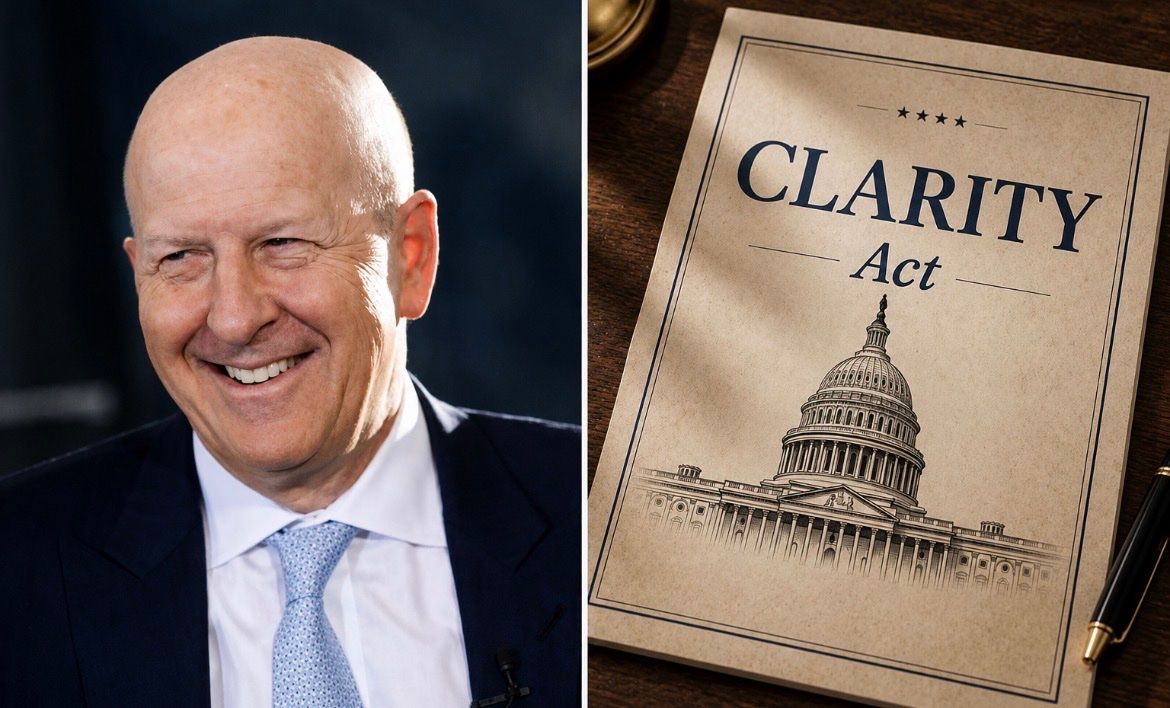
David Solomon broke ranks with much of Wall Street on July 23, 2026, publicly backing the CLARITY Act as Senate Republicans pushed revised bill text toward a possible floor vote before the August recess. According to a Politico interview that rippled across financial media within hours, Solomon called the legislation imperfect but necessary, arguing it would finally give regulated institutions a clear jurisdictional map for digital assets. The endorsement matters less as a policy opinion and more as a signal of capital positioning: Goldman already runs live tokenized real estate infrastructure and has an ETF filing sitting in a competitive bitcoin income product race. Our own read is that Solomon's timing is not really about ideology at all. It's about locking in first-mover regulatory alignment before a legislative window closes for months, while JPMorgan's Jamie Dimon digs in on a genuinely separate structural concern, deposit flight risk from yield-bearing stablecoins, that has nothing to do with whether crypto itself gets clearer rules.
What Did Solomon Actually Say and Why Does the Framing Matter
Solomon told Politico he wants to see the CLARITY Act "move forward" so market structure can get settled and the broader innovation cycle can continue, while conceding the bill has flaws worth debating. That framing is deliberate: he is not selling crypto to Goldman's institutional client base, he is selling regulatory certainty as a prerequisite for capital that is already sitting on the sidelines.
Why a Level Playing Field Argument Beats a Deregulation Argument
Solomon's central phrase, that the bill creates "a level playing field to enhance market stability," is a risk-management pitch aimed squarely at compliance officers and boards, not a pro-crypto ideological stance. This distinction is the whole ballgame for how this endorsement should be read. A bank the size of Goldman doesn't need permission to be bullish on blockchain technology; it needs a settled jurisdictional answer so its legal department can sign off on scaling existing pilot products without exposure to retroactive enforcement risk. Framing it as "stability" rather than "opportunity" is a calculated move designed to neutralize the exact objection that has kept large banks cautious for years: regulatory whiplash.
What Jurisdictional Gap Is the Bill Actually Closing
The CLARITY Act, as currently drafted, would settle a multi-year turf dispute by classifying most digital assets as non-securities and placing primary oversight with the CFTC rather than the SEC, while assigning specific rules to exchanges, brokers, and token issuers. That single classification question is precisely what has kept large custodians and asset managers structurally cautious, because building compliance infrastructure around an asset class that could be retroactively reclassified as a security carries legal exposure most risk committees won't accept at scale.
How Does Goldman's Own Balance Sheet Explain the Timing
Goldman's endorsement lands weeks after the bank disclosed $4.04 trillion in assets under supervision for the second quarter of 2026, a $391 billion quarterly increase that gives Solomon's public comments outsized institutional weight compared to a mid-tier regional bank making the same argument. Numbers at that scale are the real subtext behind the endorsement.
What Live Crypto Infrastructure Is Goldman Already Running
Goldman has partnered with outside firms on a tokenized real estate fund built on its proprietary blockchain-based digital asset platform, giving it operational, not theoretical, exposure to on-chain settlement of real-world assets. That is a meaningfully different starting position than a bank simply issuing a supportive press statement. When a firm already has tokenized infrastructure live, the calculus around regulatory clarity shifts from "should we enter this market" to "how fast can we scale what we've already built," and that urgency shows up directly in how forcefully an executive lobbies for a specific bill.
Why the Bitcoin Income ETF Filing Adds Competitive Pressure
Goldman Sachs Asset Management filed for a bitcoin-linked premium income ETF using a covered-call structure only after a larger rival's competing bitcoin income product had already launched, turning regulatory clarity into a genuine competitive race rather than a leisurely policy debate. Our take here is straightforward: when an asset manager is playing catch-up in a specific product category, every month of regulatory ambiguity is a month of lost market share to the first mover. That competitive pressure, more than any abstract belief in blockchain's future, is a very plausible driver behind why Solomon chose this exact week to go public with his position.
| Institutional Position Holder | Stance on CLARITY Act | Core Rationale |
|---|---|---|
| Goldman Sachs (Solomon) | Endorses | Regulatory certainty enables scaling existing tokenization and ETF products |
| JPMorgan (Dimon) | Opposes | Stablecoin yield provisions create unfair deposit-competition with insured banks |
| A leading US-listed digital asset exchange (CEO) | Supports | Calls the bill a genuine bipartisan compromise ready for a floor vote |
| Senate Democratic caucus | Rejects current draft | Ethics provisions seen as inadequate given existing conflict-of-interest concerns |
| Community and regional banking groups | Oppose | Warn of deposit flight undermining local lending capacity |
Solomon personally disclosed he holds "very little" bitcoin, a detail that matters analytically because it separates his institutional advocacy from any personal price-appreciation motive. He is not lobbying as a holder hoping for a favorable tax or custody regime on his own coins; he is lobbying as the head of a firm whose asset-management and platform businesses depend on category-wide clarity that applies well beyond any single token.
Why Is Jamie Dimon's Opposition a Separate Argument, Not a Rebuttal
Dimon's objection centers narrowly on stablecoin yield mechanics, not on whether crypto markets deserve clearer federal rules in general, which is why treating Goldman and JPMorgan as simply "for" and "against" crypto regulation misses the actual structural disagreement. As reported from his earlier Fox Business remarks, Dimon's concern is that the bill would let crypto firms offer yield on dollar-pegged stablecoins that functions economically like a bank deposit, without requiring the same capital reserves, deposit insurance, or prudential oversight banks must maintain.
How Does the Deposit Flight Argument Actually Work Mechanically
If a stablecoin issuer can offer a competitive yield without holding the reserve capital a bank must hold against insured deposits, rational depositors have a direct financial incentive to move dollars out of FDIC-insured accounts and into yield-bearing stablecoins, shrinking the deposit base regional and community banks rely on for local lending. This is a genuine structural concern, not simply protectionist noise from an incumbent industry. Community banking groups have echoed the same warning, framing it as a systemic capital-formation issue for local credit markets rather than a competitive grievance specific to JPMorgan's own balance sheet.
Why Goldman and JPMorgan Aren't Actually Contradicting Each Other
Solomon's business lines, tokenization infrastructure, ETF products, institutional custody, don't directly compete with the deposit-taking function that Dimon is defending, which is why a bank of Goldman's scale can support the bill's market-structure clarity while a deposit-heavy commercial bank objects to one specific provision inside the same legislation. Reducing this to "Wall Street splits over crypto" flattens a more precise story: two banks with different core business models are reacting rationally to how one bill's specific provisions interact with their own balance sheet exposure.
What Political Friction Still Threatens the Bill's Path
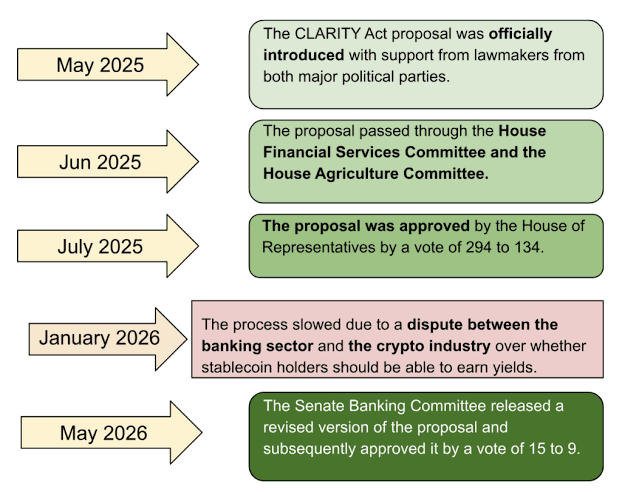
Republican senators circulated a revised draft in the week of July 20, 2026, adding new ethics restrictions on public officials while keeping the core SEC-CFTC jurisdictional split intact, aiming for a floor vote before Congress breaks for its August recess. That timeline is tight, and the added language hasn't resolved the underlying political fight.
Why Do Democrats Call the Ethics Provisions Insufficient
Senate Democrats, with Elizabeth Warren among the most vocal, have already dismissed the revised draft as inadequate, arguing the new official-conduct restrictions don't meaningfully address scrutiny already directed at crypto-related financial activity connected to the current administration. This is the genuine landmine in the bill's path, not the bank-versus-bank stablecoin fight that dominates most coverage. A market-structure bill can resolve every technical SEC-CFTC jurisdictional question and still stall entirely over a conflict-of-interest argument that has nothing to do with market mechanics.
What a Missed August Vote Actually Costs the Industry
If the bill doesn't clear the Senate before recess, the CLARITY Act's timeline slides into an uncertain fall calendar where competing legislative priorities routinely bump crypto market-structure reform further down the list, and every additional month of delay is another month institutional capital stays parked on the sidelines waiting for the jurisdictional settlement Solomon is publicly pushing for. That cost compounds. Firms that have already built tokenization infrastructure, like Goldman, absorb the delay as opportunity cost on products they can't fully scale; firms still deciding whether to enter the space at all treat continued ambiguity as a reason to wait even longer.
Positioning ahead of legislative catalysts like this one requires separating genuine structural signal, institutional balance sheets, competing product timelines, jurisdictional mechanics, from short-term political noise generated by any given week's Senate floor statements. Traders and allocators who want to act on this kind of policy development responsibly should apply a disciplined risk framework, size exposure to the actual probability of passage rather than headline momentum, and continue building literacy around how SEC-CFTC jurisdictional questions translate into real product and liquidity changes once a bill actually becomes law.
Frequently Asked Questions About the Goldman Sachs CLARITY Act Endorsement
1. What exactly did David Solomon say about the CLARITY Act
David Solomon told Politico on July 23, 2026 that he supports moving the CLARITY Act forward to establish clearer digital asset market structure, while acknowledging the legislation has imperfections worth debating. His stated rationale centered on creating a level playing field that would improve market stability and let previously sidelined regulated institutions participate more actively in crypto markets.
2. Why does JPMorgan's Jamie Dimon oppose the same bill Goldman supports
Dimon's opposition targets a specific stablecoin yield provision, not the bill's broader jurisdictional framework, arguing that letting crypto firms pay deposit-like interest on stablecoins without matching bank-grade capital and insurance requirements creates unfair competition for insured deposits. This is a narrower, deposit-flight-focused objection rather than a rejection of crypto regulatory clarity in principle.
3. What would the CLARITY Act actually change about US crypto regulation
The bill would classify most digital assets as non-securities under primary CFTC oversight rather than SEC jurisdiction, while establishing specific compliance rules for exchanges, token issuers, and brokers operating in US markets. This settles a long-running jurisdictional ambiguity that has made large regulated institutions cautious about scaling digital asset products.
4. Why are Senate Democrats still blocking the revised bill despite new ethics language
Senate Democrats, including Elizabeth Warren, have rejected the revised draft's added ethics provisions as insufficient to address existing conflict-of-interest concerns tied to crypto-related financial activity connected to current administration officials. This objection is separate from the bank industry's stablecoin yield dispute and represents the more politically volatile obstacle to passage.
5. How does Goldman's own crypto business explain the timing of this endorsement
Goldman already operates a live tokenized real estate fund on its proprietary blockchain platform and has filed for a bitcoin premium income ETF after a competitor's similar product already launched, giving the bank a direct commercial incentive to push for regulatory certainty now rather than wait for a resolution later in the year.
Disclaimer: This content is provided for general branding and informational purposes only and doesn't constitute financial, investment, legal, or tax advice. Any events, rewards, online events, or related information mentioned herein should not be considered a recommendation, solicitation, or invitation to purchase, sell, trade, or otherwise deal in any crypto assets or to use any services. Crypto assets are highly volatile and may result in loss. WEEX services and online events may not be available in all regions and are subject to applicable laws, regulations, and eligibility requirements. You are responsible for ensuring that your use of WEEX services complies with local laws and for carefully assessing the risks before participating in any crypto-related activities.
You may also like

What Is a Broker? The Complete Guide to Understanding Financial and Crypto Brokers

How to Compare Crypto Brokers: What the Rankings Don't Tell You and What Actually Matters

Oracle Stock Price Prediction 2026-2027: Can ORCL Reach $250 After the Pentagon Deal?

Is Oracle Stock a Buy After the $7 Billion Pentagon Deal? What the Defense Contract Changes
SPCX Stock Price Is Down $1 Trillion From Its Peak: Is Now the Time to Buy?
Is Tesla Stock a Buy at $320 After the Q2 Earnings Crash?

SPCX Stock Price and Starship Flight 13: What Tonight's Launch Needs to Deliver

Why Tesla Stock Crashed 14% on Record Revenue: What the 1.4% Operating Margin Actually Means
Tesla Stock Is Betting Everything on Robotaxi and Optimus: What Investors Are Actually Paying For
Intel Stock vs AMD Stock: Which Chip Giant Is the Better Buy After Q2?
Intel Stock Price Prediction 2026-2027: Can INTC Reach $150 After the Foundry Turnaround?

What Is Tokenized USO/USOS and How Do Commodity-Backed RWAs Function in DeFi Trading in 2026
What Are the Risks and Rewards of Trading Tokenized Equities Like GME On-Chain in 2026

Is Intel Stock a Buy After Q2 Earnings? What 163% Year to Date Gain and Raised Guidance Tell Investors
How Does Tokenized GameStop (GMEx) Differ From the GME Meme Coin on Blockchains in 2026
Goldman Sachs CEO Backs Senate Crypto Bill: The Institutional Blueprint for Wall Street On-Chain Liquidity in 2026
Intel Stock Soars After Q2 Earnings Beat: What the Strongest Revenue Growth in 15 Years Actually Means

WEEX API Compatibility: What Changes When You Migrate From Another Exchange
WEEX API Python SDK: How to Sign and Call It End to End
CRUDEOIL Airdrop: Share 50,000 USDT Rewards on WEEX
USDC Use Cases Explained: Payments, DeFi, Cross-Border Transfers, and Key Risks
Top Crypto Brokers in 2026: Types, Rankings and How to Choose the Right One
SpaceX IPO Stock Performance: SPCX From $135 to the Lock-Up Test

What Is a Crypto Broker? How Is It Different From a Crypto Exchange?
What Is a Futures API? How to Call It and Keep It Safe
Robinhood Chain Explorer: How to Find the Official One

WEEX API Guide: Setup, Calls, Permissions, and Security
5 Reasons WEEX Poker Party Series 4 Is the Event You Don't Skip
The Joker Is Back: Draw Your Share of a $1,000,000 USDT Pool on WEEX
How to Start Crypto Quantitative Trading as an Individual
What Is a Broker? The Complete Guide to Understanding Financial and Crypto Brokers
How to Compare Crypto Brokers: What the Rankings Don't Tell You and What Actually Matters
Oracle Stock Price Prediction 2026-2027: Can ORCL Reach $250 After the Pentagon Deal?
Is Oracle Stock a Buy After the $7 Billion Pentagon Deal? What the Defense Contract Changes
SPCX Stock Price Is Down $1 Trillion From Its Peak: Is Now the Time to Buy?
Is Tesla Stock a Buy at $320 After the Q2 Earnings Crash?
Contents
Popular coins
Latest articles